

Taga Harmony PC-10000DC black


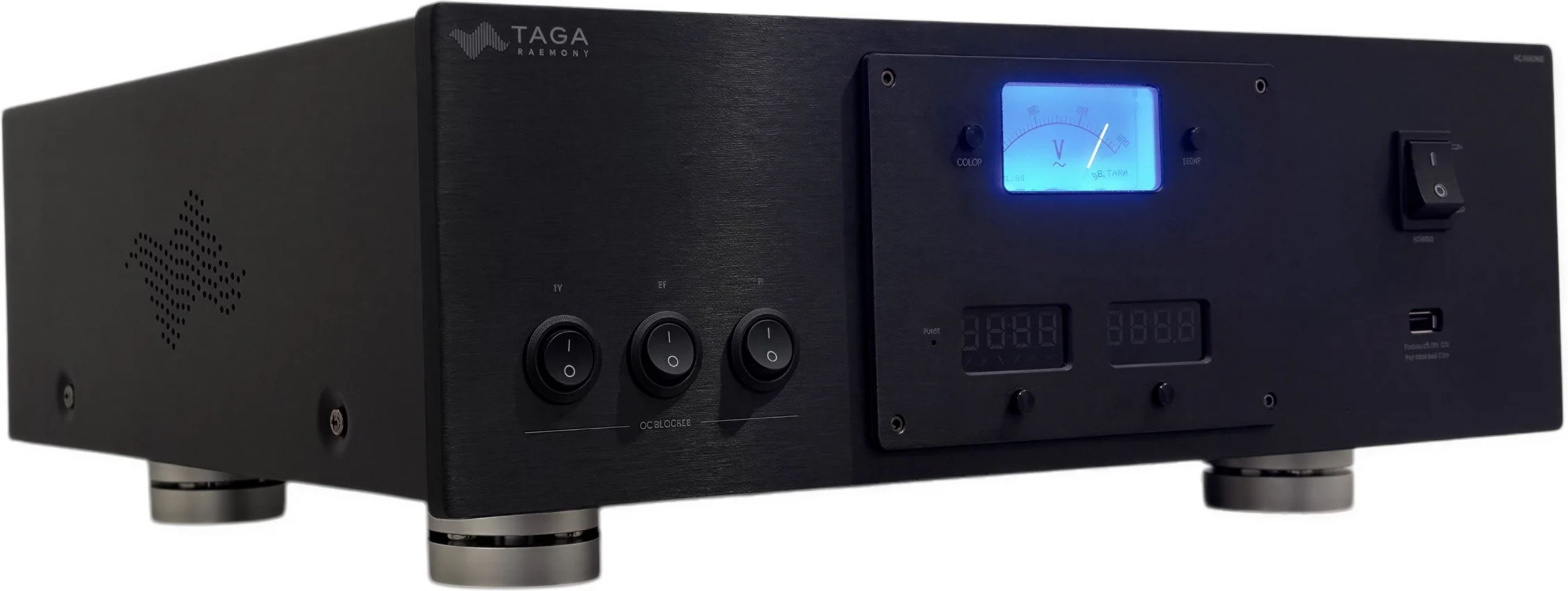
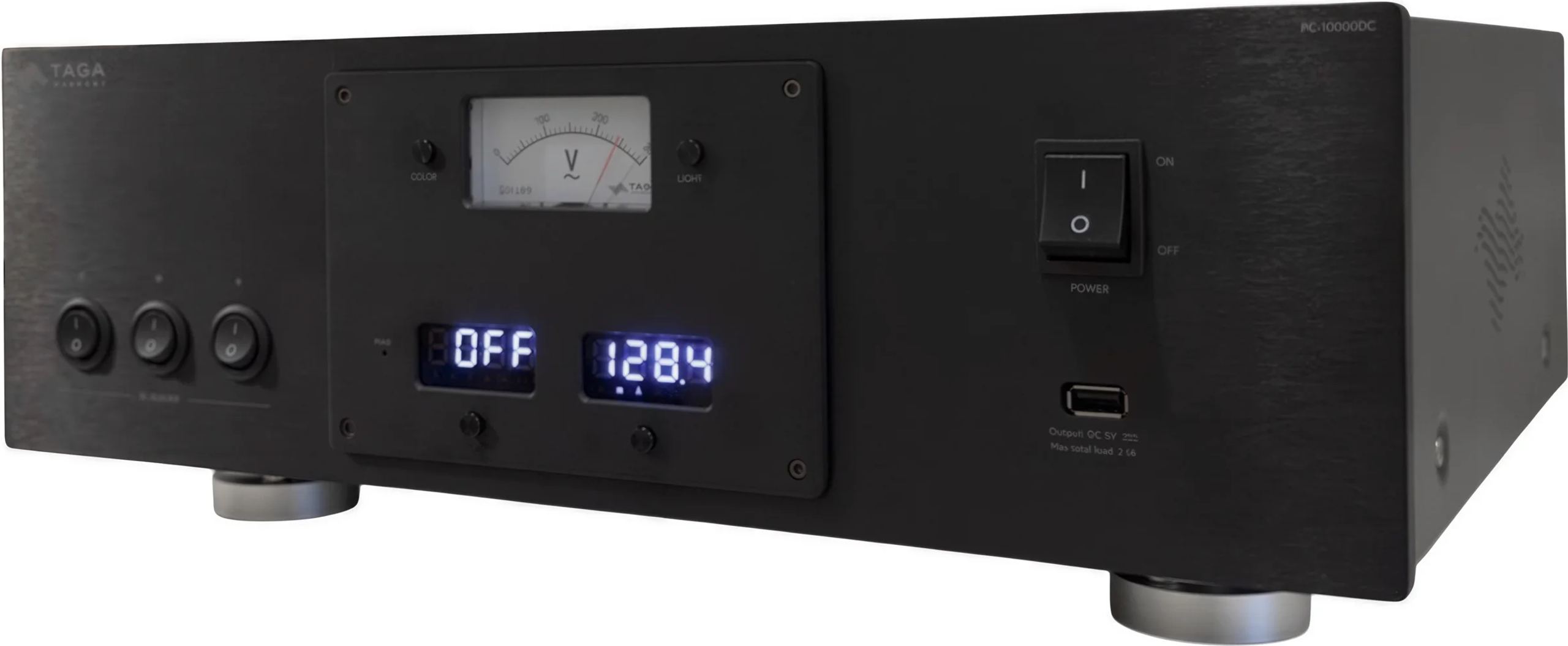
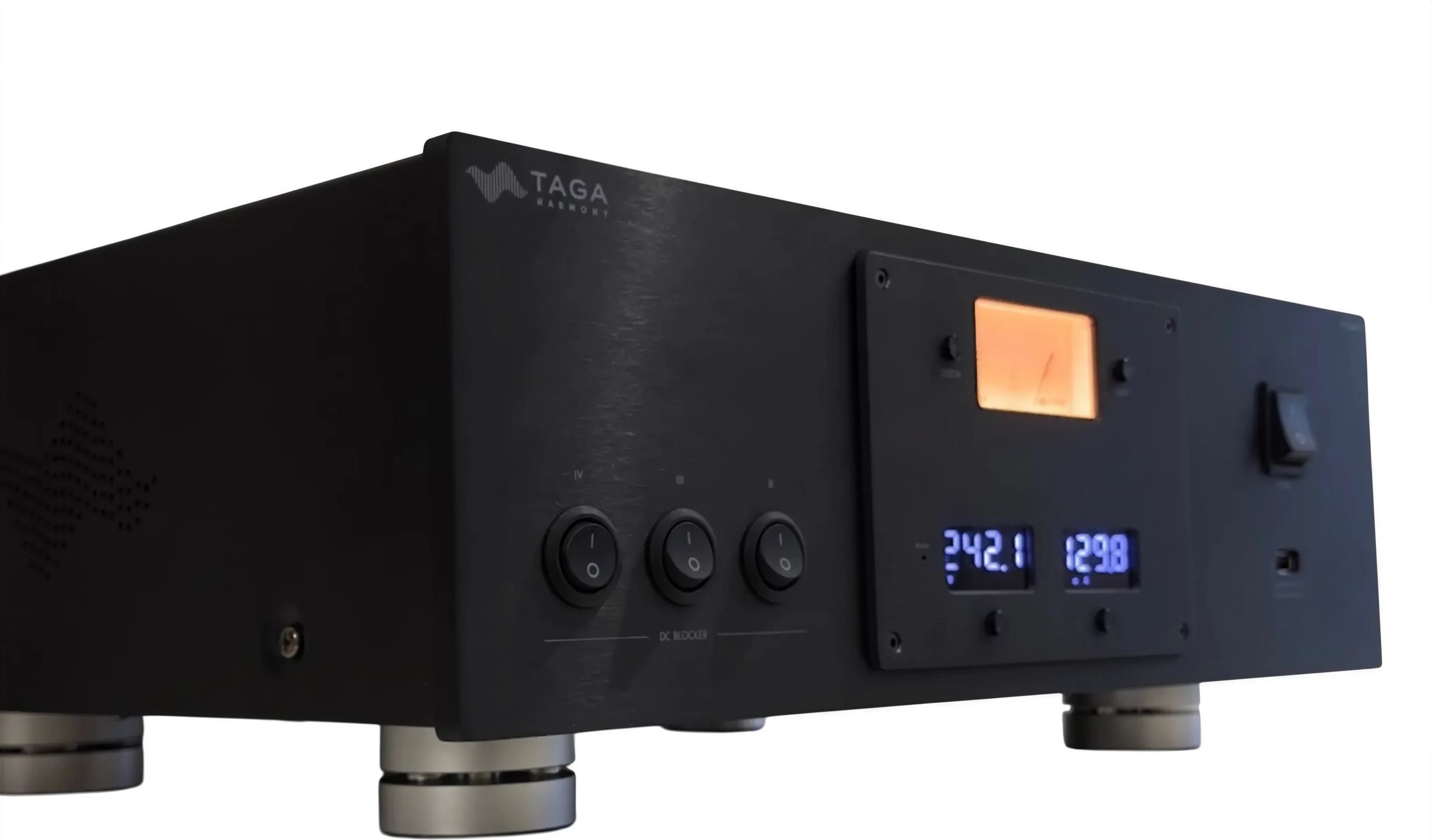
Taga Harmony PC-10000DC, high-end power conditioner
The electricity coming from the wall outlet is far from clean. Refrigerators, switching power supplies, dimmers, and electrical interference from nearby devices inject constant noise into it, which travels back to audio and video components, raising the noise floor and sometimes causing transformers to hum. The PC-10000DC from Taga Harmony is a power conditioner that combines four countermeasures in a single enclosure: noise filtering, DC blocking, linear USB power supply, and surge and overload protection.
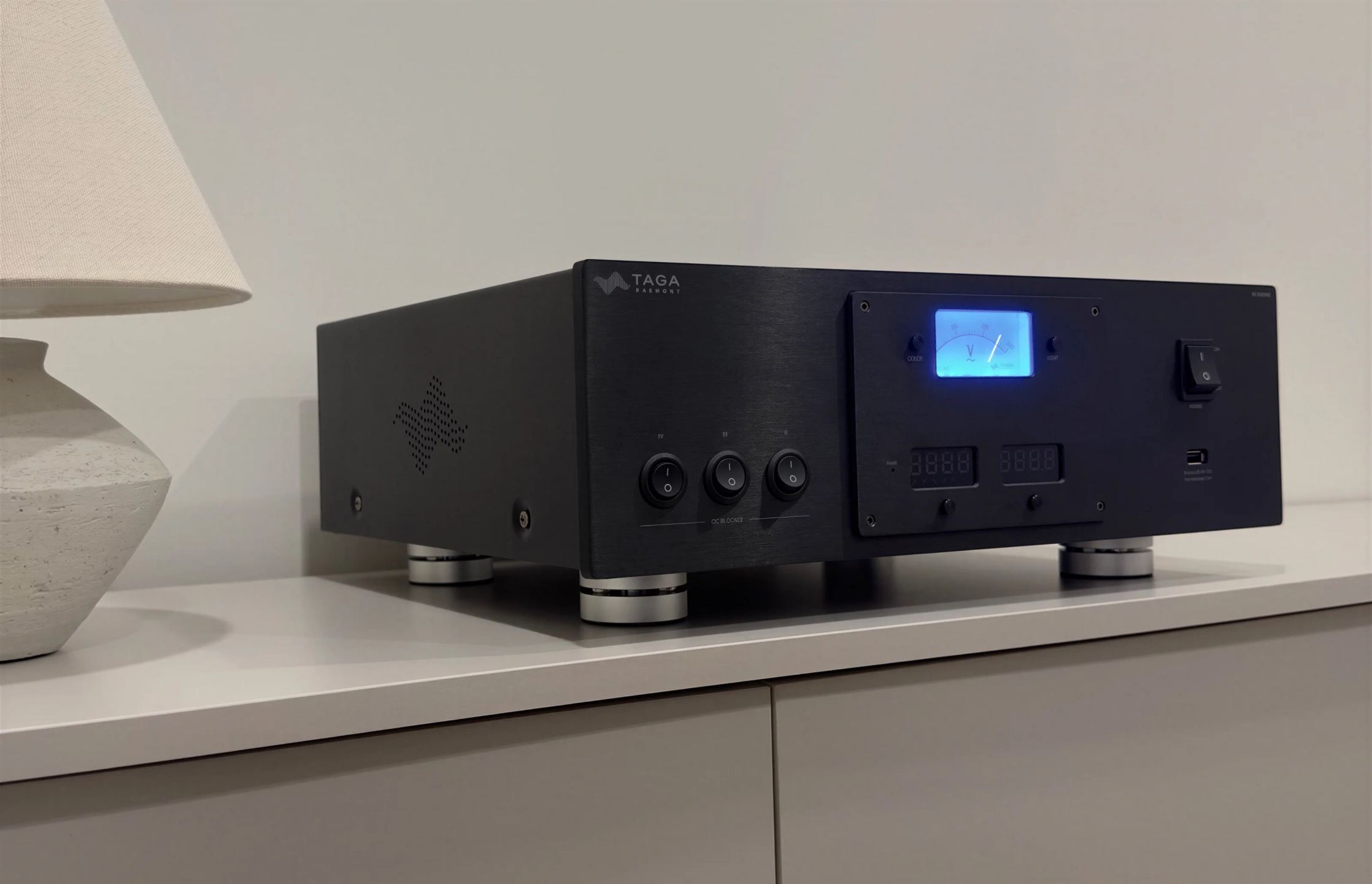
Four separately filtered outlet groups
The eight Schuko outlets are not all the same. The conditioner divides them into four groups of two, each with its own filter calibrated for a type of equipment. A power amplifier draws a great deal of current and sends its own load demands back into the mains; a digital source, on the other hand, draws little but is affected by the slightest interference. Mixing both on a shared filter means allowing the former to contaminate the latter. By isolating the stages, Taga prevents this cross-contamination.
Group I, limited to 1 A, is reserved for sources: CD or Blu-ray players, turntables, tuners. It receives low-power inductive filtering and additional isolation via the toroidal transformer. The manufacturer is clear on this point: nothing else should be connected to it. Group II (3 A) accommodates digital accessories such as a DAC, a network player, or a Bluetooth receiver. Groups III and IV, both rated at 5 A, respectively handle preamplifiers and accessories, then power amplifiers, with high-power inductive filtering.
| Group | Max current | Intended equipment | DC blocker |
|---|---|---|---|
| I | 1 A | Sources (CD, Blu-ray, turntable, tuner) | no |
| II | 3 A | Digital accessories (DAC, network player, BT receiver) | yes |
| III | 5 A | Preamplifiers and accessories | yes |
| IV | 5 A | Power amplifiers | yes |
The total load must not exceed 14 A (20 A peak), or 3450 W for all outlets and USB ports combined. Taga specifies that these assignments may not necessarily be optimal for every device: connecting the same component to different groups and listening to the result remains the best way to find the right setup, provided Group I is kept exclusively for sources.
DC component blocking
A common mains issue can go unnoticed until a transformer starts to buzz. A small DC component can sometimes be superimposed on the AC voltage, often due to poorly filtered nearby devices. It partially saturates the toroidal transformers in amplifiers, causing them to vibrate, run hotter, and allow audible hum through the speakers.
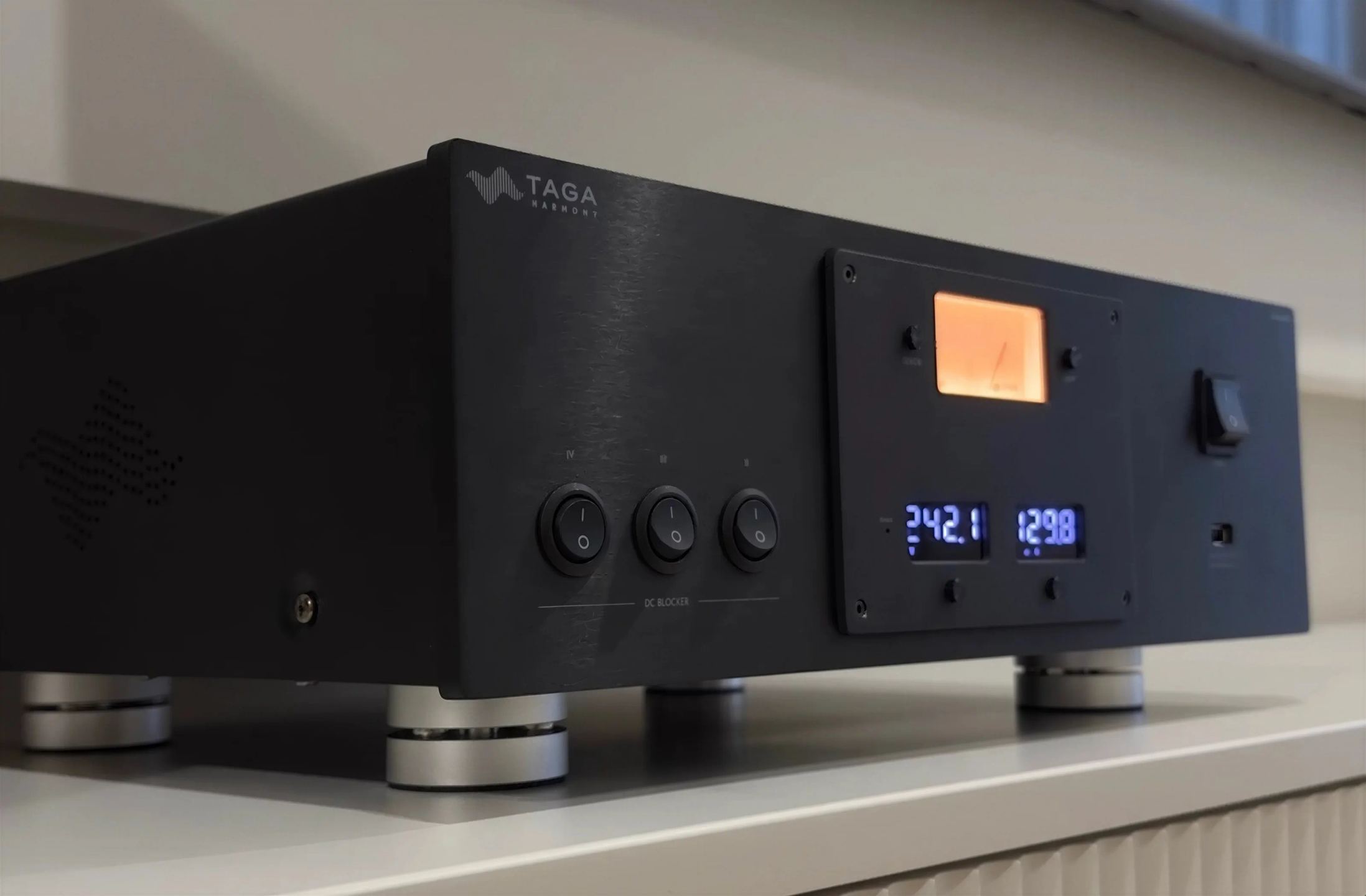
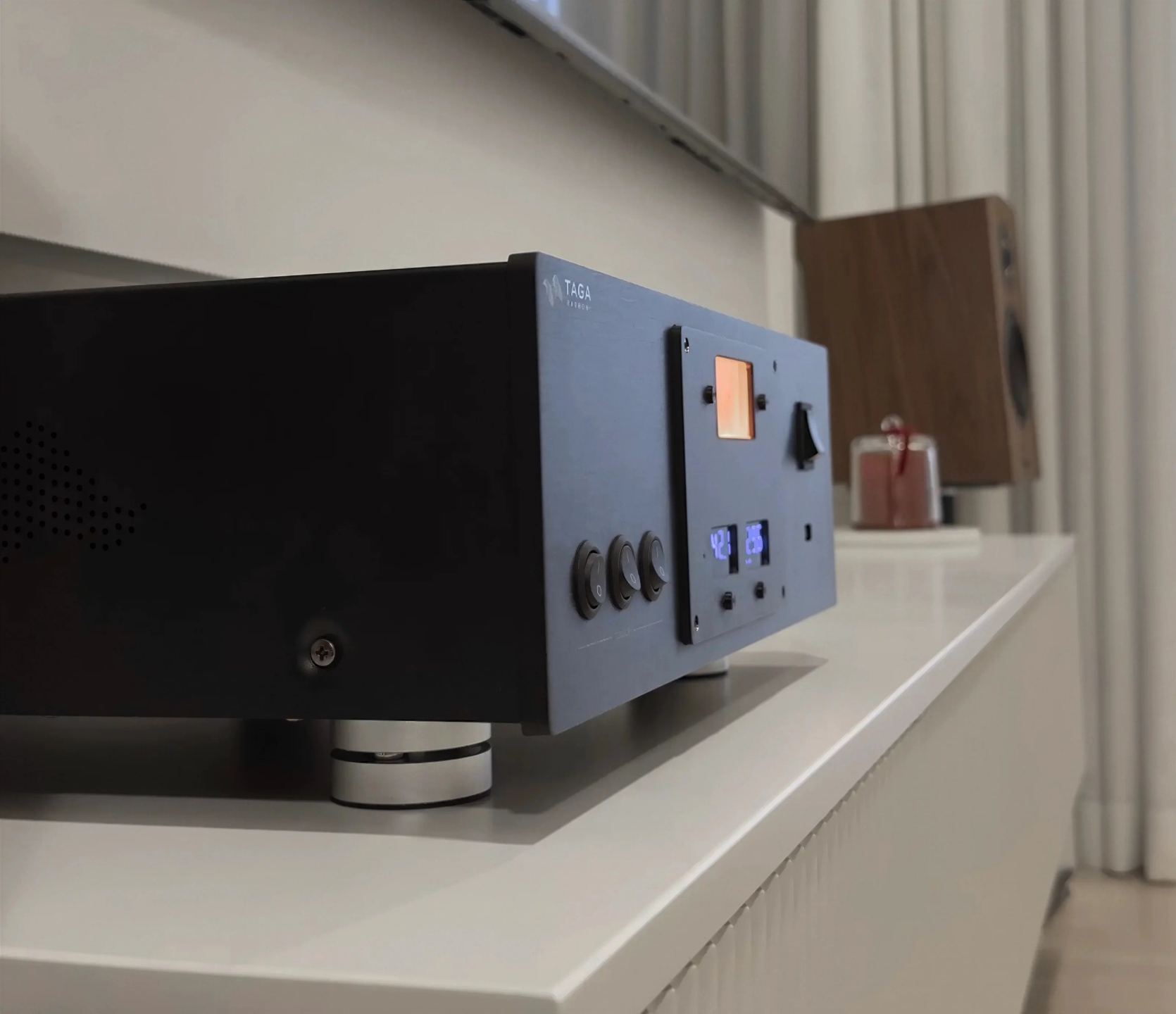
The built-in blocker eliminates or greatly reduces this component on Groups II, III, and IV. Three front-panel switches activate or deactivate it on a group-by-group basis, and Taga states that they can be operated while the conditioner is switched on, allowing direct comparison with and without it. If your transformers are silent, leaving it disabled costs nothing: it is a remedy to keep available rather than a feature to activate as a matter of principle.
A linear power supply for USB
Two 5 V USB-A ports complement the AC outlets, and their appeal lies in how they are powered. Most small DC devices make do with an inexpensive switching power adapter, which generates high-frequency noise and readily feeds it back into the mains. The conditioner powers its USB ports through a linear power supply derived from the toroidal transformer, with three-stage filtering, the last stage specifically treating HF interference on the 5 V output. A network player powered this way benefits from significantly cleaner current than with its original adapter.
Each port is protected by a transient voltage suppressor (TVS) against faults coming from the connected device. The load is shared between the two ports: Taga specifies 2.1 A combined, to be divided between connected devices, with no more than one device connected per port. One point deserves attention: charging a device via USB can reduce the effectiveness of mains filtering. For critical listening, it is best to disconnect anything that is charging.
The conditioner’s internal construction
Under the cover, a 200 W toroidal transformer isolates sources from line noise and forms the basis of the linear power supply. Each filtering group receives its own SQ common-mode choke and X- and Y-class capacitors, known for mains noise filtering. Rather than wires, Taga connects each filtering board to the main board using thick brass plates, sixteen in total, to shorten the current path and limit losses. Each filter group, the main board, and the transformer receive individual metal shielding.
The internal wiring deserves mention: the connections between the boards and the 230 V outlets, as well as the input wiring, use 12 AWG oxygen-free 5N (99.999%) single-crystal copper. All boards rest on an anti-vibration platform suspended on twelve damping spacers, and the conditioner stands on metal ball feet that isolate the chassis from vibrations. These measures partly explain the weight: nearly 13 kg for an enclosure measuring 16 × 43 × 34.2 cm.
Monitoring voltage and current
The front panel offers more than a switch. An analog needle voltmeter indicates mains voltage, with backlighting that can be switched on or off and set to one of five colors (white, blue, orange, red, green). Two digital displays complete the information: the left one shows voltage, while the right one switches between current (in A or mA), power (W), frequency (Hz), and power factor at the press of a button.
These readings remain approximate, and Taga makes no secret of it: ±5% for the analog meter, ±3% for the digital display, with possible discrepancies between the two. They are intended to keep an eye on voltage stability, not to measure power quality as a laboratory instrument would.
Phase detection and grounding
Two settings are essential for proper operation. The first concerns phase: a front-panel indicator lights up when the polarity of the outlets is reversed relative to the conditioner’s reference. A selector on the rear allows phase and neutral to be swapped to turn off this indicator. It must only be operated with the conditioner switched off: operating it while powered can damage the conditioner or connected equipment and voids the warranty.
Grounding is not optional. A grounding screw on the rear must be connected to a room earth point using an insulated cable, not supplied. If the wall outlet is not properly grounded, an electrician must intervene so that the conditioner can operate as intended.
Documentation
Technical Specifications
Design
- Premium mains conditioner with DC blocker
Sockets and Outputs
- 8 Schuko sockets (230 V) divided into 4 groups of 2 sockets
- Group I (1 A max): sound sources
- Group II (3 A max): digital accessories [DC blocker]
- Group III (5 A max): preamplifiers and accessories [DC blocker]
- Group IV (5 A max): amplifiers [DC blocker]
- 2 USB-A ports with linear power supply (5 V)
- Total current: 2.1 A
Power and Load
- Total maximum load: 14 A [peak at 20 A]
- Total power (sockets and USB ports): 3450 W
Filtering and Protection
- Noise filter: -10 dB to 55 dB (2 to 100 MHz)
- Maximum surge current: 4500 A [8 / 20 µs, single]
- Maximum peak voltage: 3000 V [10 mA]
- Maximum clamping voltage: 775 V [8 / 20 µs]
- Maximum absorbed energy: 140 J [10 / 1000 µs]
- Incoming DC blocking: up to 12000 mV (12 V)
- USB protection via transient voltage suppressor and overvoltage protection
- Maximum reverse standoff voltage: 30.8 V
- Breakdown voltage: 37.8 V
- Clamping voltage: 49.9 V
- Overvoltage protection
- Overload protection
- Phase detector with polarity reverser
Display and Indicators
- Analogue voltage indicator (±5% accuracy)
- Switchable backlight
- 5 selectable backlight colours
- 2 digital displays (±3% accuracy) showing: voltage (V), current (A, mA), power (W), frequency (Hz), power factor (PF)
Features
- USB charging
Included Accessories
- TAGA Harmony TPC-TS-1.5m power cable
Power Supply and Consumption
- Supply voltage: 230 V, 50 / 60 Hz
- Consumption: ≤ 3.0 W (no external device connected, DC blocker disabled)
- +0.2 W with backlight enabled
Dimensions and Weight
- Dimensions (H x W x D): 16 x 43 x 34.2 cm (feet included, excluding switches and sockets)
- Weight: 12.9 kg per unit
Frequently Asked Questions
Does a power conditioner really make a difference to sound quality?
It depends on the condition of your installation. On an already clean circuit, the difference may remain subtle. The effect is most noticeable with transformer hum, residual hiss, or a lower noise floor once the system is isolated from the mains. The most certain benefit remains protection against power surges: you cannot judge it by ear, but it protects the equipment over time.
Is the power conditioner suitable for a home theater installation?
Yes, it is designed for both audio and video. A power amplifier or home theater amplifier connects to group IV, dedicated to high power. The limit to monitor is the current: each group has its own maximum, and a large, power-hungry amplifier can come close to it. As long as the assignments and limits are respected, audio and video coexist without issue.
Should the supplied power cord be replaced?
The conditioner is supplied with a 1.5 m Taga TPC-TS power cord, sufficient to get started. If you replace it with another cord, do not be surprised if the phase indicator changes state: cables do not always connect phase and neutral the same way internally. This is not a fault, merely a sign of different wiring, which can simply be corrected using the polarity selector.
What should I do if the outlets no longer supply power?
The surge and overload protection has probably cut the power. Unplug the conditioner, remove the connected devices and allow it to cool down for fifteen minutes. If all outlets remain dead, check the mains fuse at the rear and, if necessary, replace it with a strictly identical model, with the power cord unplugged. If only certain groups are affected, their internal fuses can only be replaced by Taga after-sales service.
Can it be powered from an extension cord or power strip?
The conditioner requires a properly grounded three-conductor single-phase mains outlet, and this grounding is mandatory for it to operate as intended. Plugging it directly into a grounded wall outlet is preferable to daisy-chaining extension cords, which adds contact points and a risk of upstream overload.
How much does it consume when nothing is plugged in?
Less than 3 W at idle, with the DC blocker switched off; add approximately 0.2 W if the display backlight is on. The conditioner’s own power consumption remains negligible: most of the power passing through it comes from the devices it supplies.
Where does the PC-10000DC fit within the Taga Harmony range?
It sits at the top of Taga’s PC series of power conditioners, above models such as the PC-8000DC, PC-7000 and PC-5000. In the brand’s nomenclature, the DC suffix indicates the DC blocker. This model combines the series’ most comprehensive functions: group filtering, switchable DC blocking, linear USB power supply and dual monitoring display.
- Eco-contribution included in the sale price.
- GTIN / EAN: 5907529267264




