

Aurender N150 silver


Specifications and features


Overview
Plugging a laptop into a DAC means accepting the electrical noise of a machine doing a thousand other things at once. Aurender has been making music servers for around fifteen years that take the opposite approach: a closed system, software developed under the same roof as the electronics, with just one task to perform. The N150 opens this range and succeeds the N100H, with a deliberate choice: one USB audio output, and nothing else.
One output, and it is carefully designed
No DAC inside, no analog, coaxial or AES-EBU connection. The N150 sends the digital stream via its USB Audio Class 2.0 output to an external DAC, full stop. This minimalist approach has a technical reason: the USB section is physically and electrically isolated from the processor board, which is the main source of noise in this type of machine. The audio clock is a temperature-compensated TCXO oscillator.
It supports PCM up to 768 kHz at 32 bits, native DSD512 and DSD256 in DoP. These limits naturally depend on the capabilities of the DAC connected downstream: most current models stop earlier, and the N150 simply adapts accordingly. In terms of files, it plays DSD (DSF and DFF), WAV, FLAC, AIFF, ALAC, M4A, APE and common formats. MQA Core decoding is available as a paid option from the app, enabling the first unfold to a non-certified DAC.
The trade-off is clear: a DAC without a USB input remains incompatible unless a conversion box is used. Aurender offers two in its accessory catalogue, the UC100 and UT100, which convert the USB output into a coaxial or optical signal.
Silence starts with the power supply
A 50 W linear power supply powers the whole unit, with no switching. The processor is a low-power dual-core Intel selected for its modest appetite: 12 W during playback, 32 W at maximum, 4.2 W in standby. Less current drawn means fewer disturbances radiated toward the audio section.
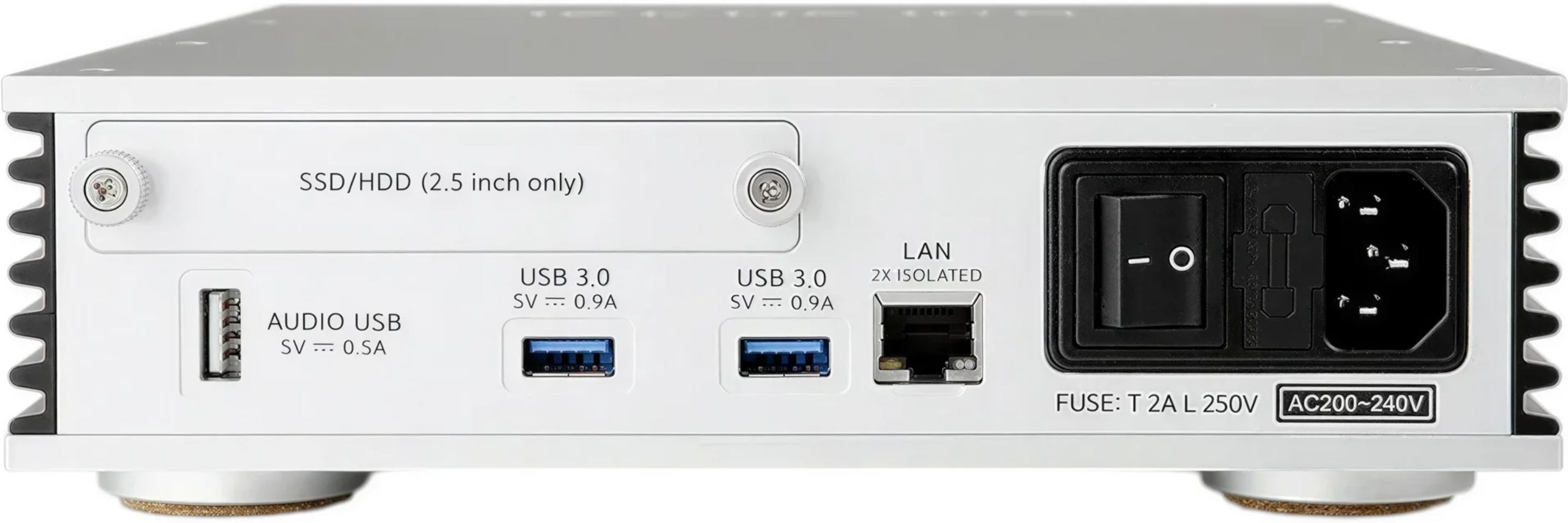
The Gigabit Ethernet port features dual transformer isolation, filtering noise coming from the home network. There is no Wi-Fi: a wired connection is mandatory, requiring a network socket or powerline adapter near the installation, but eliminating a radio transmitter from the chassis.
A supercapacitor UPS system complements the power supply. In the event of a mains outage, it provides enough energy to shut down the machine properly and preserve the file system, without the chemical battery that would need replacing after a few years.
Playback runs through the SSD cache
Its internal operation is what truly sets an Aurender server apart from an ordinary network player. When a track is selected in the app, it is first copied to the 240 GB NVMe SSD, then played from that SSD. The storage drive then returns to idle.
Two benefits follow. The mechanical drive or library SSD wears less and does not run during listening. More importantly, playback no longer depends on the network’s instantaneous quality: an unreliable connection to a NAS no longer causes dropouts, since the file is already there. The same principle applies to online streams, which are buffered before being played back.
Critical listening mode takes the same logic further. It turns off the display, front-panel buttons and background tasks not required for playback, further reducing internal electrical activity. You lose the display of the current track, which remains an acceptable compromise when control is handled from a tablet anyway.
A drive to install yourself, or none at all
A 2.5-inch bay awaits behind the front panel, accessible without a technician’s intervention. An SSD or hard drive can be inserted at purchase or later, depending on the size of the library to be hosted. Those who listen only online can leave the bay empty and pay nothing for unnecessary storage.
Two USB 3.0 ports on the rear are used for transfers: copying a collection from an external drive, or importing over the network from a NAS. These ports carry data, not audio. A library kept on a NAS can also be played directly, but Aurender recommends internal storage for stability.
Conductor, the app that controls everything
There is no universal remote control or old-fashioned web interface: operation is handled through Aurender Conductor, on iPhone, iPad or Android. The app combines local files and online catalogues in a single library, with Tidal, Qobuz and internet radio integrated, plus Spotify Connect and AirPlay. The N150 is also Roon Ready certified for those who have already built their library around this ecosystem.
This closed approach has its supporters and its limitations. It improves stability because the manufacturer controls the entire software chain. In return, adding a music service depends entirely on Aurender’s schedule, and the app is the only everyday gateway.
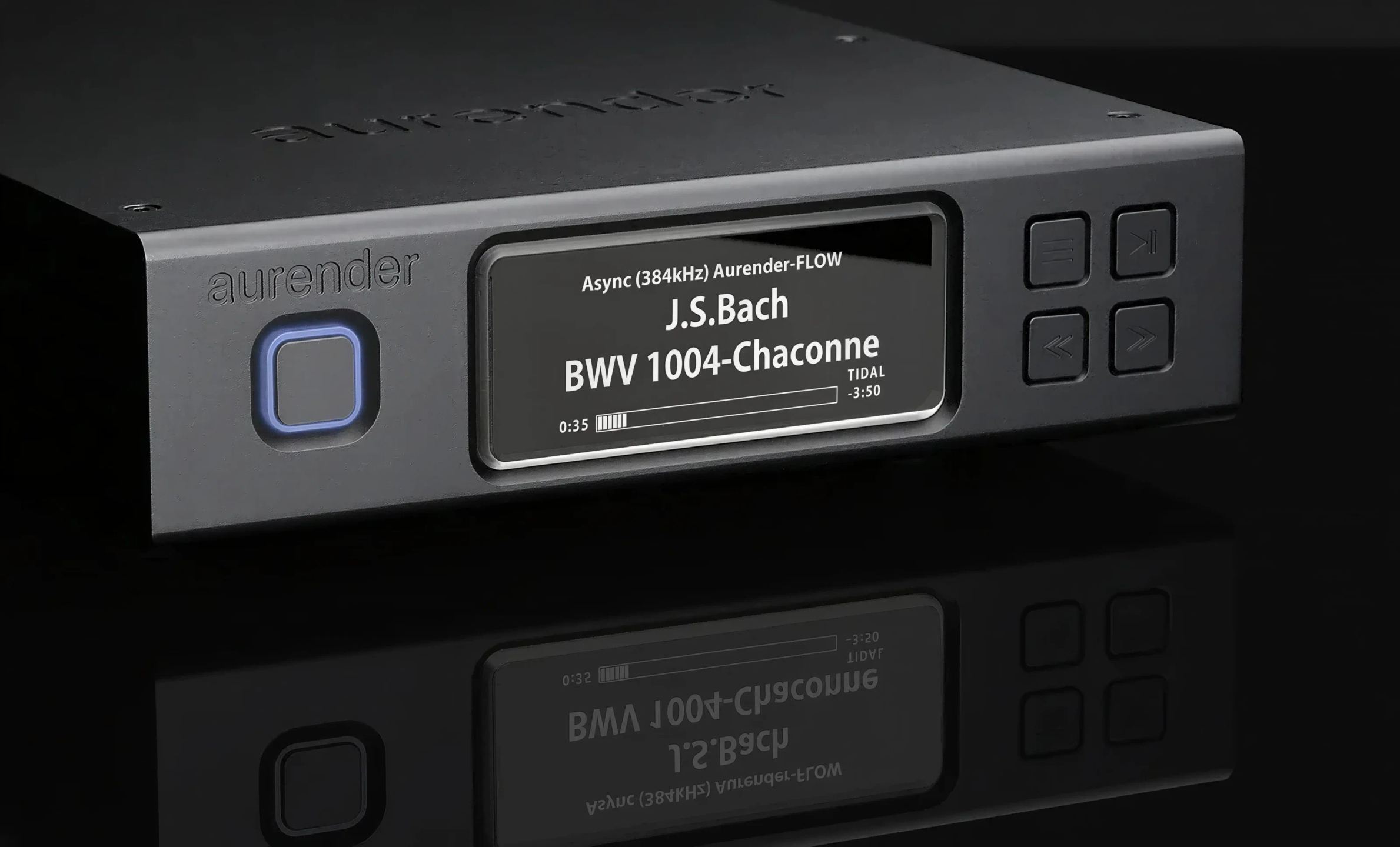
The 3-inch AMOLED display shows the current title in high contrast, readable from a distance. It is not the large colour panel with cover art found on higher models in the range, which also add S/PDIF and AES-EBU outputs. The machined aluminium chassis measures 215 × 353 × 64 mm and weighs approximately 5.3 kg, in half-DIN format: it fits on a desk or beside another component on the same shelf.
What the N150 changes compared with the N100H
The lineage is direct, with several areas revised. RAM increases to 8 GB, twice that of the N100H. The SSD cache rises to 240 GB, in NVMe format. The dual-core Intel processor and dual-isolated network port are new, as is the user-accessible storage bay, absent from the previous model, which was only available with its original drive.
For anyone coming from a laptop or CD player and who already owns a good DAC with a USB input, the shortcut is simple: the N150 provides the server and transport side without duplicating the conversion already paid for elsewhere.
Technical Specifications
Type and function
- High-resolution network audio transport
- Built-in DAC: no
- CD ripping: no
Digital audio output
- Dedicated USB Audio output
- USB resolution: PCM up to 768 kHz / 32 bits, native DSD512, DSD256 via DoP
- Audio clock: TCXO
- Analog outputs: none
- S/PDIF and AES-EBU outputs: none
Formats and compatibility
- Supported formats: DSD (DSF, DFF), WAV, FLAC, AIFF, ALAC, M4A, APE and other audio formats
- MQA: compatible with MQA Core Decoder upgrade
- Streaming services: integrated via the Aurender ecosystem
- Roon compatibility: Roon Ready
- Control application: Aurender Conductor
Hardware architecture
- Processor: low-power dual-core Intel
- RAM: 8 GB
- System storage and cache: 240 GB NVMe SSD
- Music storage: 1 x 2.5-inch bay for SSD or hard drive, user-installable
Connectivity
- USB ports: 2 × USB 3.0 for external storage
- Network: dual-isolated Gigabit Ethernet
Power supply
- 50 W linear power supply
- Built-in supercapacitor UPS system
- Power consumption:
- 12 W during playback
- 32 W maximum
- 4.2 W in standby
Display and chassis
- 3-inch AMOLED display
- Machined aluminum chassis
Dimensions and weight
- Dimensions (W × D × H): approximately 215 × 353 × 64 mm
- Height without feet: approximately 56 mm
- Weight: approximately 5.3 kg
Frequently Asked Questions
Can the N150 rip CDs?
No, it does not include an optical drive or any ripping function. The collection must be digitized beforehand, then copied to the internal drive via the USB ports or from a NAS. Aurender reserves ripping for its content servers, which perform this role upstream and then feed the other machines on the network.
What disk capacity can be installed?
The bay accepts a standard 2.5-inch hard drive or SSD. Available 2.5-inch capacities commonly go up to 4 TB for hard drives and 8 TB for SSDs. The SSD remains silent and unaffected by vibrations, while the hard drive costs less per terabyte; the read cache makes this difference largely unnoticeable in use, since the drive does not spin during playback.
Should the N150 be left on all the time?
Aurender designs its servers to remain powered on, and the 4.2 W standby power consumption reflects this. Fully starting up the system takes a little time, and keeping the unit warm avoids waiting before every listening session. The internal UPS ensures a clean shutdown in the event of a power outage.
Does the N150 work with Roon?
Yes, it is Roon Ready certified and appears as an output device in a Roon system, controlled from the Roon apps. An active Roon Core server is therefore required elsewhere on the network. The Conductor app can still be used in parallel, with the Aurender cache, but the two modes cannot be combined within the same playback.
What happens to MQA decoding on the N150?
The MQA Core decoder is a paid option that can be activated from Conductor. It performs the first unfold, up to 88.2 or 96 kHz, allowing MQA files to be played through a non-certified converter, or allowing a certified converter to complete the rendering. As the format has become less relevant with music services, this option is mainly of interest for existing file collections.
Can headphones be connected directly to the N150?
No, there is neither a headphone output nor an analog output. A headphone amplifier must be connected to the converter located behind the USB output.
Can the volume be adjusted from the N150?
The output is fixed-level, with no digital attenuation. Adjustment is made on the converter if it has one, or on the downstream preamplifier.
- Eco-contribution included in the sale price.




