Aurender A200 silver


Specifications and features


Overview
Connect a single unit between the internet router and the amplifier, then access all your music—local files as well as online platforms—with the care of a high-end source. That is what this network server from Korean brand Aurender offers. Successor to the A100, it combines file playback, streaming access, a digital-to-analog converter and volume control in a compact machined aluminum chassis.
Everything you need between the router and the amplifier
Aurender divides its network players into two families. Models in the N series, such as the N150, are pure transports: they play files and send them to an external converter, with no analog stage. The A200 belongs to the A series, the range of servers with an integrated converter and analog output. A single unit is then all that is needed between the network source and the amplifier.
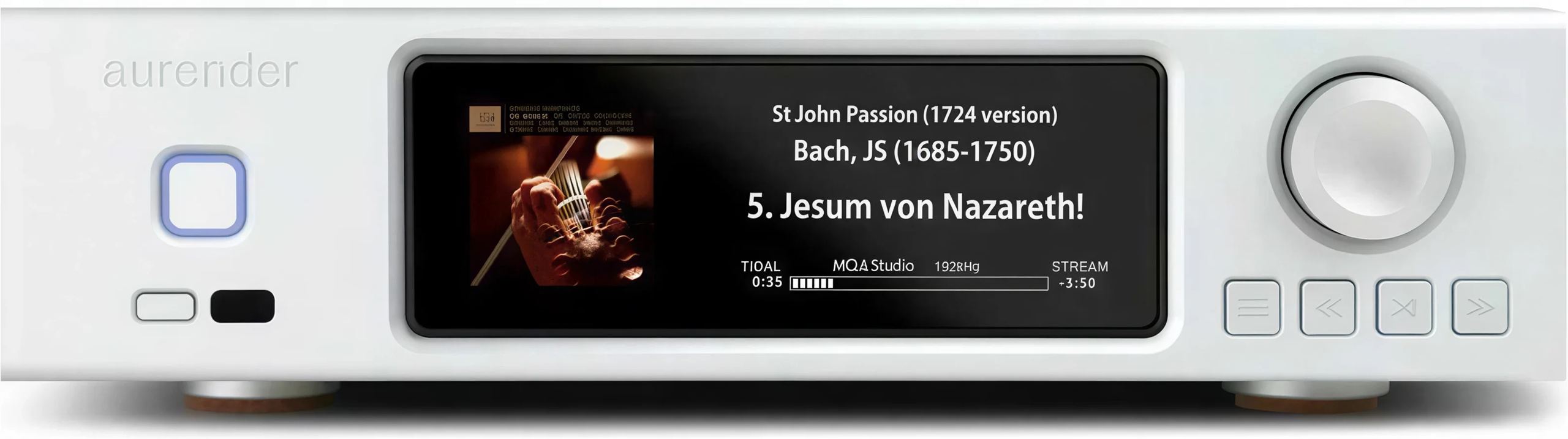
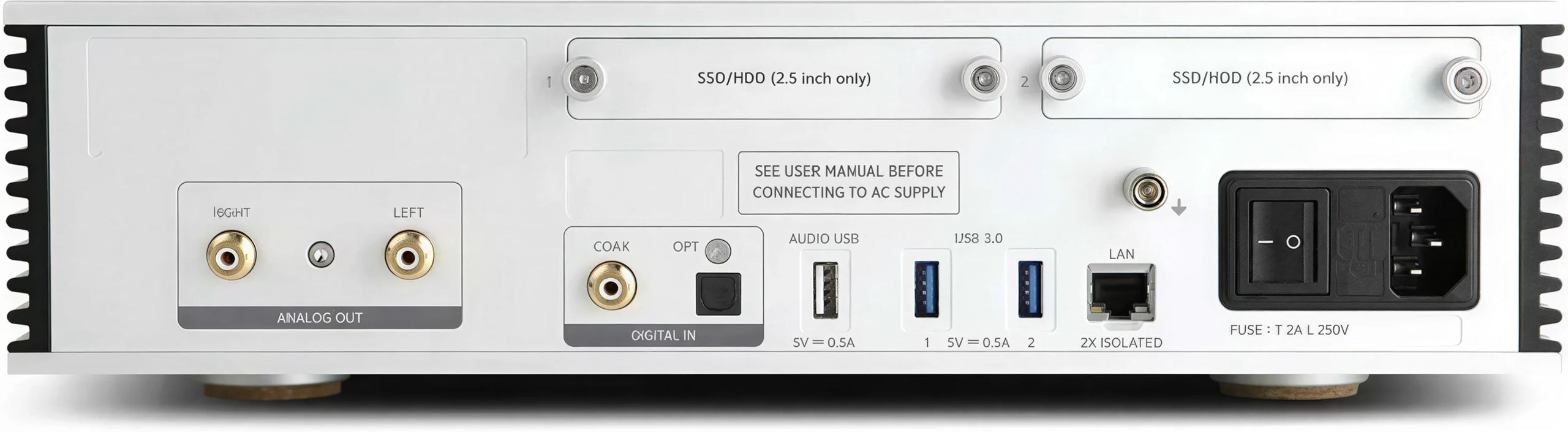
The A200 replaces the A100 as the most compact and affordable model in the A series. Its low-power quad-core Intel processor has been revised, the color display measures 6.9 inches and the machined aluminum chassis weighs 9.6 kg and is 350 mm wide. Analog outputs are provided by two unbalanced RCA sockets. Balanced XLR connections remain the preserve of higher models in the series, starting with the A15.
Playback begins with a copy to memory
Each Aurender operates on a caching principle. Before being played, a track—whether it comes from an internal drive, a NAS or an online platform—is first copied to a 240 GB NVMe SSD. Playback then takes place from this fast memory, never directly from the network or library drive. The latter can remain at rest during listening, protected from the vibrations and electrical noise of its motor.
The benefit lies in the consistency of the audio stream: the vagaries of a home network or the latency of a NAS no longer reach the conversion stage. The A200 features 8 GB of RAM and a critical listening mode that turns off the display and background tasks to minimize machine activity during playback.
An AKM4490 converter and a precision clock
The converter is based on an AKM4490 chip in stereo configuration, with integrated full MQA decoding. The analog outputs support PCM up to 768 kHz in 32-bit and DSD up to native DSD512. Full decoding applies to MQA-encoded files; this format has lost importance since major platforms switched to high-resolution FLAC, but it remains supported end to end.
The quality of a converter depends greatly on the precision of its clock. A poorly timed digital signal introduces jitter, tiny synchronization errors that degrade reproduction. The A200 relies on an FPGA-controlled clock and a TCXO oscillator, with jitter kept below 100 femtoseconds.
The power supply is entirely linear, with no switching. Separate toroidal transformers power the server section, digital outputs and converter, isolating the audio stage from noise generated by the computing section. A supercapacitor UPS takes over in the event of a sudden mains power outage and enables a clean shutdown, with no chemical battery to replace.
Adjust the volume and connect your system
Volume control is performed directly in the converter, at variable level. The A200 can therefore drive a power amplifier without a preamplifier, serving as both source and digital preamp. Nothing requires this setup: by setting the output to a fixed level, it can just as easily be connected to the input of a preamplifier or integrated amplifier.
Two digital inputs, one coaxial on RCA and one optical Toslink, open the converter to other sources. A television or CD player can then use the A200’s converter. A dedicated USB Audio output works in the opposite direction: it turns the A200 into a simple transport for an external converter, should you wish to upgrade this component in the future.
Local library or everything online
Two 2.5-inch bays accommodate hard drives or SSDs that you install yourself, up to 8 TB per slot. Enough to host a large local file library. There is also nothing to prevent leaving these bays empty and listening exclusively online: the SSD cache is sufficient for playback.
For networking, the A200 connects via Ethernet, with two Gigabit ports isolated by transformers. There is no Wi-Fi: the wired connection avoids radio noise and wireless connection dropouts, at the cost of running a cable to the unit. Two USB 3.0 ports at the rear are used for data transfer and external drives.
Control is via the Aurender Conductor app, on iPhone, iPad or Android tablet and phone. It brings together the local library and the Tidal and Qobuz platforms, manages Spotify Connect and AirPlay, and the A200 is Roon Ready for those using this environment. During playback, the unit consumes 26 W, and 6.5 W in standby.
Technical specifications
General
- Type: network audio server with analog output
- Chassis: machined aluminum
- Control system: Aurender Conductor
- Display: 6.9” color IPS LCD – 1280 × 480 pixel resolution
Hardware architecture
- Processor: low-power Intel Quad-Core
- RAM: 8 GB
- Built-in DAC: AKM4490 in stereo configuration
- MQA decoding: built-in MQA Full Decoder
Clock and digital processing
- Architecture: FPGA-controlled precision clock
- Clock technology: TCXO
- Jitter reduction: less than 100 fs
Storage
- Storage slots: 2 2.5” bays for user-installable HDDs or SSDs
- System and cache storage: 240 GB NVMe SSD
- Maximum capacity: up to 2 × 8 TB with compatible SSDs
- Playback from: internal storage, USB drive and NAS
Power supply
- Type: fully linear power supply
- Transformers: toroidal transformers dedicated to the various sections
- Uninterruptible power supply: supercapacitor UPS
- Power consumption:
- Playback: 26 W
- Maximum: 30 W
- Standby: 6.5 W
Audio outputs
- Analog outputs: unbalanced stereo RCA
- Volume control: variable, directly at the DAC level
- Use: can be connected directly to a power amplifier
- Digital output: dedicated USB Audio
Digital inputs
- Coaxial: 1 × RCA
- Optical: 1 × Toslink
Network and USB connectivity
- Network: dual isolated Gigabit Ethernet port
- USB data ports: 2 × rear USB 3.0
Audio performance
- PCM via analog outputs: up to 768 kHz / 32 bits
- DSD via analog outputs: up to native DSD512
- PCM via USB: up to 768 kHz / 32 bits
- DSD via USB: up to native DSD512 or DSD256 in DoP
- MQA: built-in full decoding
Compatible audio formats
- PCM formats: WAV, FLAC, AIFF, ALAC, M4A, APE and others
- DSD formats: DSF, DFF
- MQA: compatible with built-in full decoding
Aurender features
- Playback with caching system
- Compatibility with major streaming services
- Local music library management
- Critical Listening mode
- Control via the Aurender Conductor app
- NAS and USB hard drive compatibility
- Remote technical support
Dimensions and weight
- Dimensions with feet: 350 × 356 × 96.5 mm
- Height without feet: approximately 84 mm
- Weight: 9.6 kg
Frequently asked questions
Does the A200 have a headphone output?
No. The A200 is a source designed to feed an amplifier or preamplifier, without a headphone stage. In the A series, the headphone amplifier is found on the A30, higher up in the range.
What is the difference compared with a network transport such as the N150?
The N150 is a pure network transport: it reads files and sends them to an external converter via its USB output, with no conversion or analog output. The A200 includes the converter, a pair of RCA outputs, and volume control. It forms a complete source, whereas the N150 requires a separate converter.
Can it be connected directly to speakers?
Not with passive speakers. Its volume control allows it to connect directly to a power amplifier, but it does not itself provide the power required by the speakers. With active speakers equipped with a line input, a direct connection remains possible.
Do you need to provide the storage drives yourself?
Yes. The two 2.5-inch bays can be fitted with hard drives or SSDs of your choice, up to 8 TB per bay. You can also leave them empty and listen exclusively via streaming: playback is then handled from the internal SSD cache.
How do I add streaming services?
Tidal and Qobuz are integrated into the Conductor app and can be controlled from it. Spotify is played via Spotify Connect from the Spotify app, and AirPlay allows audio to be sent from an Apple device. The A200 is also Roon Ready compatible.
Does the A200 come with a remote control?
Yes. An aluminium remote control is included with the device, in addition to the Conductor app. It covers standard playback and volume functions, allowing you to control the A200 without using a phone or tablet.
Does it work without being connected to a computer?
Yes. The A200 is standalone: it connects to the modem or router and is controlled via the Conductor app on a smartphone or tablet. No computer needs to remain switched on to play music.
- Eco-contribution included in the sale price.