Aurender N20 silver


Specifications and features


Overview
A network transport does not convert the signal: its sole task is to deliver the cleanest possible digital stream to the converter. Aurender takes this approach as far as treating its coaxial, BNC and AES/EBU outputs with the same care as USB, whereas many transports treat them as secondary. The N20 sits in the middle of the brand’s range of digital sources, with almost all the hardware from its flagship model, the N30SA, brought together in a single chassis.
A transport that converts nothing
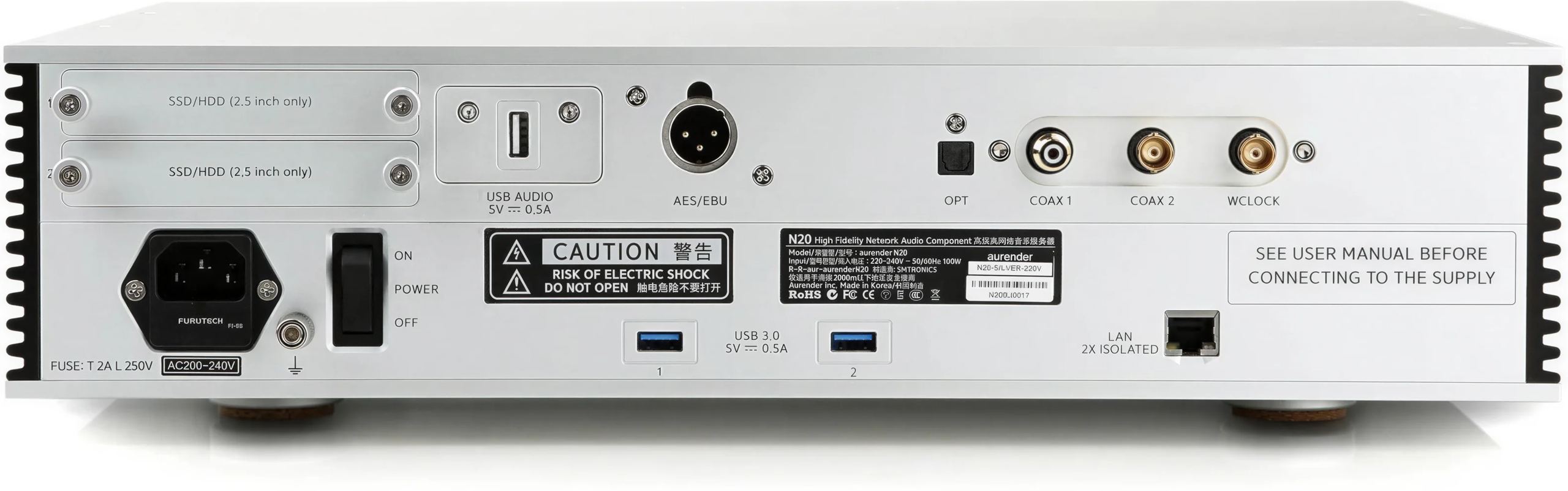
The N20 contains no converter and has no analog output. It connects to an external digital-to-analog converter (DAC), which takes over the conversion, and sends it the signal through one of its digital outputs: USB, AES/EBU, RCA coaxial, BNC coaxial or TosLink optical. This design choice focuses the entire design on a single goal: the cleanliness of the digital signal upstream of the DAC.
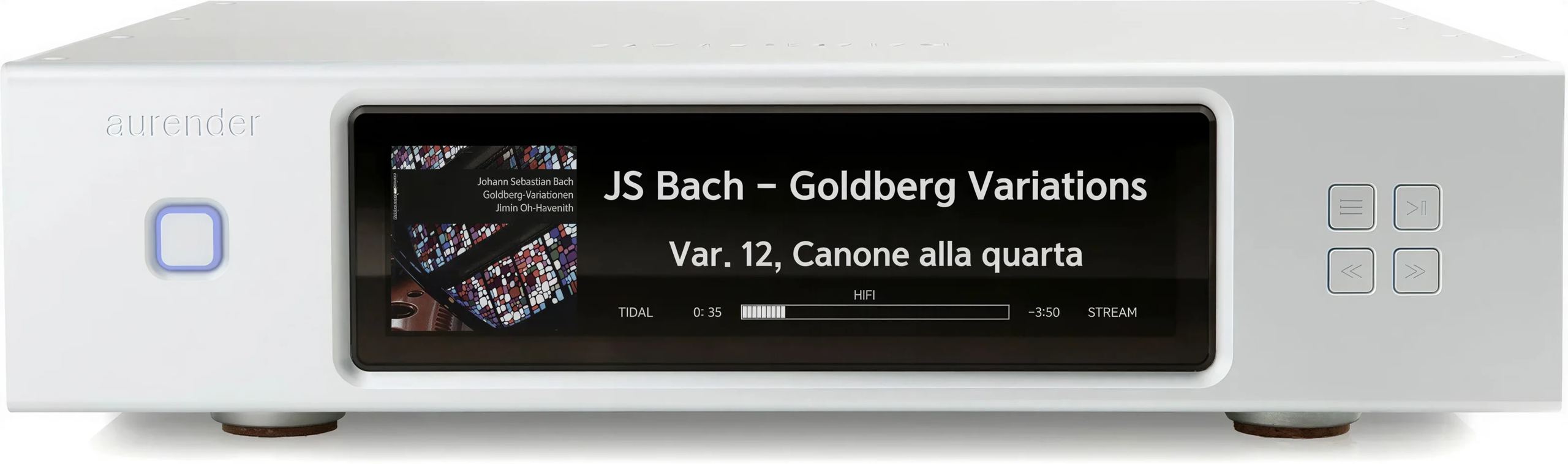
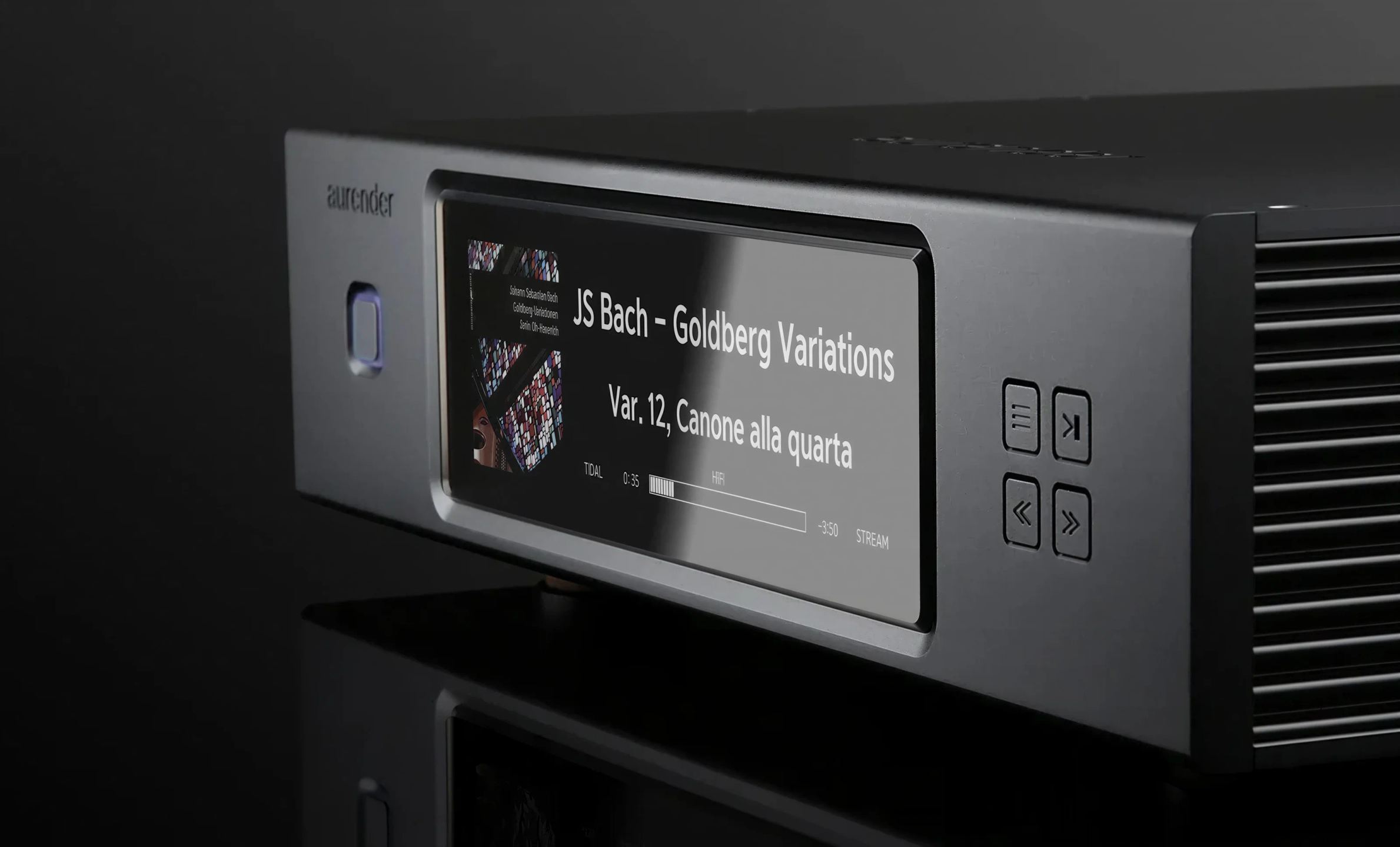
The chassis is machined from aluminum, measuring 429 × 356 × 112 mm and weighing 13.5 kg. The front panel features an 8.8-inch color IPS display (1920 × 480 pixels) showing the album cover, artist name and currently playing track.
An OCXO clock on the S/PDIF outputs
This is what sets the N20 apart from the models below it. Its S/PDIF outputs (RCA coaxial, BNC coaxial, optical) and AES/EBU are driven by an OCXO clock, a quartz oscillator maintained at a constant temperature in a heated enclosure. Via USB, it is the converter’s clock that sets the playback timing; via S/PDIF and AES/EBU, everything depends on the transport’s clock. A more stable clock reduces jitter, those timing variations that degrade the signal, for clearer, more controlled sound.
The N200, just below it in the range, does without this OCXO-clock output board and is limited to a USB output. The N30SA, above it, goes further by isolating the audio outputs in a separate chassis. The N20 adopts this same design in a single enclosure.
A master clock input completes the package: a 75 Ω BNC socket accepts an external 10 MHz, 12.8 MHz or 44.1 / 48 kHz signal to synchronize the N20 with a reference clock such as Aurender’s MC20.
Bit-perfect USB, reworked S/PDIF
The two output families do not follow the same logic. Via USB, the N20 remains bit-perfect: the file is sent without alteration or any processing, up to 768 kHz / 32-bit PCM, native DSD512 and DSD256 in DoP. This is the preferred route with a converter that accepts DSD via USB.
The S/PDIF and AES/EBU outputs are limited to lower specifications, 192 kHz / 32-bit PCM and DSD64 in DoP, but they benefit from the OCXO clock and two optional processing modes. The N20 can upsample lower-resolution content up to 176.4 or 192 kHz, on these outputs only. It also converts DSD files (64, 128, 256 or 512) to PCM at 88.2 or 176.4 kHz, allowing DSD playback through a converter that does not support it via S/PDIF. This conversion runs on an FPGA circuit featuring a filter with several thousand coefficients, rather than in software.
A power supply derived from the N30SA
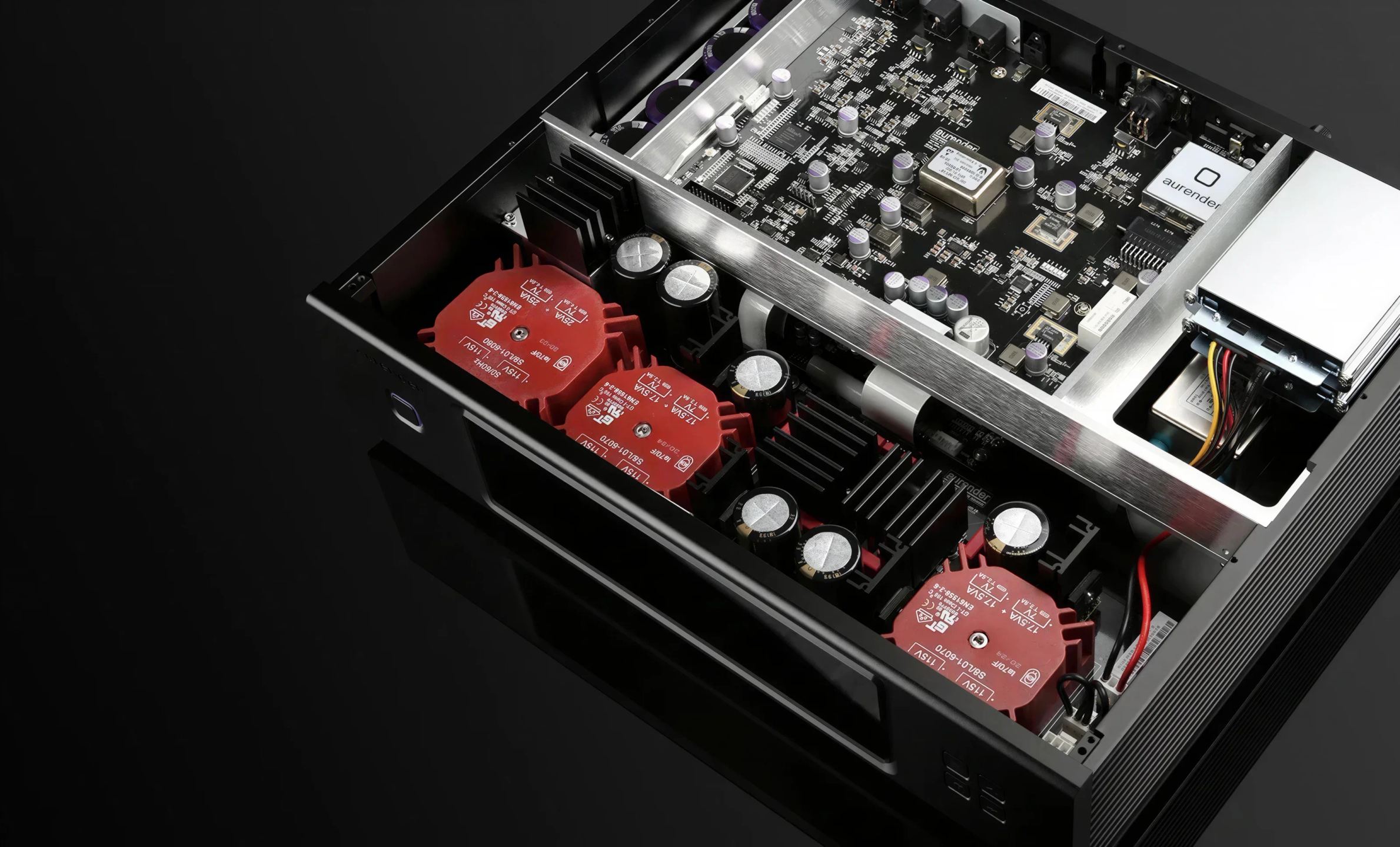
The N20’s hybrid power supply forms the basis for that of the N30SA. It delivers clean DC power to the digital output board, while a separate linear circuit powers the machine’s non-audio sections: a 50 W unit for the computing section, two 35 W linear units for the output board. The processor is a low-power Intel quad-core, selected to limit the electrical noise generated by any computing power. The unit consumes 40 W during playback, 70 W at peak and 3.5 W in standby.
An internal supercapacitor UPS takes over in the event of a power outage and gives the machine time to shut down properly, without a chemical battery that needs replacing over time.
Playback from memory, not the network
The N20 never plays a track directly from the network or library drive. It first copies it into solid-state memory, a 480 GB NVMe SSD supported by 8 GB of RAM, then plays it from this memory. The library drive remains idle during listening, and network or NAS disruptions no longer affect playback.
The USB audio output is physically and electrically isolated from the processor board, the main source of noise in this type of device. A critical listening mode turns off the display, buttons and background tasks not required for playback, to reduce the noise level even further. Network connection is exclusively via Ethernet cable, with Gigabit dual transformer isolation, a wired link that is more stable than wireless and protected from dropouts.
Local storage, online sources and Conductor
Two 2.5-inch drive bays are accessible to the user, to be fitted with SSDs or hard drives as needed, or left empty for fully online listening. Storage is therefore only paid for if it is needed. Two USB 3.0 ports on the rear are used to transfer files from a USB stick or external drive.
For files, the N20 plays DSD (DSF, DFF), WAV, FLAC, AIFF, ALAC, M4A, APE and other common formats. Control is handled through the Aurender Conductor app, on iPad, iPhone or Android devices, providing access to Tidal, Qobuz and Internet radio, along with Spotify Connect and AirPlay. The N20 is also Roon Ready. MQA Core decoding remains available as an optional upgrade, activated from the app.
Technical Specifications
General
- Type: high-fidelity network audio transport
- Chassis: machined aluminum
- Dimensions: approximately 429 × 356 × 112 mm
- Weight: approximately 13.5 kg
Digital Outputs
- Dedicated USB Audio
- AES / EBU
- RCA coaxial SPDIF
- BNC coaxial SPDIF
- TosLink optical SPDIF
Clock and Synchronization
- Audio clock: high-precision OCXO
- Master clock input: BNC 75 Ω, compatible with 10 MHz, 12.8 MHz and 44.1 / 48 kHz
Audio Performance
- USB output: up to 768 kHz / 32-bit PCM, native DSD512 and DSD256 via DoP
- SPDIF and AES / EBU outputs: PCM up to 32-bit / 192 kHz, DSD64 via DoP
- DSD-to-PCM conversion: DSD64 / 128 / 256 / 512 to 88.2 or 176.4 kHz PCM
- PCM upsampling: up to 176.4 / 192 kHz on SPDIF outputs
Formats and Compatibility
- Supported formats: DSD (DSF, DFF), WAV, FLAC, AIFF, ALAC, M4A, APE and other major audio formats
- MQA compatibility: MQA Core Decoder upgrade available
Storage and Memory
- Internal storage: 2 x 2.5-inch bays for user-installable HDD or SSD
- System and cache SSD: 480 GB NVMe
- RAM: 8 GB
Connectivity and Processing
- USB data ports: 2 × USB 3.0
- Network: dual-isolated Gigabit Ethernet
- Processor: low-power Intel Quad Core
Power Supply
- Power supply: hybrid power supply with dedicated linear circuits
- Built-in UPS: yes, via supercapacitors
- Power consumption
- 40 W during playback
- 70 W peak
- 3.5 W standby
Interface and Control
- Display: 8.8-inch color IPS LCD screen, 1920 × 480 pixel resolution
- Control software: Aurender Conductor
Frequently Asked Questions
Does the N20 connect via Wi-Fi?
No. Network connectivity is provided exclusively via Ethernet cable, which is more stable than wireless and protected from dropouts. If no network socket is available near the system, a powerline adapter (PLC) or a Wi-Fi repeater equipped with an Ethernet port can bring the signal to the N20.
Can the N20 rip CDs?
No, it does not rip discs. Its library is populated by importing files from a NAS, USB drive, or USB hard drive via the rear USB 3.0 ports. To digitize a CD collection, you need to use a computer or server that handles ripping.
Can the N20 be used without a tablet or smartphone?
Control is via the Aurender Conductor app, on iOS and Android. The front-panel screen displays the cover art and playback information, but browsing the library and adjusting settings require the app. An iPad, iPhone or Android device is therefore required for operation.
What is the master clock input for?
The 75 Ω BNC input accepts the signal from an external reference clock, such as Aurender’s MC20, at 10 MHz, 12.8 MHz or 44.1 / 48 kHz. In a system already built around a master clock, the N20 locks to it rather than to its internal OCXO clock. Without this type of setup, the internal clock does the job on its own.
What storage capacity can be installed, and is an SSD necessary?
Both bays support 2.5-inch drives, SSDs or hard drives, up to 8 TB each, for a total of 16 TB. Drives are not included: storage can be selected and installed as needed, and the bays can remain empty for streaming-only listening.
Is MQA decoding enabled by default?
No. The MQA Core decoder is available as an optional upgrade, activated via the Conductor app. It does not come into play for other high-resolution formats, which the N20 supports from the outset.
Which output should I connect to my converter?
It depends on the DAC. The USB output remains bit-perfect and supports up to DSD512, which suits a DAC compatible with DSD via USB. The AES/EBU, coaxial and optical outputs benefit from the OCXO clock and are useful with a DAC whose USB input is less refined, or when using PCM up to 192 kHz. The N20 powers all its outputs simultaneously: you can connect two links and switch on the DAC side to compare by listening.
- Eco-contribution included in the sale price.