

Aurender ACS100 silver


Specifications and features


Overview
Digitize a CD collection without turning on a computer, keep each album in its original format and recall it from a tablet: that is the job this Aurender unit covers. Disc ripper, library manager and network server in one compact aluminum chassis, the ACS100 takes on some of the functions of its big brother, the ACS10, in a streamlined version.
A CD ripper, not a disc player
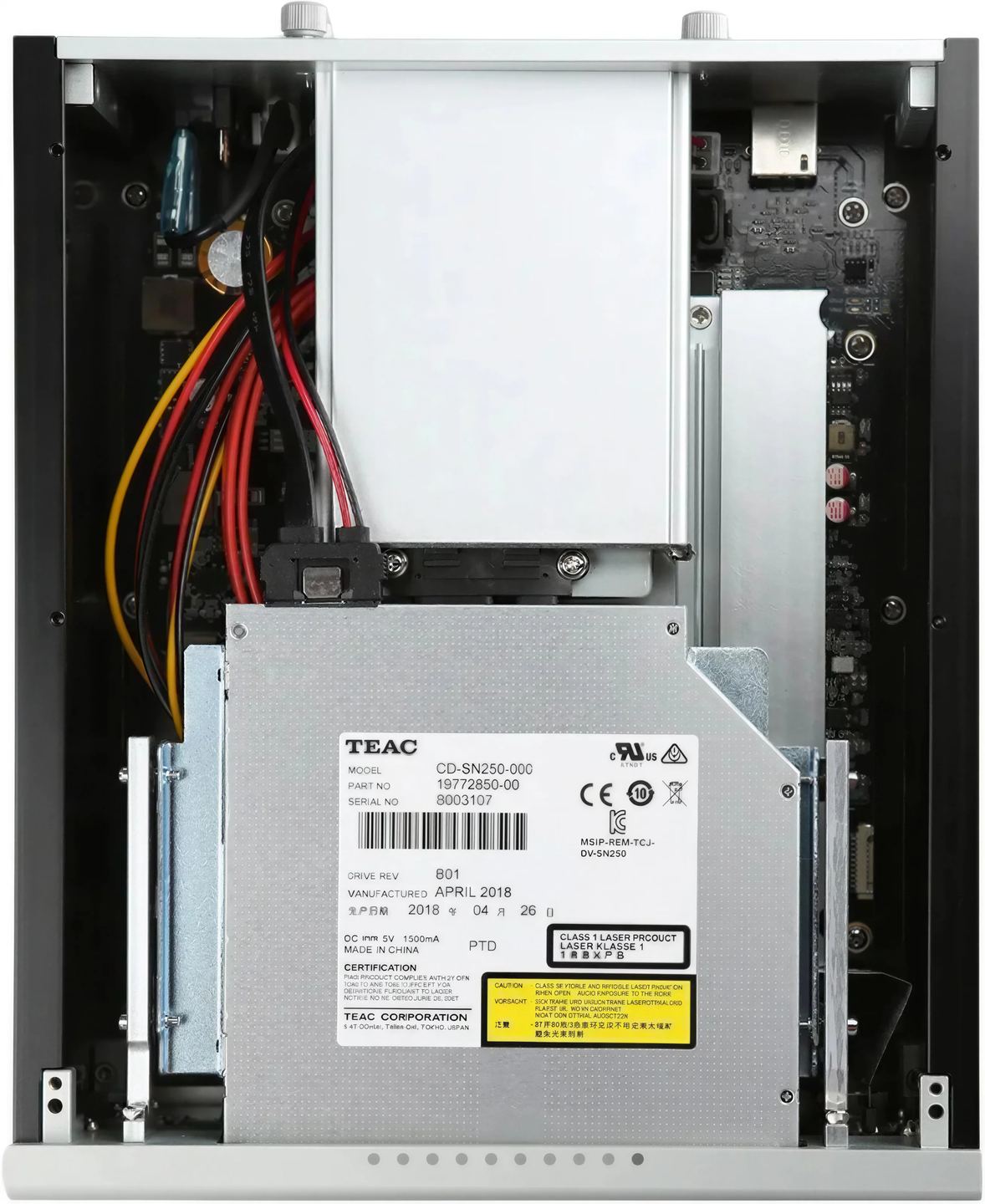
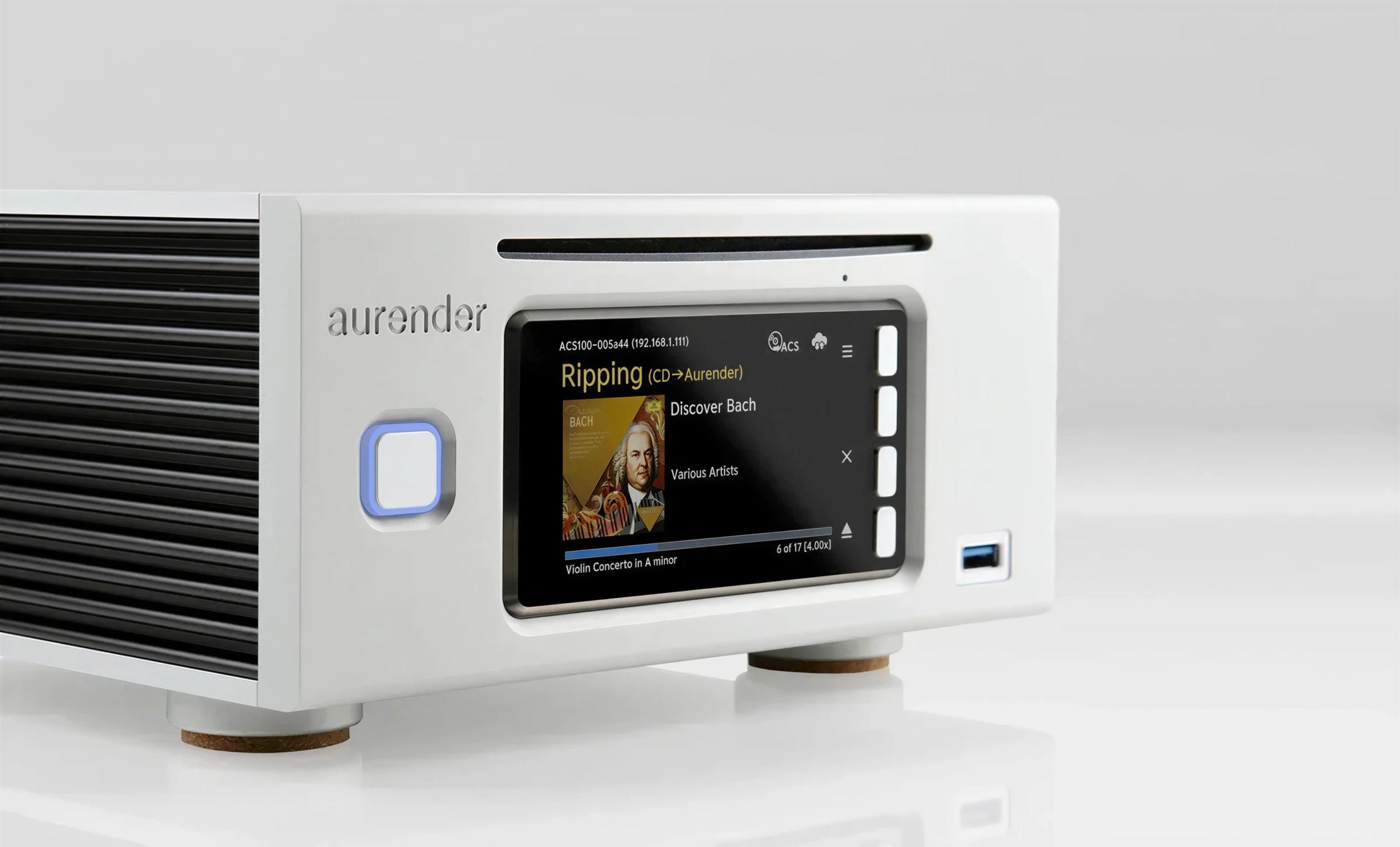
The slot-loading TEAC optical drive is not there to play discs in real time, but to copy them. You insert a CD, the ACS100 rips it to its internal storage in FLAC, WAV or AIFF, corrects read errors and automatically retrieves metadata and cover art, displayed on the front panel. Music is then played from the stored file, no longer from the disc. Once the disc has been digitized, you can put it away.
For large music collections, the unit accepts the Acronova Nimbie automatic loader, which processes discs one after another without intervention. Ripping remains the upstream half of a digital source: it creates and stores the files, while digital-to-analog conversion takes place further down the chain.
A single audio output, via USB
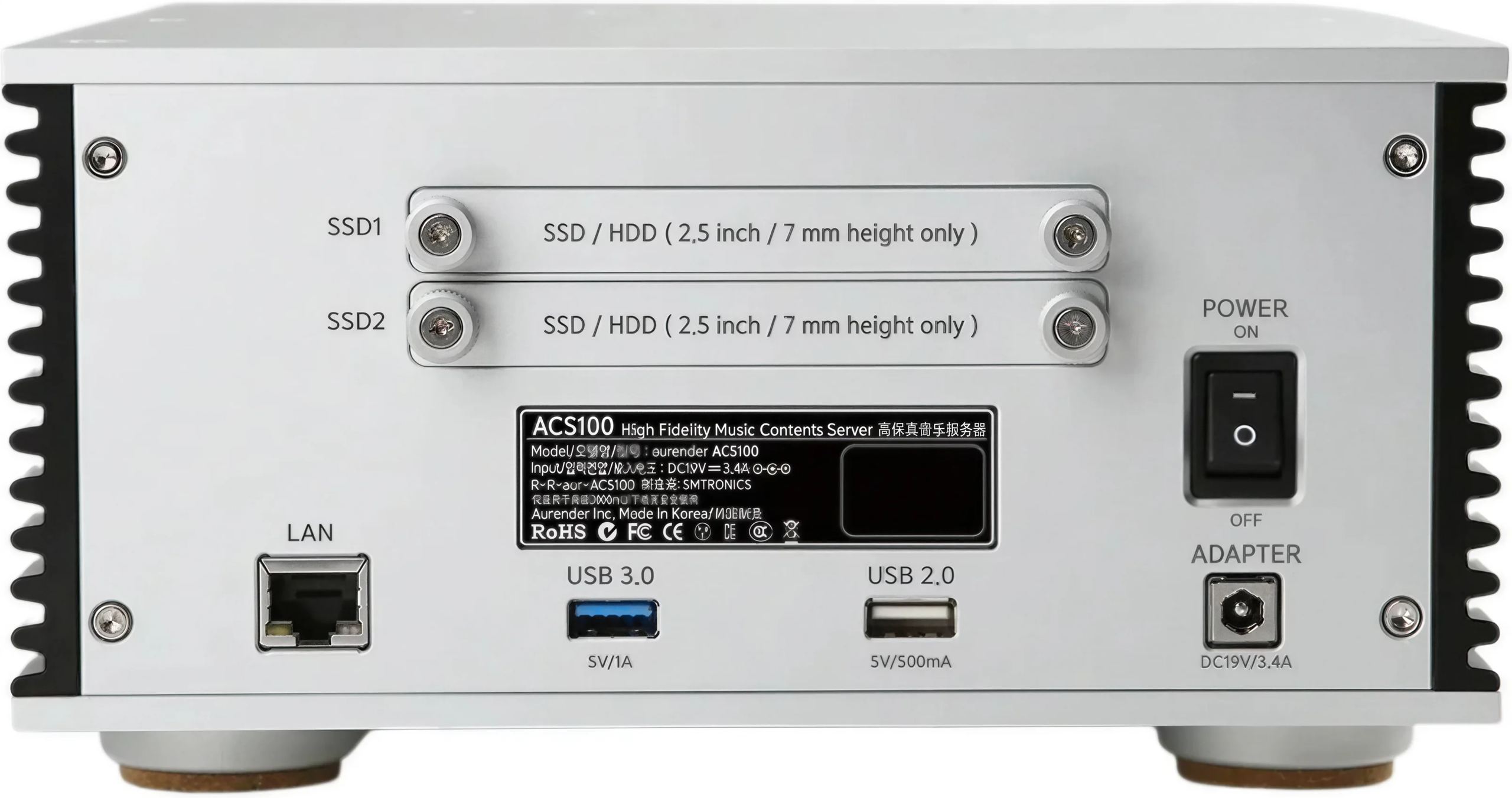
On the audio side, the ACS100 offers only one output: USB Audio Class 2.0. No analog connection, no S/PDIF or AES-EBU, no headphone output. It therefore connects to an external converter, or to another Aurender device. This USB link carries PCM up to 32-bit and 384 kHz, DSD up to DSD128 in DoP and up to DSD512 natively.
This is where the main compromise versus the ACS10 lies. On the higher-end model, the USB audio output is dedicated, isolated and separately filtered; on the ACS100, it uses a standard USB port. The unit’s intended use explains this choice: its primary role is as a central server feeding other Aurender players over the network; directly connecting a converter via USB is secondary.
Two storage bays and cache playback
Storage is not included: two sliding bays at the rear accommodate 2.5-inch hard drives or SSDs, to be installed by the user, with up to 16 TB possible when fitted with two 8 TB SSDs. You can start with a single drive and add another later. A 240 GB NVMe SSD is used for the system and cache.
This cache bears the Aurender signature. During playback, the track is first copied to the SSD, then played from that SSD while the library drive remains idle. The mechanical drive spins less, generates less heat, wears less, and its electrical noise no longer mixes with the signal.
Central server for a multiroom system
Two isolated Gigabit Ethernet ports connect the ACS100 to the network. Its primary role is to centralize the music in an Aurender installation. It rips, stores and distributes the library to the other players in the home, room by room. The SmartMerge function merges its library with that of another Aurender player, for a unified collection. Unlike the ACS10, it does not serve as an audiophile network switch.
However, nothing requires it to be part of an Aurender setup. On its own, connected to a converter via USB, it acts as a source for a complete system. The network connection is wired only: no Wi-Fi, a choice consistent with the noise concerns guiding the rest of the design.
Control, formats and streaming services
Everything is controlled from Aurender Conductor, the in-house iOS and Android app, while the ACS Manager app handles the library: metadata editing, sorting and duplicate removal. Tidal and Qobuz subscriptions are integrated into the app, along with Spotify Connect and internet radio. The unit is Roon Ready and works as a Roon playback endpoint on the local network. MQA Core decoding is available as a paid option in the app.
For playback, it supports DSD (DSF and DFF), WAV, FLAC, AIFF, ALAC, M4A, APE and other common formats.
Machined aluminum and supercapacitor UPS
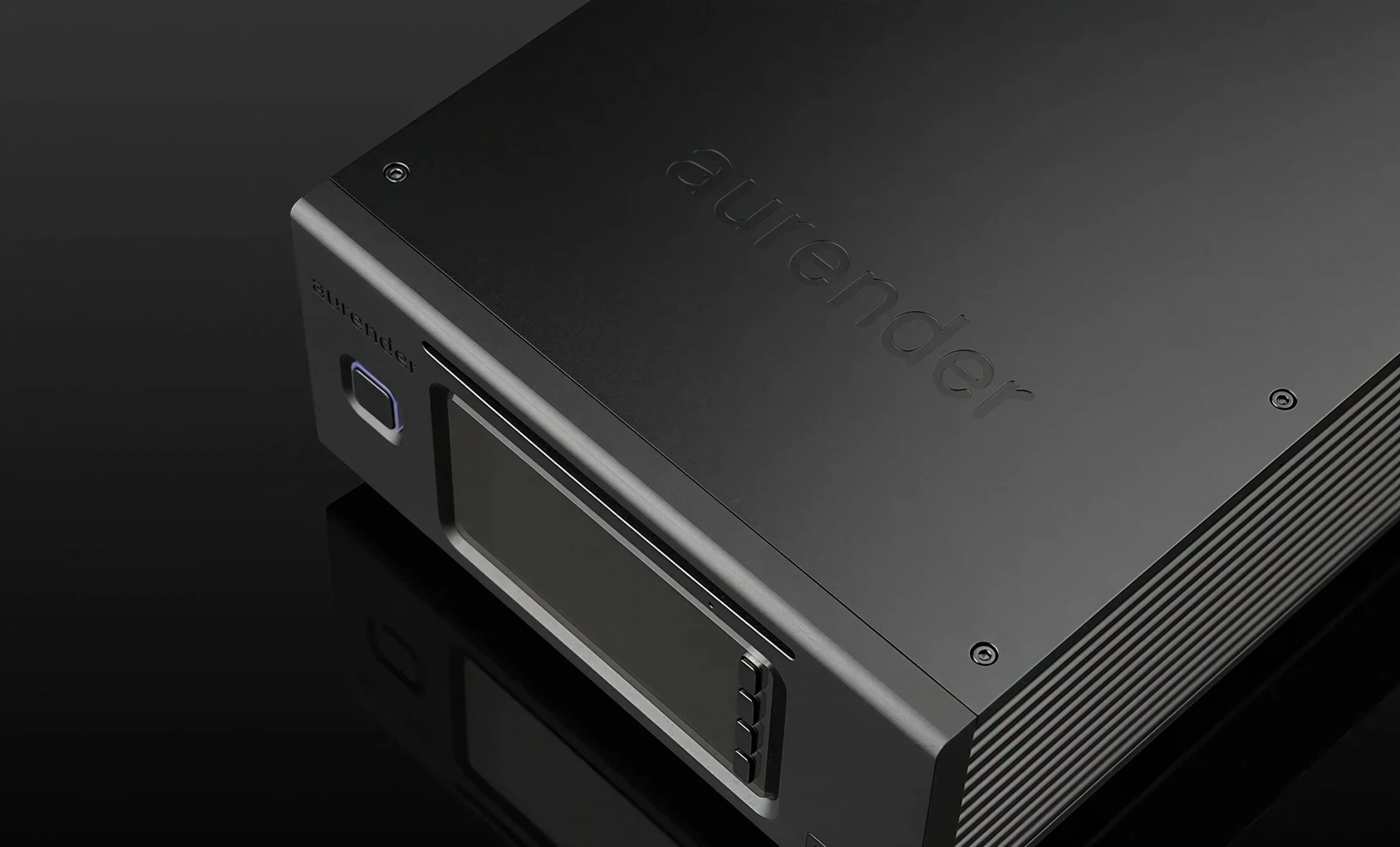
The chassis is machined from aluminum, in a compact format measuring 21.6 cm wide, 25.7 cm deep and 11.2 cm high, weighing just under 5 kg. On the front, a 4-inch IPS color screen displays album artwork and playback information. Inside, a low-power quad-core Intel processor, 8 GB of RAM and an X-TAL audio clock keep everything running.
Power is supplied by a 19 V switching AC adapter, the other cost-saving measure compared with the ACS10 and its linear power supply. An internal supercapacitor UPS takes over in the event of a power outage, allowing time for a proper shutdown, without a chemical battery to replace. Power consumption remains low: 16.5 W during playback, 23.5 W at maximum, 6.5 W in standby.
Technical specifications
Overview
- Product type: content server and CD ripper
- Main functions: music library management, CD ripping, metadata editing, multiroom central server
- Network use: central server for multiple Aurender devices
- Multiroom compatibility: yes
Hardware architecture
- Processor: low-power Intel Quad-Core
- RAM: 8 GB
- System and cache storage: 240 GB NVMe SSD
- Internal storage: 2 user-installable 2.5” drive bays
- Maximum capacity: up to 16 TB with 2 × 8 TB SSDs
- Audio clock: X-TAL
CD ripping and playback
- Optical drive: slot-loading CD drive
- CD ripping: automatic ripping with error correction
- Autoloader compatibility: Acronova Nimbie
Software and compatibility
- Library management: Aurender ACS Manager
- Control application: Aurender Conductor
- Roon Ready: yes
- MQA: MQA Core Decoder upgrade available
Supported audio formats
- Compatible formats: DSD (DSF, DFF), WAV, FLAC, AIFF, ALAC, M4A, APE and others
- USB PCM output: up to 32-bit / 384 kHz
- USB DSD DoP output: up to DSD128
- Native USB DSD output: up to DSD512
Connectivity
- Ethernet network: dual isolated Gigabit LAN port
- Rear USB: 1 × USB 3.0 + 1 × USB 2.0
- Front USB: 1 × USB 3.0
- Digital audio output: USB
- Digital audio inputs: no
- Analog outputs: no
- SPDIF / AES-EBU outputs: no
- Headphone output: no
Power supply and consumption
- Power supply: external 19 V / 3.42 A SMPS power adapter
- Uninterruptible power supply: yes, via supercapacitors
- Playback power consumption: 16.5 W
- Maximum power consumption: 23.5 W
- Standby power consumption: 6.5 W
Design and dimensions
- Chassis: machined aluminum
- Front display: 4-inch IPC LCD
- Dimensions
- Width: 21.6 cm
- Depth: 25.7 cm
- Height: 11.2 cm
- Weight: 5 kg
Frequently Asked Questions
How does the ACS100 differ from the ACS10?
The ACS10 remains the higher-end model in the range. It features a linear power supply, whereas the ACS100 uses an external switching adapter, adds a dedicated, isolated and filtered USB audio output, and also serves as an audiophile network switch for other Aurender devices. The ACS100 retains the essential ripping, library management and central server functions in a more affordable format.
Should you keep your CDs after ripping them?
Once the disc has been digitized to internal storage, playback is from the file, without the CD. There is no need to reinsert the disc to listen to the album again. Keeping the original discs remains useful as a backup and proof of purchase, but daily use is through the library.
FLAC, WAV or AIFF: which ripping format should you choose?
All three are lossless and reproduce the CD content exactly. FLAC compresses the data without degrading it and handles tags well (title, artist, cover art), making it the most flexible choice for a large library. WAV and AIFF do not compress and therefore take up more space, with more limited metadata handling for WAV.
Which storage drives can be installed?
Both bays support 2.5-inch SATA drives, HDDs or SSDs, sold separately. Capacity can be expanded up to 16 TB total with two 8 TB SSDs. A hard drive offers greater capacity at a lower cost, while an SSD remains silent and unaffected by vibrations.
Is MQA Core decoding included as standard?
No, it can be added as a paid option through the app. Without this option, an MQA file remains readable and plays at its base resolution, without the format’s initial unfolding.
Can the ACS100 be connected directly to an amplifier?
Only if the amplifier includes a digital-to-analog converter with a USB audio input. The unit’s only output is digital, via USB, with no analog connector. With an amplifier without a USB input, an external converter must be placed between the two.
Is Wi-Fi supported?
No. Network connection is only possible via an Ethernet cable, using one of the two Gigabit ports. The absence of an internal radio eliminates an additional source of noise near the audio circuits and stabilizes throughput to the other players.
- Eco-contribution included in the sale price.




