Aurender ACS10 black


Specifications and features


Overview
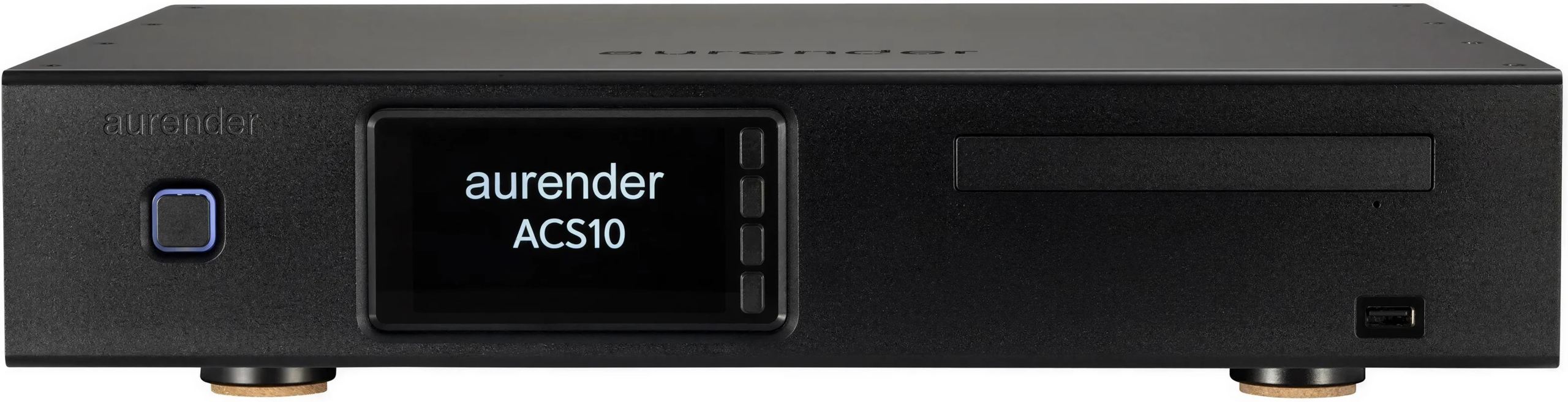
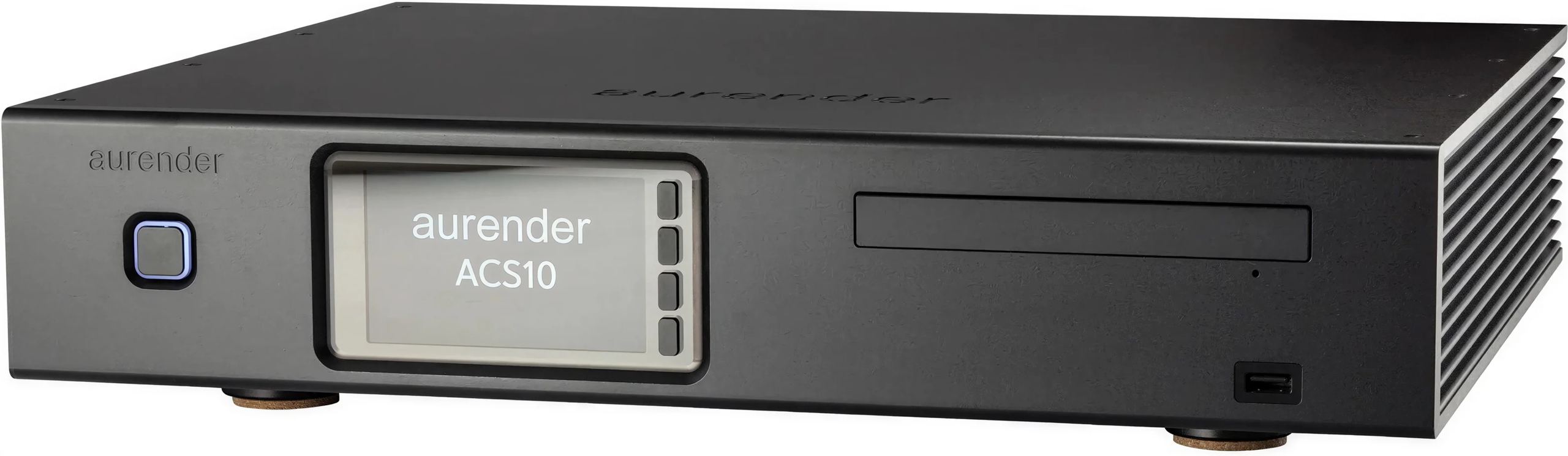
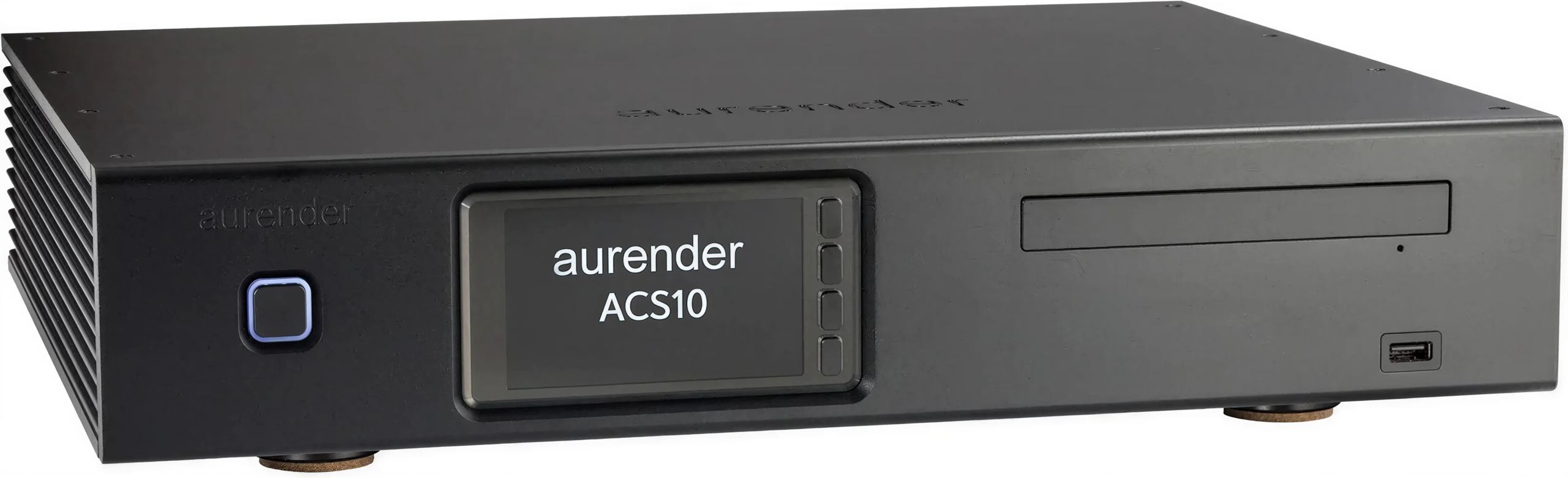
Digitizing a collection of several hundred CDs, organizing the resulting files and then correcting their metadata: until now, these tasks required a computer, the last intruder in a digital chain. Aurender builds its network players around the opposite goal: keeping the PC out of playback. The ACS10 extends this logic right to the file source, combining a CD player, dual-drive storage and library management in a single aluminum chassis.
Removing the computer from the digital chain
The full name, Aurender Content Server, sums up the concept. A low-power quad-core Intel processor manages the whole system, selected for its low heat output and minimal electrical noise, two parameters that matter for an audio source. Ripping, storage and metadata editing are all handled within a single device, with a USB audio output on par with the brand’s high-end players. The machine operates independently, connected to a USB DAC, or alongside an already installed Aurender player.
Digitizing a CD collection without a PC
Ripping relies on an industrial-quality front-mounted tray-loading optical drive. A press starts extraction: the in-house software engine reads the disc, applies error detection and correction to obtain a faithful copy, retrieves metadata and cover art, then stores the file in the folder you have defined. Three formats are available for extraction: FLAC, WAV and AIFF. The 4-inch (10.2 cm) screen displays the cover art during the operation.
A second application, ACS Manager, brings together ripping settings, the metadata editor, duplicate detector and file copy or move operations. To digitize a large number of discs in succession, the ACS10 recognizes the Acronova Nimbie automatic loader, which processes CDs without intervention.
Two hard drives and mirrored duplication
Storage relies on two internally mounted 3.5-inch hard drives, for a capacity of up to 28 TB. This is selected when ordering, with the 12 TB dual-drive version (24 TB total) available as an option. By default, the two drives operate in mirror mode (RAID 1): each file is written identically to both units, so a drive failure causes no data loss. The trade-off is straightforward: usable capacity corresponds to a single drive, while the other serves as a copy. This duplication can be disabled in the settings to recover all available space, at the expense of redundancy. The 24 and 28 TB versions receive 16 GB of RAM and a 480 GB NVMe SSD cache, compared with 8 GB and 240 GB for the lower-capacity versions.
Playback via an isolated USB output
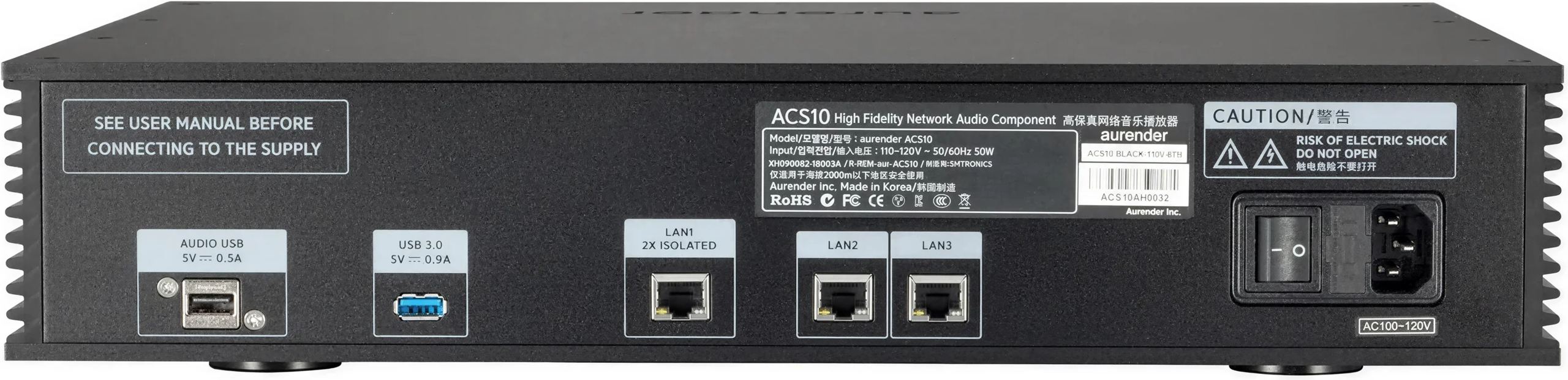
For listening, the ACS10 offers only one audio output, USB, and this is a deliberate choice. This USB Audio Class 2.0 port is electrically isolated and handled on a board separate from the processor, to keep computer noise away from the signal. It supports PCM up to 32-bit/384 kHz, DSD128 in DoP and native DSD512, and plays most common formats (DSF, DFF, WAV, FLAC, AIFF, ALAC, M4A, APE). This output connects to a USB DAC: the device includes neither a converter, analog connection, nor S/PDIF or AES-EBU output. Conversion remains the responsibility of an external DAC, leaving the choice of the component that has the greatest influence on sound character.
Playback follows the caching principle used in Aurender players: before being played, the track is copied to the SSD cache, then played from this fast memory. The slower, noisier hard drives remain idle during listening, and network slowdowns do not disrupt the stream. The Aurender Conductor application serves as the browsing and control interface from a tablet, and provides access to local files as well as Tidal, Qobuz, Spotify Connect streaming services and web radio stations, depending on their availability in the country. The ACS10 is also Roon Ready. A paid extension adds MQA Core decoding (first unfold) for those who own this type of file. Control operates as a closed system rather than open UPnP, an approach aimed at stability that requires using Conductor, without a third-party control application.
Central library for an Aurender system
Connected to the network, the machine plays the files of another Aurender player as if they were its own. The SmartMerge function combines the two libraries into a single list, that of the existing player and that of the ACS10 storage, limited to pairing one ACS10 with a single player. An Aurender owner running out of space, or wanting to add ripping and backup, gains these functions without changing players.
Three Gigabit Ethernet ports are fitted on the rear, including one with dual isolation reserved for the audio path, less exposed to network interference. The other two allow switch use, with the ACS10 placed between the router and other devices. Two USB 3.0 ports, one on the front and the other on the rear, are used for data transfers.
Linear power supply and controlled shutdowns
The power supply is entirely linear, bulkier than a switching unit but electrically quieter. A supercapacitor UPS takes over in the event of a power outage: it keeps the device running long enough for a clean shutdown, protecting the library and its index from corruption, without a chemical battery that will age over time. Power consumption remains low: 16.5 W during playback and 23.5 W maximum, 6.5 W in standby. A TCXO clock times the digital exchanges. The machined aluminum chassis measures 42.9 cm wide by 35.6 cm deep and 9.7 cm high (8.4 cm without the feet), and weighs 12.2 kg.
Technical specifications
Overview
- Product type: music content server / CD ripper / network transport
- Main function: centralization, storage and management of music libraries
- Central server function: sharing the library with multiple Aurender players via the network
CD ripping and playback
- Tray-loading CD optical drive
- Automatic ripping with secure extraction and error correction
- Extraction formats: FLAC, WAV, AIFF
- Auto-loader compatibility: compatible with Acronova Nimbie Auto Loader
Library management and applications
- Advanced sorting, editing and metadata management
- Applications: Aurender Conductor, ACS Manager
Storage
- Dual integrated hard drives
- Maximum capacity: up to 28 TB
- RAID 1 configuration with data duplication function
- System and cache SSD
- 240 GB NVMe
- 480 GB NVMe for 24 and 28 TB versions
Hardware architecture
- Low-power Intel Quad Core processor
- RAM
- 8 GB
- 16 GB for 24 and 28 TB versions
- TCXO audio clock
- Machined aluminum chassis
- 4-inch (10.2 cm) IPC LCD display
Digital audio performance
- Dedicated and isolated USB digital audio output
- PCM resolution via USB: up to 32-bit / 384 kHz
- DSD compatibility: DSD128 via DoP, native DSD512
- Compatible formats: DSF, DFF, WAV, FLAC, AIFF, ALAC, M4A, APE and others
- MQA compatibility: MQA Core Decoder upgrade available
Connectivity
- Analog outputs: no
- Digital inputs: no
- S / PDIF / AES-EBU outputs: no
- USB data ports
- 1 × front USB 3.0
- 1 × rear USB 3.0
- Network connectivity
- 1 × doubly isolated Gigabit LAN port
- 2 × Gigabit LAN ports
Power supply
- Fully linear power supply
- Power outage protection: integrated supercapacitor UPS
- Playback power consumption: 16.5 W
- Maximum power consumption: 23.5 W
- Standby power consumption: 6.5 W
Dimensions and weight
- Width: 42.9 cm
- Depth: 35.6 cm
- Height: 9.7 cm with feet / 8.4 cm without feet
- Weight: 12.2 kg
Frequently Asked Questions
Can you insert a CD and listen to it directly, without copying it?
No. The optical drive is used for ripping: it digitizes the disc into a file, which is then played from storage. It is not a CD player in the traditional sense, with real-time playback of the disc in the tray.
Is a converter required for listening?
For direct listening from the ACS10, yes: its USB output connects to a converter (DAC), which handles the conversion and feeds the amplification. However, if you use it solely as a ripper, storage device and central library for another Aurender player, that player handles the output, and no additional DAC is required.
Does RAID 1 serve as a backup?
No. Mirroring protects against a disk failure, not against accidental deletion, file corruption, theft, or a household incident, which would affect both disks at the same time. A separate backup on external media is still recommended for a collection you care about.
Does the ACS10 connect via Wi-Fi?
No, network connectivity is provided via Ethernet, through the three Gigabit ports on the rear panel. A wired connection avoids the uncertainties of a wireless network and is well suited to a device that remains installed in a hi-fi cabinet.
Can an already digitized library be transferred?
Yes. Files stored on a computer or NAS are copied to the internal storage over the network. ACS Manager then makes it possible to standardize metadata, identify duplicates, and organize the collection according to your sorting rules.
Does secure ripping take longer than fast ripping?
On a disc in good condition, extraction is quick. On a scratched or damaged disc, rereading questionable sections to ensure an exact copy takes longer: that is the price of a file faithful to the original disc.
- Eco-contribution included in the sale price.