Aurender NH10 silver



Overview
A high-end streamer and a refined converter can have their performance compromised by an almost always overlooked link: the network that feeds them. Electrical noise, jitter and ground loops travel up the Ethernet cable to the audio devices. Aurender’s first network switch, the NH10 addresses this entry point with the methods Aurender applies to its servers: precision clock, linear power supply and galvanic isolation.
Why the network affects sound
Streaming relies on a protocol that corrects errors: data arrives intact, a bit remains a bit. What the network also carries is high-frequency electrical noise, ground loops and the instability of the inexpensive clocks found in consumer switches. This noise couples to the streamer’s ground, then propagates to the converter’s analogue stage, where it becomes audible.
The subject is divisive, and it must be said: no switch makes an already correct data stream “more correct.” What the NH10 handles is the electrical environment around that stream, not the bytes themselves. The potential improvement therefore depends on the rest of the chain, the sensitivity of downstream devices and the cleanliness of the existing network.
An OCXO clock to pace the data
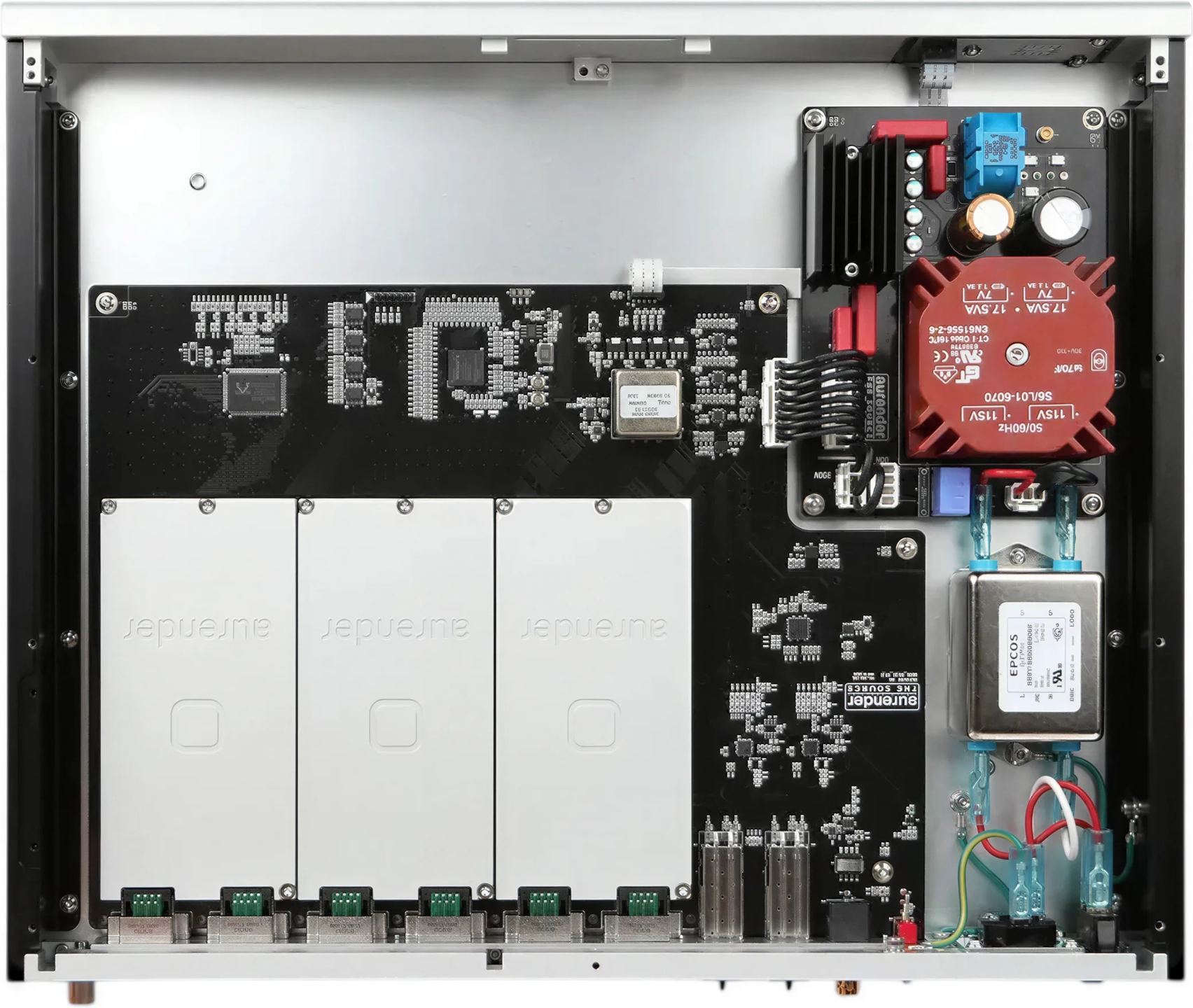
A switch times the traffic it relays according to its own clock. The NH10 incorporates an OCXO, a quartz oscillator kept at a constant temperature by a small internal oven. Compared with a quartz oscillator left at room temperature, this regulation limits frequency drift: stability falls below 0.005 ppm. An FPGA circuit aligns all internal operations to this single reference, reducing synchronization deviations and jitter injected into the transmitted signal.
A BNC master clock input (10 MHz, 0.7 Vrms, 50 Ω) provides additional flexibility: it accepts an external reference, such as one of the brand’s MC10 or MC20 master clocks, to synchronize the NH10 to a common time base with the rest of an Aurender installation.
Eight ports and two levels of filtering
The NH10 distributes eight connections: six copper RJ45 ports and two SFP ports for optical fibre, all Gigabit (100 or 1000 Mbps). This configuration also makes the device a single distribution point for several audio components—streamer, server or network player—fed from the same filtered source.
Not all RJ45 ports receive the same treatment. LAN 1 and 2 ports pass through two-stage filtering, while LAN 3 to 6 ports benefit from more advanced seven-stage filtering. Devices most sensitive to noise, such as the streamer or network converter, belong on these heavily filtered ports; the less critical home network connection on the first two.
The two SFP ports go further. Optical fibre does not conduct electricity: the link is galvanically isolated, with no copper path through which noise or a ground loop could pass. It is the cleanest connection for isolating the NH10 from the home network, or for serving a device equipped with an SFP input.
A fully linear power supply
Every audiophile switch faces a contradiction: fighting noise while being powered by a switching supply, itself a source of high-frequency noise. The NH10 avoids this. Each circuit is powered by linear regulation, with no DC-to-DC converters whatsoever. This choice comes at a cost in size, weight and heat, but it provides clean voltage at the most sensitive point: the power supply itself. Power consumption remains moderate: 3.1 W in standby, 26 W maximum during the clock warm-up phase, and 20 W once synchronization has stabilized.
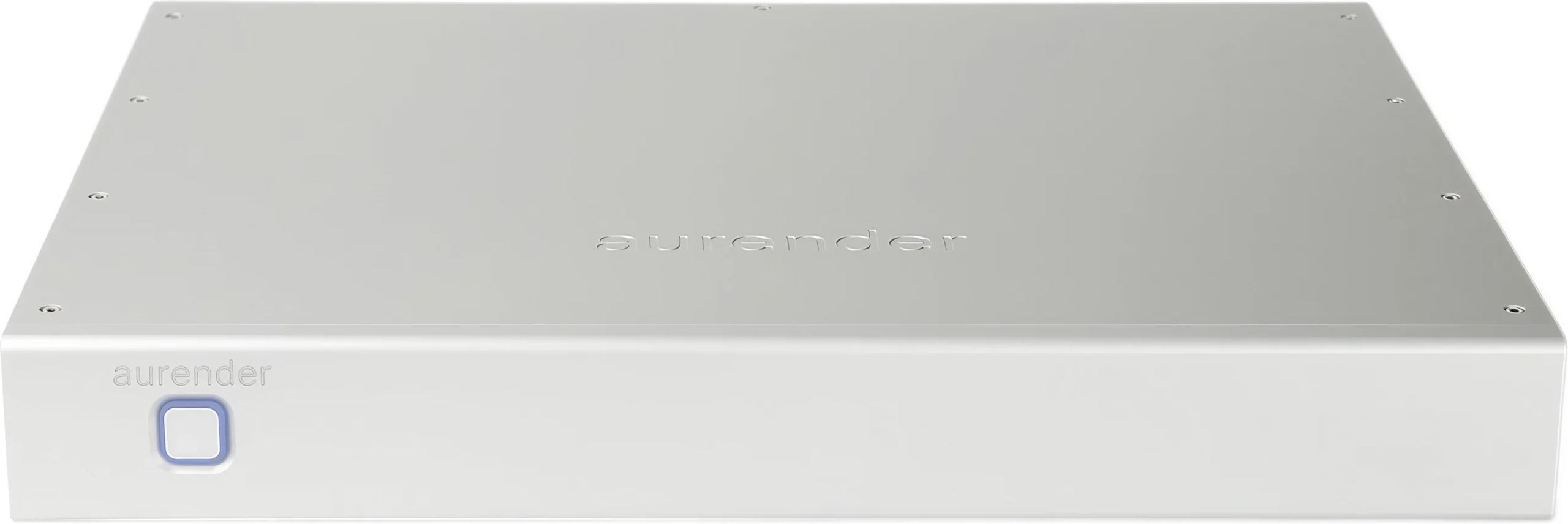
A switch turns off the ports’ activity LEDs, whose flashing produces slight but real electrical noise, for operation that is entirely silent from an electrical standpoint. The machined aluminium chassis completes the package: it shields against interference, damps vibrations and, at 8 kg, gives the NH10 a stable foundation.
Where to place it in the chain
The NH10 fits between the home network and the audio system, as the final switch before the listening devices. Its compatibility is not limited to Aurender servers: any device equipped with an Ethernet socket or SFP port can be connected, whether a streamer, network player, server or NAS, regardless of brand. Supported standards (IEEE 802.3i, 802.3u, 802.3ab, 802.3z) cover Fast Ethernet and Gigabit over both copper and fibre, with a range of 100 m per link.
In an Aurender installation already equipped with an N-series server and a master clock, the BNC input closes the loop: the switch, server and clock then share the same time reference. For a system from another brand, the NH10 remains a clean network entry point, with enhanced filtering and a linear power supply, without dependence on an ecosystem.
Technical specifications
General
- Type: audiophile network switch
- Function: network transmission optimization for digital audio systems
- Network standards: IEEE 802.3i, IEEE 802.3u, IEEE 802.3ab, IEEE 802.3z
- Chassis: high-precision machined aluminum, providing protection against electrical interference and vibrations
Network connectivity
- RJ45 ports: 6 Gigabit Ethernet ports
- SFP ports: 2 ports
- Connectors: 8-pin RJ45 and SFP
- Transfer rate
- LAN 1 to LAN 6: 100 / 1000 Mbps
- SFP 1 and SFP 2: 100 / 1000 Mbps
- Maximum transmission distance: 100 m
- Network filtering
- LAN 1–2: 2× filtering
- LAN 3–6: 7× filtering
- SFP ports: optical isolation
Clock and synchronization
- Internal clock: OCXO (Oven-Controlled Crystal Oscillator)
- Frequency stability: < 0.005 ppm
- Synchronization: FPGA control and synchronization
- Master clock input
- Frequency: 10 MHz
- Level: 0.7 Vrms
- Connector: BNC
- Impedance: 50 Ω
Noise reduction
- Fully linear power supply
- No DC / DC converters
- Galvanic isolation via optical SFP ports
- Advanced filtering on each RJ45 port
- Network LED off switch
Power supply
- Input voltage: 110 / 220 V
- Fuse: 2 A, 5 × 20 mm, time-delay
- Power consumption
- Standby: 3.1 W
- Power-on / warm-up phase: 26 W max.
- Stabilized operation: 20 W max.
Operating conditions
- Operating temperature: 10 to 35 °C
Dimensions and weight
- Dimensions (W × D × H): 430 × 355 × 56 mm
- Height with feet: 68 mm
- Weight: 8 kg
Frequently Asked Questions
Does the NH10 speed up the network connection?
No. A Gigabit port already far exceeds the bandwidth required for an audio stream, even in high resolution: a DSD or 24-bit PCM file remains well below the capacity of a 1000 Mbps connection. The NH10 does not aim to transmit faster, but more cleanly, by reducing the noise and timing instability that accompany data.
Do SFP ports require a separate module and cable?
Yes. An SFP slot is a cage that accepts a removable transceiver module, selected according to the type of fiber, then connected using an optical cable. To connect an RJ45 device from an SFP port, SFP-to-copper modules are available. These components are not included and must be selected according to the installation.
Does the NH10 replace my modem or router?
No. It is a switch, not a router: it does not handle IP address assignment, internet access, or Wi‑Fi. It is installed downstream from the router, along the network path to the audio devices, and distributes an already established connection.
Is an external clock necessary to get the most out of the NH10?
No. The internal OCXO operates independently and already provides the stated frequency stability. The 10 MHz BNC input is an upgrade option for those with a reference master clock; it is not required for operation.
Can the NH10 be connected to the network via Wi-Fi?
No, the connections are wired, using copper or fiber. This is consistent with its function: wireless would reintroduce the irregularity and noise that the device is designed to eliminate. The network reaches it by cable, and it serves audio devices in the same way.
Does the enclosure heat up during operation?
The linear power supply and the OCXO oven generate moderate heat, consistent with the 20 W consumed under steady-state operation. It is best to leave it some ventilation space, with no special precautions beyond that.
Is it better to leave it on all the time?
The clock performs at its best once it has reached operating temperature, after a warm-up phase during which power consumption rises to 26 W. Leaving it powered on maintains this stability, while standby requires only 3.1 W. For regular listening, continuous operation makes sense.
- Eco-contribution included in the sale price.