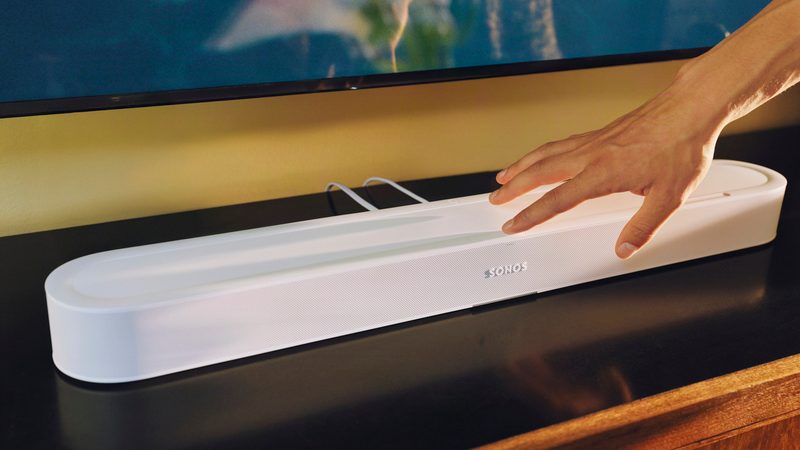
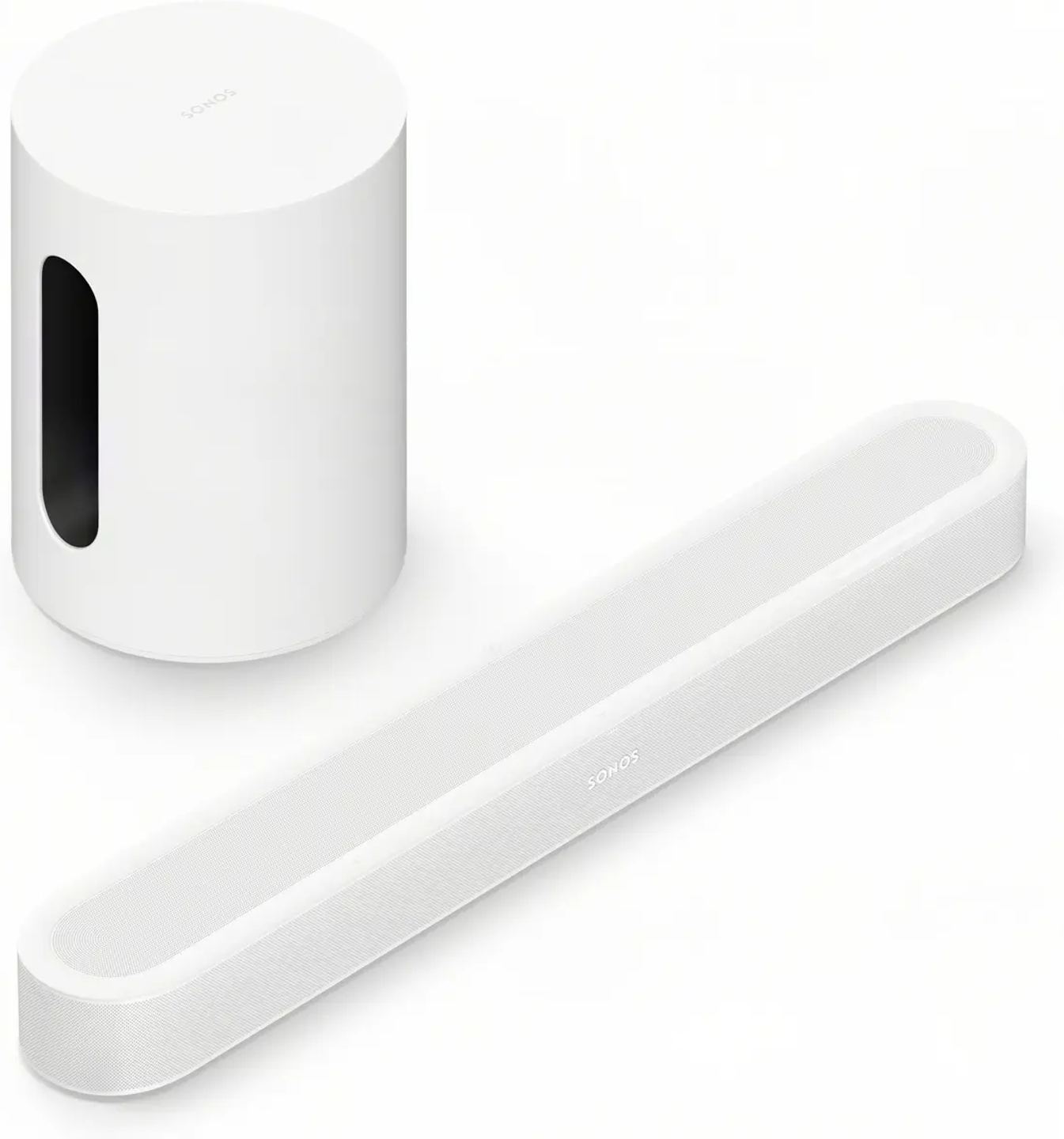
Sonos Beam Ultra + Sub Mini white Pack






Specifications and features


Overview
Five years after the Beam Gen 2, Sonos is renewing its compact soundbar and replacing simulated height effects with two speakers that genuinely radiate toward the ceiling. Paired with the Sub Mini subwoofer, it forms a home theater setup that fits beneath most TVs, with bass reaching where a standalone soundbar runs out of steam. Setup is handled through the Sonos app, while the TV remote remains in control.
Nine speakers, two aimed at the ceiling
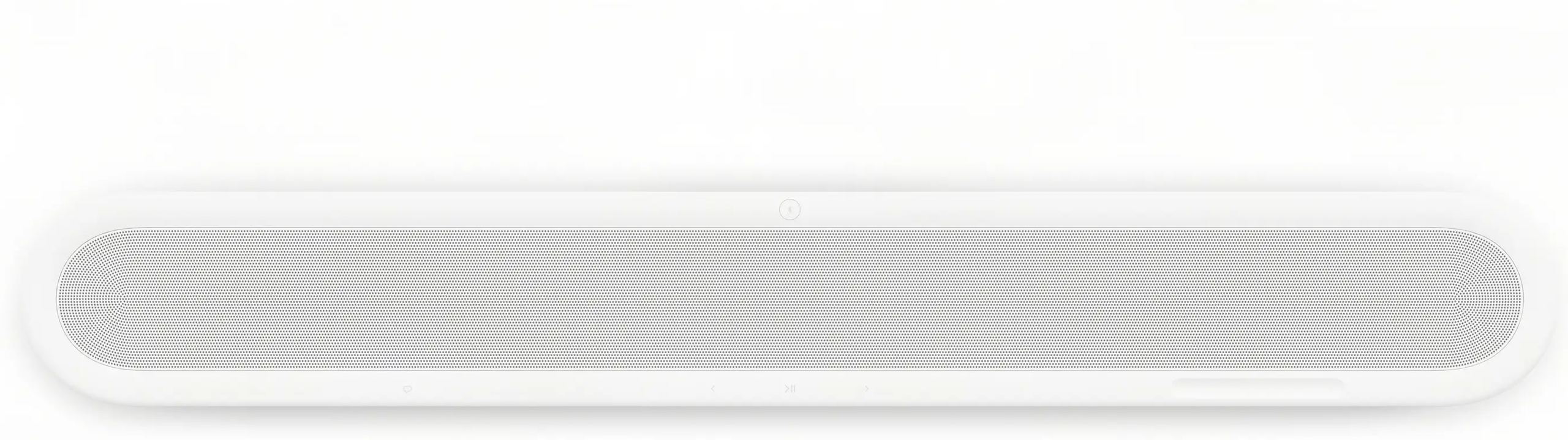
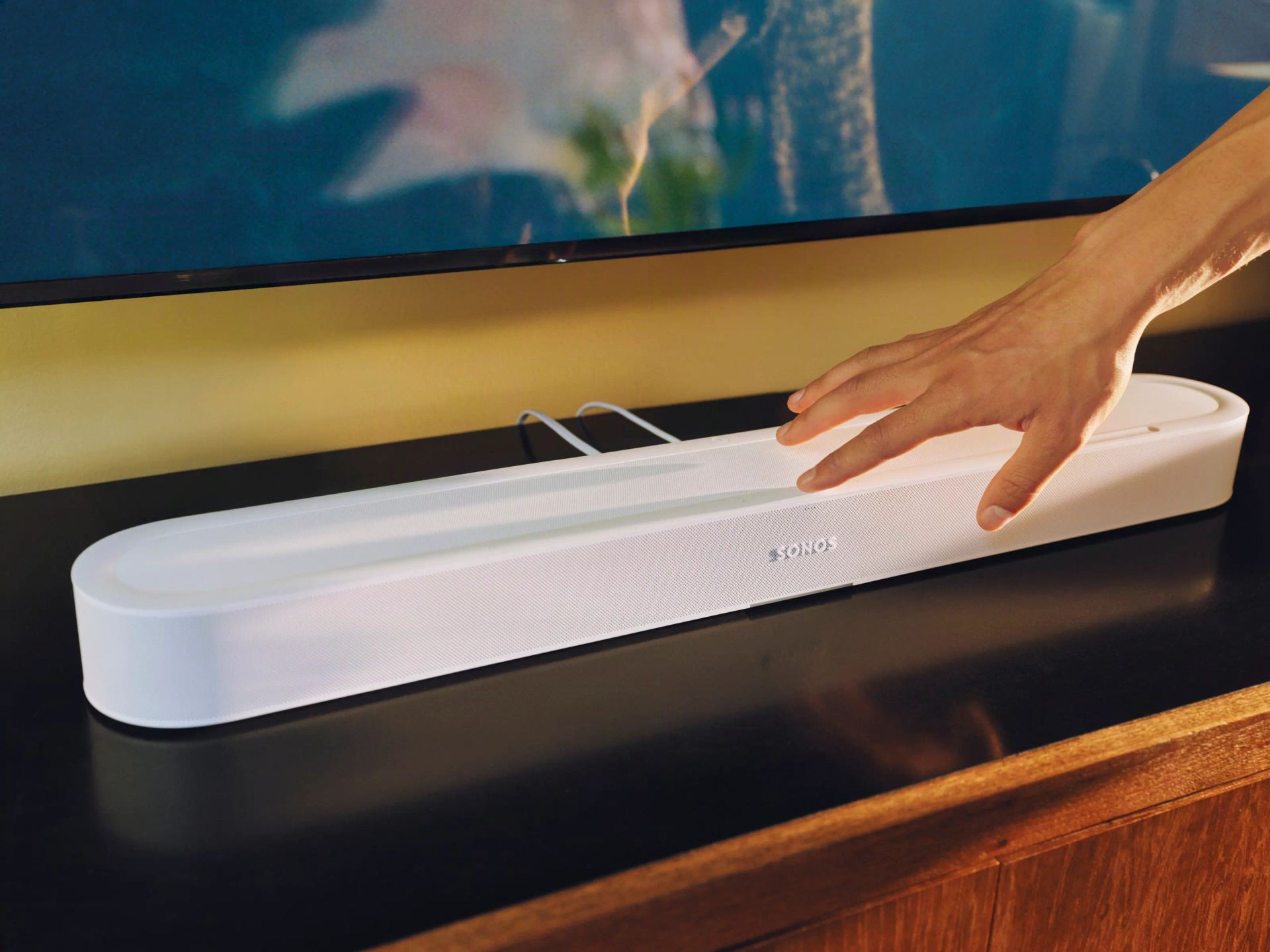
The Beam Gen 2 operated in 5.0 and created its height effects through signal processing, without any speaker aimed at the ceiling. The Beam Ultra moves to nine Class D amplifiers and a 7.1.2 configuration: five tweeters and four low-profile woofers. The center tweeter, aimed forward, maintains the center image and dialogue. Two horn-loaded side tweeters widen the stereo soundstage to the sides. The final two point upward, housed in a directional horn, and reflect Dolby Atmos sound off the ceiling.
That is the difference from the previous generation: height no longer comes from calculation, but from drivers that actually play upward. Digital processing and acoustic projection are still at work, as with any all-in-one soundbar, but height now rests on a physical foundation. To accommodate these nine speakers, the enclosure has been extended by around ten centimeters compared with the Beam Gen 2, measuring 75 cm wide, 6.5 cm high and 10.5 cm deep: it remains slim enough to fit beneath a TV.
A compact subwoofer reaching down to 25 Hz
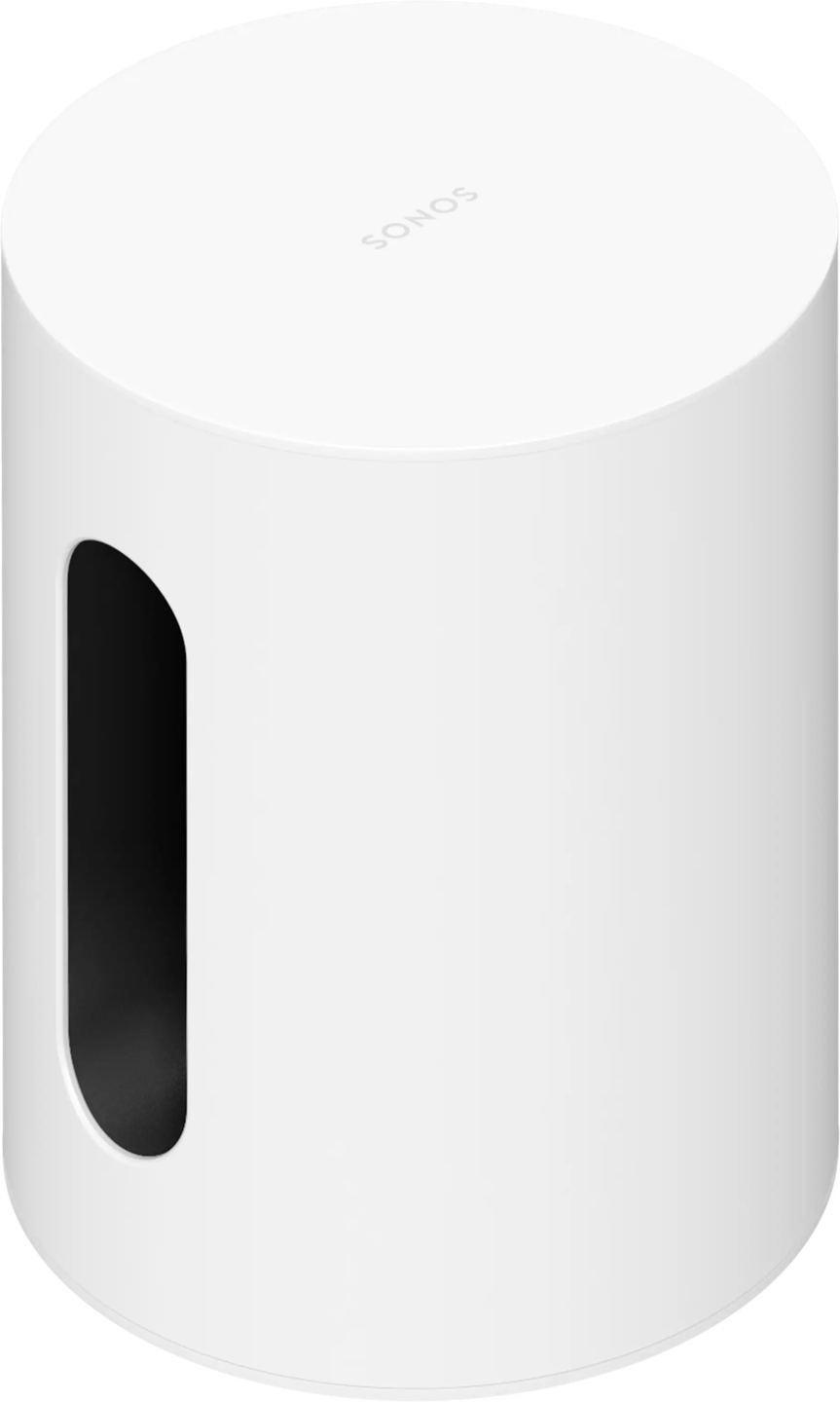
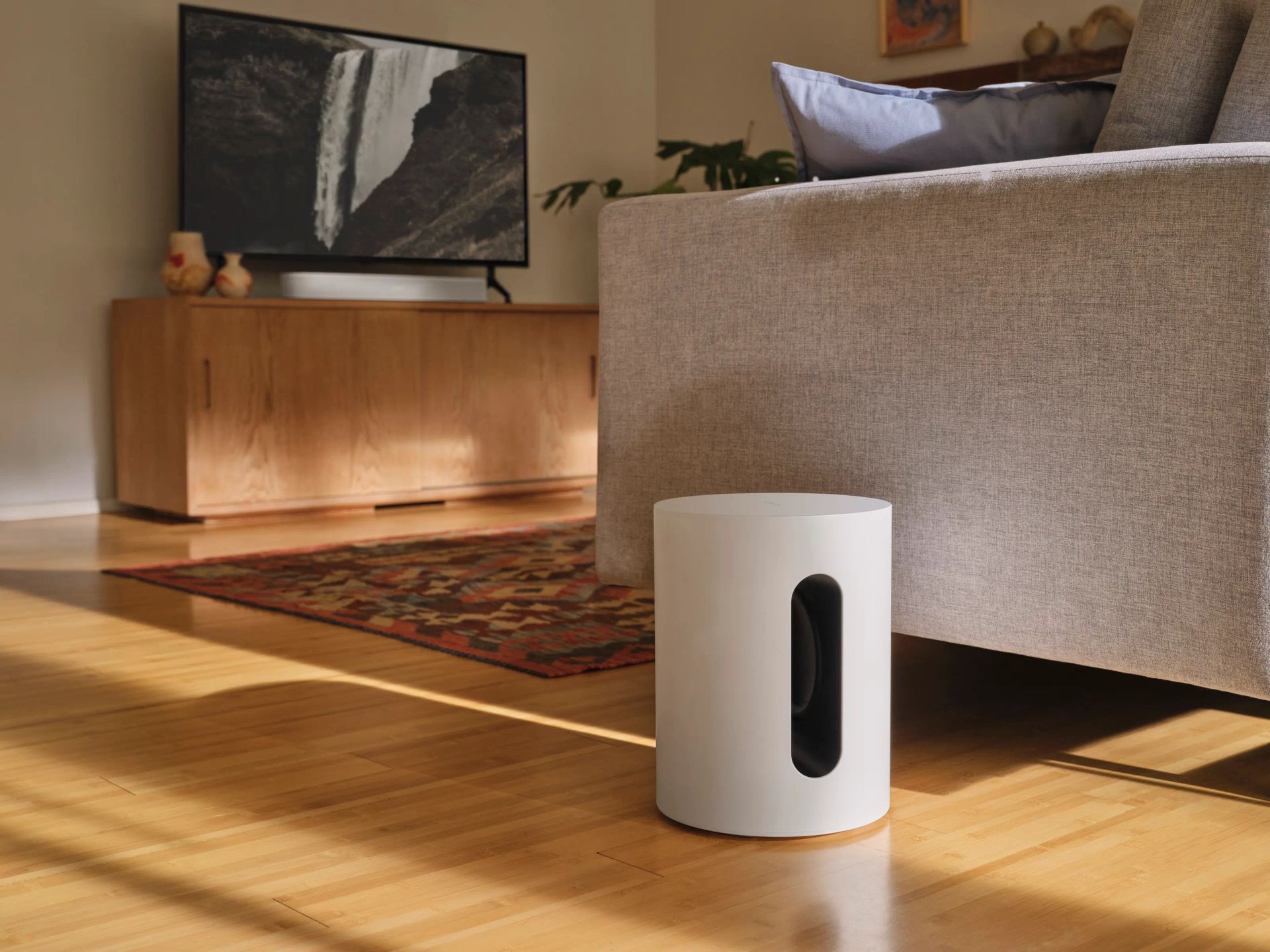
The soundbar’s four woofers already cover standard bass, but stop before the lowest frequencies. The Sub Mini takes over. In its sealed cylindrical enclosure, two 15 cm woofers face each other and operate in opposition: their movements cancel each other out, reducing subwoofer vibration and distortion. Each woofer has its own Class D amplifier. The result extends down to 25 Hz, the same low-end limit as Sonos’s larger subwoofer.
The connection to the soundbar is wireless, over the Wi-Fi network, with a 5 GHz band that keeps bass synchronized with the picture. As soon as they are paired, the system automatically sets the crossover frequency between the soundbar and subwoofer and rebalances the whole setup: the soundbar woofers are relieved of the bottom end, which is assigned to the Sub Mini. Trueplay calibration then adjusts the bass to the room acoustics and accommodates placement near a wall (an iOS device is required for this measurement). The cylinder measures 30.5 cm high and 23 cm across, and weighs 6.35 kg; its central tunnel can face in any direction. This compact size is intended for small to medium-sized rooms and moderate listening levels.
Clear dialogue even in action scenes
The center channel has been redesigned, with a new waveguide and a processor dedicated to voice processing. The dialogue enhancement function identifies human voices and separates them from the rest of the soundtrack; four levels can be adjusted in the Sonos app, from a simple boost to a pronounced enhancement when the scene becomes noisy. Night Sound mode reduces volume differences so you can watch a film late without waking the household: explosions are subdued while voices remain audible.
The soundbar also supports Trueplay calibration, available on both iOS and Android, which measures the room and corrects the response according to walls and furnishings. Bass, treble and Loudness settings remain manually accessible in the app.

Connecting to the TV and network
A single HDMI cable connects the soundbar to the TV via the HDMI eARC port, which carries lossless Dolby Atmos streams (Dolby TrueHD) and Dolby Digital Plus tracks. Once connected, the soundbar responds to the TV remote, with no accessory required. Wi-Fi is used for the Sonos network and online playback; Bluetooth receives sound directly from a phone, while AirPlay 2 connects it to the Apple ecosystem.
For controls, touch buttons on the top complement voice control: an array of long-range microphones with beamforming and echo cancellation picks up commands from a distance, and a physical switch turns these microphones off. The soundbar can also send TV audio to Sonos headphones, useful for listening late without disturbing others. In terms of formats, it supports Dolby Atmos, Dolby Digital, Dolby Digital Plus, Dolby TrueHD, stereo and multichannel PCM, and DTS Digital Surround: it therefore handles DTS 5.1 from discs and certain streams, but not object-based DTS:X, which is absent from the list.
Rear speakers, including portable ones
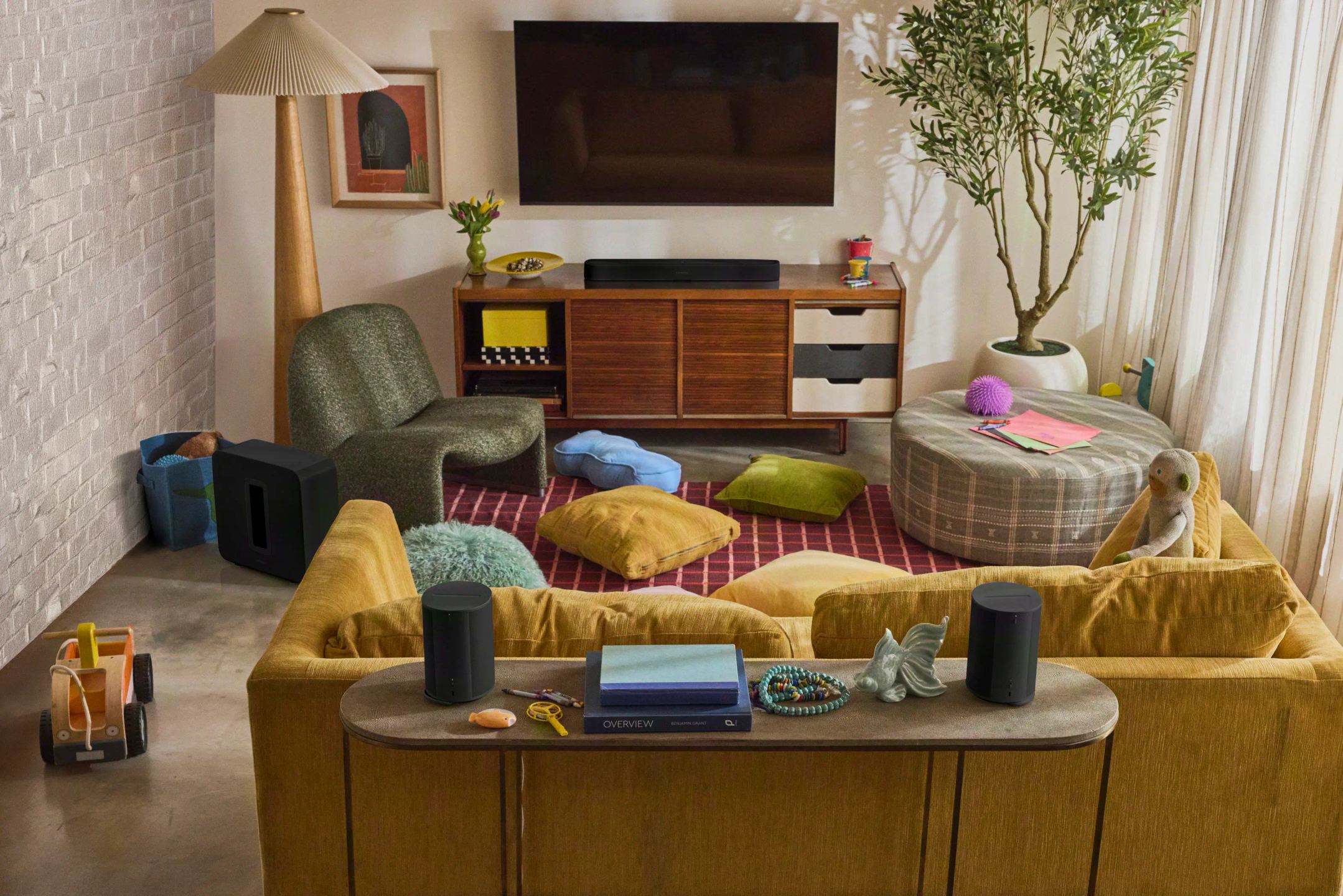
The soundbar and Sub Mini duo already covers the front channels and bass of a home theater system. For true surround sound, the soundbar supports a pair of wireless rear speakers: Sonos speakers placed behind the sofa handle the surround channels. New to this generation, compatible portable Sonos speakers, such as the Move 2, can serve as rear speakers once placed behind listeners, then be moved elsewhere in the house. This allows you to build toward a complete system without running cables to the back of the room, and they can be added at any time through the app.
The same setup also serves multi-room music: Sonos speakers play in unison or by zone depending on the rooms. The soundbar runs on Sonos 27, the operating system that accompanies this range.
Beam Ultra Soundbar
Technical specifications
Audio and amplification
- Amplification: 9 Class D digital amplifiers
- Speakers: 5 tweeters and 4 low-profile woofers
- Audio configuration: 7.1.2 channels
- Simulated overhead sound: optimization of vertical effects according to installation
Audio formats and technologies
- Spatial audio: Dolby Atmos
- Spatial music: Dolby Atmos Music
- Compatible home theater formats: Dolby Atmos, Dolby Digital, Dolby Digital Plus, Dolby TrueHD, stereo PCM, multichannel PCM, DTS Digital Surround
Sound processing
- Equalization: bass and treble adjustment, and Loudness function
- Acoustic calibration: Trueplay, compatible with iOS and Android
- Dialogue enhancement: AI processing with 4 adjustment levels
- Night Sound mode
Connectivity
- HDMI eARC
- Wi-Fi
- Bluetooth
- Apple AirPlay 2
- Compatible with the TV remote control
- TV audio streaming to Sonos headphones
Controls and microphones
- Touch controls
- Voice controls
- Far-field microphone array
- Beamforming and multichannel echo cancellation
- Physical microphone disablement
Expandability
- Can be expanded into a home theater system with a subwoofer and surround speakers
Dimensions
- Width: 75 cm
- Height: 6.5 cm
- Depth: 10.5 cm
Box contents
- Sonos Beam Ultra
- Power cable
- HDMI cable
- Setup guide
- Legal and warranty documentation
Sub Mini
Technical specifications
Audio and performance
- Amplification: 2 Class D digital amplifiers, tuned for optimal sound
- Woofers: 2 15 cm woofers, positioned face-to-face to reduce vibrations
- Design: sealed enclosure to limit distortion and enhance bass
- Frequency response: extends down to 25 Hz for deep bass
Audio features
- Automatic equalization
- Manual adjustments: bass and treble adjustment, and Loudness function via the Sonos app
- Trueplay: sound optimization according to room acoustics (iOS required)
Physical characteristics
- Dimensions: 305 x 230 x 230 mm
- Weight: 6.35 kg
Connectivity
- Wi-Fi: compatible with 2.4 / 5 GHz (802.11 a / b / g / n)
- Ethernet: 10 / 100 port for wired connection
Power and environment
- Voltage: 100-240 V, 50 / 60 Hz
- Operating temperature: 0 to 40 °C
Box contents
- Sonos Sub Mini
- Power cable (2 m)
- Quick start guide
- Legal notices and warranty
Frequently Asked Questions
Does the Beam Ultra work on its own, without the Sub Mini?
Yes. The soundbar plays TV audio and music on its own, using its nine speakers. In this package, the Sub Mini reinforces the deepest bass, below the frequencies the soundbar’s woofers can reach on their own. The subwoofer pairs with the soundbar in the app and adjusts automatically once recognized.
Can the Sub Mini be used with other Sonos devices?
Yes. In addition to the Beam Ultra, the Sub Mini pairs with other Sonos soundbars such as the Ray or Arc Ultra, and it can also support a pair of compact Sonos speakers for music listening. It connects to only one product at a time: to move it from one system to another, you need to pair it again in the app.
What is the difference between the Sub Mini and the larger Sonos Sub?
The Sub Mini is more compact and suited to small to medium-sized rooms and moderate volumes. Both extend down to 25 Hz, but the larger subwoofer moves more air, handles higher levels, and is better suited to large rooms. Here, the Sub Mini complements a compact soundbar, with a consistent size match.
How do I connect a music source or an external player?
The soundbar connects to the TV via the HDMI eARC port: sound from devices connected to the TV, such as a Blu-ray player or a console, is transmitted through this cable. Music is played via the network (online services and local network files), AirPlay 2 or Bluetooth. The soundbar has no analog input: a wired source, such as a turntable, should instead be connected to the TV or another component in the system.
Where should the soundbar and subwoofer be placed, and can the soundbar be wall-mounted?
The soundbar is 75 cm wide: you need a piece of furniture or a recess at least this wide, and a centered position beneath the screen provides the best soundstage. It can be placed flat or wall-mounted using the Beam Ultra wall mount, sold separately. The Sub Mini sits on the floor near the soundbar, with its cylindrical shape fitting against a piece of furniture or in a corner.
Is Bluetooth used to listen to music?
Yes. In addition to the Wi‑Fi network, the soundbar receives music via Bluetooth from a phone or tablet, which is convenient for a guest who is not on the Sonos network. Wi‑Fi remains the preferred option for online services and multi-room playback, while Bluetooth is useful for occasional listening.
- Eco-contribution included in the sale price.