

Sonus Faber Gravis III walnut


Overview
Few subwoofers are ones you want to display rather than hide behind a sofa. Sonus Faber, whose speakers are recognizable by their wood and leather cabinets, applies the same exacting finish to its Gravis III. Beneath this refined surface, a 25 cm long-excursion driver and 600-watt amplification handle a room’s bass, with settings controlled from a dedicated app.
A cube you can leave on display
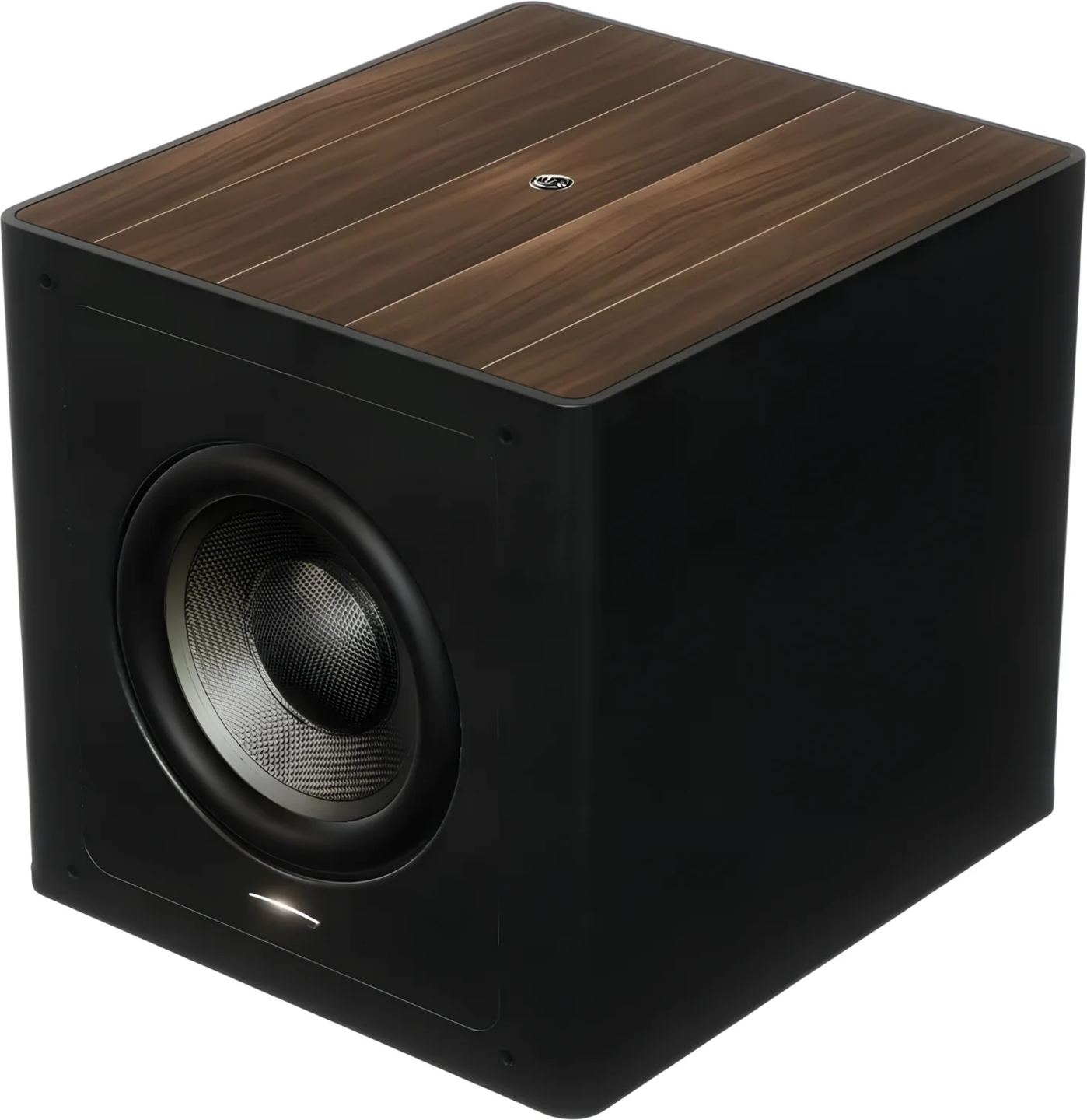
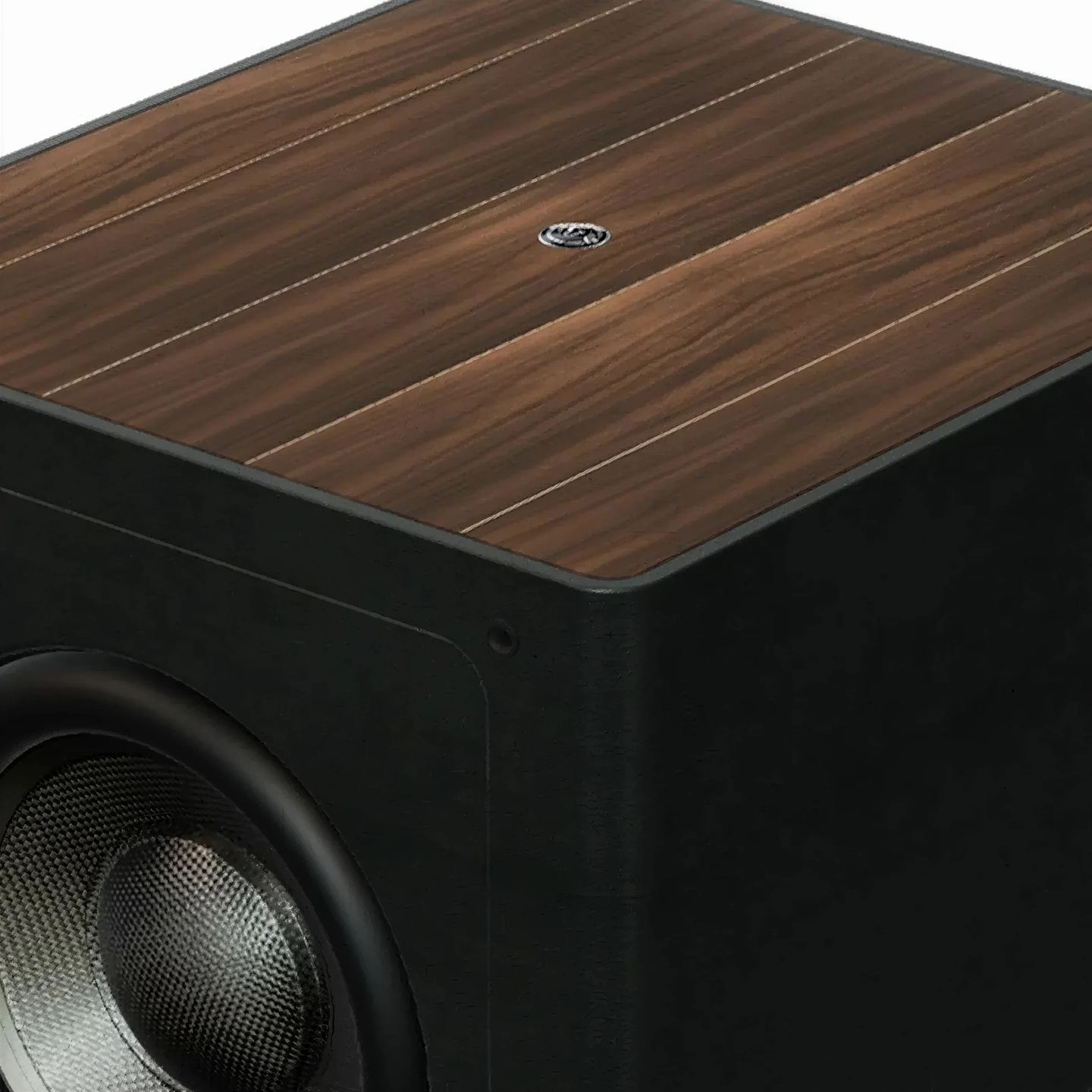
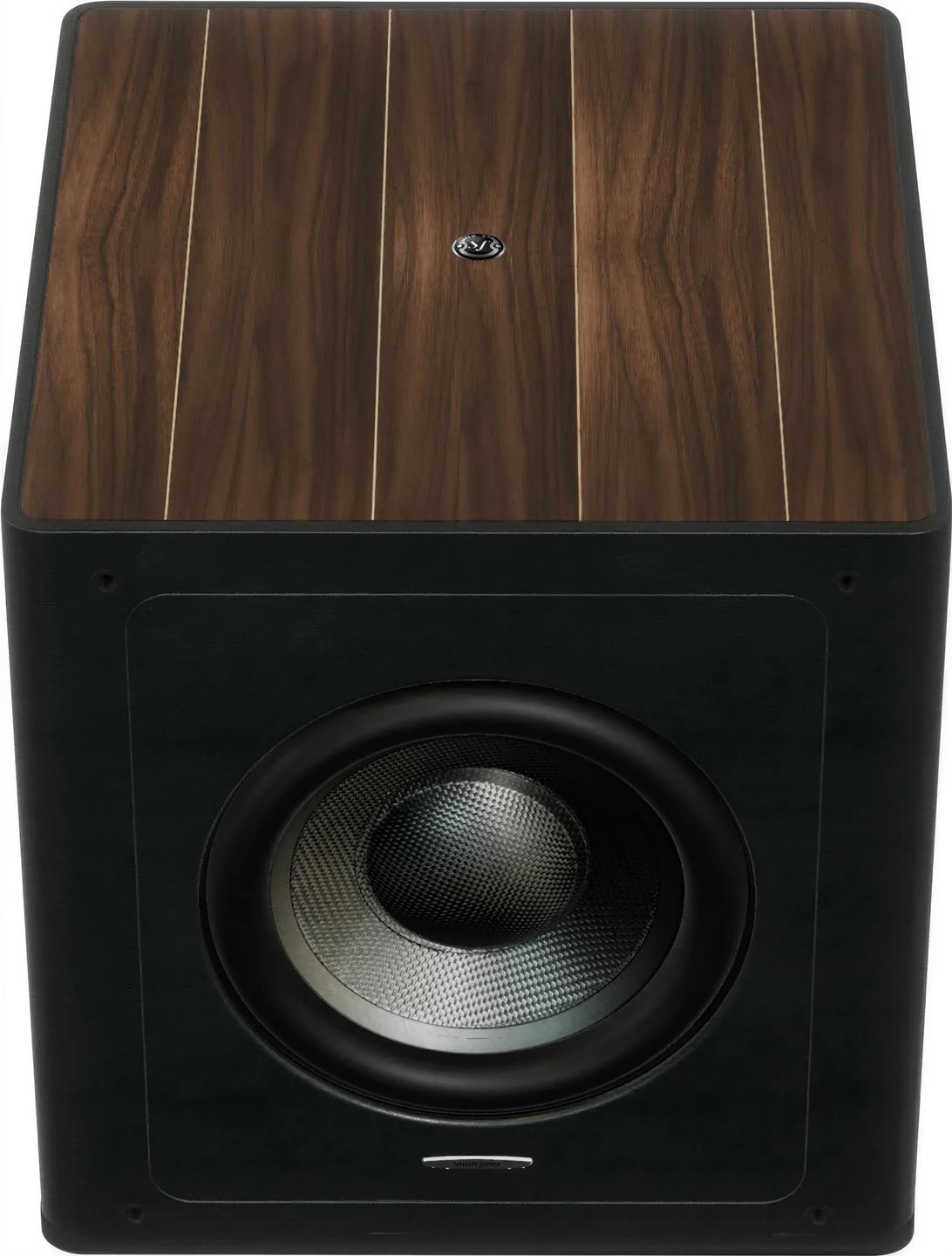
The design starts with a simple cube, whose edges have been softened to eliminate sharp corners. The front panel and sides are covered in black leather, while the top panel is available in matte walnut veneer, matte wenge, or glossy black lacquer. These three finishes match those of the brand’s speaker collections (Lumina, Sonetto, Olympica Nova), so that a subwoofer placed beside a pair of floorstanding speakers visually belongs to the same ensemble. A small round logo on the upper front panel marks the object, while aluminum elements complete the trim.
Compact for a subwoofer of this caliber (41.5 cm high, 40 cm wide, 49.5 cm deep), it nevertheless weighs 26.7 kg, a sign of a dense cabinet with little vibration. Rubber feet isolate it from the floor and limit the transmission of bass into the structure.
A sealed 25 cm driver
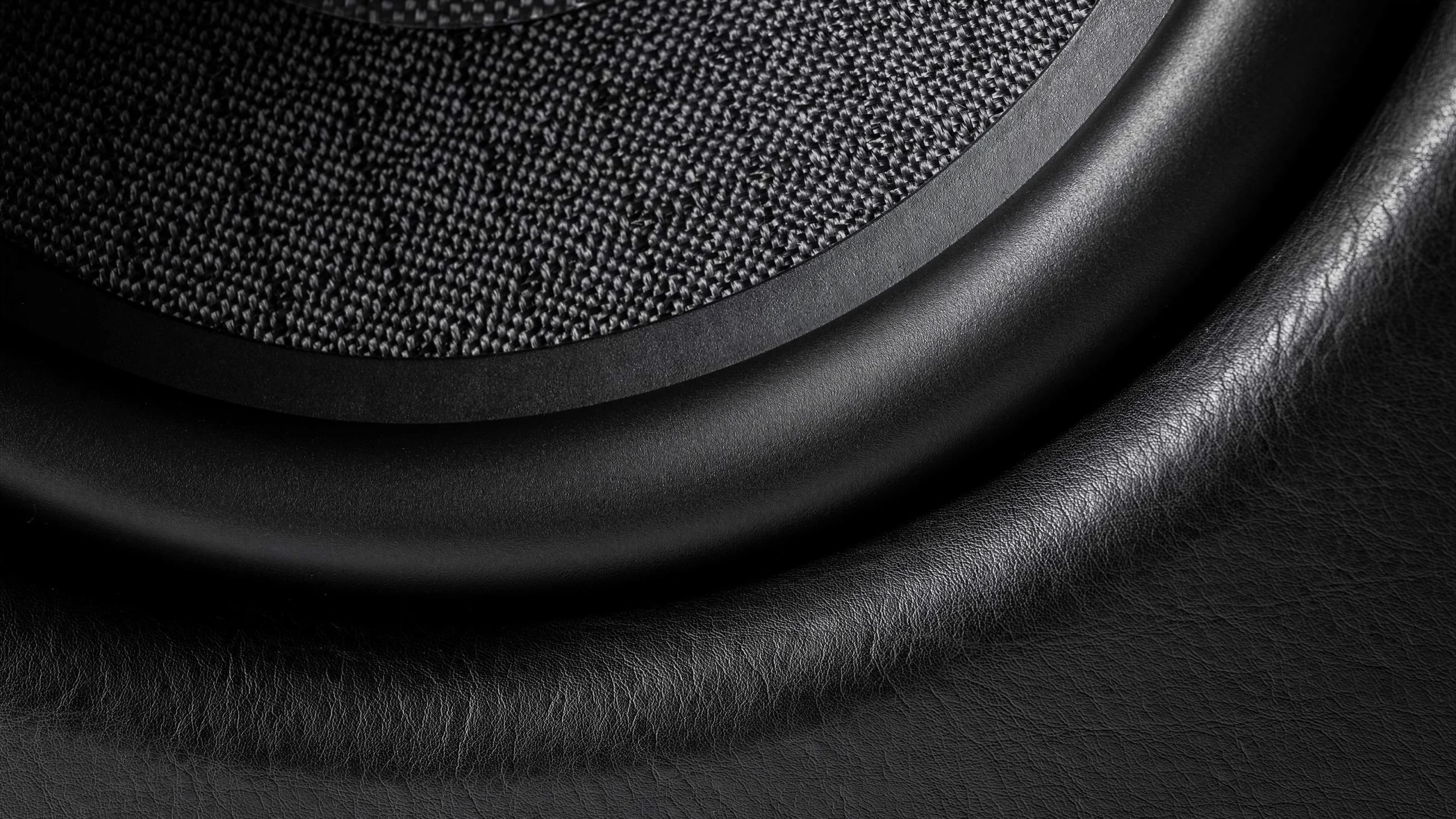
Bass relies on a single 25-centimeter driver. Its cone uses a honeycomb sandwich structure, both rigid and lightweight, which deforms little when it moves air. Its wide rubber surround and long-excursion design allow it to move back and forth over a large range, a requirement for deep bass in a compact cabinet volume.
The cabinet is sealed, with no port. This sealed design generally reaches slightly less low than a ported subwoofer of the same size, but it delivers tighter, better-controlled bass, with better control over cone movement. The Gravis III is rated down to 25 Hz at -6 dB, an extension that covers most of the very low bass in music and film soundtracks.
The built-in Class AB amplification delivers 600 watts continuously and up to 900 watts peak. Acoustic filtering uses a 4th-order Linkwitz-Riley network, with a 24 dB-per-octave slope. The crossover frequency, meaning the point at which the subwoofer takes over from your main speakers, can be continuously adjusted between 40 and 150 Hz: the lower the value, the more your speakers retain control of the lower end of the spectrum.
Everything is adjusted from the app
Control is handled through an in-house app. It begins with automatic room calibration: the subwoofer measures how your living room boosts or dips certain frequencies depending on its position, then corrects these issues. A room always adds its own coloration to bass, and this step largely neutralizes it.
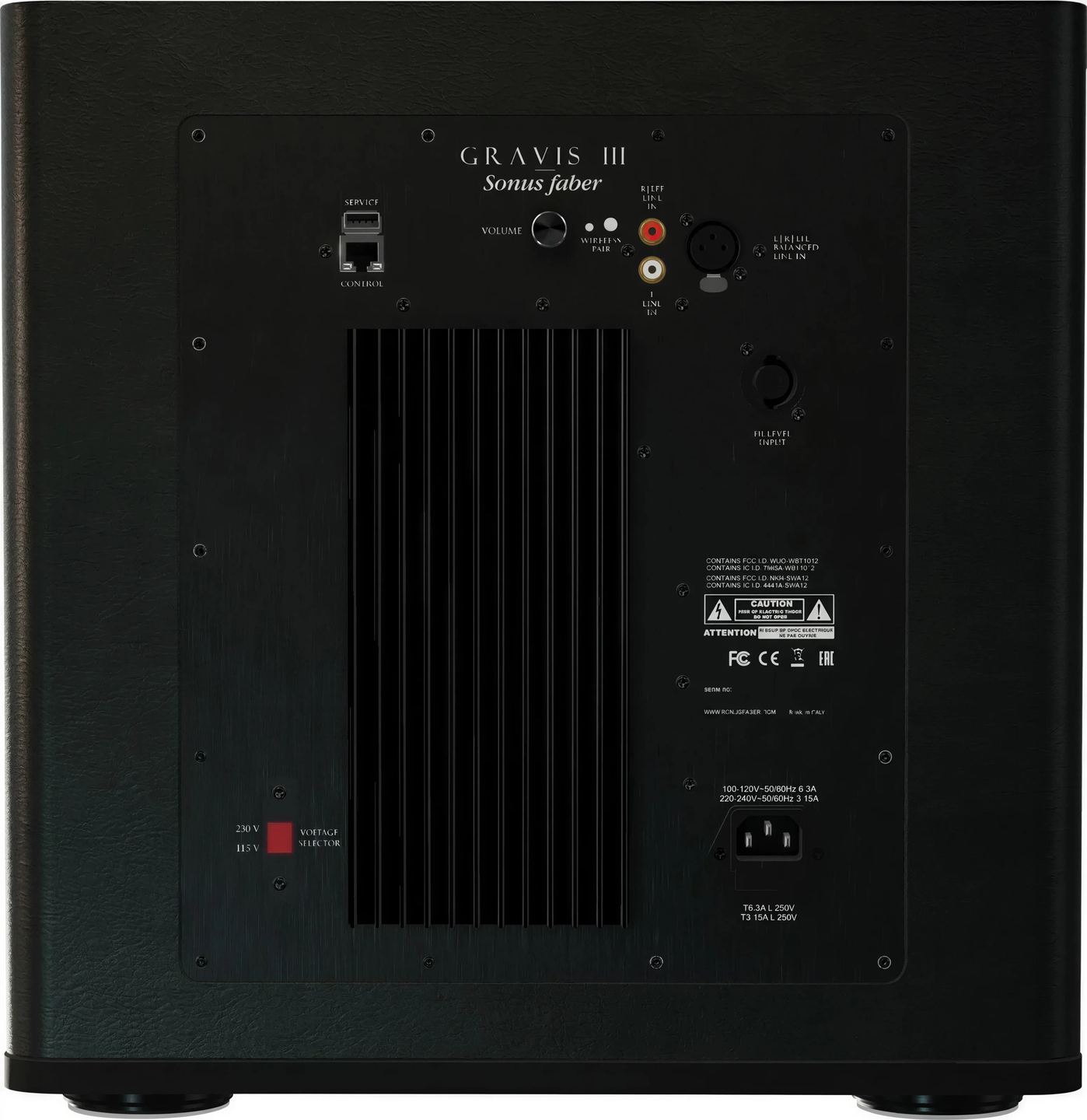
Beyond this automatic correction, four presets allow different configurations to be stored. A parametric equalizer provides up to eight filters for manually adjusting specific areas. The phase setting covers a full rotation (0 to 360°), and delay can be adjusted from 1 to 20 milliseconds, two tools used to time-align the subwoofer with the speakers according to their respective distances from the listener. The main volume remains directly accessible on the unit, without using a phone. An adjustable standby threshold switches off the electronics in the absence of a signal, reducing power consumption to below 2 watts.
Three ways to connect it
Connectivity covers the most common scenarios. Two unbalanced RCA inputs (Left, Right and LFE) receive the signal from a home theater amplifier via its subwoofer output, or from a stereo preamp. A balanced XLR input handles longer cable runs without picking up interference, useful in a large room or an in-wall installation. Finally, a high-level input on a 4-pole Neutrik Speakon connector connects in parallel with the amplifier’s speaker terminals, a practical solution when it does not offer any dedicated subwoofer output.
This flexibility makes the Gravis III equally suitable for a cinema-oriented multichannel system or a two-channel stereo setup, where it extends the bass of floorstanding or bookshelf speakers that lack low-end foundation.
Its place in the Gravis line
Sonus Faber built its first subwoofer, the Gravis FB100, in 1986, before leaving this category aside for a long time. The Gravis collection marks its return to bass, with five models. The III sits in the middle of the range. Alongside the V and VI, it is among the most powerful versions in the line, designed to accompany the brand’s large speaker collections. Its finishes and stature make it primarily suited to the Olympica Nova, but nothing prevents pairing it with a more modest pair, as a well-adjusted subwoofer benefits every type of speaker.
It is sold individually, one subwoofer per box. In a difficult room, installing two in different locations smooths bass distribution and reduces areas where bass is either too prominent or, conversely, absent.
Documentation
Technical specifications
Design
- Type: active subwoofer
- Enclosure: sealed cabinet
- Configuration: 1-way
- Cabinet shape: square
- Decoupling system: rubber feet
Driver
- 1 × 25 cm woofer
- Honeycomb-structure sandwich cone
- Wide rubber surround
- Long-excursion technology
Frequency response
- Frequency range: 25 Hz to Fc (-6 dB)
- 4th-order Linkwitz-Riley acoustic filtering
- Continuously adjustable crossover frequency via the app: 40 to 150 Hz
- Filter slope: 24 dB / octave
Amplification
- Built-in amplification: Class AB
- RMS power: 600 W
- Peak power: 900 W
Settings and signal processing
- Direct master volume control
- 4 presets selectable via the app
- Phase adjustment: 0 to 360°
- Up to 8 parametric equalization filters
- Delay adjustment: 1 to 20 ms
- Automatic room calibration
- Adjustable automatic on / off threshold
- Full control via dedicated app
Connectivity
- 2 × unbalanced RCA line inputs: Left / Right / LFE
- 1 × balanced XLR line input
- 1 × high-level input on 4-pole Neutrik Speakon connector
Power supply
- Supply voltage: 100–120 V AC, 50 / 60 Hz or 220–240 V AC, 50 / 60 Hz
- Voltage selected at the factory
- Standby power consumption: < 2 W
- Rated power consumption: 700 W
- Fuse:
- T6.3 A L250 V for 100–120 V
- T3.15 A L250 V for 220–240 V
Finishes and materials
- Semi-gloss or gloss wooden cabinet
- Black leather covering
- Aluminum elements
Dimensions and weight
- Dimensions (H × W × D): 41.5 × 40 × 49.5 cm
- Packaged dimensions (H × W × D): 54 × 59 × 51 cm
- Weight: 26.7 kg
- Packaged weight: 38 kg
Frequently asked questions
Does the Gravis III need a separate amplifier to operate?
No. It is an active subwoofer: its Class AB amplification is built in. It only needs a mains socket and a cable from your amplifier or preamplifier. No external power amplifier is required.
Is it equally suitable for stereo music and movies?
Yes. Its LFE input connects it to the subwoofer output of a home theater amplifier for movie bass effects. Its Left/Right inputs and high-level input also allow it to complement a two-speaker stereo system, where it adds a solid foundation beneath floorstanding or bookshelf speakers. Its sealed enclosure, precise and well-controlled, is particularly suited to music listening.
Can it be connected to an amplifier without a subwoofer output?
Yes, that is the purpose of the Speakon high-level input. It connects in parallel with the amplifier’s speaker terminals and picks up the signal directly at that level. Many integrated stereo amplifiers without a dedicated subwoofer output are connected this way.
Does automatic calibration eliminate the need for careful placement?
It corrects a lot, but not everything. A subwoofer placed in a corner greatly reinforces the bass, while an isolated subwoofer in the middle of a wall produces less. It is best to first find a suitable position by ear, then run the calibration to fine-tune it. Moving the subwoofer warrants rerunning the measurement, as the room response changes with its position.
What are the phase adjustment and delay used for?
Both adjust when the subwoofer’s bass arrives relative to the sound from the main speakers. If the two sources are not synchronized, the bass may partially cancel out around the crossover frequency, resulting in thin or hollow low end at that point. Phase and delay align the subwoofer according to its distance from the listener, for a seamless blend with the speakers.
Can it be placed near a wall?
A sealed subwoofer, with no port, tolerates being placed near a wall better than a bass-reflex model, whose rear port can generate air noise if it is too close to a partition. Proximity always reinforces bass, but calibration and the built-in equalizer can compensate for this excess.
Is one Gravis III enough, or should you plan for two?
A single subwoofer is suitable for most medium-sized living rooms. In a large room, or when bass response is very uneven from one listening position to another, two subwoofers placed in different locations distribute bass more evenly and reduce level variations depending on the position in the room.
- Eco-contribution included in the sale price.


