

Sonus Faber Gravis VI walnut


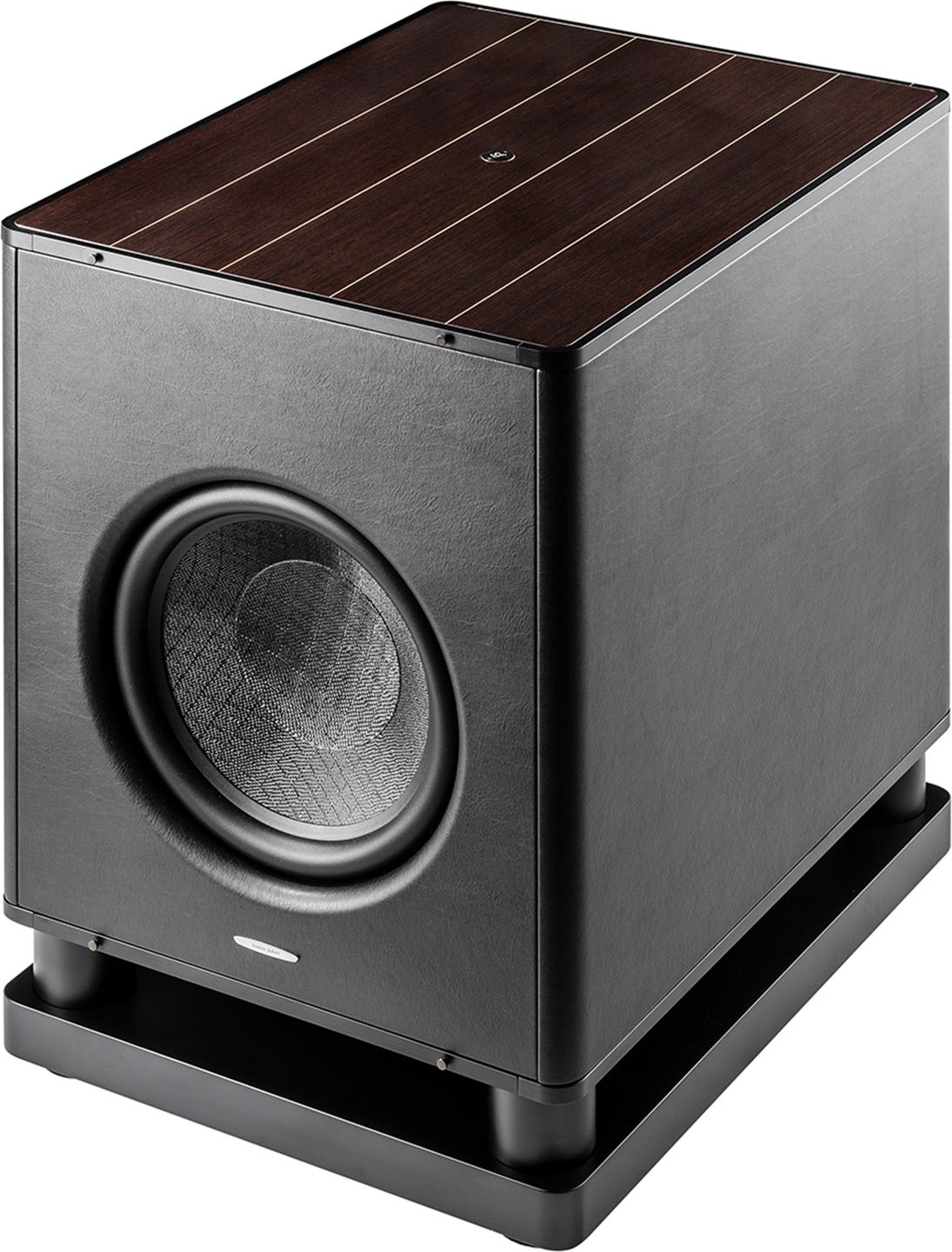
Sonus Faber Gravis VI, the sealed subwoofer from the Reference collection
Reaching down to 18 Hz without the bass becoming bloated is the goal of the flagship Gravis subwoofer range. Sonus Faber has been working on the subject for a long time: its first subwoofer, the Gravis FB100, dates back to 1986. The Gravis VI extends this expertise to complement speakers from the Reference collection, with two 320 mm drivers in a sealed enclosure and 1700 watts of continuous amplification.
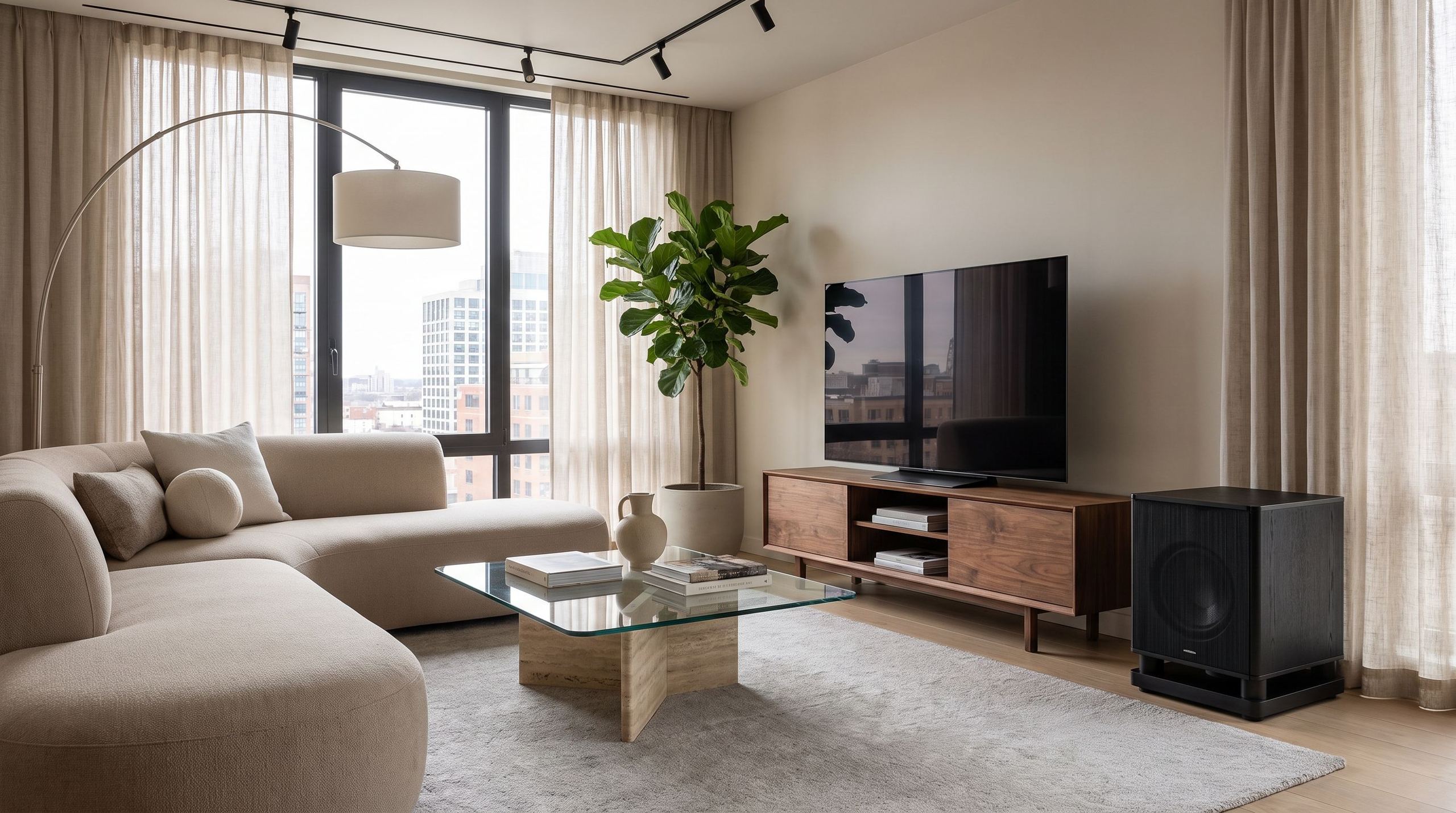
Two 320 mm drivers in a sealed enclosure
The Gravis VI’s acoustic foundation is based on two 320 mm (12-inch) long-excursion drivers, fitted into an airtight cabinet. This sealed-enclosure design, rather than a ported bass-reflex tuning, prioritizes bass control and transient precision: the subwoofer releases less unwanted energy and follows the rapid attacks of a double bass or a soundtrack explosion more accurately. In return, a sealed enclosure reaches slightly less deep than a similarly sized vented cabinet, a compromise Sonus Faber offsets with the radiating area of two large drivers and the available power.
Each diaphragm is a three-layer sandwich cone: two layers of woven synthetic fibers surround a Nomex honeycomb core. This structure remains rigid without weighing down the moving assembly, allowing it both to move a great deal of air and retain control of movement. The wide rubber surround allows the large excursions required for the very lowest frequencies.
By default, response extends down to 18 Hz at the -6 dB point, with a fourth-order Linkwitz low-cut slope. The Gravis VI therefore reproduces the infrabass that most floorstanding speakers leave aside, while the upper limit (the crossover frequency) remains adjustable according to the speakers with which it is paired.
1700-watt Class AB amplification
The built-in amplification operates in Class AB and delivers 1700 watts RMS, with peaks of 2400 watts. Class AB is not the most common choice for active subwoofers, where Class D dominates due to its efficiency: Sonus Faber instead favors linearity and a certain warmth in the bass here, even if it means dissipating more heat. The power reserve is especially useful in large rooms and during dynamic peaks, when two 320 mm drivers demand current without weakening.
Fine adjustment from the app
All setup is handled through a dedicated app, available for iOS and Android. It allows continuous adjustment of the crossover frequency between 40 and 150 Hz, with a 24 dB-per-octave slope, to define the precise point at which the Gravis VI takes over from the speakers. Phase can be adjusted across a full 360 degrees, enough to align the subwoofer with the main speakers even in challenging configurations.
The app also provides access to adjustable delay from 1 to 20 milliseconds, useful for synchronizing bass with the rest of the system or with a second subwoofer, as well as a parametric equalizer offering up to eight filters. These filters, combined with automatic room calibration, correct the peaks and dips that the room inevitably imposes on bass, where an unadjusted subwoofer begins to boom on certain notes. Four presets store different uses, and the main volume remains directly accessible on the subwoofer.
Three inputs for all systems
The Gravis VI accepts three types of connection. The two unbalanced RCA inputs receive a line-level signal, left and right channels or an LFE channel, as supplied by a home theater processor. The two balanced XLR inputs are suitable for long cable runs and high-end preamps, where balanced operation limits interference pickup. The high-level input, on a four-pole Neutrik Speakon connector, connects directly to the amplifier’s speaker terminals: the subwoofer then receives the same signal as the speakers and retains the amplifier’s sonic signature.
Automatic standby and wake-up, with an adjustable threshold, prevent the electronics from remaining powered on continuously. To avoid using a signal cable, Sonus Faber optionally offers a wireless transmitter, the Gravis Transmitter, compatible with the Gravis III, V and VI.

Square cabinet, leather and lacquered wood
Beneath its finely crafted exterior, the Gravis VI remains an imposing object. The square cabinet is topped with a hand-finished wood or high-gloss lacquer panel, including a red finish with grain oriented at 45 degrees, while the sides are clad in black leather and enhanced with aluminum. The brand has matched the subwoofer’s aesthetics to those of the speakers in the Reference collection, so that it integrates into a system without looking out of place.
The weight speaks for itself: 52 kg per unit, measuring 616 mm high, 448 mm wide and 585 mm deep. This mass contributes to the cabinet’s inertia, so it moves all the less when the drivers push hard. A rubber isolation pad decouples it from the floor. The Gravis VI is sold individually: one is enough to fill a room, but installing two subwoofers distributed in different locations often smooths bass response more effectively.
Technical specifications
System
- Type: dual-driver active subwoofer, sealed enclosure
- Drivers: 2 long-excursion Ø 320 mm woofers, honeycomb sandwich cone, wide rubber surround
Acoustic performance
- Frequency response: 18 Hz to Fc (continuously adjustable by the user), at −6 dB, 4th-order Linkwitz acoustic filter, default setting
Amplification
- Built-in amplifiers: high-performance Class AB
- RMS power: 1700 W
- Peak power: 2400 W
Power supply
- AC input voltage: 100 – 120 Vac – 50 / 60 Hz or 220 – 240 Vac – 50 / 60 Hz, factory selected
- Power consumption:
- Standby: < 2 W
- Rated power: 2100 W
- Fuse:
- T12A H250V (100 – 120 Vac – 50 / 60 Hz)
- T6.3A H250V (220 – 240 Vac – 50 / 60 Hz)
Connectivity
- 2 unbalanced line inputs (LINE), left and right / LFE channels, RCA connectors
- 2 balanced line inputs (LINE), XLR connectors
- 1 high-level input (HIGH LEVEL), Neutrik Speakon© 4-pole connector
Controls and operation
- Direct access to main volume (Master)
- Control via dedicated app:
- 4 selectable presets
- Volume adjustment
- Continuously adjustable crossover frequency from 40 to 150 Hz, 24 dB / oct filter slope
- Continuously adjustable signal phase from 0° to 360°
- Up to 8 parametric equalization filters
- Adjustable delay from 1 to 20 ms
- Automatic room calibration
- Automatic power on / off with selectable threshold
Cabinet and finishes
- Square-shaped cabinet
- High-gloss lacquered wood
- Black leather
- Aluminum
Isolation
- Isolation system: rubber pad
Dimensions and weight
- Product dimensions (H x W x D): 616 x 448 x 585 mm per unit
- Packaged dimensions (H x W x D): 810 x 600 x 725 mm per unit
- Net weight: 52 kg per unit
- Packaged weight: 60 kg per unit
Documentation
- User manual
- Quick start guide
- Firmware update
Frequently asked questions
Which speakers does the Gravis VI pair well with?
Sonus Faber matches it to its Reference collection, both sonically and visually, and positions it at the top of the Gravis line. The range includes more compact models for the brand’s other collections, from the Gravis V to the Gravis I and II. However, there is nothing to prevent it from being used with another full-range system, provided the amplification and room are up to the task.
What distinguishes the Gravis VI from the Gravis V?
The Gravis VI reaches lower, down to 18 Hz versus 20 Hz for the Gravis V, and Sonus Faber places it at the very top of the range, tuned to the Reference collection, whereas the Gravis V accompanies the Homage speakers. For a large room or a system already extending very low in the bass, the difference is justified.
Can it be used wirelessly?
Yes, provided you add the Gravis Transmitter, sold separately and compatible with Gravis III, V and VI. It transmits the signal wirelessly between the source and the subwoofer. A wired connection via RCA, XLR or high-level input remains possible at any time.
Do you need an amplifier for a subwoofer?
No. The Gravis VI is an active subwoofer: its amplification is built in. It only needs a line-level or high-level signal, and a mains outlet. The high-level input even allows it to be connected to the speaker terminals of an integrated amplifier, without using a dedicated subwoofer output.
Is the Gravis VI suitable for both home theater and music?
Both uses are covered. The LFE input and presets make integration with a home theater processor easier, while precise phase, delay and equalizer adjustment supports stereo music listening, where blending with the speakers requires finesse.
Where should the subwoofer be placed in the room?
The sealed enclosure tolerates placement close to a wall quite well, and moving the subwoofer closer to a corner reinforces the bass. Whatever location you choose, the automatic calibration and eight parametric filters compensate for much of what the room adds or takes away.
- Eco-contribution included in the sale price.


