

FiiO EA13 silver


Overview
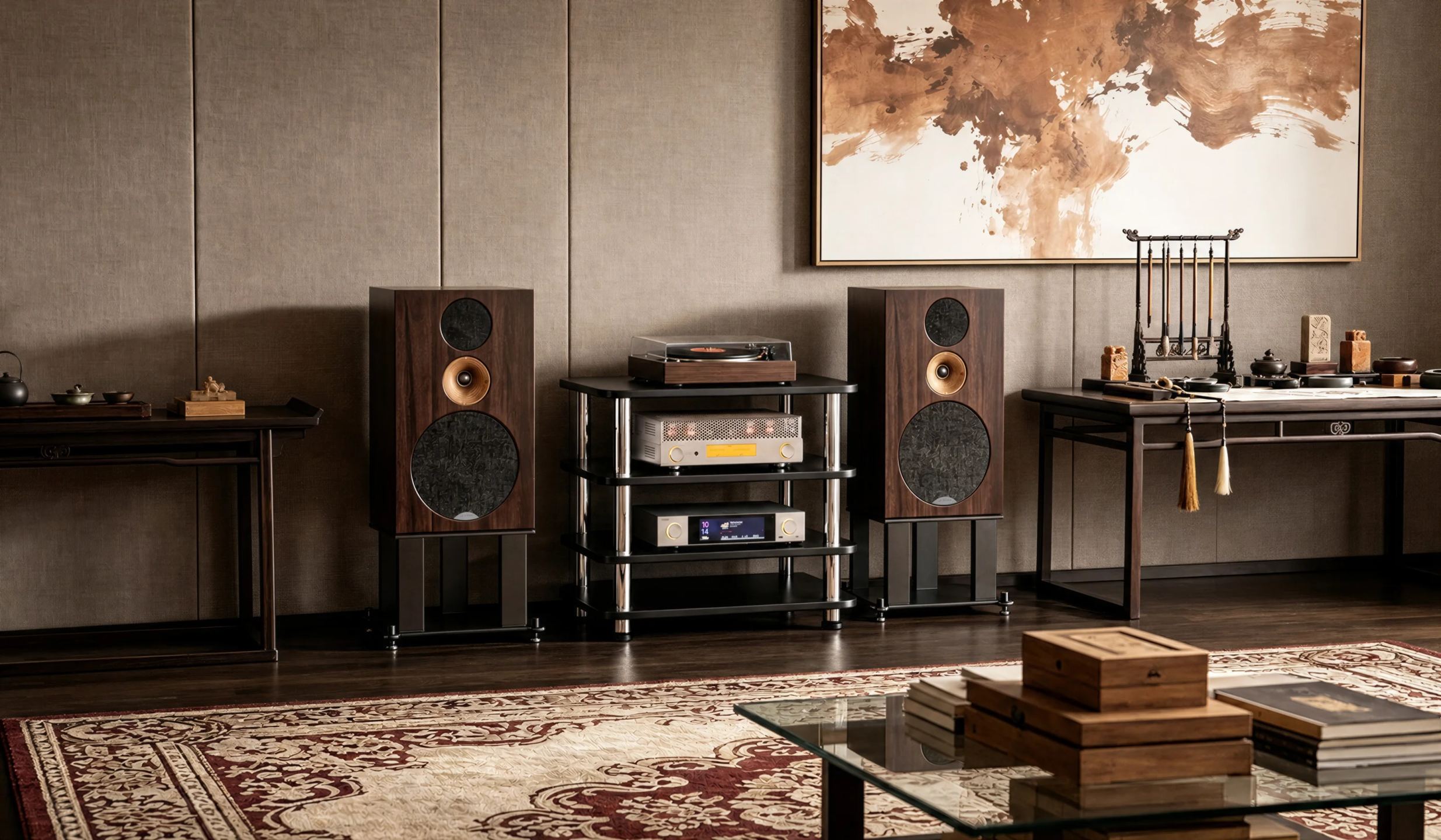
Miniature DACs, digital audio players and in-ear headphones made FiiO’s name. A change of scenery: here is a large all-analogue stereo tube amplifier that revives the recipes of the 1950s. Six tubes, Class A amplification, two needle VU meters and not a single digital processing chip in the signal path. Enough to rediscover tube warmth in a modern living room.
FiiO’s first tube amplifier
After years spent making portable audio and desktop DACs more accessible, FiiO launches its first large-format, fully analogue stereo tube amplifier with the EA13, developed over three years. No hybrid compromise here: the entire signal passes through the tubes.
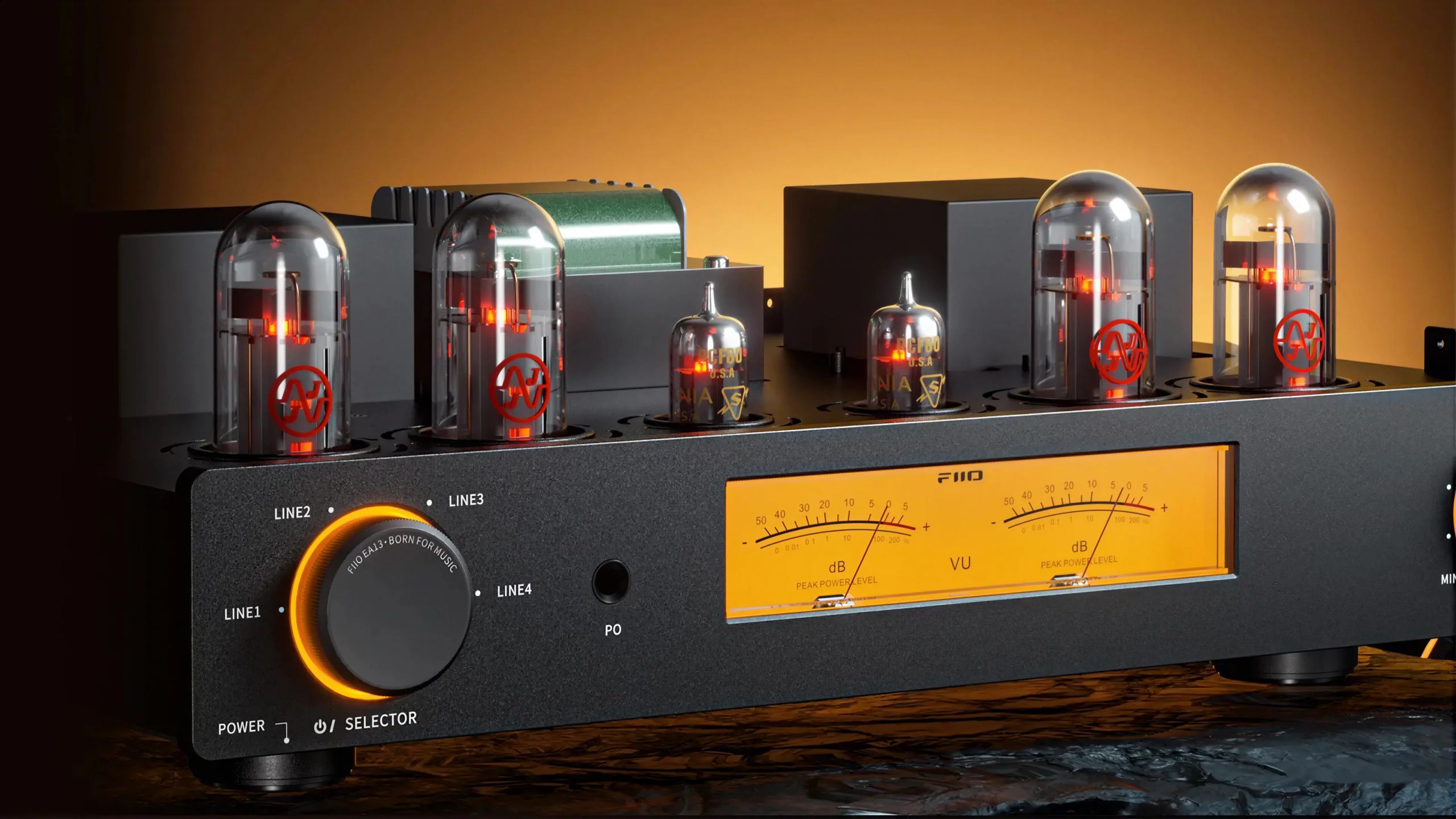
The device features six tubes. Two American-made Sylvania NOS PCF80 tubes handle voltage amplification and input signal driving. Four JJ Electronic EL34 tubes, made in Slovakia, provide the power stage. The EL34 is one of the best-known power tubes in tube audio, valued for its rich midrange and smooth treble. The circuit operates in pentode mode, a way of using the tube that prioritizes available power.
Class A push-pull and in-house transformers
Class A refers to an operating mode in which the tubes conduct the signal continuously, across the entire waveform. It is the most linear setting, the one that gives tube amplifiers their warm, fluid sound, at the expense of high heat output and power consumption. Push-pull distributes the work across two tubes per channel, each reproducing one half of the waveform: efficiency increases and certain distortions cancel each other out.
In terms of power, the EA13 delivers 18 watts per channel into 8 ohms at less than 1% distortion, and up to 28 watts if 5% is tolerated. The realistic listening figure is therefore the clean 18 watts, with the 28 watts being a ceiling rather than a cruising level. The tubes are self-biased: no manual adjustment or multimeter measurement is needed, either at start-up or after replacement.
The output transformer is the component that matches the high impedance of the tubes to the low impedance of the speakers. FiiO designed its own, with an EI silicon-steel core, wide bandwidth and low noise. Each transformer is potted in a mixture of fine sand and epoxy resin inside a sealed enclosure, which dampens mechanical core vibrations and protects it from humidity, for a quieter noise floor.
Line inputs, speakers and headphones
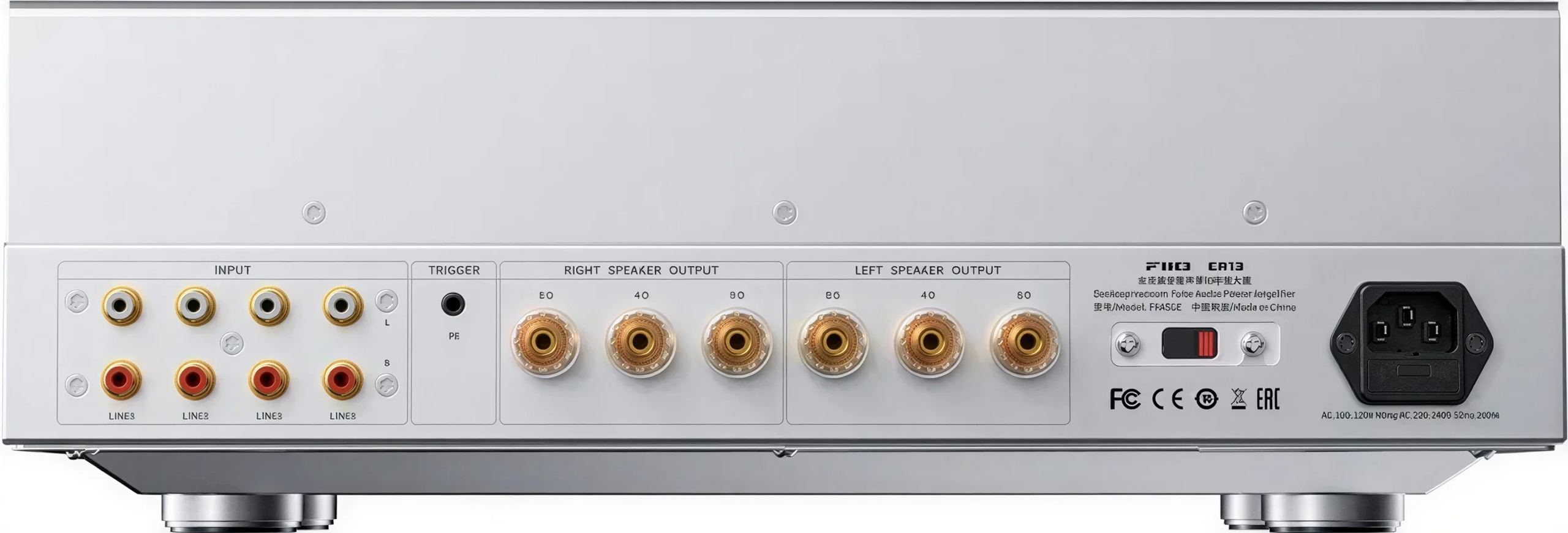
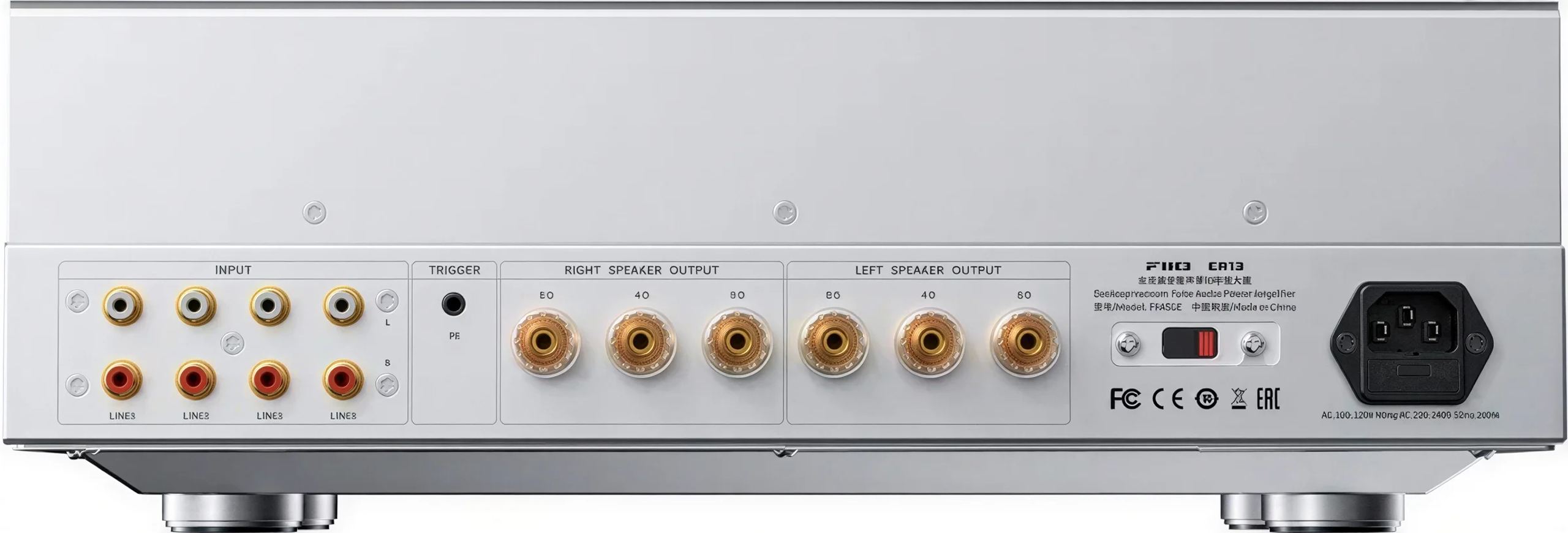
The connectivity gets straight to the point. Four line-level RCA inputs accept a streamer, CD player, DAC or turntable fitted with its phono preamp. There is no built-in DAC, Bluetooth, network player, phono preamp or remote control: the signal remains analogue from start to finish. FiiO presents the EA13 as a power amplifier, but the front-panel volume control and source selector make it, in practice, an integrated amplifier.
Volume is adjusted with the analogue potentiometer, while sources are selected with the four-position selector. A 12 V trigger input (3.5 mm mini-jack) allows the amplifier to turn on and off along with the rest of a system. Speakers connect to gold-plated binding posts, with two separate outputs, one for 8-ohm loads and the other for 4-ohm loads.
A 6.35 mm headphone jack completes the front panel, designed for impedances from 16 to 300 ohms. Its power remains modest, from 30 mW into 16 ohms to 185 mW into 300 ohms, as it is derived from the output transformers. It is a secondary listening option for undemanding headphones, not the device’s main function.
VU meters, lighting and automatic standby
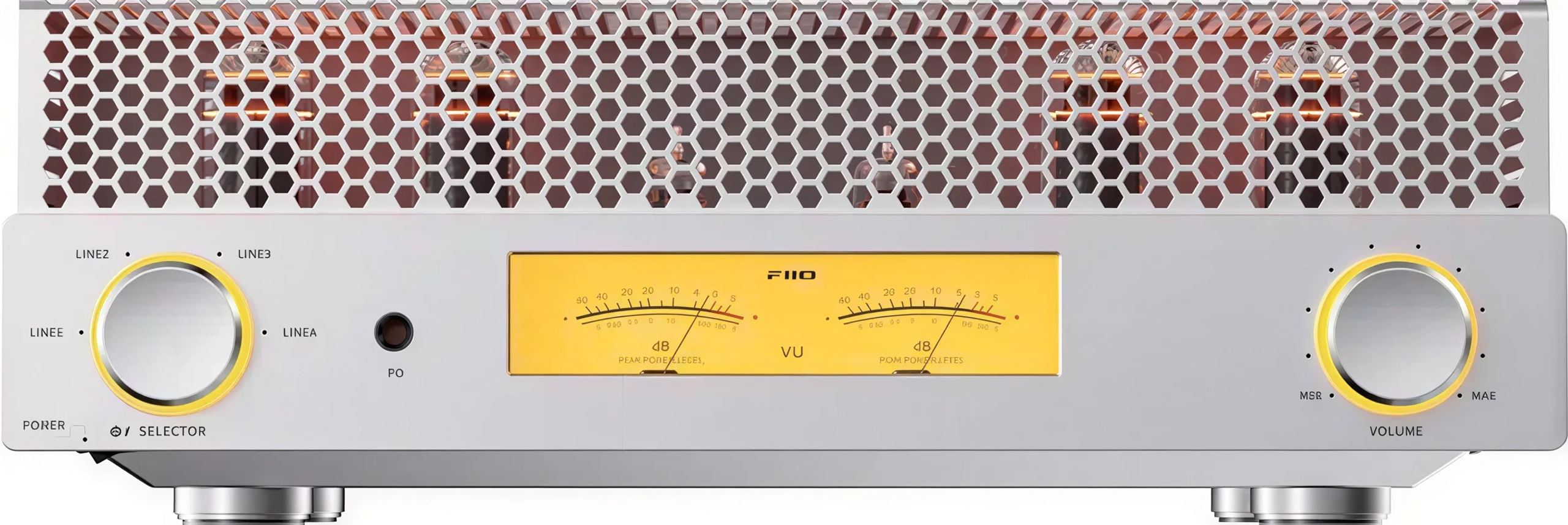
At the centre of the front panel, two mechanical needle VU meters take centre stage. A VU meter (“volume unit”) is a dial that displays the signal level in real time; the two needles follow the music, one per channel, beneath warm LED backlighting controlled by a dedicated circuit.
Around the knobs, RGB lighting can be adjusted in colour and switched off, with a single or double press on the left knob, which also controls standby mode. A detection circuit monitors the selected input: after thirty minutes without a signal, the EA13 automatically enters standby, saving electricity and preserving tube life. The power supplies for the audio section and control electronics are separate, so operation of the VU meters, lighting and standby does not interfere with the signal.
A machined chassis and removable cover
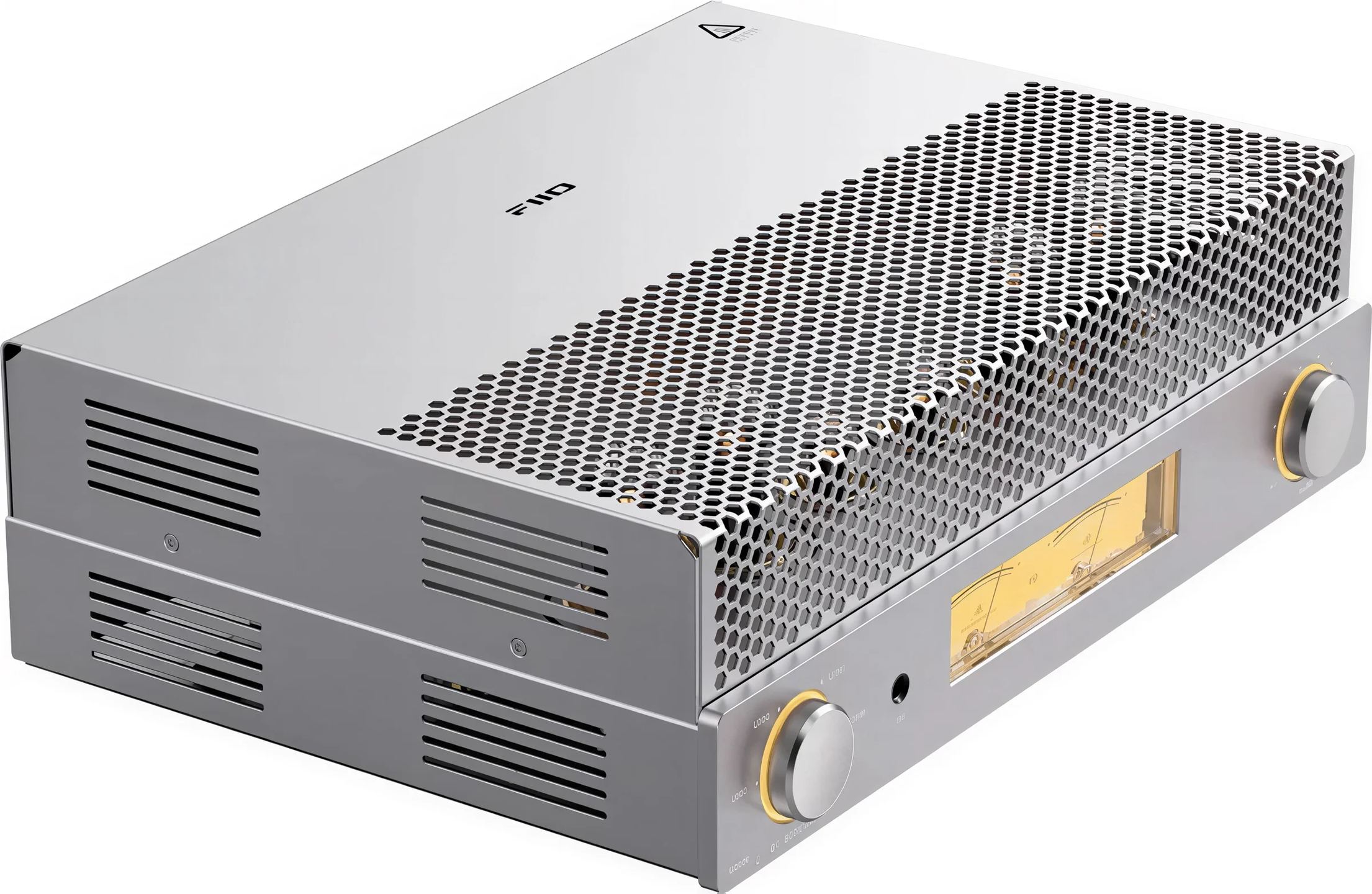
The unit weighs nearly 17.7 kg, most of which comes from the transformers and chassis. The front panel is made of thickened, sandblasted CNC-machined aluminium, mounted on a metal chassis. A perforated honeycomb cover protects the tubes from dust and curious hands; it can be removed using the supplied screwdriver and screws, leaving the tubes exposed to the air or, conversely, keeping them protected.
A 115 / 230 V voltage selector adapts the amplifier to the mains supply. Since Class A runs hot continuously, it is best to leave it plenty of space and airflow, as supported by the perforated cover and automatic standby. Two finishes are available: black and silver.
Technical Specifications
Overview
- Type: integrated tube amplifier
- Operating mode: line input
- Amplification class: Class A, push-pull
- Colors: black / silver
- Dimensions: approximately 430 × 339 × 145 mm
- Weight: approximately 17.7 kg
Tube Configuration
- 6 imported tubes
- 2 × Sylvania NOS PCF80
- 4 × JJ Electronic EL34
Connectivity
- Analog inputs: 4 × RCA
- Speaker outputs: 4 Ω / 8 Ω
- Headphone output: 1 × 6.35 mm jack
- Recommended impedance: 16 to 300 Ω
- Trigger input: 1 × 3.5 mm
Controls and Display
- Volume control: analog potentiometer
- Input selection: 4-position selector (4 sources)
- Display: dual-channel stereo mechanical needle VU meters with LED backlighting
- Adjustable RGB lighting
- Automatic standby after 30 minutes without a signal
Power Supply
- Mains voltage: 100–120 V / 60 Hz or 220–240 V / 50 Hz
- Voltage selector: 115 V / 230 V
- Separate power supply for the digital and analog sections to limit interference
Design and Manufacturing
- Custom EI output transformer, wide bandwidth and low noise
- CNC-machined aluminum chassis with thickened, sandblasted front panel
- Integrated protective cover around the tubes
Audio Performance — Headphone Output
- Output power
- ≥ 30 mW + 30 mW into 16 Ω
- ≥ 60 mW + 60 mW into 32 Ω
- ≥ 185 mW + 185 mW into 300 Ω
- THD+N: < 0.06% (1 kHz / -16.3 dB @ 32 Ω)
- Frequency response: 20 Hz – 20 kHz, attenuation < 0.05 dB
- Extended frequency response: 20 Hz – 65 kHz, attenuation < 2.9 dB
- Signal-to-noise ratio: ≥ 95 dB
- Dynamic range: ≥ 95 dB
- Crosstalk: ≥ 76 dB (1 kHz @ 32 Ω)
- Noise level: < 25 µV (A-weighted)
- Maximum output voltage: 46.2 V peak-to-peak
Audio Performance — Speaker Output
4 Ω Output
- Output power: ≥ 18 W + 18 W into 4 Ω, THD+N < 1%
- Specified maximum power: ≥ 28 W + 28 W into 4 Ω, THD+N < 5%
- Output impedance: < 1.5 Ω
- Crosstalk: ≥ 77 dB (1 kHz @ 4 Ω)
- Signal-to-noise ratio: ≥ 97 dB
- Dynamic range: ≥ 97 dB
- Frequency response: 20 Hz – 20 kHz, attenuation < 0.7 dB
- Extended response: 20 Hz – 60 kHz, attenuation < 2.9 dB
8 Ω Output
- Output power: ≥ 18 W + 18 W into 8 Ω, THD+N < 1%
- Specified maximum power: ≥ 28 W + 28 W into 8 Ω, THD+N < 5%
- Output impedance: < 1.5 Ω
- Crosstalk: ≥ 77 dB (1 kHz @ 8 Ω)
- Signal-to-noise ratio: ≥ 97 dB
- Dynamic range: ≥ 97 dB
- Frequency response: 20 Hz – 20 kHz, attenuation < 0.4 dB
- Extended response: 20 Hz – 70 kHz, attenuation < 2.7 dB
Rated Power
- 2 × 28 W
Box Contents
- FiiO EA13 × 1
- Mains power cord × 1
- Quick start guide × 1
- Screwdriver × 1
- Screws × 2
- Warranty card × 1
Frequently Asked Questions
Can a turntable be connected to the EA13?
Yes, provided you use a phono preamp, either one built into certain turntables or an external model. All four inputs are line level: they expect an already amplified signal. A cartridge connected directly would sound far too quiet.
Should you adjust or replace the tubes yourself?
The tubes are self-biasing: no adjustment or measurement is required, either at start-up or when replacing them. EL34 and PCF80 tubes are widely available and easy to find. Standby mode after thirty minutes limits tube wear when the amplifier is left on without music.
How do you choose between 4- and 8-ohm outputs?
Connect your speakers to the output that matches their nominal impedance, as specified by their manufacturer. These two terminals are two different taps on the output transformer; using the one closest to your speakers’ impedance allows the transformer to operate under good conditions. If you are unsure between two values, try both outputs and keep the one that sounds most balanced.
Does the EA13 come with a remote control?
No. The volume is adjusted using the front-panel potentiometer and the sources using the selector. This is a design choice: less electronics in the signal path, even if it means getting up to adjust the level.
Does it heat up and consume a lot of power?
Class A keeps the tubes operating continuously, even at low volume: the amplifier heats up and draws current as long as it is on. Leave space around and above it for ventilation, and let the automatic standby prevent idle operation.
Can it be connected to a digital source such as a computer, TV or streamer?
Yes, by adding an external converter (DAC) connected to one of the RCA inputs, since the EA13 has no digital stage. The 12 V trigger input allows it to be switched on and off with the rest of the system.
Which speakers are best suited for it?
With around 18 clean watts per channel, the EA13 performs best with reasonably efficient speakers that require little power to play loudly. Less sensitive speakers in a large room will be more demanding. Bookshelf speakers and many floorstanding speakers with decent sensitivity remain well within its capabilities.
- Eco-contribution included in the sale price.




