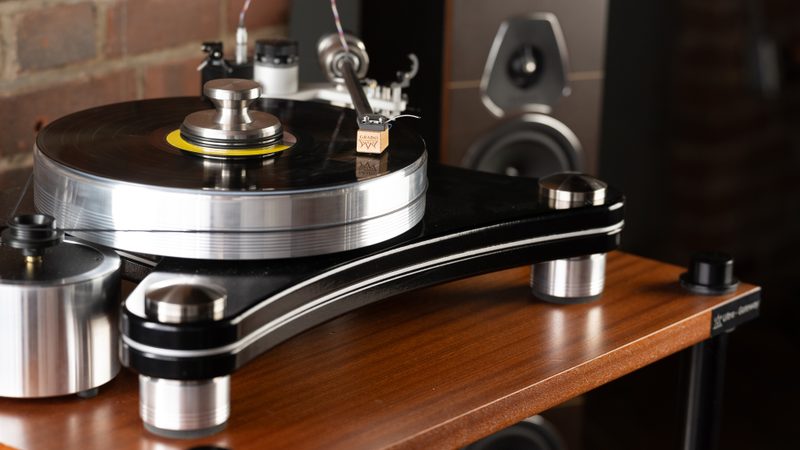
Grado Opus 4 (high-end)

Grado Opus 4 High-output moving iron cartridge from the Timbre series
Vinyl playback happens on an infinitely small scale: it is the cartridge, at the tip of the tonearm, that reads the groove and converts it into an electrical signal. Grado, a family-run company from Brooklyn, approaches this component differently from most manufacturers, using a moving iron principle developed by its founder. The Opus 4 opens the Timbre series, Grado’s wood-bodied cartridge range, and is its most affordable version.
Why Grado relies on moving iron
The vast majority of cartridges fall into two families. In a moving magnet cartridge, a small magnet fixed to the end of the cantilever (the slender arm that carries the stylus) moves in front of stationary coils. In a moving coil cartridge, it is the coils themselves that move, mounted on the cantilever.
Grado took a third route. Its founder, Joseph Grado, had patented the stereo moving coil cartridge before designing the moving iron flux-bridger principle: the coils and magnet remain stationary, and only a tiny piece of iron attached to the cantilever moves within the magnetic field. The moving mass at the tip is therefore very low, helping the stylus faithfully track rapid groove variations without the fragility of a coil assembly suspended from the cantilever. This design also delivers a stronger signal than a conventional moving coil cartridge.
A maple body to control resonance
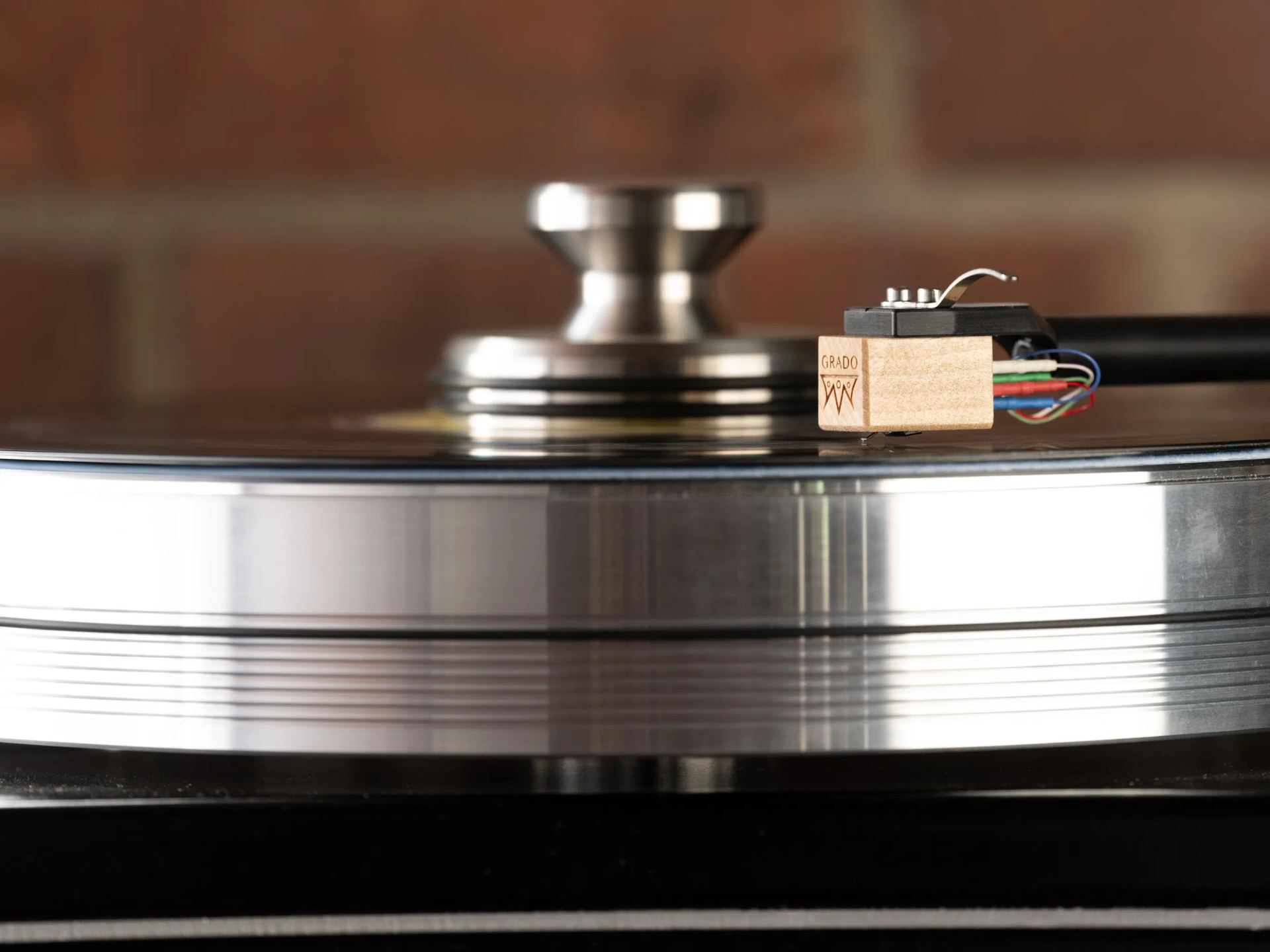
The Opus 4 body is carved from a block of American maple. The wood is not there for aesthetics alone: it damps unwanted resonances which, travelling back to the stylus, can blur playback. Maple gives the Timbre series its tonal foundation; higher models use denser woods such as olive or osage orange.
The stylus has an elliptical profile, bonded to its mount and fitted to the end of an aluminium cantilever. The elliptical profile follows the groove walls better than a spherical stylus and reads treble detail more finely; the Opus 4 response extends up to 60 kHz, and average left/right channel separation reaches 30 dB, enough to maintain a precise stereo image. Inside, the coils are made from 5N OCC copper, with 99.999% purity, cast to limit breaks in the metal structure and preserve signal continuity. Cryogenic treatment and internal damping reduce residual vibrations. The cartridge weighs 8.3 g and fits the half-inch standard used by almost all headshells.
An output level that simplifies connection
The Opus 4 is available in two output levels; this high-output version delivers 4.0 mV, a comfortable voltage that can be used with a moving magnet phono input, the most widespread type. This high level makes the preamp’s job easier, as it receives an already substantial signal, helping to maintain a quiet noise floor.
The role of this phono preamp: to raise the cartridge’s low-level signal to line level and apply RIAA equalisation, the inverse curve of the one used when cutting the record. In terms of electrical loading, the Opus 4 accepts a wide range, from 10 kΩ to 47 kΩ, with 47 kΩ being the standard value for a moving magnet input. This flexibility makes it easier to match with most preamps on the market.
Matching the cartridge to the tonearm
Compliance describes the flexibility of the suspension that allows the cantilever to move. The Opus 4 is rated at 20 µm/mN, a high value: its suspension is relatively compliant. A compliant cartridge performs best on a low- to medium-mass tonearm. Tonearm and cartridge form a mechanical system whose resonant frequency should ideally fall between 8 and 12 Hz, below the audio band and above record vibrations; pairing a tonearm that is too heavy with a compliant cartridge would bring this frequency down too low.
Tracking force, the weight with which the stylus rests in the groove, should be set between 1.6 and 1.9 g. Staying within this range protects both the groove and the stylus while stabilising playback. At 8.3 g, the Opus 4 can be fitted easily with common counterweights.
The Opus 4’s place in the Timbre series
Within the Grado catalogue, the Opus 4 is the first wood-bodied cartridge. Below it, the Prestige series retains a plastic body and a stylus that the user can replace themselves. The Timbre series begins with the Opus, with each model using the same moving iron principle while stepping up in materials: after the Opus’s maple come the olive wood bodies of the Platinum and Sonata, then the osage orange and boron cantilever of the Master and Reference, up to the Statement.
The Opus 4 provides access to the sound of hand-assembled Brooklyn-made wood-bodied Grado cartridges without the budget required for higher-end models. It succeeds the Opus 3, retaining its approach while refining the body geometry to make installation easier and improve playback stability.
Technical Specifications
Design and Technology
- Type: moving iron cell, flux-bridger principle
- Version: high output, stereo
- Mounting: standard half-inch
Materials and Construction
- Body: American maple
- Cantilever: aluminum
- Stylus: bonded elliptical diamond
- Internal wiring: OCC 5N copper, cryogenic treatment, internal damping
Electrical Performance
- Output voltage: 4.0 mV (at 5 cm/s, 45°)
- Inductance: 55 mH
- Internal resistance: 660 Ω
- Load impedance: 10 kΩ to 47 kΩ
- Capacitive load: operation independent of cable capacitance
Acoustic Performance
- Frequency response: 10 Hz to 60 kHz
- Channel separation: 30 dB on average, from 10 Hz to 30 kHz
Mechanical Specifications
- Compliance: 20 µm / mN
- Tracking force: 1.6 to 1.9 g
- Weight: 8.3 g
Frequently Asked Questions
Does the Opus 4 Haut niveau connect to any phono preamp?
It requires a moving magnet (MM) phono input. Many integrated amplifiers have one; simply check that it is set to MM if it is switchable. If your amplifier does not have a phono input, an external MM phono preamp can be placed between the turntable and a line input. An input dedicated to moving coil cartridges, with very high gain, is not suitable for the high output level of this version.
Does the cable length or capacity affect the sound?
Grado moving-iron cartridges are relatively insensitive to cable capacitance, whereas many moving-magnet cartridges see their high-frequency response shift depending on this value. The combined capacitance of the turntable cable and phono input therefore has little effect on the Opus 4, allowing greater flexibility in cable choice.
Can you replace the stylus yourself when it is worn out?
No. On Grado cartridges with wooden bodies, the diamond assembly is integrated into the body and cannot be removed, unlike the Prestige series. Grado instead offers an exchange program: the worn cartridge is sent back to the Brooklyn workshop and returned rebuilt at a reduced price. This program also allows upgrading to a higher-end wooden model.
What is the difference between the high-level and low-level versions?
Both share the same design; only the output level changes. The high-output version delivers 4.0 mV and works with a standard MM input. The low-output version drops to 1.0 mV and requires a phono preamp with higher gain. For a conventional phono setup, the high-output version is the most straightforward choice.
How do I know if my tonearm is compatible with the Opus 4?
Two factors are generally sufficient. First, the tonearm’s effective mass: the Opus 4’s high compliance is suited to low- to medium-mass tonearms, the most common on current turntables. Second, the adjustments: the tonearm must allow tracking force to be set to around 1.7 g and have a standard half-inch cartridge mount. Most hi-fi turntables meet these requirements.
- Eco-contribution included in the sale price.