Cayin HA-300 MK3 black


Overview
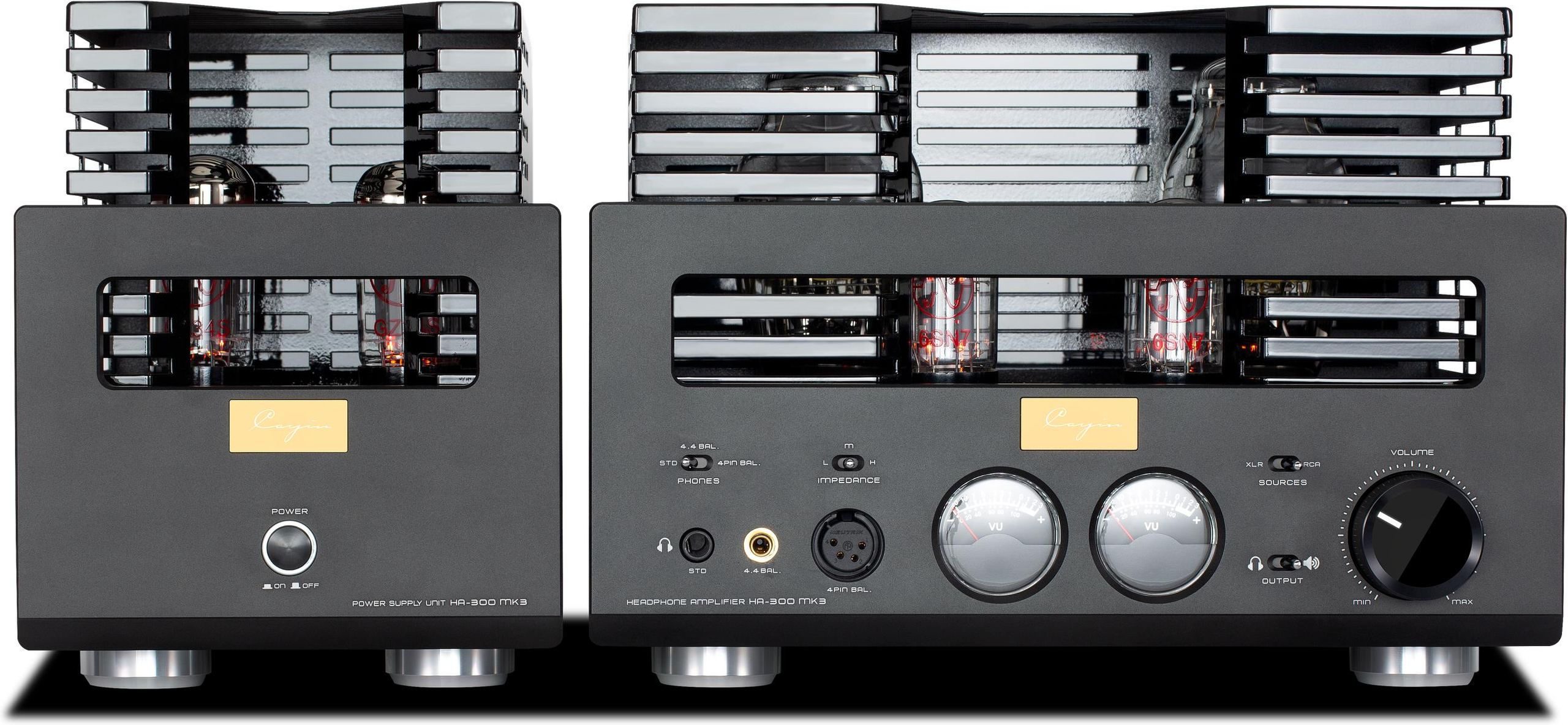
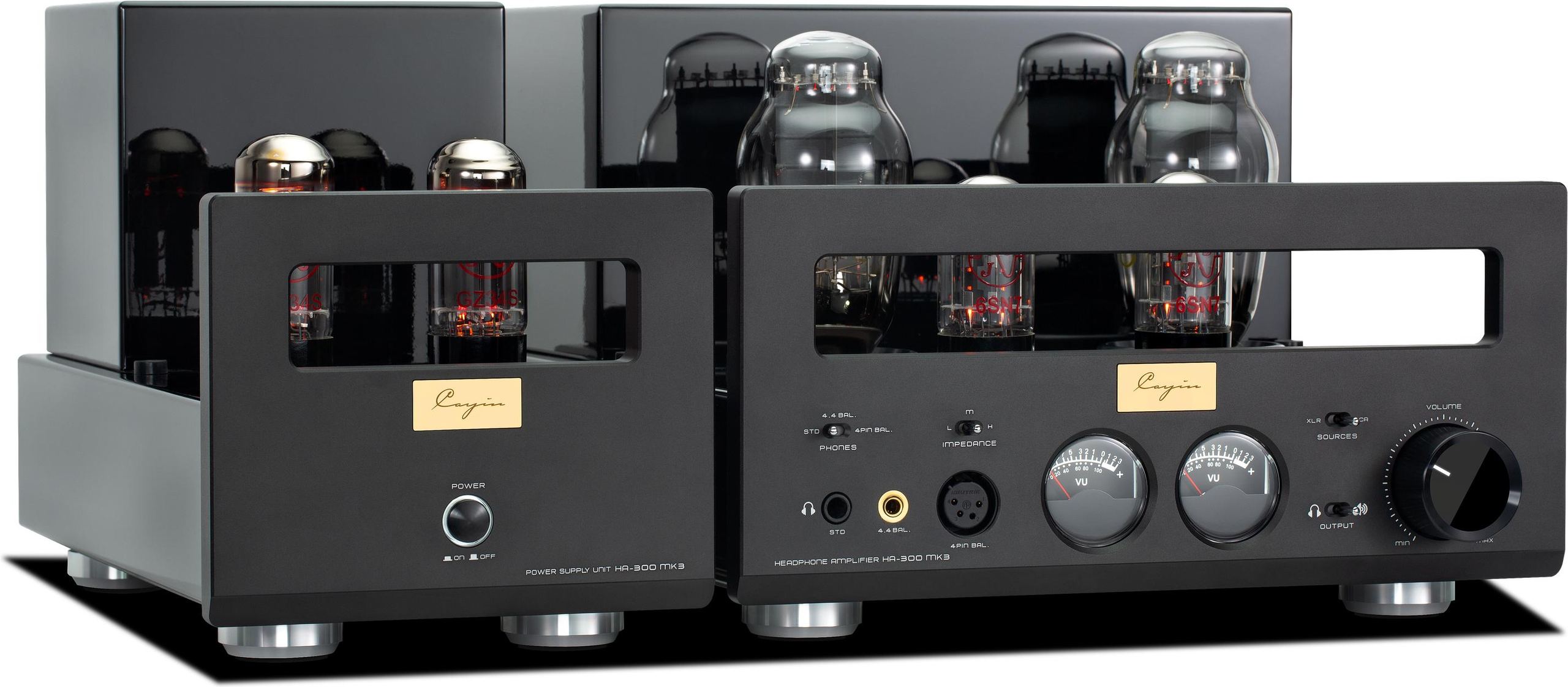
Third generation of Cayin’s flagship headphone listening product, the HA-300 MK3 retains the pure Class A single-ended (SET) topology built around directly heated 300B triodes, a formula the Chinese brand has been refining for nearly a decade. Revised circuitry, next-generation transformers, redesigned power supply and expanded compatibility with sensitive IEMs: this iteration does not change the philosophy, it takes it further.
Two chassis, one isolation principle
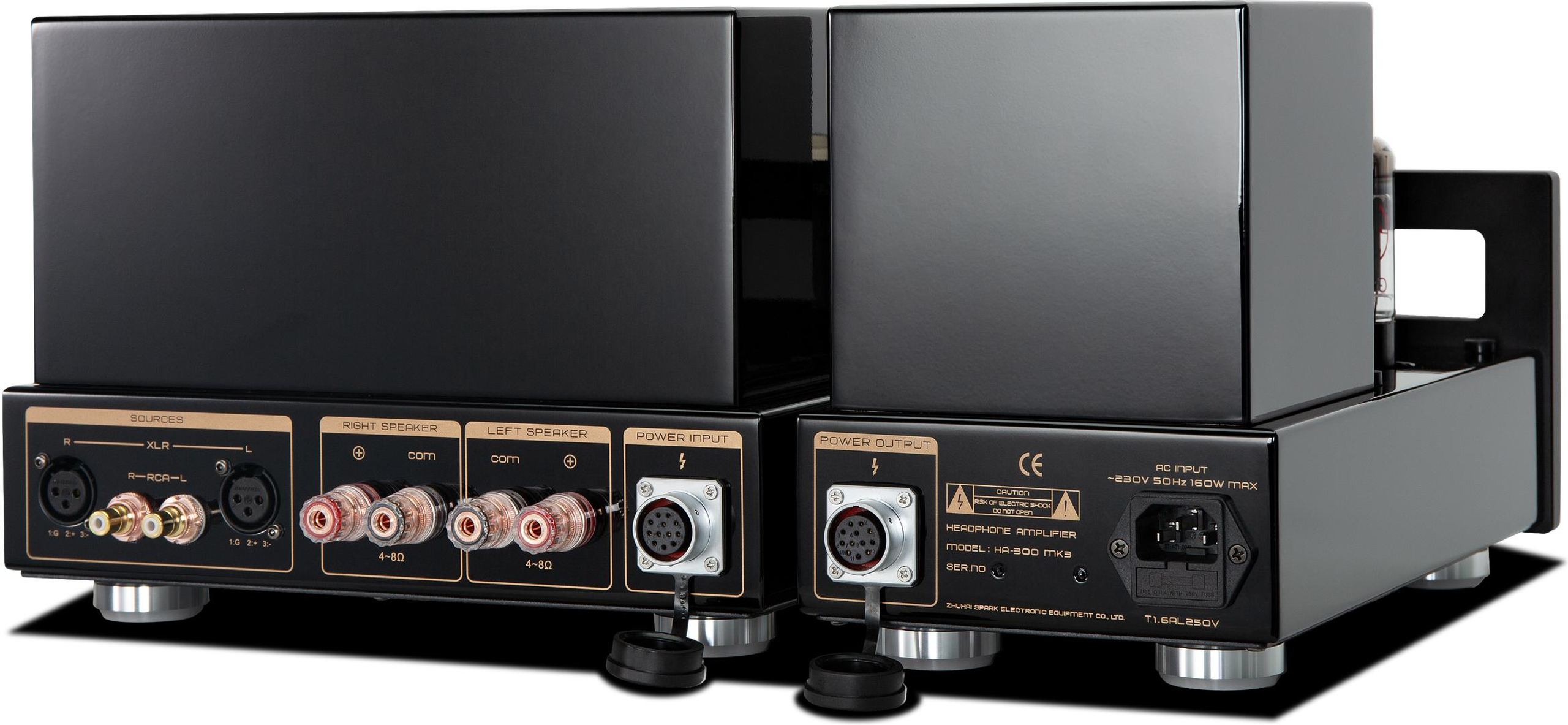
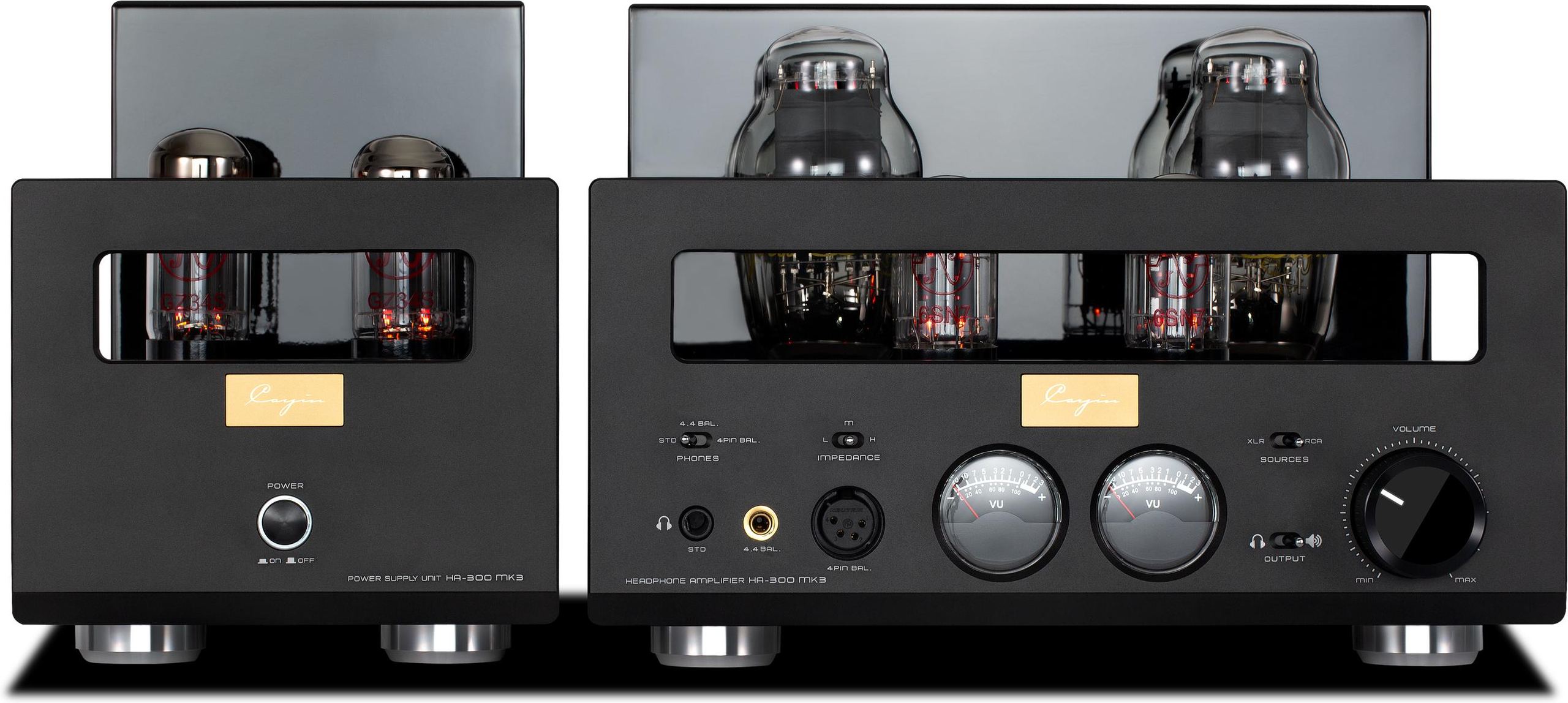
The HA-300 MK3 physically separates the amplifier and its power supply into two distinct enclosures. The idea is simple: keep the power transformers and their magnetic field away from the audio path to limit interference, vibrations and residual noise. The two units communicate via a lockable aviation-type connector umbilical cable, which secures the connection and reduces losses. The terminals are protected from dust when the cable is disconnected. This design choice was already present on the MK2, but Cayin announces dedicated work on EMI isolation and chassis mechanical rigidity, helping to lower the noise floor.
The assembly has considerable weight: 16.8 kg for the amplifier (286 × 368 × 205 mm) and 10 kg for the power supply unit (159 × 345 × 205 mm). This is a desktop unit designed to stay in place.

Transformers designed and wound in-house
Transformers are a critical element in a transformer-coupled SET amplifier: they directly shape tonal density, soundstage and transient behavior. Cayin designs and winds its own in-house, a know-how few manufacturers still master today. The MK3 introduces a third generation of wide-band EI output transformers and toroidal power transformer, both optimized for this platform.
Compared with previous versions, Cayin claims enhanced shielding, lower residual ripple, reduced interference and a more stable power supply. The wide bandwidth of these transformers promotes consistent reproduction across the entire spectrum. The result naturally depends on the rest of the system, but mastery of the output transformer is a structural advantage in this topology: it is what “speaks” to the headphones.
Six tubes, a minimalist circuit
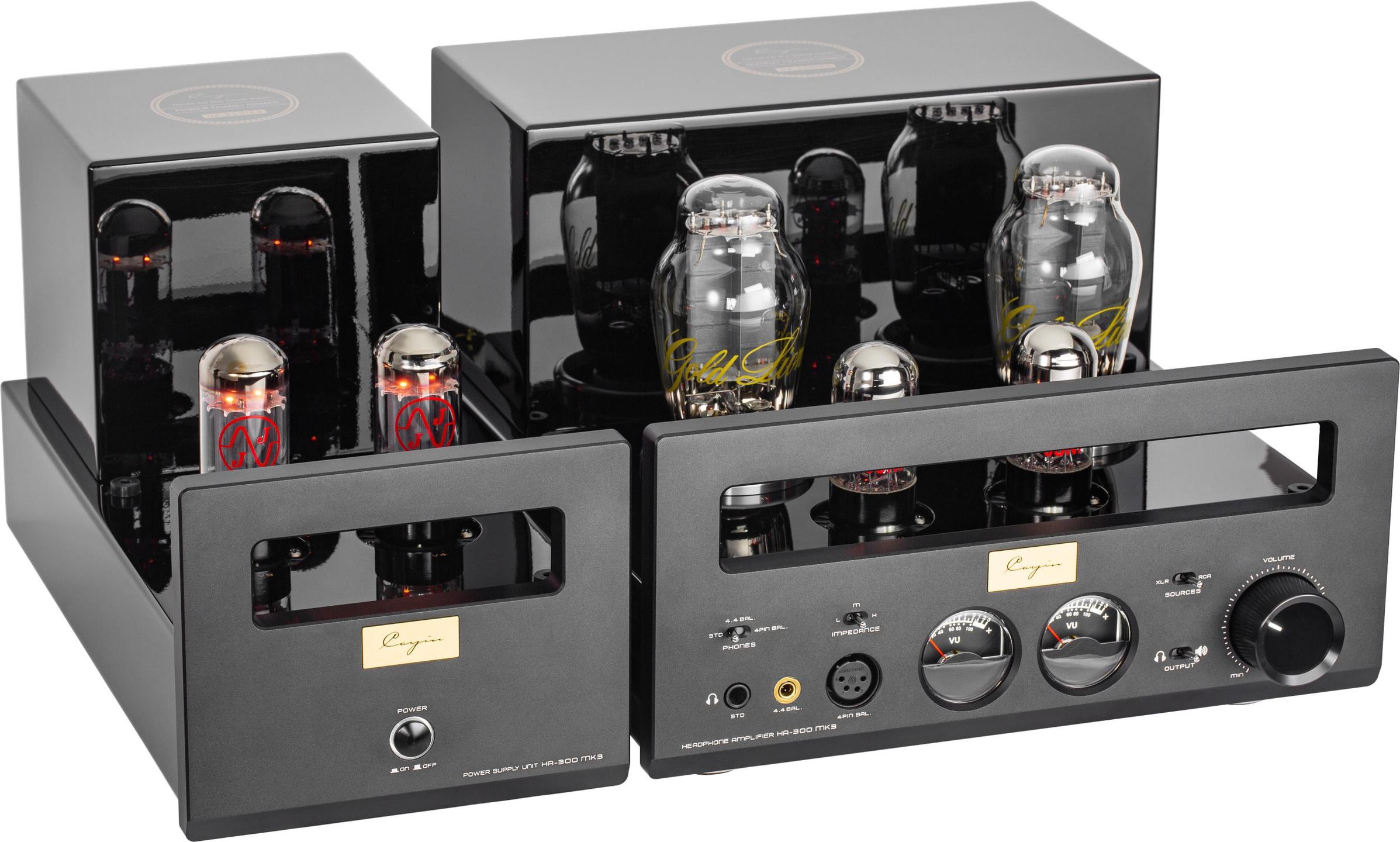
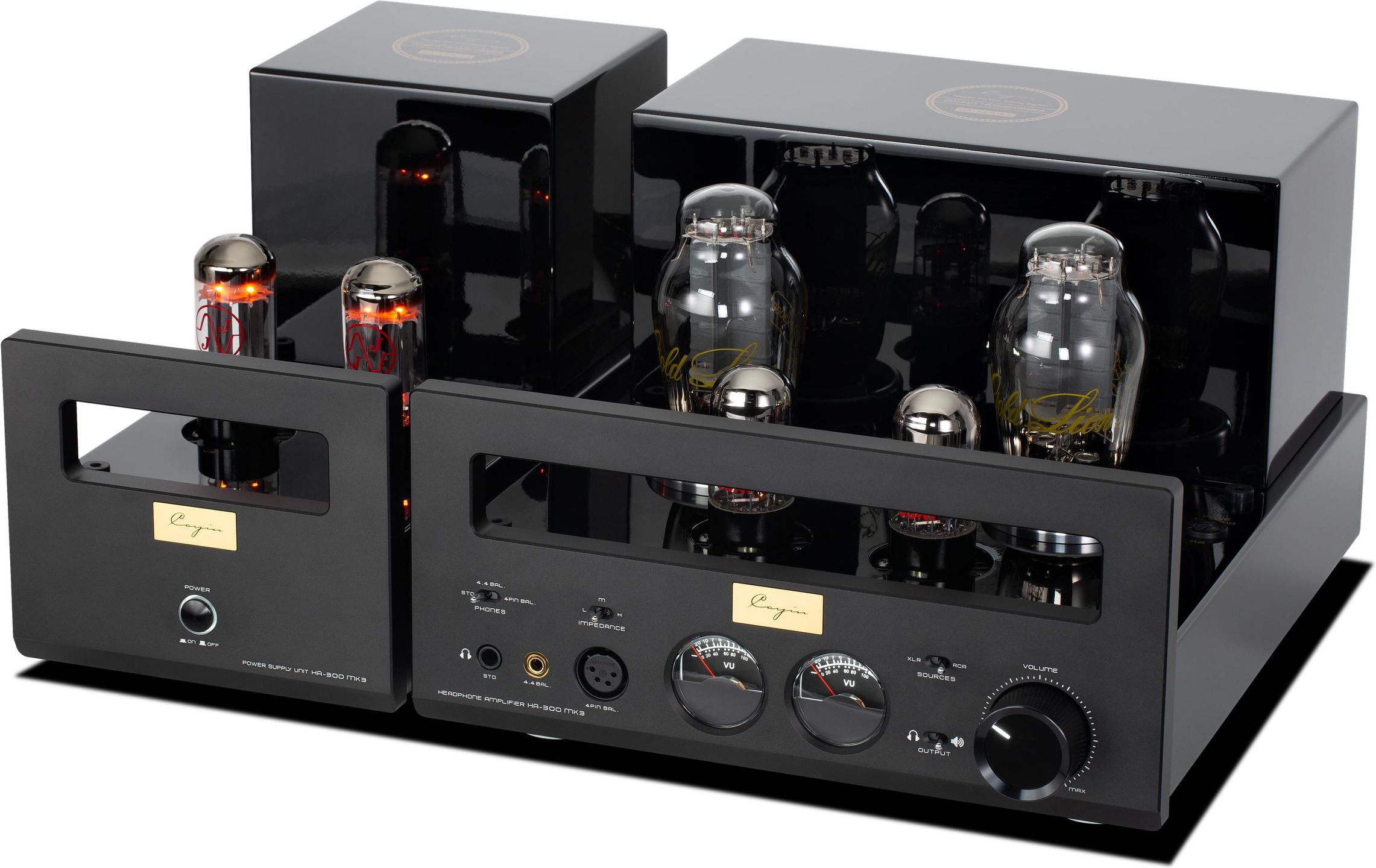
The SET philosophy is based on signal path simplicity. A single power tube per channel (the 300B) amplifies the signal without splitting it, preserving the even-order harmonics prized in high-fidelity listening. The voltage stage uses a pair of 6SN7 tubes, a classic match for the 300B, while rectification is handled by two GZ34 / 5AR4 tubes.
The MK3 comes with a selected tube set: two Genalex Gold Lion PX300B output tubes, two JJ 6SN7 driver tubes and two JJ GZ34 rectifier tubes. Each tube is tested, matched and subjected to a 48-hour burn-in at the factory before shipping. The move to GZ34 tubes (the MK2 used four NOS RCA 22DE4 tubes) opens up a wider range of replacement options for “tube rolling,” a common practice in the world of tube amplifiers to tailor the sound signature to personal taste.
All internal wiring is hand-built point-to-point.

Three headphone outputs, three impedance ranges
One of the frequent criticisms of 300B headphone amplifiers concerns their difficulty with sensitive IEMs: too much background noise, too much available power, and insufficient precision in volume control. The MK3 addresses this issue with three separate outputs, each calibrated for a different use.
The balanced 4-pin Neutrik XLR output delivers up to 6,500 mW per channel. It is the main output, designed for planar magnetic headphones and high-impedance models that demand current. The 6.35 mm jack output provides 6,000 mW per channel in single-ended mode. The 4.4 mm Pentaconn output, capped at 1,600 mW per channel, is specifically optimized for IEMs: suitable level, reduced noise. This is rare on a 300B amplifier, and one of the significant new features of this generation.
A three-position impedance selector (Low: 8-65 Ω, Medium: 65-300 Ω, High: 300-600 Ω) allows the output load to be matched to the headphones in use. Frequency response extends from 12 Hz to 35 kHz (±3 dB), signal-to-noise ratio is rated at 100 dB (A), and total harmonic distortion remains below 1% at 1 kHz.
A speaker amplifier too
The HA-300 MK3 is not just a headphone amplifier. Its rear speaker terminals deliver 2 × 8 W in Class A, with a frequency response of 10 Hz to 35 kHz and a signal-to-noise ratio of 102 dB (A). This is modest in absolute terms, but sufficient to drive efficient compact speakers in an office or modestly sized room. Supported impedance ranges from 4 to 8 Ω. For those who alternate between headphone and speaker listening, this dual use avoids multiplying components.
Selected components and hybrid volume control
The choice of passive components says a great deal about the MK3’s positioning. The coupling capacitors are DUELUND models, made in Denmark and known in the tube amplification world for their low distortion and transparency. The tube sockets are gold-plated (rather than ceramic with gold-plated pins as on previous generations), improving conductivity, contact stability and durability.
Volume control combines two technologies: a JRC MUSES 72320 chip (high-fidelity electronic control, with low noise and low distortion) paired with a 41-step ALPS attenuator. This hybrid solution aims for the precision of digital adjustment with the smooth progression of a stepped potentiometer.
A design refined in every detail
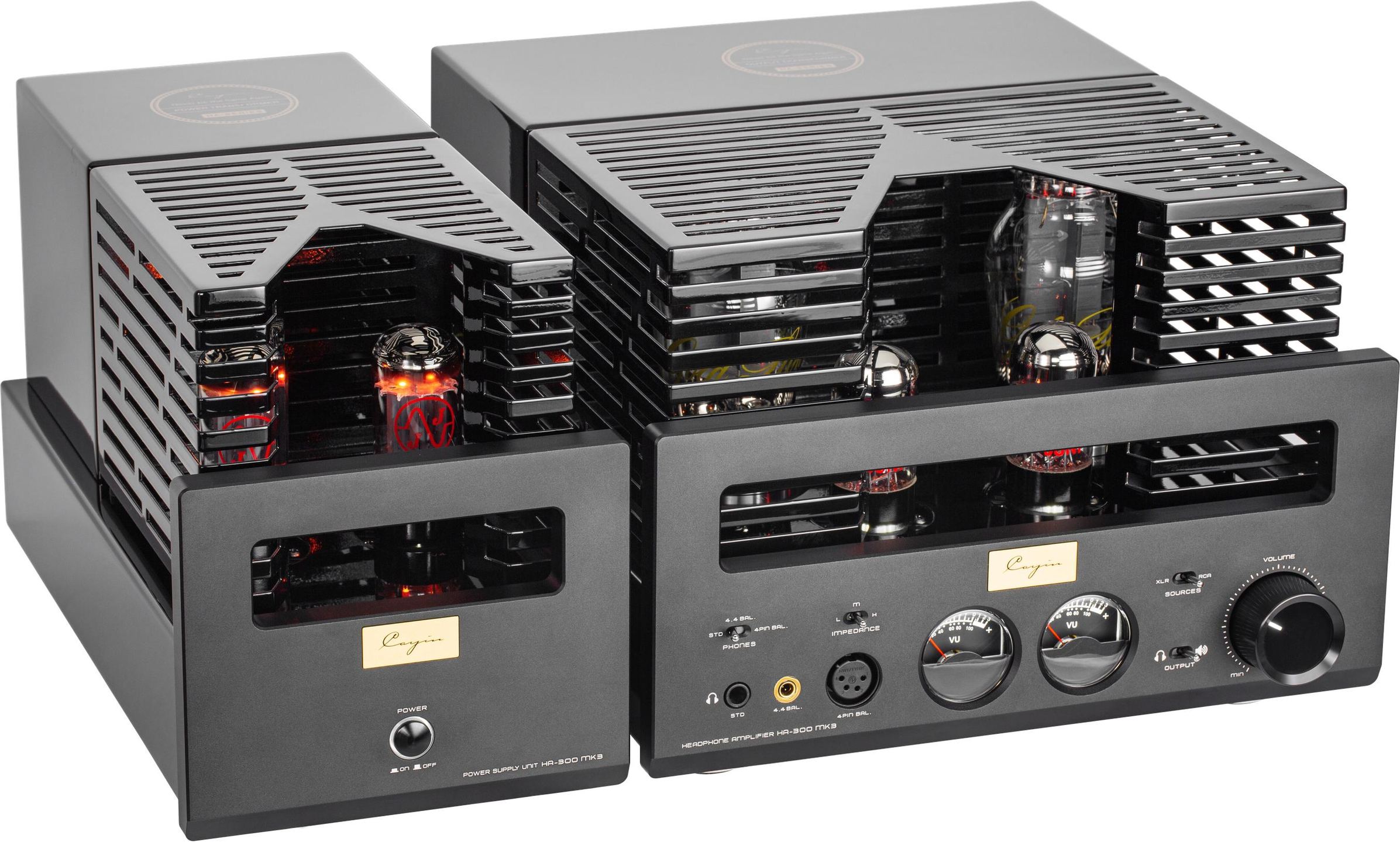
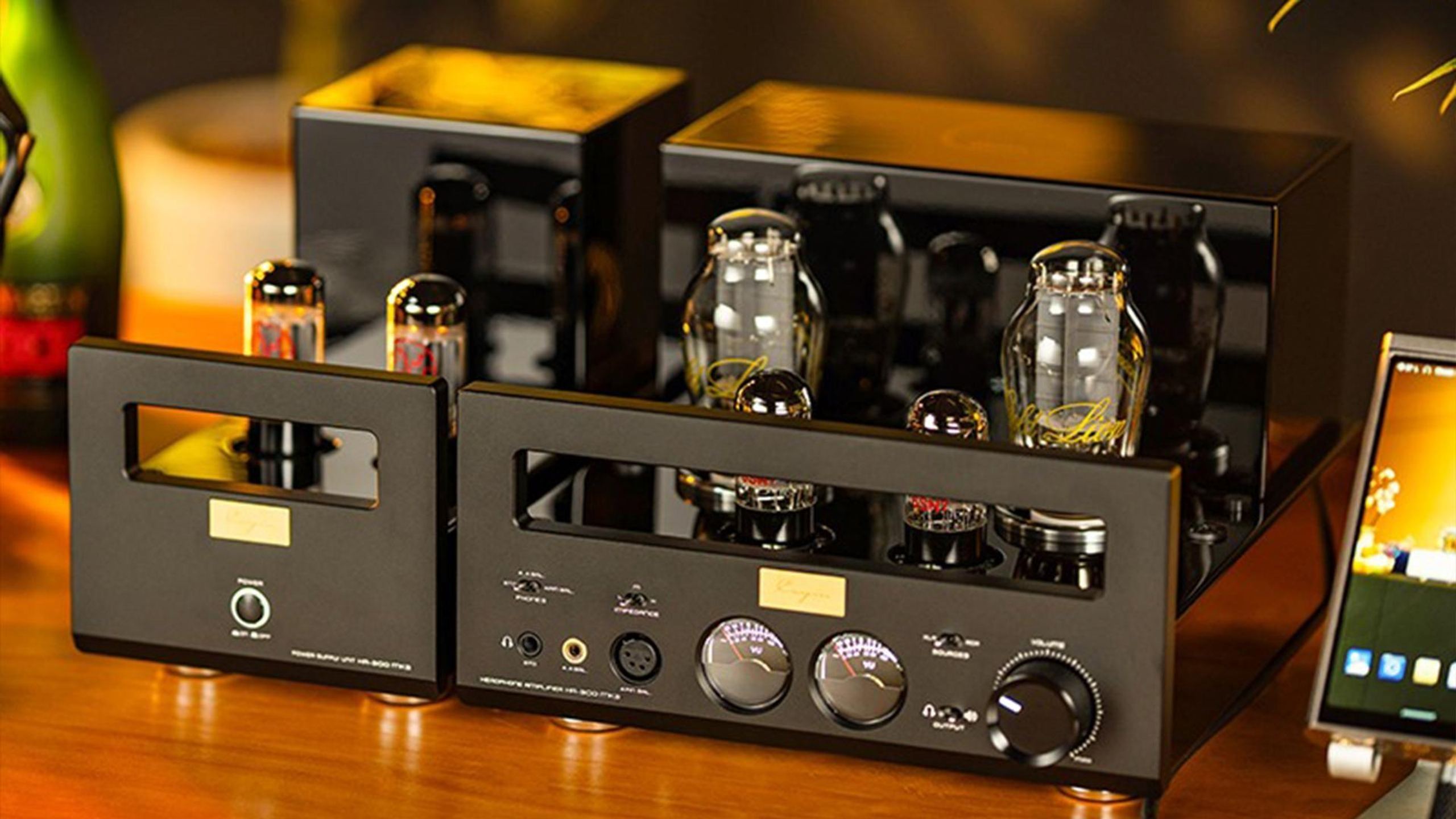
Compared with the MK2, the finish moves to a sandblasted treatment that is more resistant to scratches and fingerprints than conventional brushed metal. The transformer cover has been streamlined: the decorative aluminum plates have been removed in favor of a more understated design that promotes heat dissipation. The tube protection cage adopts a new “family” design with a plug-in structure, replacing the former metal wire grille. This makes tube installation and replacement easier. The nameplate features a textured relief, and the tube rings have been reworked. Two front-panel VU meters provide a visual reference while listening. A 60-second delay with mute on power-up protects the circuit and headphones while the tubes reach operating conditions.
For inputs, the MK3 accepts one balanced XLR source and one RCA source, with input impedances of 12.5 kΩ (XLR) and 25 kΩ (RCA). There is no line output: this is a pure amplifier, not a preamplifier. There is also no remote control, meaning you need to get up to adjust the volume when listening through speakers.
Technical specifications
Architecture and design
- Type: tube amplifier for headphones and speakers
- Topology: single-ended Class A with 300B triodes
- Design: dual-chassis with separate power supply
- Wiring: hand-made point-to-point
- Power stage: 300B
- Voltage stage: regulated, low-noise
- Start-up delay: 60 seconds
- Power supply: enhanced circuit with improved isolation and reduced interference
- Secure aviation-type connector
Audiophile components
- Wide-band EI output transformers (3rd generation)
- Toroidal power transformer (3rd generation)
- DUELUND coupling capacitors (Denmark)
- Volume control
- JRC MUSES 72320 chip
- 41-step ALPS attenuator
- Gold-plated tube sockets
- Selection of matched tubes with 48-hour factory burn-in
Included tubes
- 2 × Genalex Gold Lion PX300B: power amplification
- 2 × JJ 6SN7: voltage amplification
- 2 × JJ GZ34 / 5AR4: rectification
- Compatible with many equivalent tubes for sound customization (tube rolling)
Headphone output
- Power
- Balanced 4-pin XLR: 6500 mW + 6500 mW
- 6.35 mm jack: 6000 mW + 6000 mW
- Balanced 4.4 mm Pentaconn: 1600 mW + 1600 mW (IEM-optimized)
- Frequency response: 12 Hz – 35 kHz (±3 dB)
- Total harmonic distortion: less than 1% (1 kHz, 1500 mW)
- Signal-to-noise ratio: 100 dB (A-weighted)
- Input sensitivity: 250 mV – 1200 mV
- Impedance ranges
- Low: 8 – 65 Ω
- Medium: 65 – 300 Ω
- High: 300 – 600 Ω
- Headphone impedance selector: High / Medium / Low
Speaker output
- Power: 8 W + 8 W
- Amplification class: Class A
- Frequency response: 10 Hz – 35 kHz (±3 dB)
- Total harmonic distortion: less than 1% (1 kHz, 3 W)
- Signal-to-noise ratio: 102 dB (A-weighted)
- Compatible impedance: 4 – 8 Ω
Connectivity
- 1 × stereo RCA input
- 1 × balanced stereo XLR input
- 1 × 6.35 mm jack headphone output
- 1 × balanced 4.4 mm Pentaconn headphone output
- 1 × 4-pin XLR headphone output
- 1 × pair of speaker binding posts
Design and manufacturing
- Sleek, modern industrial design
- Premium sandblasted finish
- Redesigned tube protection cage
- Premium details: textured nameplate, improved tube rings
- Dual front-panel VU meters
Dimensions and weight
- Amplifier: 286 × 368 × 205 mm – 16.8 kg
- Power supply: 159 × 345 × 205 mm – 10 kg
Power supply
- Consumption: 160 W maximum
- Voltage
- 220 – 240 V: T1.6A L250V fuse
- 100 – 120 V: T3.15A L250V fuse
- 300B fuse: T100 mA E250V
Operating conditions
- Temperature: 0 °C to 40 °C
- Humidity: 20% to 80%
Frequently Asked Questions
Does the HA-300 MK3 include a digital-to-analog converter (DAC)?
No. The HA-300 MK3 is a pure analog amplifier. It must be connected to an analog source (CD player, external DAC, turntable…) via its XLR or RCA inputs. No digital input (USB, optical, coaxial) is available.
Can sensitive IEMs be used without annoying background noise?
This is one of the MK3’s development focuses. The 4.4 mm Pentaconn output has been specifically calibrated for IEMs, with output power reduced to 1,600 mW and a lowered noise floor. The impedance selector in the “Low” position (8-65 Ω) completes the adaptation. Results will depend on the sensitivity of each IEM model, but Cayin has clearly worked on this point compared with previous generations.
Which speakers can be powered with the 2 × 8 W output?
High-sensitivity speakers (sensitivity from around 90-92 dB/W/m upward) will work well in an office or a small listening room. Compact bookshelf speakers from brands such as Klipsch, Zu Audio, Omega, or Devore Fidelity are common pairings with this type of amplification. Large floorstanding speakers with low sensitivity are not a suitable use case.
How long should you wait after powering on before listening?
The HA-300 MK3 imposes an automatic 60-second delay with mute at startup, while the tubes stabilize. Listening is possible as soon as this phase ends. Directly heated tubes such as the 300B generally reach their optimal operating state after 15 to 30 minutes of operation.
Can the power supply block from an HA-300 MK2 be reused with the MK3?
No. Cayin specifies that the power supplies of the MK2 and MK3 are based on different designs and are not interchangeable. An MK2 owner wishing to acquire an MK3 power supply (or vice versa) must place a specific order with Cayin.
- Eco-contribution included in the sale price.