

Pro-Ject X2B lacquered black


Pro-Ject X2 B: True Balanced turntable
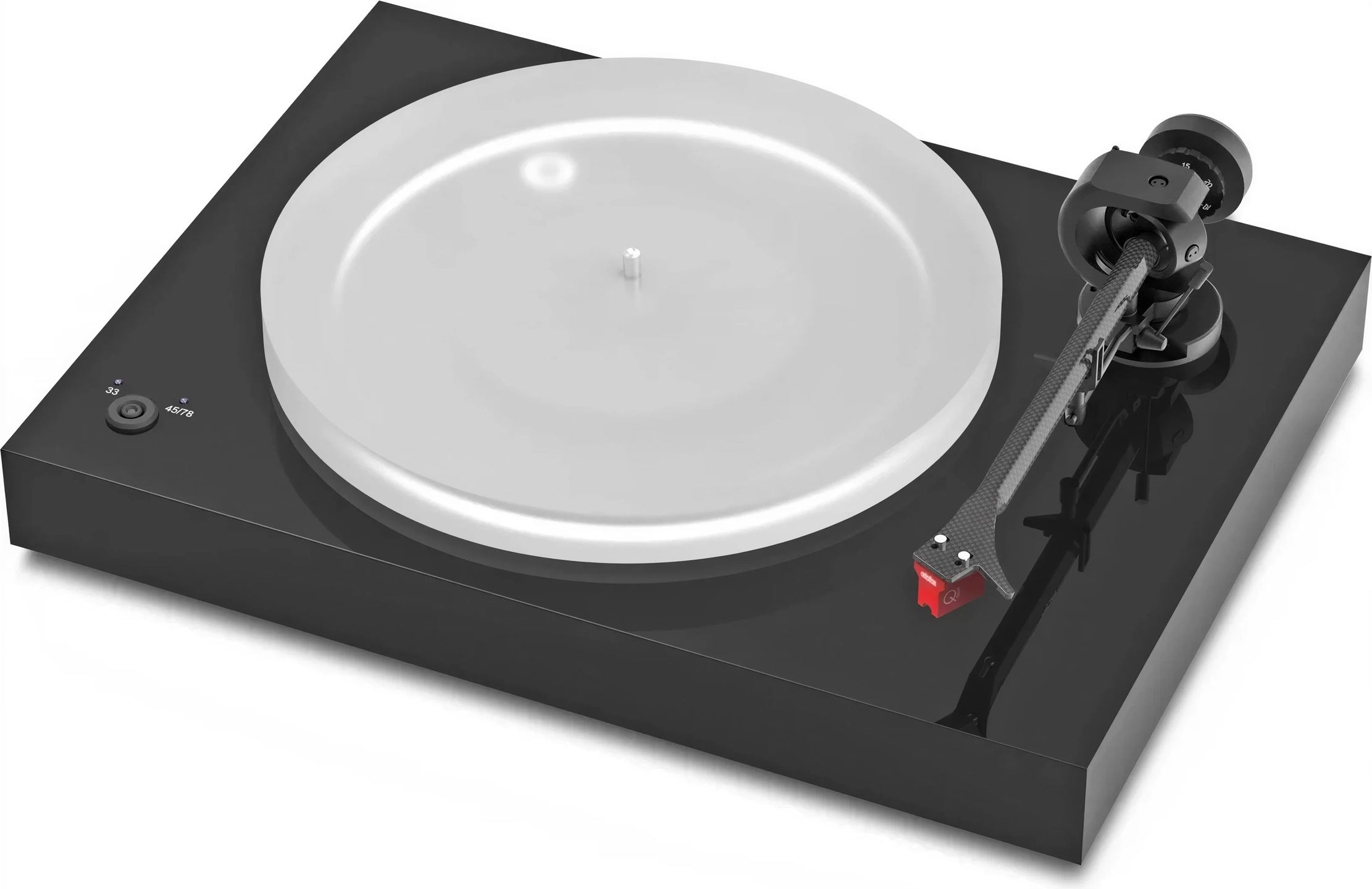
At the output of a cartridge, a turntable’s signal is only a few tenths of a millivolt, and wireless networks as well as household electronic devices have ample opportunity to interfere with it before it reaches the phono preamp. The X2 B takes the foundation of the X2 (massive chassis, heavy acrylic platter, nine-inch carbon tonearm) and adds a balanced output that protects this signal. It comes with a pre-adjusted moving-coil cartridge from Ortofon.

A heavy chassis that keeps the motor at a distance
The turntable weighs 10 kg, and most of this mass comes from the chassis: a 50 mm-thick MDF block CNC-machined, dense enough for its own resonances to become virtually imperceptible. It receives eight hand-polished coats of paint or a natural wood veneer depending on the version. Three machined aluminium feet, damped and height-adjustable, level the turntable and limit acoustic feedback, the phenomenon in which sound from the speakers causes the tonearm and record to vibrate.
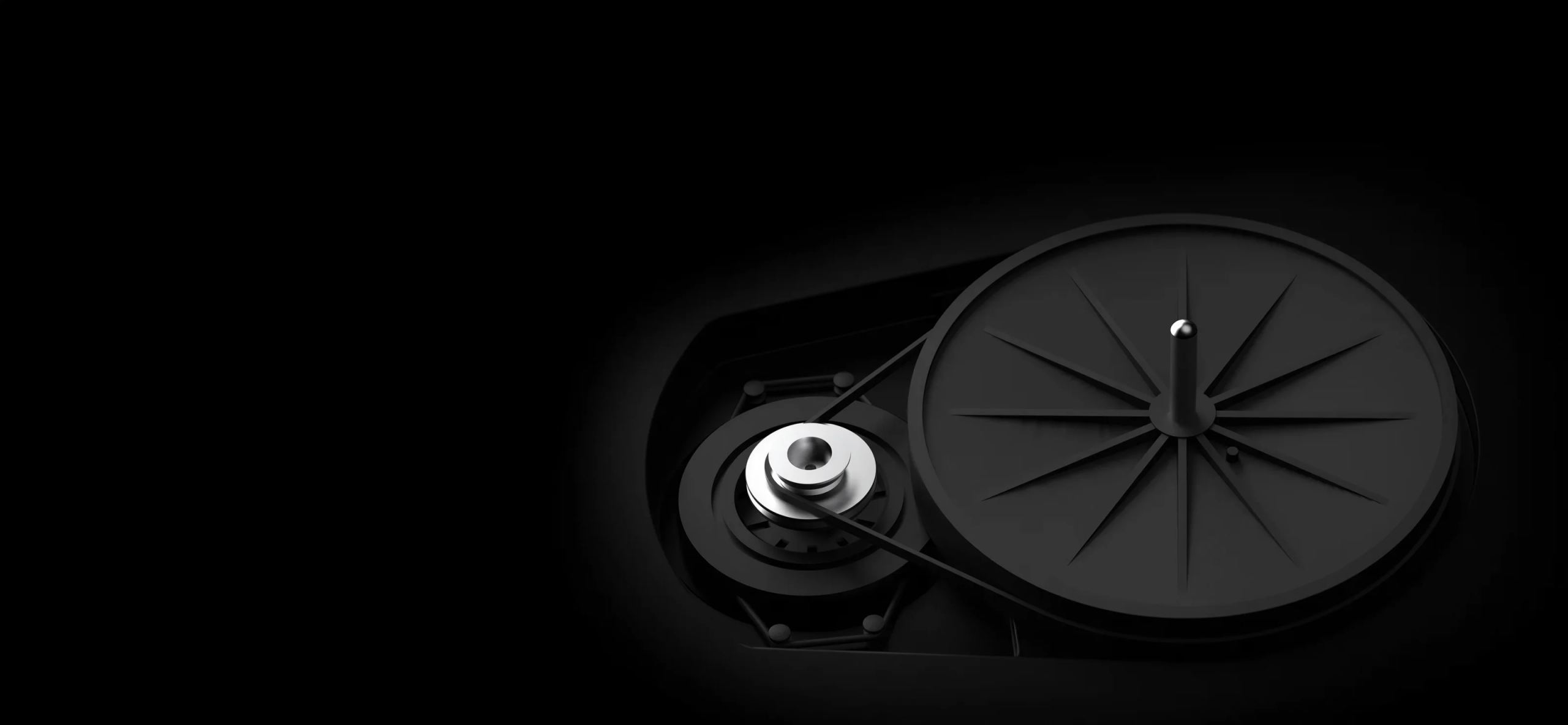
The motor drives the platter via a belt, preventing its vibrations from being transmitted directly to the record. Pro-Ject goes further: the carefully balanced motor block is suspended on a precisely tuned thermoplastic elastomer (TPE) belt, so it does not touch the chassis. A DC/AC electronic generator provides clean, stable power, resulting in consistent speed.
The belt runs around a precision-machined sub-platter with very tight bearing tolerances, supporting a 30 mm-thick, 2 kg acrylic platter. Acrylic does not resonate and provides the record with stable support. The main bearing combines a stainless-steel spindle, a soft bronze bushing and Teflon mirrors to minimise rumble, the low mechanical noise that can rise through the speakers. Wow and flutter, those slight speed variations audible on a sustained piano note, are kept to ±0.12% at 33 rpm and ±0.10% at 45 rpm, with a signal-to-noise ratio of 70 dB.
A nine-inch tonearm with no detachable connection
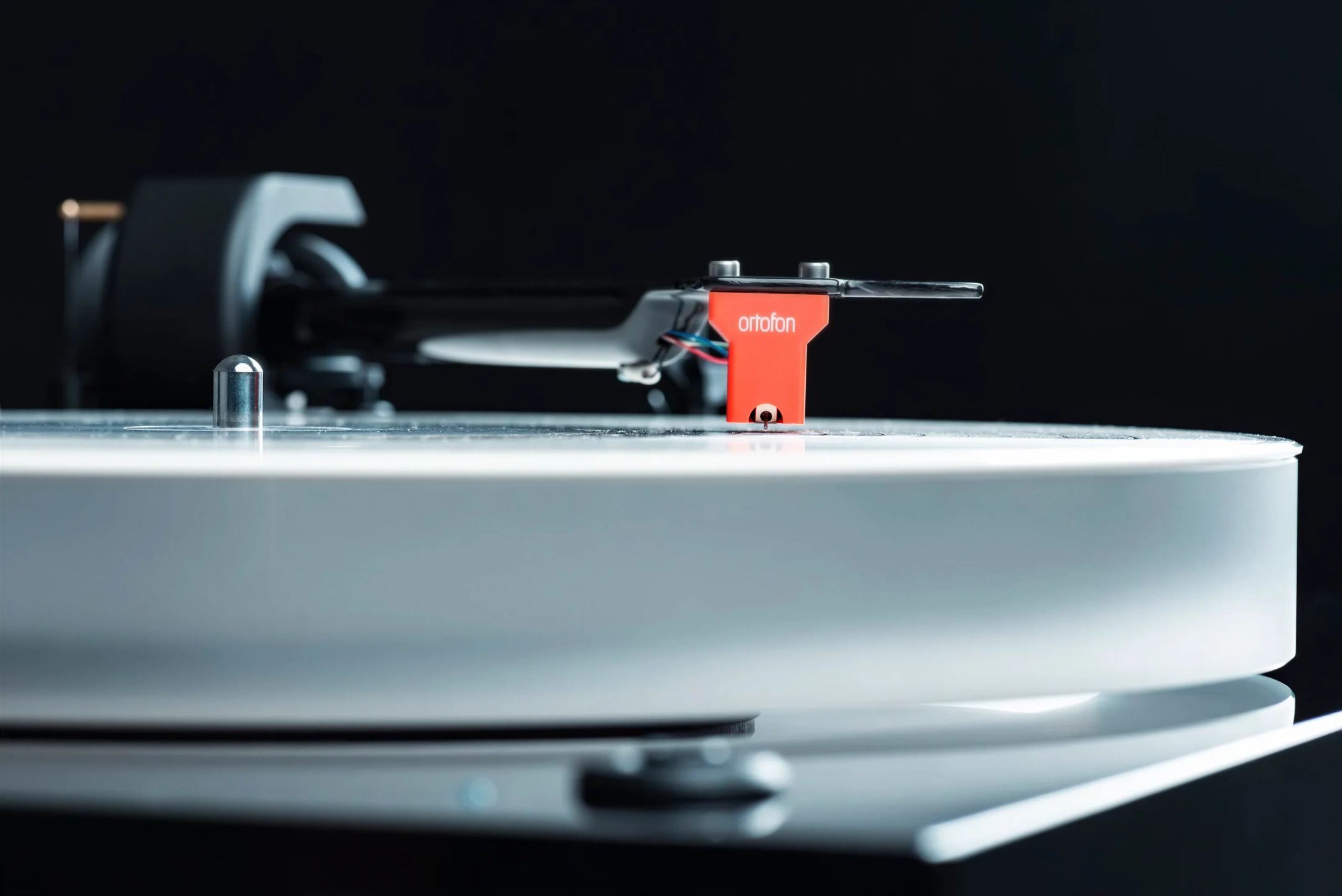
The tonearm has an effective length of 230 mm. Its tube is a one-piece sandwich construction: an outer carbon layer for rigidity and an inner aluminium tube for damping. Compared with that of the X1 B, it is longer and its tube has a larger diameter.
The headshell is integral with the tube. This one-piece construction eliminates the vibrations generated by any detachable connection, with one trade-off: changing the cartridge requires removing it directly from the tonearm, without being able to prepare a second headshell in advance. Its effective mass of 13.5 g is suitable for low- to medium-compliance moving-coil cartridges, meaning those with fairly firm suspensions.
The tonearm pivots on four very low-friction points, ensuring precise, stable groove tracking. Its TPE-damped counterweight reduces resonances between the tonearm and cartridge by up to 50%. Adjustments go further than on an entry-level turntable: azimuth corrects the cartridge’s lateral tilt so that the stylus sits straight in the groove, and tonearm height (VTA) is continuously adjustable after loosening two grub screws, allowing adaptation to a different platter mat or a taller cartridge. Tracking force is adjustable from 0 to 3 g, and the tonearm base is made entirely of aluminium.
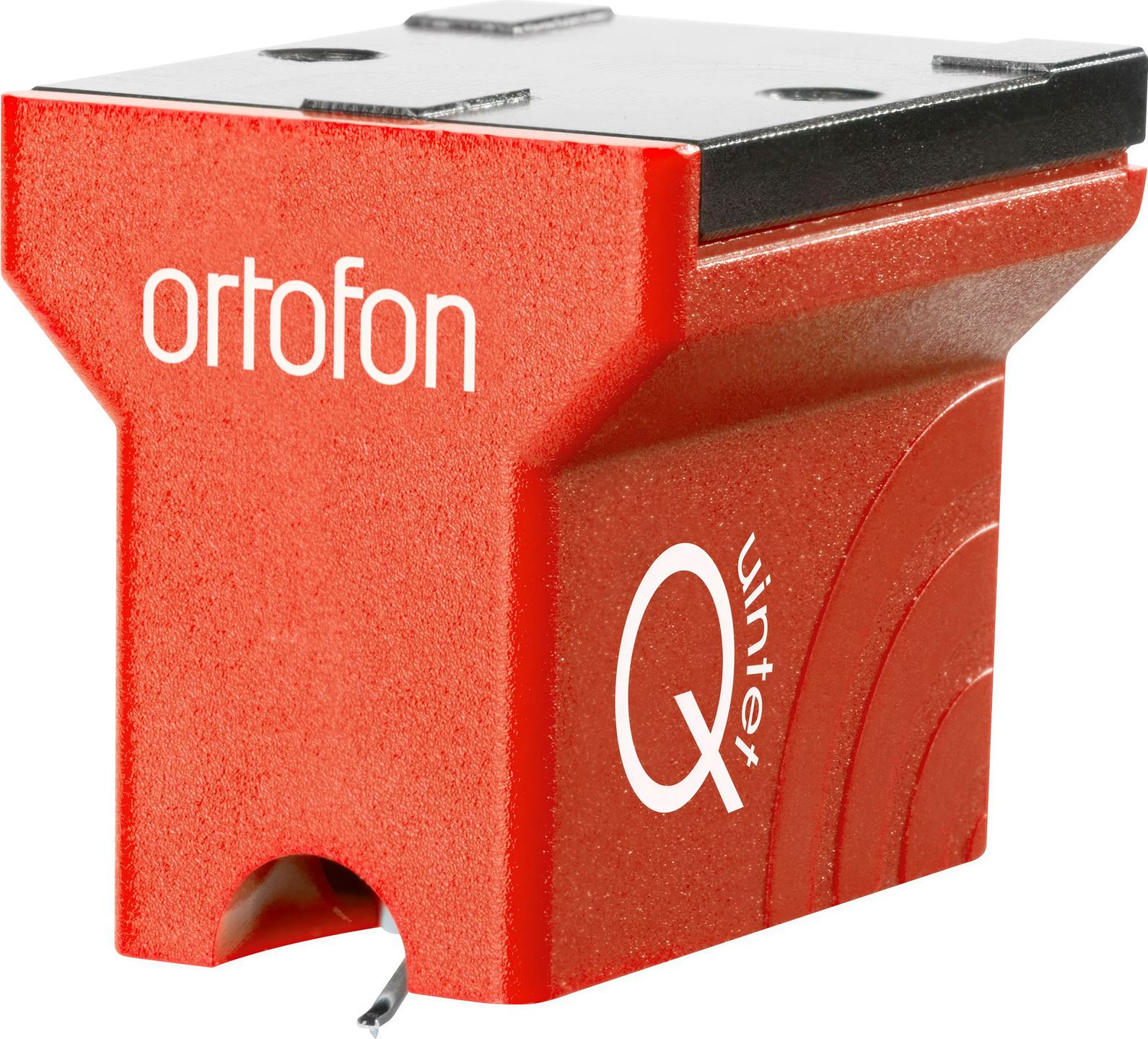
An Ortofon Quintet Red factory-fitted and adjusted
The supplied cartridge is an Ortofon Quintet Red moving-coil (MC) cartridge, supplied aligned. Its elliptical stylus (tip radii of 8 and 18 µm) follows the groove walls more closely than a conical stylus and retrieves more detail. Its 15 µm/mN compliance matches the mass of the nine-inch tonearm, and its recommended tracking force is 2.3 g, within a range of 2.1 to 2.5 g. It covers 20 Hz to 25 kHz at -3 dB, separates channels by more than 21 dB at 1 kHz, and delivers an open, dynamic sound with a touch of warmth.
Its 0.5 mV output voltage requires an MC-compatible phono preamp. Its 7 Ω internal impedance calls for a load impedance above 20 Ω.
How the True Balanced connection protects the signal
In a balanced connection, each channel uses three wires: ground, a hot wire carrying the signal, and a cold wire carrying the same signal inverted. At the receiving end, the preamp reinverts the cold signal and adds it to the hot signal. Interference picked up along the way, present identically on both wires, is cancelled out, and the music gains dynamics against a lower noise floor. An MC cartridge naturally delivers a balanced signal: the Quintet Red therefore takes full advantage of this connection.
At the rear, the X2 B offers two outputs: a pair of phono RCA connectors and a balanced 5-pin mini XLR socket. The supplied cable, a semi-balanced, shielded, low-capacitance Connect it Phono E RCA, connects to any phono input. To switch to fully balanced operation, add a Connect it Phono Mini XLR / Mini XLR cable, sold separately, and a Pro-Ject Phono Box S3 B balanced phono preamp or Phono Box DS3 B. The X2 B and Phono Box S3 B combination received the EISA award for best turntable system for this True Balanced concept.
The turntable can therefore be used from day one with a conventional preamp, while the balanced connection can be added later, at the cost of a dedicated cable and preamp.
Three speeds and quick setup
Switching between speeds is electronic, using a single button. The fitted flat belt covers 33 and 45 rpm. For 78 rpm, it is replaced with the supplied round belt, which covers 45 and 78 rpm.
The power supply is an external 15 V DC / 800 mA unit, compatible with 110 to 240 V mains power. Power consumption reaches 4.5 W maximum and drops to 0.3 W in standby. With the dust cover closed, the turntable measures 460 × 150 × 340 mm (width × height × depth). In the box, in addition to the turntable and its cartridge, are the power supply unit, dust cover, Connect it Phono E RCA cable, a felt mat and the two belts. Like the entire X range, it is handmade in Europe.
Technical specifications
Playback and drive
- Speeds: 33, 45 and 78 rpm
- Electronic speed change via a single button
- 78 rpm playback requires installation of the supplied round belt and a cartridge suitable for shellac records
- Belt drive, preventing motor vibrations from reaching the record
- Motor controlled by an electronic generator ensuring stable speed
- Motor suspension resting on a TPE belt (soft elastomer), isolating the motor from the chassis
- Acrylic platter, 30 mm thick, 2 kg, non-resonant
- Bearing with stainless steel spindle, bronze bushing and Teflon thrust pads, minimizing mechanical noise
9-inch tonearm
- Carbon and aluminum tube; carbon provides rigidity and aluminum provides damping
- One-piece construction, with no detachable connection that could generate vibrations
- Effective length: 230 mm (9 inches)
- Effective mass: 13.5 g, suitable for moving-coil cartridges
- 4-point bearing with very low friction, allowing the stylus to track the groove precisely
- Damped counterweight, reducing resonances between the tonearm and cartridge by up to 50%
- Overhang: 18 mm
- Adjustable tracking force from 0 to 3 g
- Adjustable azimuth, ensuring the stylus remains vertical in the groove
- Adjustable tonearm height (VTA), useful when changing the mat or cartridge
Ortofon Quintet Red cartridge
- Supplied factory-mounted and adjusted
- Type: moving coil (MC), allowing balanced connection
- Output voltage: 0.5 mV, requiring an MC-compatible phono preamplifier
- Elliptical stylus, delivering more detail than a conical tip
- Recommended tracking force: 2.3 g (range of 2.1 to 2.5 g)
- Compliance: 15 µm / mN, matched to the tonearm’s flexibility
- Impedance: 7 Ω, recommended load above 20 Ω
- Frequency response: 20 Hz to 25 kHz
- Weight: 9 g
- Sound reproduction: open and dynamic, with slight warmth
True Balanced balanced connection
- Outputs: RCA phono and 5-pin mini XLR
- Principle: the signal travels twice, with one path inverted, so that interference cancels out at the output
- Benefit: signal protection against interference generated by Wi-Fi and electronic devices
- Result: increased dynamics and reduced background noise
- Switching to balanced mode via the Connect it Phono Mini XLR / Mini XLR cable, sold separately
- Compatible preamplifiers: Pro-Ject Phono Box S3 B or Phono Box DS3 B
- Award: EISA Award for Best Vinyl System, in combination with the Phono Box S3 B
- No built-in phono preamplifier; the turntable connects to an MC phono input or an external preamplifier
Measurements
- Speed variation: ±0.25% at 33 rpm, ±0.20% at 45 rpm
- Wow and flutter: ±0.12% at 33 rpm, ±0.10% at 45 rpm, corresponding to slight speed variations audible on sustained notes
- Signal-to-noise ratio: 70 dB
Chassis and power supply
- 50 mm-thick MDF chassis, whose mass limits resonances
- Finish: 8 hand-polished paint layers, or wood veneer
- Feet: three aluminum feet, damped and height-adjustable
- External 15 V power supply, 110 to 240 V mains
- Power consumption: 4.5 W maximum, 0.3 W in standby
- Dimensions: 460 × 150 × 340 mm, lid closed
- Weight: 10 kg
- Handcrafted in Europe
Box contents
- Turntable with pre-mounted Ortofon Quintet Red cartridge
- Power supply unit
- Lid
- Connect it Phono E RCA cable, compatible with any phono input
- Felt mat
- Round belt for 78 rpm
Frequently Asked Questions
Can I connect the X2 B directly to the phono input of my amplifier?
Yes, if this input accepts MC cartridges. Many amplifiers only offer an MM phono input, whose gain is calibrated for cartridges delivering around 3 to 5 mV. With the Quintet Red’s 0.5 mV, the level would be low and background noise more noticeable. You therefore need an MC input, or failing that, an external MC-compatible phono preamp, with a load impedance greater than 20 Ω.
Should I buy the balanced cable and a Phono Box S3 B preamp right away?
No. The X2 B works perfectly in RCA with the supplied cable, which is already shielded and semi-balanced. A full balanced connection can be added later by adding the Connect it Phono Mini XLR / Mini XLR cable and a Phono Box S3 B or DS3 B preamplifier. Pro-Ject offers its balanced cables with different terminations depending on the intended preamplifier: check your preamplifier’s input connector before choosing.
Can another cartridge be installed on the tonearm?
Yes, taking three points into account. Since the headshell is integrated into the tonearm, the change is made directly on it, requiring a complete realignment (the overhang is 18 mm). The effective mass of 13.5 g is suitable for low- to medium-compliance MC cartridges, but less so for cartridges with very soft suspensions. Finally, to retain the benefit of the balanced connection, you need to use an MC cartridge: the internal wiring of MM cartridges does not allow the full balanced signal to be used.
Which cartridge is needed to listen to 78 rpm records?
Old shellac records have grooves that are much wider than those of microgroove records and require a cartridge fitted with a stylus suitable for this format. The Quintet Red is designed for 33 and 45 rpm vinyl records. Playing 78 rpm records therefore requires both the supplied round belt and a dedicated cartridge, fitted to the tonearm in place of the Quintet Red.
What settings should be checked when unpacking the turntable?
The cartridge comes factory-aligned. All that remains is to level the turntable using its three adjustable feet, then check the tracking force with the counterweight, ideally using a precision scale, to set it to the recommended 2.3 g. The azimuth and tonearm height settings do not need to be adjusted as long as the original cartridge and platter mat remain in place.
Is a balanced connection useful if my preamp is far away from sources of interference?
Its benefits depend on the environment. An internet router, a Wi-Fi repeater, a television, or a switch-mode power supply near the phono cable are all sources of electromagnetic fields that the balanced connection neutralizes. In an already very quiet setup, the improvement is mainly reflected in dynamics and a lower noise floor, which is all the more audible when the cartridge delivers a weak signal, as is the case with an MC.
- Eco-contribution of €0.75 included in the sale price.
- GTIN / EAN: 9120122293317