Audio Pro Drumfire D-2 W white



Specifications and features


Overview
With its hand-stitched leather-look covering and aluminum details, this wireless speaker has the silhouette of a guitar amp. Beneath the covering is a compact stereo system: four drivers and 100 W of amplification in a cabinet 36.5 cm wide, enough to fill a large room with sound. It works on its own, as part of a multiroom group, or placed on the Drumfire II W subwoofer, and is controlled through Audio Pro’s new W-generation app.
A hand-stitched stage-amp look
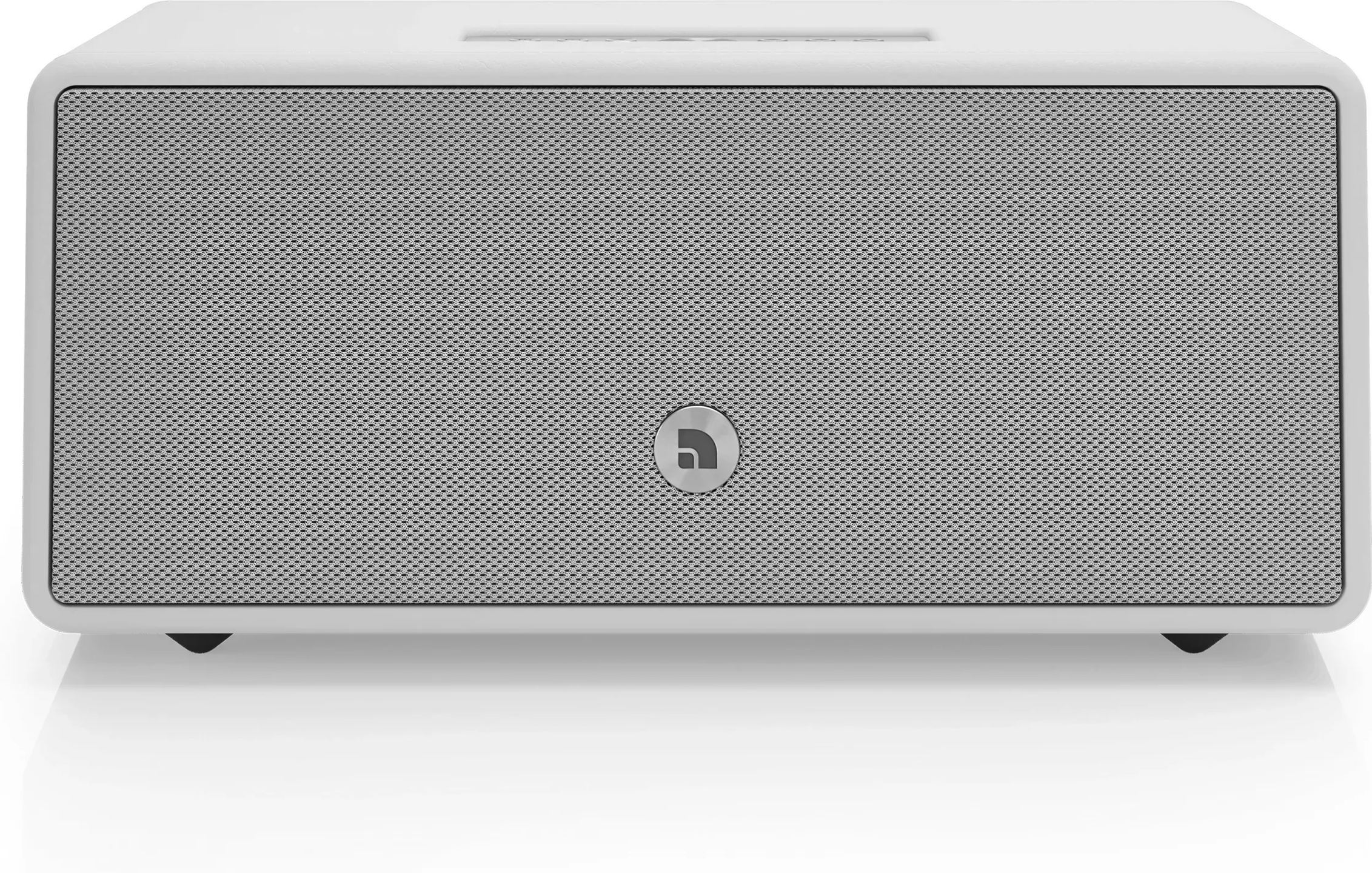
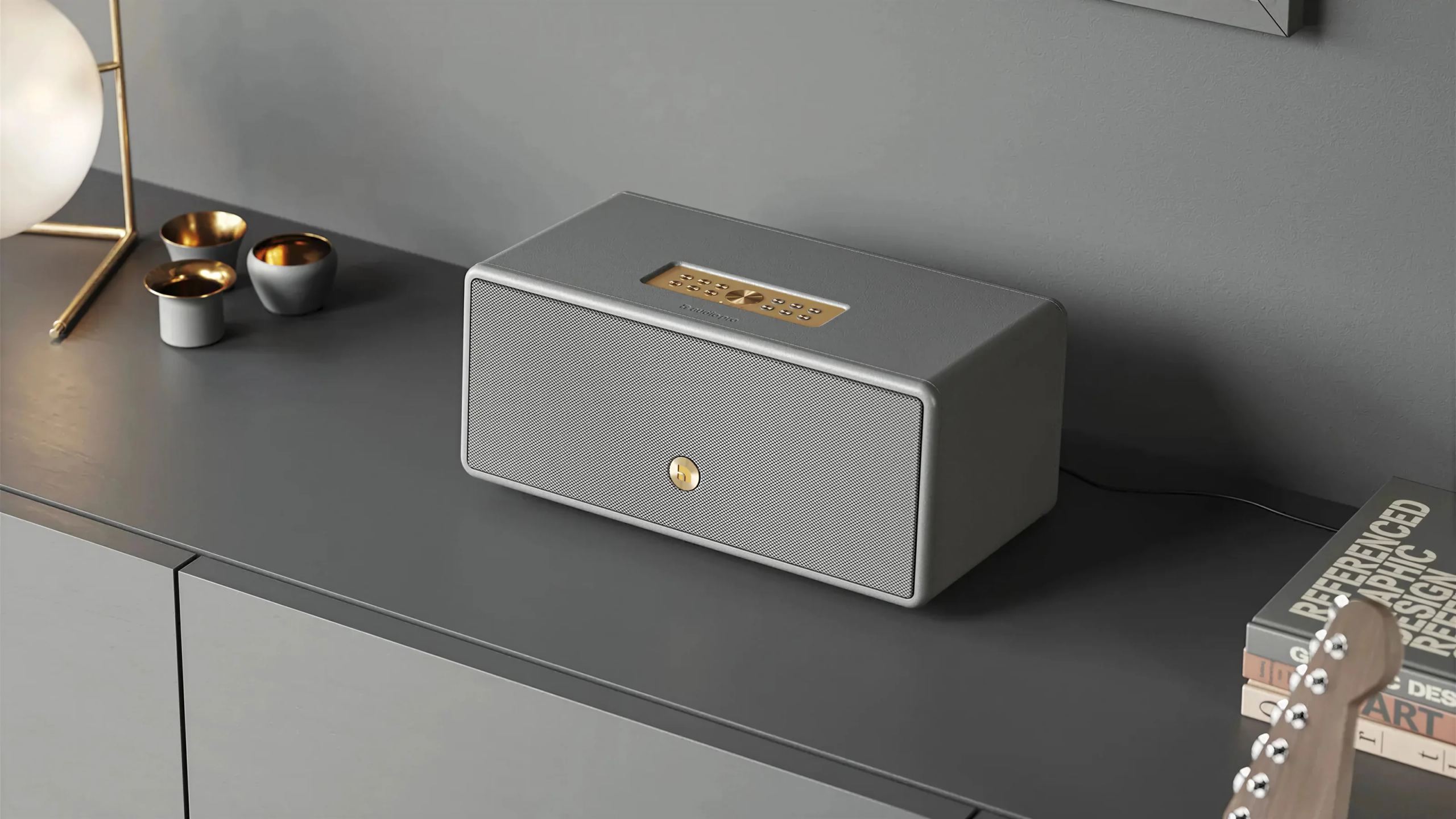
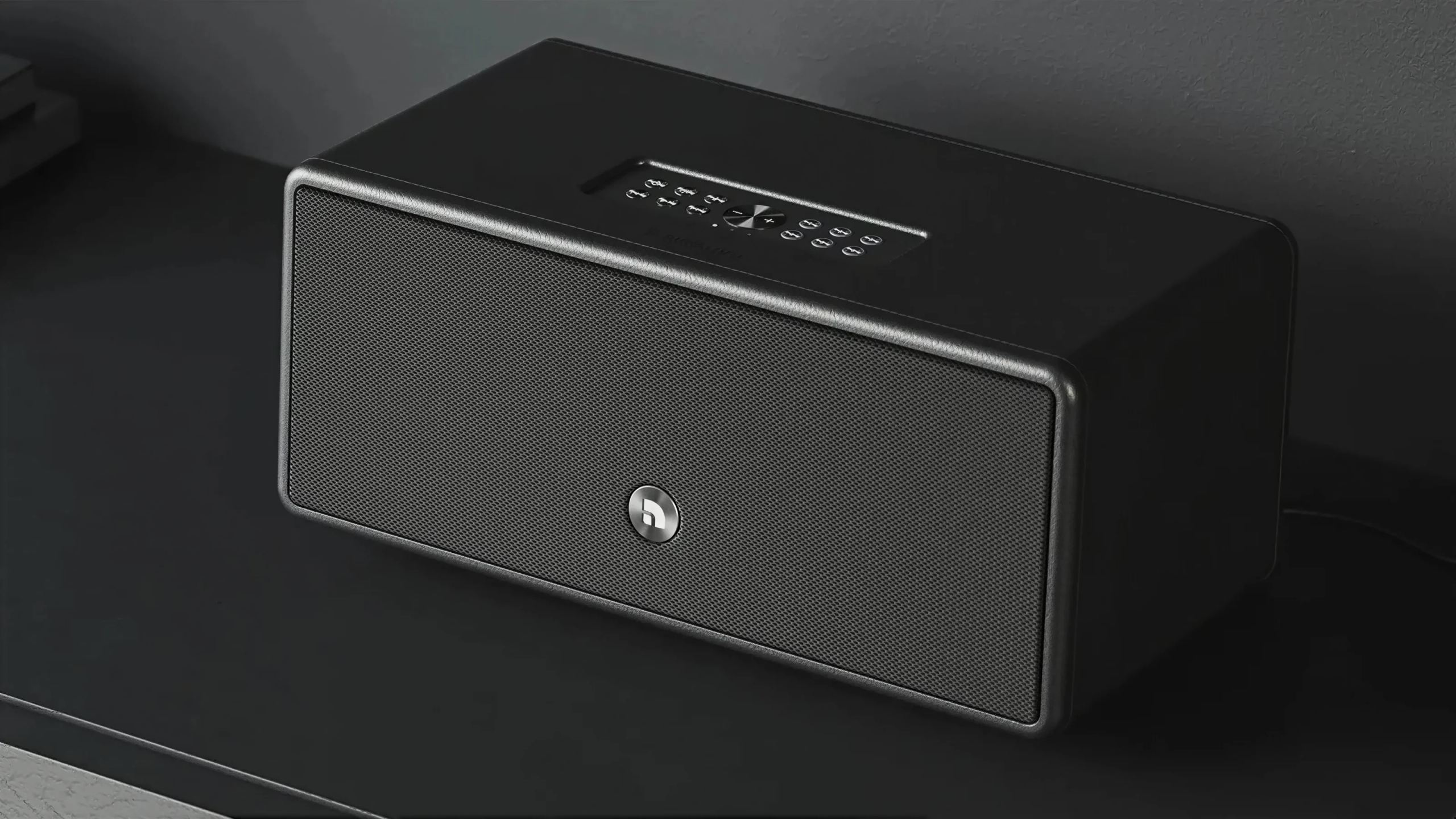
Since the first Drumfire in 2018, the range has borrowed the design of the amps lined up at the back of rock stages, and the D-2 W follows suit. The cabinet is fully wrapped in a leather-look covering held in place by hand stitching. The front is covered in fabric, and the top panel features solid aluminum components. Three colors are available: black, white, and gray. At 36.5 cm wide, 15.5 cm high, and 19 cm deep, this horizontal speaker sits on a sideboard, wide shelf, or low cabinet. Weighing 4.9 kg, it stays stable even when the volume goes up.
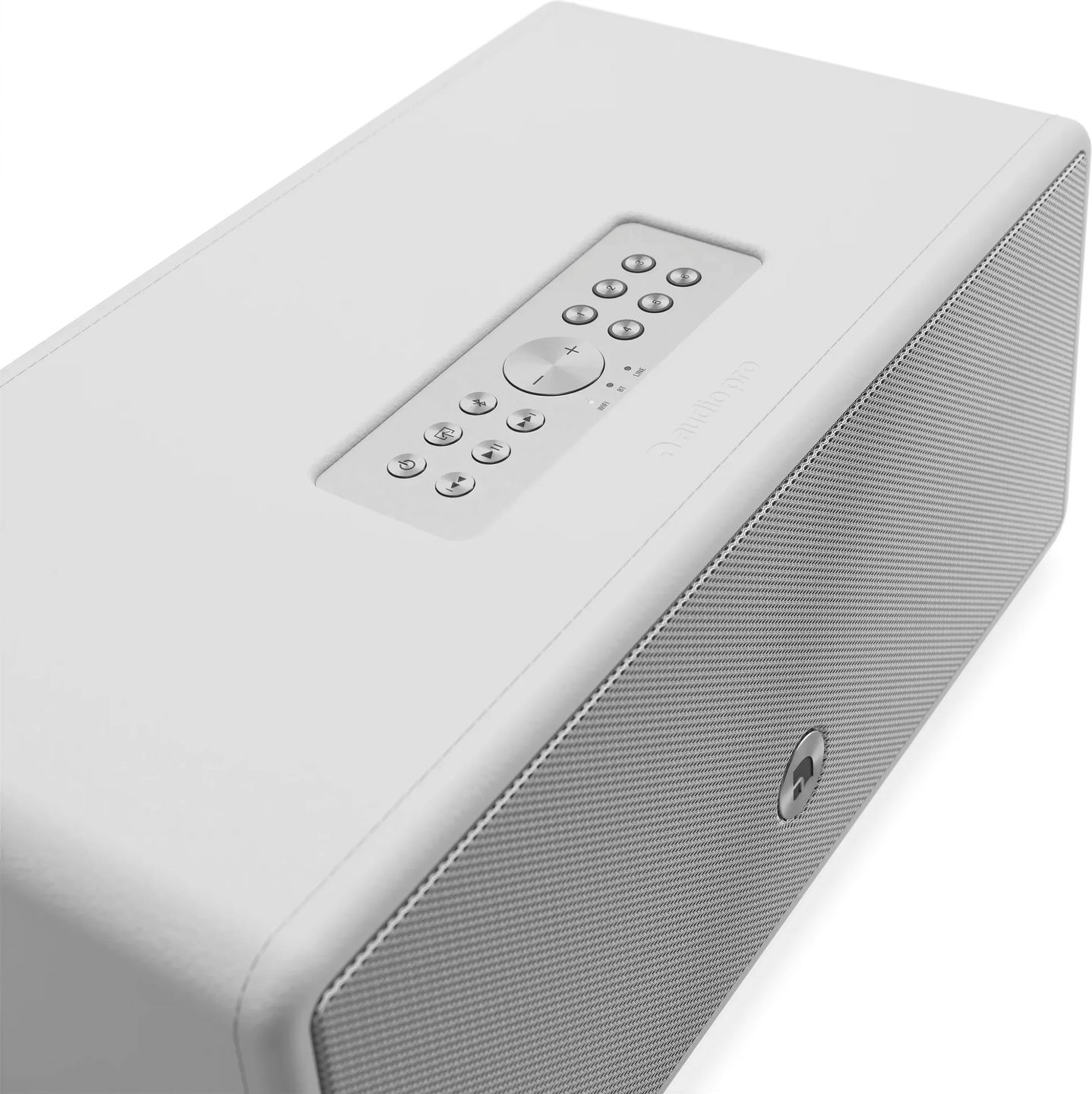
The touch controls are grouped on top: power, source selection, Bluetooth pairing, play and pause, previous or next track, and volume. There are also six preset buttons that bring up a playlist, album, or radio station with a single touch, without taking out your phone. To save what is currently playing, hold down the chosen button for three seconds, or use the app.
Four drivers for stereo sound from one cabinet
Each of the two channels combines a 25 mm soft-dome tweeter with an 11.4 cm coated-paper-cone woofer. The crossover is set at 2,500 Hz: below that, the woofer handles the bass, lower midrange, and most vocals; above it, the tweeter reproduces the upper frequencies, where cymbal tones and the breath in a voice are heard. The digital Class D amplification is spread across three channels, two rated at 20 W and one at 60 W, for a total of 100 W.
The bass-reflex design has a rear port that extends the low-frequency response. The stated frequency response runs from 61 Hz to 22 kHz, within ± 6 dB. The bass has substance with most music, but the very lowest octave remains out of reach: the lowest note of an electric bass, the sub-bass in electronic music. That is what the subwoofer output is for. The port needs some breathing room: in a bookcase or cabinet, allow about 20 cm above and at the sides, and 10 cm behind.
The two channels share the same cabinet, which narrows the stereo image compared with two speakers spaced apart in the room. For a wider left/right soundstage, two D-2 W speakers can be paired in the app.
Dual-band Wi-Fi, AirPlay, and Google Cast for everyday listening
The D-2 W connects to the home network via Wi-Fi 802.11ac, on either the 2.4 GHz or 5 GHz band. It has no Ethernet port, so Wi-Fi signal quality in the chosen location matters for stable playback. The Audio Pro app, available for iOS and Android, handles setup, equalizer adjustment, and playback. It provides access to Qobuz, TIDAL, Deezer, Amazon Music, Spotify, SoundCloud, TuneIn, and numerous Internet radio stations, with streaming up to 24-bit / 96 kHz. It also plays music stored on your phone or shared over the local network through Home Music Share. Spotify Connect and TIDAL Connect let you control listening directly from the service’s app. AirPlay (versions 1 and 2) takes over from an iPhone, iPad, or Mac, and Google Cast from compatible Android apps.
For multiroom listening, the speaker can be grouped with other W-generation Audio Pro models, as well as AirPlay 2 or Google Cast devices. The main speaker in a group can relay its own source, whether line input or Bluetooth, to all the others: a CD player connected in the living room can be heard in the kitchen. Bluetooth 4.2 remains available for a guest or for listening without a network connection.
A line input and a subwoofer output
Wired connectivity is limited to two RCA sockets. The line input accepts a CD player, a TV’s analog audio output, or a turntable connected through a phono preamplifier. There is no optical input, coaxial input, or HDMI: a TV equipped only with an optical output requires a small digital-to-analog converter.
The subwoofer output connects to a powered subwoofer for frequencies below 61 Hz. It links the D-2 W to the D-SUB subwoofer (20 cm driver, 200 W) in the Drumfire II W system. In this configuration, the crossover frequency adjusts automatically: the subwoofer takes over the bass, and the D-2 W, relieved of that work, plays louder without strain.
From the Drumfire D-2 to the W generation
The cabinet, drivers, and amplification remain the same as on the Drumfire D-2. The change is in the wireless features. The new Audio Pro app and Wi-Fi timing synchronization keep playback aligned from room to room. TIDAL Connect joins Spotify Connect, the sound adjustment has been revised, and the firmware updates itself without intervention. The D-2 W shares this platform with other W-generation speakers, such as the C5 MkII W, C10 MkII W, and C20 W, with which it can be grouped directly.
Documentation
Technical Specifications
Acoustic Design
- Multiroom connected speaker with a 2-way acoustic design
- Bass-reflex enclosure with rear port
- Drivers:
- 2 11.43 cm woofers with coated paper cones
- 2 2.54 cm soft-dome tweeters
- Passive radiator: no
Amplification and Audio Performance
- Amplifier power: 2 × 20 W + 60 W
- Frequency response: 61 Hz – 22 kHz (± 6 dB)
- Crossover frequency: 2500 Hz
- Audio streaming: up to 24 bits / 96 kHz
- In-room bass response: not specified by the manufacturer
Controls and Finish
- 6 preset buttons
- Touch controls on top
- In-app equalizer
- Leather-look finish with aluminum details
Connections
- 1 RCA line input
- 1 subwoofer output
- Ethernet: no
- Coaxial digital input: no
- Optical digital input: no
- HDMI ARC / eARC: no
- USB charging port: no
Connectivity and Playback
- Bluetooth 4.2
- Wi-Fi: 802.11 b / g / n / ac, dual-band 2.4 / 5 GHz
- AirPlay 1 and 2, Google Cast, Audio Pro multiroom
- Audio Pro app
- Playback from a smartphone
- Home Music Share over a local network
- Streaming services: Amazon Music, BBC Radio, Calm Radio, Deezer, Hotmix, iHeart Radio, Napster, Qobuz, Spotify, TIDAL, TuneIn, vTuner, SoundCloud, Pandora, Plex, Radio Paradise, QQMusic, among others
Dimensions and Power
- Dimensions (W × H × D): 155 × 365 × 190 mm
- Weight: 4.9 kg
- Built-in battery: no
- Standby power consumption: 1.7 W
Included Accessories
- Power cable, manual
Frequently Asked Questions
Can two D-2 W speakers be paired in stereo?
Yes. In the Audio Pro app, two D-2 W speakers can be set up as a left/right pair, with each playing just one channel. Placed two to three meters apart, they create a much wider soundstage than a single speaker. The pair can then join a multiroom group like any other speaker.
Can a turntable be connected directly?
Only if the turntable has a built-in phono preamp, or if you use an external preamp. The RCA input is a line input: a phono cartridge’s signal would be too weak and would lack the RIAA equalization needed to play a record. Once the preamp is in place, the record can be played through the other speakers in the group.
How do I connect the D-2 W to a TV?
Only via the analog RCA input. You therefore need a TV with an analog audio output, or a headphone output and a mini-jack-to-RCA cable. If the TV only has an optical output, an optical-to-RCA converter can make the connection. The speaker does not have HDMI ARC, so its volume cannot be adjusted with the TV remote control.
Does the D-2 W work without a Wi-Fi network?
Yes, via Bluetooth or the line input. Setup, access to streaming services, multiroom functionality and updates, however, require a high-speed Internet connection. Without a network connection, it works like a Bluetooth speaker or a conventional powered speaker.
What file formats does the D-2 W support?
MP3, WMA, AAC, FLAC and Apple Lossless (ALAC). For network playback, resolution goes up to 24-bit / 96 kHz. A 24-bit / 192 kHz file can be played, but at this capped resolution.
My Wi-Fi password contains accented characters: is that a problem?
That could be the cause. The speaker accepts UTF-8-encoded passwords, but not accented letters or certain special characters. If the connection fails during setup, that’s the first thing to check, and a guest network with a simple password can be a workaround.
Does the D-2 W go into standby mode automatically?
Yes, after about twenty minutes without a signal. It then uses 1.7 W and remains accessible on the network: starting playback from the app, AirPlay, Google Cast or Spotify Connect wakes it up.
- Eco-contribution included in the sale price.
- Manufacturer reference: 15331