Audio Pro Drumfire II W white


Specifications and features


Overview
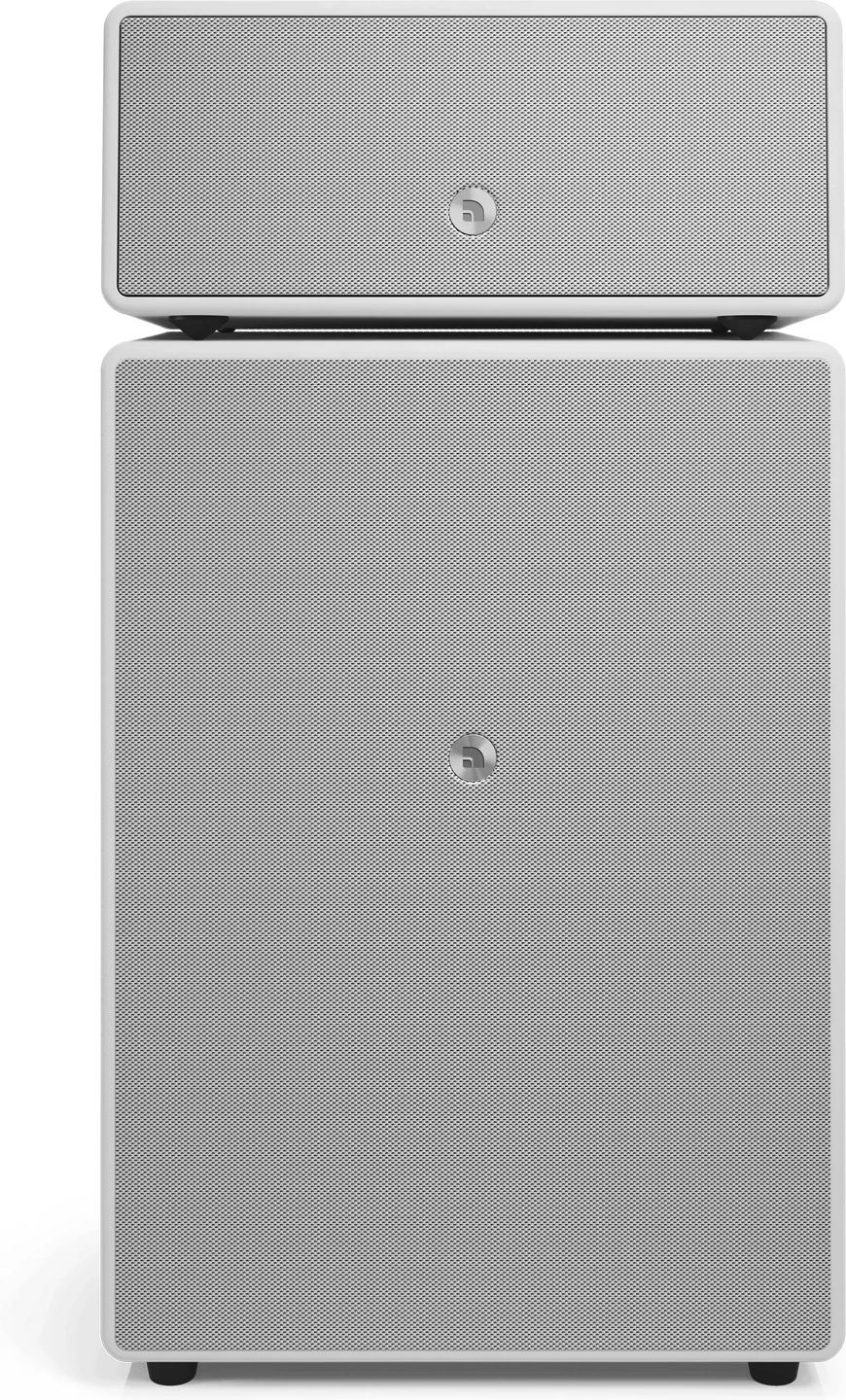
Two stacked cabinets, hand-stitched faux leather and solid aluminum details: the look recalls a guitar amp head sitting on its speaker cabinet, and the comparison extends to how it works. On top, a stereo speaker that receives music over Wi-Fi or Bluetooth; below, a 200 W subwoofer handling the low end. This W generation builds on the Drumfire II and moves to the new Audio Pro app.
A stereo module sitting on its subwoofer
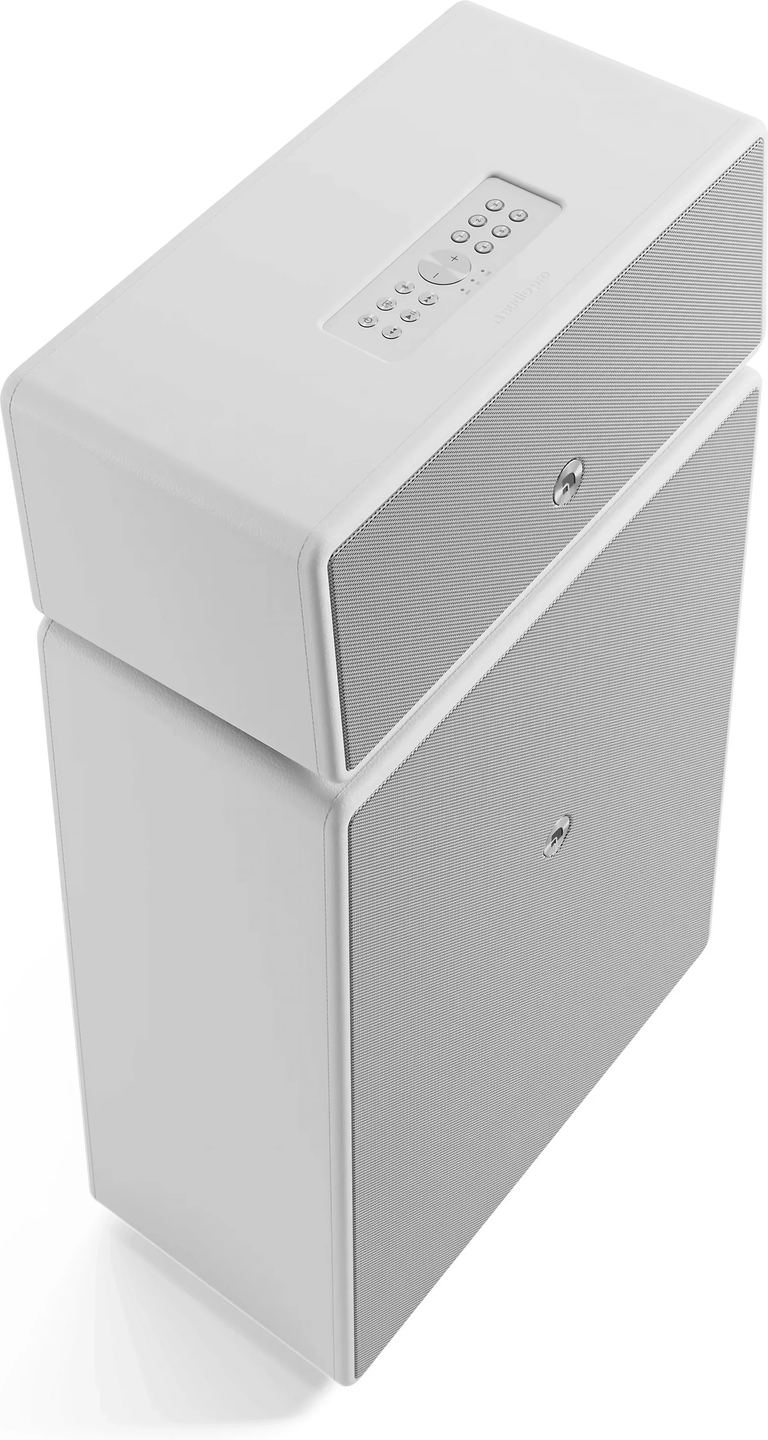
The Drumfire II W combines two components with the same width and depth (365 × 190 mm). The upper module, 155 mm high, is the Drumfire D-2 W: it houses the network electronics and two stereo channels, each comprising a 2.54 cm soft-dome tweeter and an 11.43 cm coated-paper woofer. This module sits on the D-SUB, a 500 mm-high subwoofer equipped with a 20 cm driver, also made of coated paper. Stacked, the system stands just over 65 cm high and weighs 16.6 kg: it sits on the floor, in a living-room corner or along a wall, and suits large rooms.
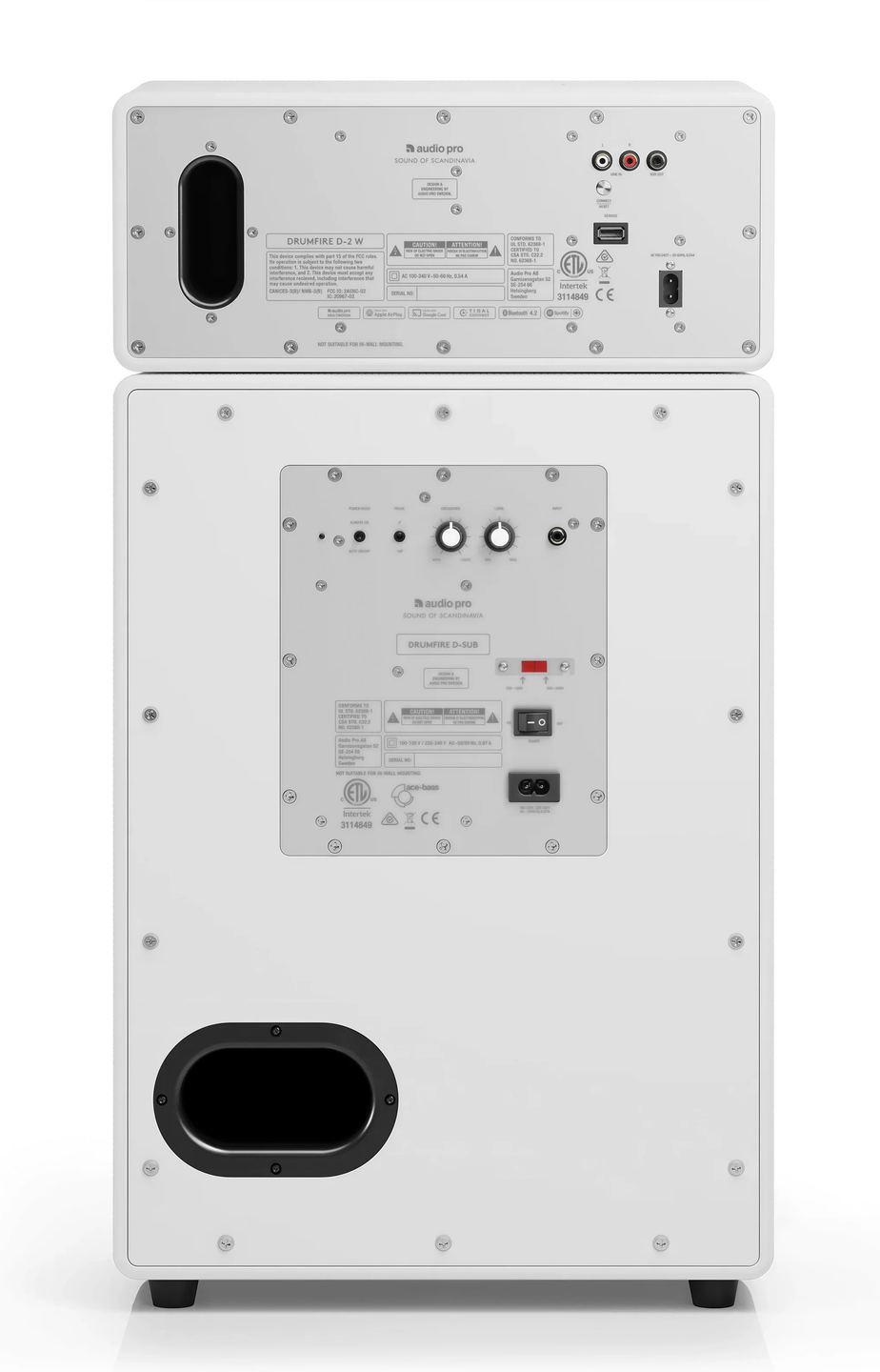
The two units are connected by a cable: the upper module’s subwoofer output (Sub Out) feeds the D-SUB, and the cable is supplied with the power cords and manual. Each cabinet has its own power supply, so two nearby outlets are needed.
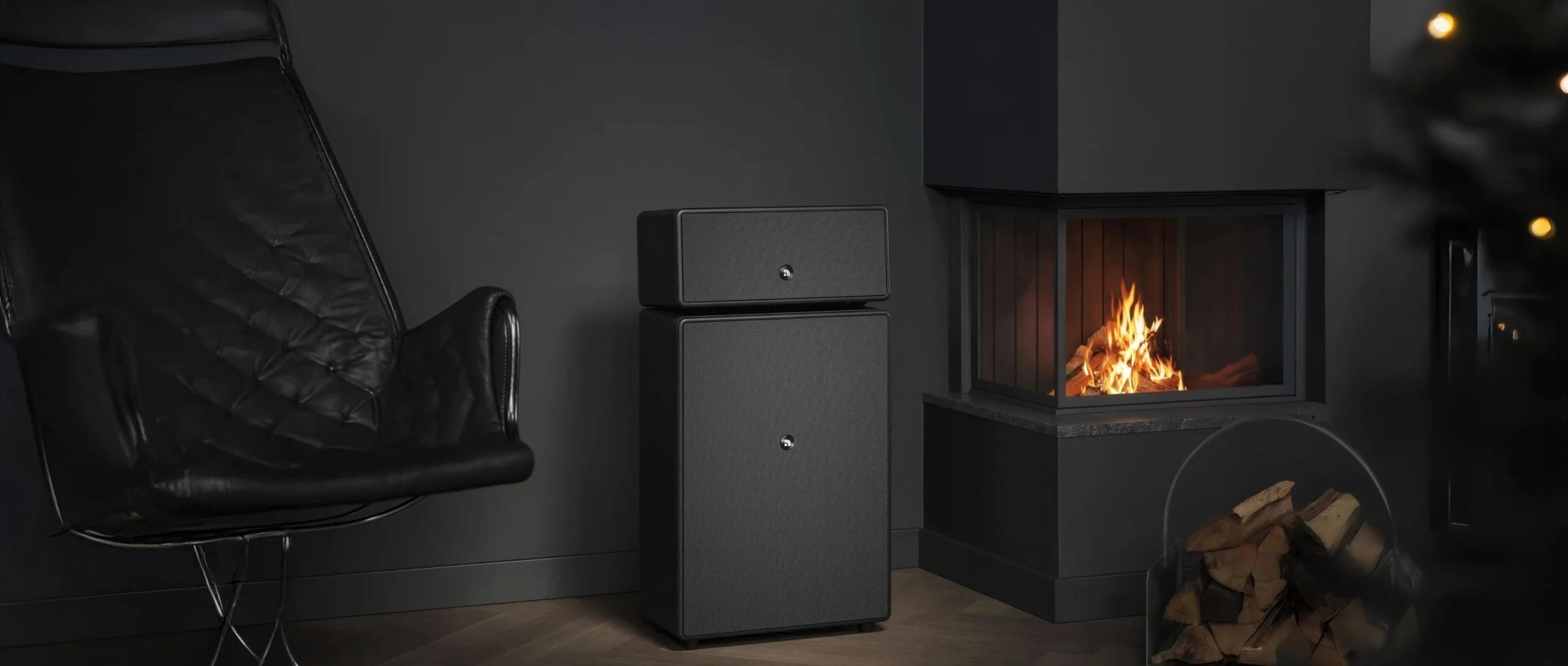
The faux-leather covering, visible stitching and solid aluminum parts echo the style of stage amplifiers. The Drumfire II W comes in white, black and gray.
Four amplifiers for 300 W in total
Power is distributed across four amplifier stages: 2 × 20 W for the tweeters, 60 W for the upper module’s woofers and 200 W for the subwoofer. Each group of drivers has its own amplifier, and the largest share of power goes to the subwoofer, where reproducing bass demands it most.
Crossover filtering takes place at two points. Around 2,500 Hz, the signal passes from the woofers to the tweeters. Lower down, between 50 and 120 Hz, the upper module hands over to the D-SUB: freed from the deepest bass, it reproduces upper bass and midrange with less strain, at both high and low volumes. Both cabinets use bass-reflex ports, which extend the bass response.
The frequency response spans 42 Hz to 22 kHz (±6 dB). Measured in a room, where the walls and floor reinforce the bass, it reaches down to 31 Hz at −6 dB. The difference between these two figures depends on placement: the closer the speaker is to a wall, the fuller the bass becomes.
Stereo has its limits. The left and right channels share the same cabinet, just a few centimeters apart, and separation fades as you move farther away. The Drumfire II W produces a room-filling sound from a single point, making it more like a powerful room speaker than a pair of widely spaced speakers.
Wi-Fi, AirPlay, Google Cast and built-in services
Connectivity starts with dual-band 2.4 GHz and 5 GHz Wi-Fi (802.11 b/g/n/ac), supporting streaming up to 24-bit / 96 kHz. From an iPhone or Mac, AirPlay sends audio from any app; from an Android phone or the Chrome browser, Google Cast does the same.
The Audio Pro app provides access to around twenty services: Spotify, TIDAL, Qobuz, Deezer, Amazon Music, Napster, Pandora, SoundCloud, Plex, and a wide choice of radio services (TuneIn, vTuner, Radio Paradise, BBC Radio, iHeart Radio, Hotmix, Calm Radio). It also plays music stored on the phone and files shared on the local network. Spotify Connect and TIDAL Connect let you control playback directly from each service’s own app.
Multiroom playback works in three ways: the Audio Pro system, which groups the brand’s speakers, AirPlay (1 and 2) and Google Cast, which also support compatible devices from other manufacturers. The Drumfire II W can play the same music as a small kitchen speaker or a different program in the living room.
Bluetooth 4.2 is useful for a guest or a phone without network access. There is no Ethernet port: the connection relies entirely on Wi-Fi, and the 5 GHz band gives the best results when the router is not too far away.
Just one wired input, analog
Connections are limited to one line-level RCA input. It accepts a CD player, the analog output of a TV or computer, or a turntable with a built-in or separate phono preamp, since the input does not amplify the weak signal from a cartridge. With no optical, coaxial or HDMI input, the Drumfire II W is primarily a speaker for music, not a TV sound system.
Touch controls and the Audio Pro app
The top of the upper module has touch controls, including six preset buttons. Each stores a radio station or playlist, recalled with a single press without using a phone: handy for starting a station in the morning, or for household members who have not installed the app.
The Audio Pro app, on iOS and Android, is the main upgrade in this W generation. It brings together multiroom management, access to services and an equalizer that adjusts the tonal balance to suit the room or your tastes. The speaker’s firmware updates itself over the network.
Documentation
Technical specifications
Design and acoustics
- Multiroom wireless speaker with a classic rock ’n’ roll design
- 2-way acoustic design with integrated subwoofer
- Bass-reflex design for the speakers and subwoofer
- Drivers: 2 × 11.43 cm coated-paper cone woofers, 2 × 2.54 cm soft-dome tweeters
- Passive radiator: no
Amplification and performance
- Total amplifier power: 300 W
- Tweeters: 2 × 20 W
- Woofers: 60 W
- Subwoofer: 200 W
- Frequency response: 42 Hz – 22 kHz (±6 dB)
- Bass response: 31 Hz (−6 dB)
- Crossover frequencies: 2500 Hz + 50–120 Hz
- Streaming quality: up to 24-bit / 96 kHz
Connections
- Analog input: 1 RCA input (line input)
- External subwoofer output: 1 Sub Out output
- Ethernet: no
- Coaxial digital input: no
- Optical digital input: no
- HDMI / ARC / TV: no
- Line output: no
- USB charging port: no
Connectivity and streaming services
- Bluetooth 4.2
- Wi-Fi 802.11 b / g / n / ac, dual-band 2.4 GHz / 5 GHz
- Multiroom technologies: Multiroom Audio Pro, Apple AirPlay 1 and 2, Google Cast
- Compatible services: Spotify, TIDAL, Qobuz, Deezer, Amazon Music, TuneIn, vTuner, SoundCloud, Pandora, Napster, QQMusic, Radio Paradise, among others
Controls and app
- Touch controls on the top panel, 6 preset buttons
- Dedicated Audio Pro app, available on iOS and Android
- Multiroom management, adjustment of the in-app equalizer, control of speaker functions
Dimensions and power
- Dimensions: 155 × 365 × 190 mm / 500 × 365 × 190 mm
- Weight: 16.6 kg
- Built-in battery: no
- Standby power consumption: 1.7 W
Included accessories
- Power cables, user manual, subwoofer cable
Frequently Asked Questions
What’s the difference compared with the previous-generation Drumfire II?
Dimensions, weight, drivers and power distribution are identical, and AirPlay 2 and Google Cast were already included. The W version changes the software side: it is controlled with the new Audio Pro app (the original Drumfire II still uses the Audio Pro Legacy app), its sound tuning has been revised, and its firmware updates automatically.
Can the top module work on its own?
Yes. It is the Drumfire D-2 W, which is also sold separately and contains all the network electronics and both stereo channels. Without the D-SUB, the bass does not extend nearly as low, since the module must reproduce the entire frequency range on its own.
How do I connect the Drumfire II W to a TV?
Without an HDMI or optical input, the connection uses the TV’s analog output (headphone jack or RCA) connected to the speaker’s RCA input. Bluetooth also works, but there may be a slight delay between the sound and picture during dialogue. For primarily TV use, a soundbar with an HDMI eARC connection is a better choice.
Can I connect a turntable to it?
Yes, provided the signal is at line level. A turntable with a built-in phono preamp connects directly to the RCA input; a turntable without one requires an external phono preamp between them.
Can you listen to your own music library?
Yes, in two ways. The app plays files stored on your phone and accesses libraries shared over your local network, whether they’re on a computer, a network drive, or a Plex server.
Where should I place the speaker for balanced bass?
On the floor, starting about twenty centimeters from the rear wall. Moving the speaker closer to a wall, and even more so to a corner, boosts the bass; if the sound becomes too bass-heavy, moving it a little farther away or reducing the bass in the app’s equalizer is usually enough.
Is 24-bit / 96 kHz quality available regardless of the source?
No, it depends on how you stream it. Qobuz or TIDAL, played through the Audio Pro app or their Connect feature, support high-resolution audio up to 24-bit / 96 kHz. AirPlay streams at CD quality, while Bluetooth compresses the signal: for high-resolution files, the built-in services and Wi-Fi remain the best option.
- Eco-contribution included in the sale price.
- Manufacturer reference: 15321