

Advance Paris A-BTC
Complementary products
Specifications and features


Advance Paris A-BTC, two-way Bluetooth module
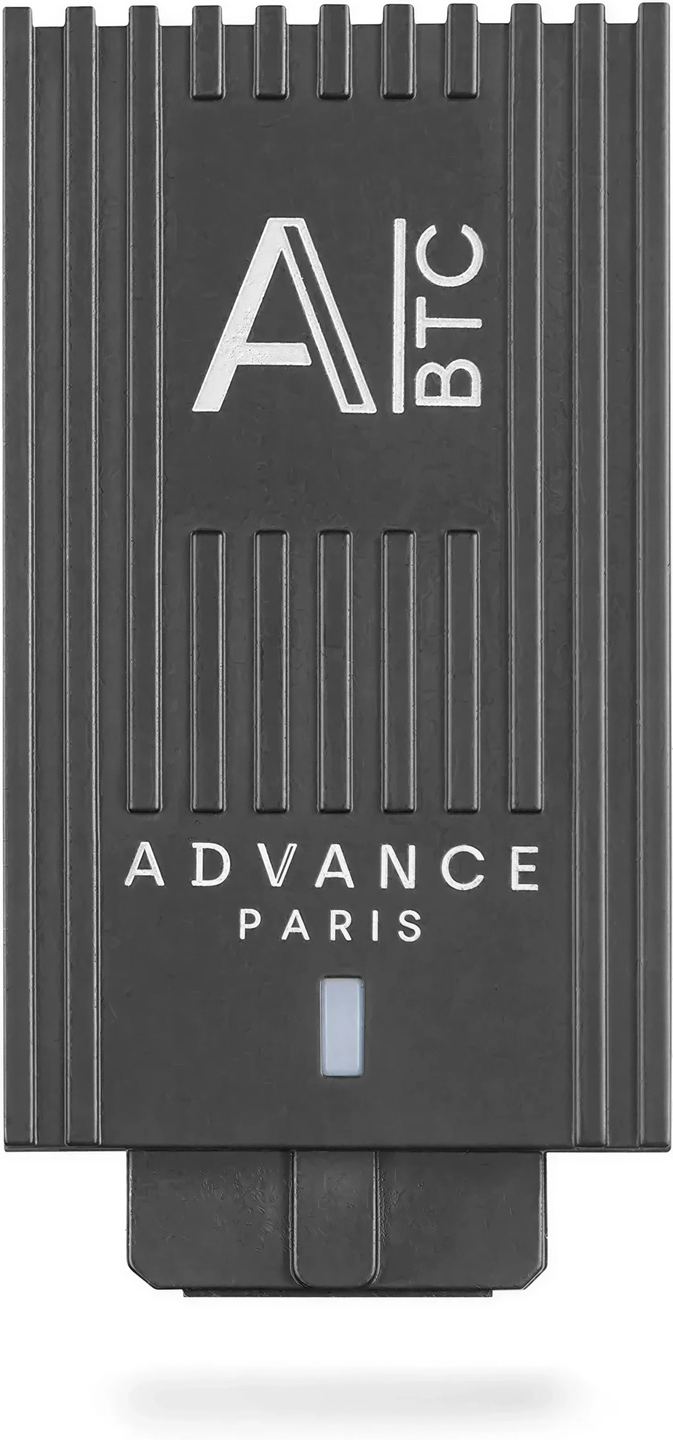
Slotted into the dedicated socket on the back of an Advance Paris amplifier, this 13-gram module adds two-way Bluetooth. It receives music from a smartphone, tablet or computer and, on some models in the range, sends the amplifier’s sound to wireless headphones, so you can listen late at night without waking anyone.
A plug-in module rather than a built-in receiver
Bluetooth evolves much faster than an amplifier ages: standards, codecs and chips change every two or three years, while good hi-fi electronics can last ten years or more. Advance Paris therefore keeps the wireless circuitry outside its amplifiers, housing it in a removable module. When a new generation arrives, you replace the module, not the amplifier. The A-BTC succeeds the X-FTB01 and X-FTB02 receivers and adopts Bluetooth 5.4, the latest standard it supports.
The ridged black housing, measuring 55 × 16 × 28 mm, bears the brand logo and a small blue LED that indicates its status. Once installed, it protrudes little more than a cable connector from the back of the unit. It draws power from the amplifier itself: no power adapter to plug in, no extra cable behind the cabinet.
Conversion handled by the amplifier’s DAC
An ordinary Bluetooth receiver receives the wireless stream, decodes it, then converts it to an analog signal with its own chip, often a modest one, before sending it to a line input. The A-BTC stops before that final step. It sends a signal that remains digital, at up to 24 bits and 48 kHz, directly to the amplifier’s digital-to-analog converter. That converter, which is far more refined than the one in a Bluetooth receiver, turns the music into an audible signal. Advance Paris calls this approach Direct Path. On an A-i190 NOVA, music sent from a phone therefore passes through the same ESS converter as a CD player or television connected digitally.
High-definition codecs for reception
Bluetooth does not carry music unchanged: it compresses it using a codec, an encoding method that the transmitter and receiver must both support. The more advanced the codec, the more information it can convey. For reception, the A-BTC supports virtually everything available today. SBC, present on all devices, provides a common baseline. AAC is the codec favored by the iPhone and iPad. The aptX family covers a large share of Android smartphones, from aptX HD to aptX Adaptive, which adjusts its bitrate to the quality of the radio connection, and aptX Lossless, which can transmit lossless CD-quality audio when conditions allow. LDAC, developed by Sony, reaches up to 990 kbit/s on Android phones that support it.
The module does not make the choice alone: the connection uses the best codec supported by both devices. An iPhone will stay on AAC, while a recent Android smartphone may switch to LDAC or aptX Lossless if it supports them.
Wireless headphone listening on NOVA and the A10 and A12 APEX
On NOVA-series amplifiers (A-i130 and A-i190) and on the A10 and A12 APEX, the A-BTC also works as a transmitter. It takes the sound from the source selected on the amplifier, whether a turntable, a CD player or the television, and sends it to Bluetooth headphones. The module works in one direction at a time: it receives or transmits, but not both at once.
For transmission, the codec list narrows to SBC, aptX, aptX HD and aptX Adaptive. Headphones compatible with aptX HD or aptX Adaptive will make the most of the connection. A model limited to LDAC and AAC, as is often the case with manufacturers that do not include aptX, will fall back to SBC—adequate for occasional listening, but less refined.
Compatibility with Advance Paris amplifiers
The A-BTC plugs into a proprietary socket found only on Advance Paris devices equipped with one. Both reception and transmission work on the A-i130 NOVA, A-i190 NOVA, A10 APEX and A12 APEX. The A8 APEX supports reception only: you can listen to music from your phone through it, but cannot send its sound to headphones. On these models, the module remains an optional extra sold separately, like the A-NTC network module for NOVA amplifiers.
Documentation
French
Technical specifications
Function and compatibility
- Model: Advance Paris A-BTC
- Type: plug-in Bluetooth receiver and transmitter module
- Function: adds Bluetooth to an Advance Paris amplifier equipped with the dedicated socket
- Reception: playback from any Bluetooth source, including a smartphone, tablet or computer
- Transmission to Bluetooth headphones: compatible with devices in the NOVA range and the A10 / A12 APEX; sound from sources connected to the amplifier is transmitted to the headphones
Bluetooth
- Version: Bluetooth 5.4
- Receive codecs (Rx): SBC, AAC, aptX, aptX HD, aptX Adaptive, aptX Lossless, LDAC
- Transmit codecs (Tx): SBC, aptX, aptX HD, aptX Adaptive
Dimensions and weight
- Module:
- Dimensions: 55 × 16 × 28 mm
- Net weight: 13 g
- Packaging:
- Dimensions: 85 × 85 × 34 mm
- Gross weight: 65 g
Frequently Asked Questions
Can the A-BTC be used with an amplifier from another brand or via a USB port?
No. The module plugs into a proprietary Advance Paris socket and does not work like a universal USB Bluetooth dongle. On a device from another brand, it would have neither power nor a digital connection.
Is my Advance Paris amplifier from the Classic or MyConnect range compatible?
Not yet. A software update for the Classic and MyConnect amplifiers, planned by Advance Paris for late October 2026, should make them compatible. Devices in these ranges with an input for an X-FTB01 or X-FTB02 receiver will support the A-BTC.
Do I need to pair my phone again every time I listen?
No. Like any Bluetooth device, the A-BTC remembers previously paired sources. Then simply select the Bluetooth input on the amplifier and choose the module in your phone’s settings.
Can you watch a movie with headphones while the TV speakers are on?
Yes, if the TV is connected to the amplifier (via HDMI eARC or an optical connection, depending on the model) and the amplifier is a NOVA or an A10 or A12 APEX. The delay between picture and sound depends on the codec: aptX Adaptive has significantly lower latency than SBC, making compatible headphones the best choice for video.
Is Bluetooth reception as good as a wired source?
Even with aptX Lossless or LDAC, Bluetooth still depends on the quality of the radio connection and what the source sends it: a track already compressed by a streaming service gains nothing from being transmitted through a lossless codec. The module offers a comfortable, well-balanced listening experience, but a network player or CD player connected digitally still has the edge for critical listening.
What if the phone only supports SBC?
The connection still works, since all Bluetooth devices support SBC. On Android, Developer options let you check which codec is in use and, sometimes, switch to another one supported by the phone.
- Eco-contribution included in the sale price.
- GTIN / EAN: 3760179292640




