iFi Audio iDSD GR 2 MT
Specifications and features


Overview
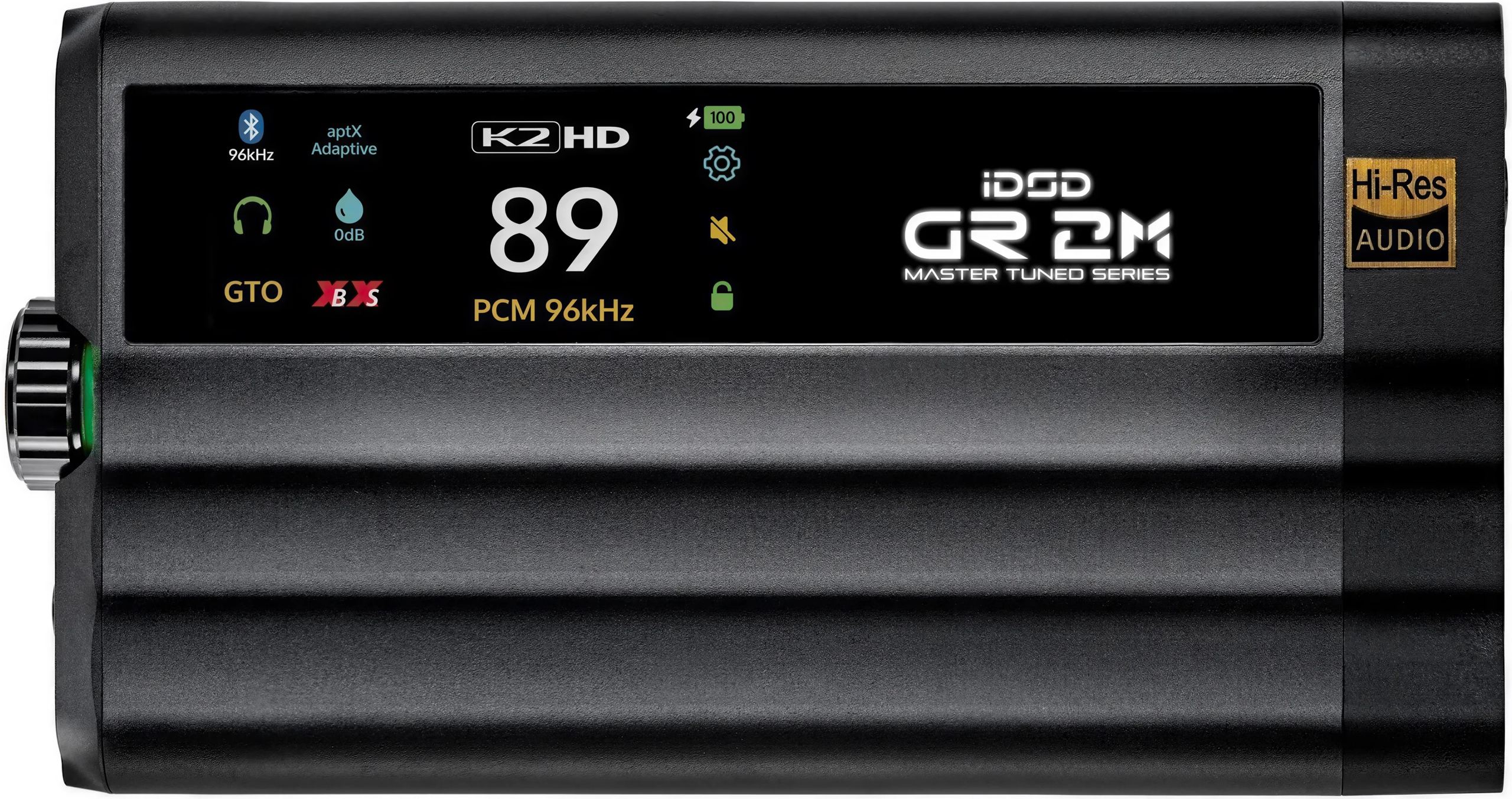
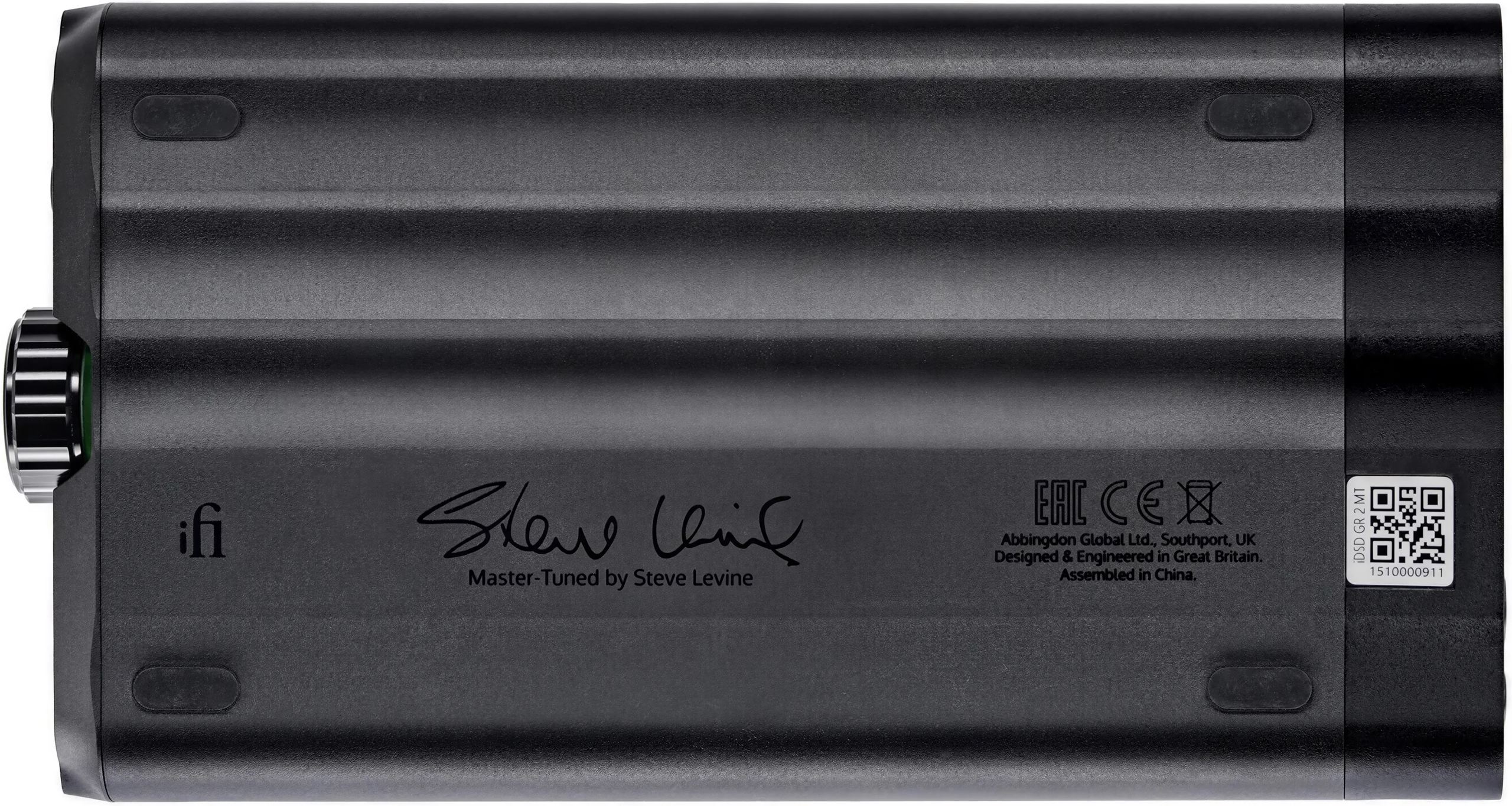
From the outside, almost nothing distinguishes this version from the iDSD GR 2, iFi Audio’s portable DAC and headphone amplifier: the same dimensions and the same touchscreen. The differences are inside. British producer Steve Levine has tuned two digital filters by ear, and iFi has replaced the circuit board along with several components in the signal path. The letters MT stand for Master Tuned.
Two digital filters tuned by Steve Levine
Every DAC applies a digital filter to the signal. This filter removes artifacts generated above the audible band during sound reconstruction, and its design (steeper or gentler roll-off, phase behavior, ringing before or after an attack) slightly alters the definition of transients and the sense of space. It is not an equalizer: the differences between filters are subtle, more or less perceptible depending on the headphones and the recording.
Steve Levine, a Grammy and Brit Award winner, has produced Culture Club, the Beach Boys, Motörhead and Gary Moore. He worked with iFi’s engineers on two exclusive filters, one for PCM files and the other for DSD, and every listening-based decision for this version went through him. His aim is to reproduce the balance and emotional impact he seeks in the studio when capturing a take. The filter can be selected from the touchscreen or the iFi Nexis app.

A ceramic board and a revised conversion stage
Most electronic circuits use a glass-epoxy substrate called FR-4, as found in the standard GR 2. The GR 2 MT switches to a hydrocarbon-ceramic laminate derived from aerospace and radio-frequency circuits, with lower dielectric losses that are more stable with temperature. The signal travels across a substrate that alters it less.
The second change occurs directly at the output of the conversion chip. The Burr-Brown PCM1795 outputs current rather than voltage, and it is up to iFi to build the circuit that converts this current into usable voltage, known as the I/V stage. On the GR 2, this stage combines OVA2637 operational amplifiers with standard surface-mount resistors. The MT uses OV4627A units and precision tantalum resistors, which improve the balance between the left and right channels and stabilize the soundstage. In the amplifier, standard electrolytic capacitors give way to Japanese Audio Note Kaisei capacitors, chosen for the density they bring to the midrange.
The only visible sign of these changes is that the logo next to the screen is now fully illuminated. The stated power, signal-to-noise ratio and distortion remain those of the GR 2: these replacements affect the character of the sound, not the figures.
Power and balanced circuitry carried over from the GR 2
The circuit is balanced from end to end, from conversion to the headphone outputs, with Class A operational amplifiers. Through the 4.4 mm balanced jack, it delivers up to 1513 mW into 32 Ω, or 50% more than the older xDSD Gryphon, and 119 mW into 600 Ω. Its maximum voltage of 8.6 V is sufficient for high-impedance dynamic headphones as well as low-sensitivity planar models.
The 3.5 mm S-Balanced jack accepts a standard plug while benefiting from the balanced circuit: each channel has its own ground return, reducing crosstalk between left and right. It delivers 567 mW into 32 Ω.
Output impedance remains below 0.4 Ω at 4.4 mm and 0.2 Ω at 3.5 mm. This low value prevents the amplifier from shifting the tonal balance of a multi-driver in-ear monitor whose impedance varies with frequency. The noise floor sits 115 dB below the maximum level (A-weighted) across all outputs.

Home DAC connectivity in 268 grams
Over USB-C, the GR 2 MT accepts PCM up to 768 kHz at 32 bits and DSD up to DSD512. A combined S/PDIF jack accepts an optical or coaxial connection from a television, console or CD player. Bluetooth 5.4 supports aptX Lossless, aptX Adaptive, aptX, LDAC up to 990 kbit/s, LHDC/HWA, AAC and SBC, covering both Android smartphones and iPhone.
The 4.4 mm and 3.5 mm analog inputs turn the GR 2 MT into a standalone headphone amplifier: a portable player or another DAC can be connected to benefit from its power. In the other direction, the 4.4 mm and 3.5 mm line outputs feed an amplifier or powered speakers. K2HD processing, developed by JVCKENWOOD, reintroduces the subtle harmonics lost when a recording was digitized.
Battery, desktop mode and Nexis app
The 4900 mAh lithium-polymer battery lasts around seven hours, a duration that decreases with power-hungry headphones at high volume or over Bluetooth. A full recharge takes around 3 hours 30 minutes with a USB-C charger. Hybrid power management prioritizes mains power when an external source is connected, drawing on the battery only during peaks in power consumption before returning to mains power. Placed next to a computer for the day, the GR 2 MT stays plugged in without using up its charge cycles.
The color OLED touchscreen provides direct access to the main settings without digging through menus. The iFi Nexis app provides access to advanced settings and installs firmware updates wirelessly.
Technical specifications
Audio conversion and processing
- Type: portable digital-to-analog converter (DAC) / headphone amplifier
- DAC chip: Burr-Brown PCM1795
- PCM resolution: up to 32 bits / 768 kHz
- DSD support: up to DSD512
- Audio technologies: K2HD, iEMatch, proprietary PCM and DSD filters
Connectivity and inputs
- Bluetooth: version 5.4
- Codecs: aptX Lossless, aptX Adaptive, aptX, LDAC, LHDC / HWA, AAC, SBC
- Wired digital inputs: 1 × USB-C, 1 × optical / coaxial S/PDIF
- Analog inputs: 1 × balanced 4.4 mm jack, 1 × unbalanced 3.5 mm jack
Outputs and amplification
- Analog outputs: 1 × balanced 4.4 mm jack, 1 × unbalanced 3.5 mm jack
- Headphone outputs: 1 × balanced 4.4 mm jack, 1 × 3.5 mm S-Balanced jack
- Amplification architecture: fully balanced, Class A output stage
- Output power:
- Up to 1513 mW RMS into 32 Ω
- Balanced 4.4 mm output: 119 mW into 600 Ω
- 3.5 mm output: 567 mW into 32 Ω, 30 mW into 600 Ω
- Maximum output voltage: 6.94 V into 32 Ω (balanced 4.4 mm), 8.60 V into 600 Ω
- Output impedance:
- 4.4 mm output: ≤ 0.4 Ω
- 3.5 mm output: ≤ 0.2 Ω
- Signal-to-noise ratio (SNR) / dynamic range (DNR): 115 dBA
- Total harmonic distortion and noise (THD + N):
- Headphone outputs: 0.006% at 16 Ω
- Line outputs: 0.0005% at 0 dBFS
Display
- Display: color OLED, capacitive touchscreen
Battery and power supply
- Battery: lithium-polymer, 4900 mAh
- Battery life: approximately 7 hours
- Power supply: USB-C, 5 V / > 1.8 A
- Charging time: approximately 3.5 hours
Dimensions and weight
- Dimensions (W × H × D): 141 × 75 × 19 mm
- Net weight: 268 g
Frequently Asked Questions
Can an iDSD GR 2 owner get Steve Levine's filters through an update?
No. Both filters are exclusive to the MT version, and the hardware modifications (ceramic board, I/V stage, Audio Note capacitors) cannot be installed via software. The standard GR 2 retains its own filters, tuned by the iFi team.
Does the GR 2 MT work with an iPhone?
Yes, in two ways. iPhones equipped with a USB-C port connect directly via cable and send an uncompressed digital stream. Over Bluetooth, the iPhone only transmits in AAC: aptX Lossless and LDAC require a compatible Android smartphone.
What does aptX Lossless mean in practice?
This codec transmits a lossless stream at 16-bit/44.1 kHz, CD resolution, provided that the smartphone is Snapdragon Sound certified and the wireless connection is good. When conditions deteriorate, it switches to a lower bitrate with compression. LDAC, meanwhile, remains a lossy codec, even at its maximum bitrate of 990 kbit/s.
Could a highly sensitive in-ear earphone produce audible hiss?
With 1.5 W available, there is a risk with high-sensitivity earphones. The iEMatch function, now built around low-impedance MOSFET transistors, reduces the output gain and noise floor. The output impedance then rises to approximately 4.5 Ω. The volume control also retains more travel before reaching a normal listening level.
Can the K2HD processing be reduced?
Yes. K2 mode applies similar processing, without the oversampling used by K2HD. It is suitable for those who prefer more subtle processing of the signal.
Can the GR 2 MT be connected to a hi-fi system?
Yes, via its line outputs. The balanced 4.4 mm output connects to the XLR input of an amplifier or active speakers with a 4.4 mm to XLR cable, and the 3.5 mm output to an RCA input with a jack to RCA cable. The GR 2 MT then serves as a converter for a computer, a television via the optical connection or a smartphone via Bluetooth.
Do updates require a computer?
No, the iFi Nexis app installs them wirelessly from a smartphone. The app’s features that use the USB connection are only available on Android.
What's in the box?
The GR 2 MT comes with a card signed by Steve Levine, a USB-A to USB-C cable, a USB-C to USB-C cable, a microfiber protective pouch, and a manual. Charging requires a USB-C charger capable of supplying 5 V at more than 1.8 A, to be purchased separately. The warranty is two years in the European Union.
- Eco-contribution included in the sale price.
- Manufacturer reference: IFI0060
- GTIN / EAN: 5061043053625