

T+A Talis R 330 black (pack of 2)


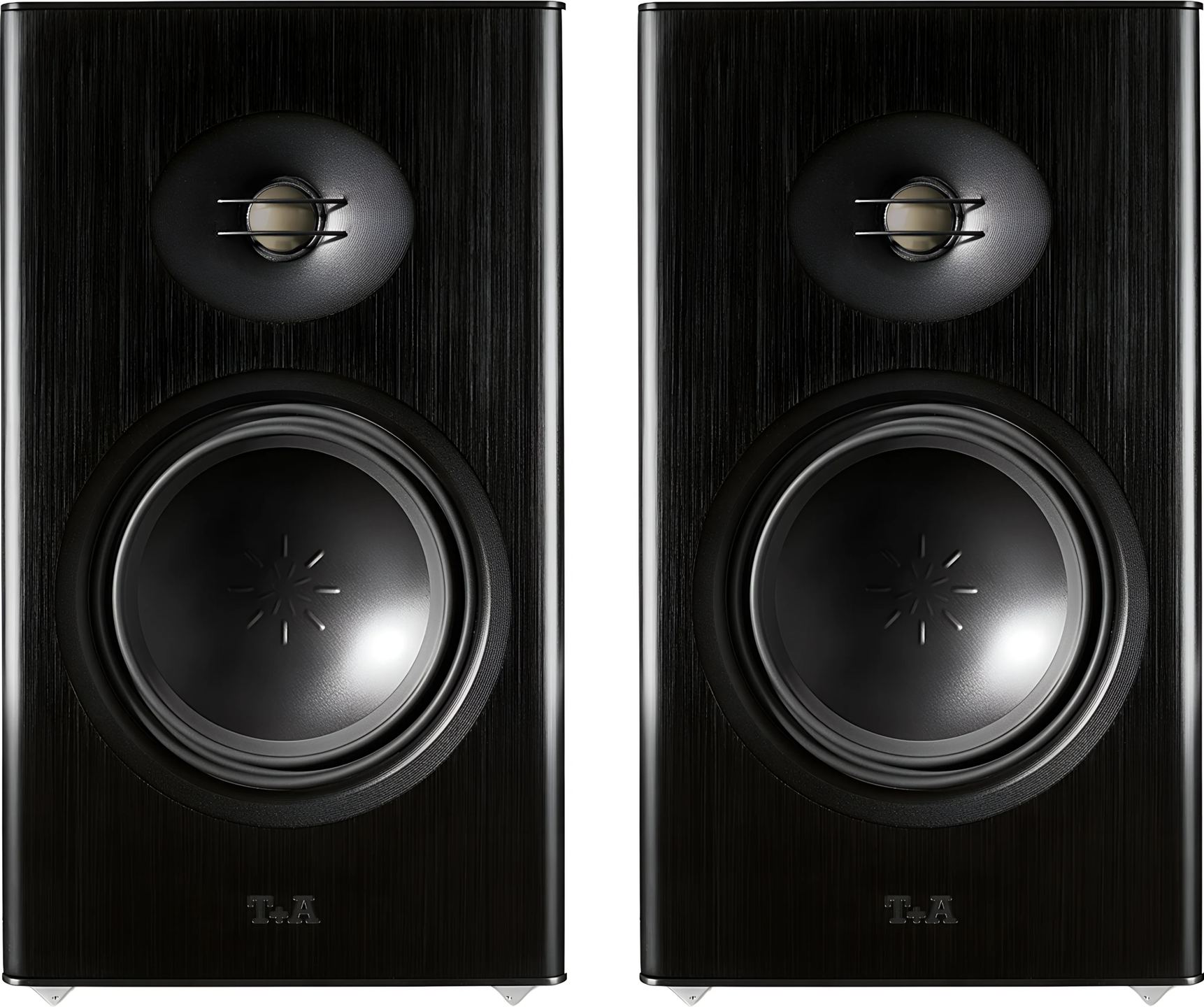
T+A Talis R 330: the aluminium compact from Herford
More than twenty litres of usable volume in a cabinet 37 centimetres tall: this two-way speaker’s proposition lies in that relationship between its footprint and its interior. T+A takes the solutions from its Talis S 330 floorstander—hand-brushed aluminium, a wraparound baffle and an in-house crossover—and brings them to a bookshelf format. It succeeds the Talis R 300, with redesigned lines and reworked bass.
An aluminium cabinet with no visible screws
The cabinet is made of hand-brushed anodised aluminium, in black or silver. The drivers are black in both cases: on the black version, everything blends into a single shade; on the silver version, they contrast sharply with the metal. The design moves away from the R 300’s stark geometric simplicity and adopts slightly tapered sides, joined to the front baffle by an almost invisible chamfer.
This front panel is a WrapAround Baffle, a component exclusive to the Talis range. It wraps around the entire front of the speaker and meets the cabinet body only at a carefully calculated point at the rear. The drivers and their mountings are secured from inside, with no visible screws. The benefit goes beyond aesthetics: the shortest wavelengths, those of the treble, react to the slightest edge or discontinuity in the baffle, which then reflects some of the sound and slightly colours the upper frequencies. By eliminating these breaks, T+A achieves cleaner treble, building on its previous Organic Baffle.
The thin, rigid side panels provide an internal volume of more than twenty litres within overall dimensions of 37 × 21 × 28 cm. Each speaker weighs 15 kg, a substantial weight for this size, owing to the density of the metal and the internal structure. It is best handled with care when unpacking and positioning.
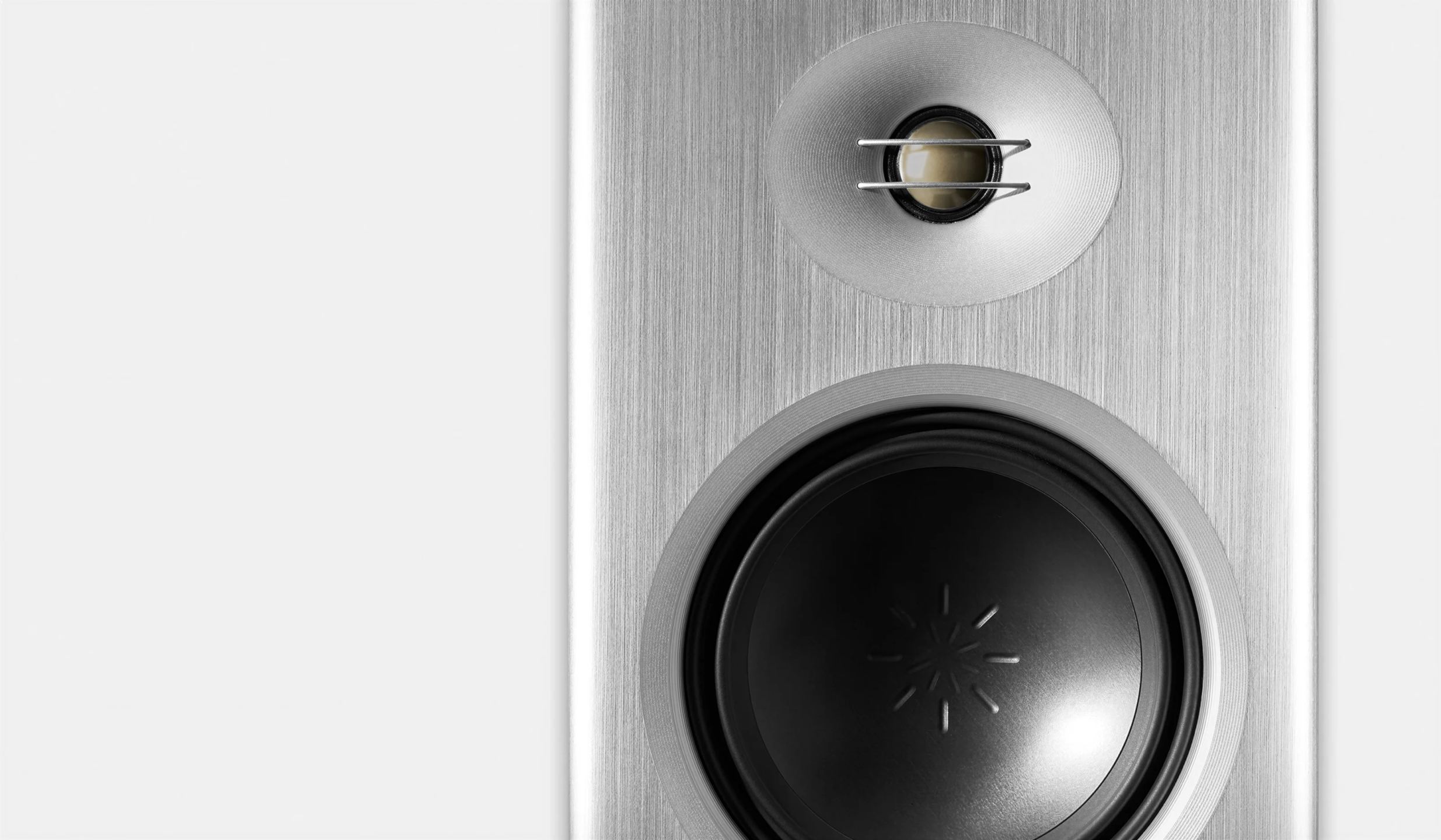
A single driver for bass and midrange
In a two-way speaker, the 17 cm driver handles all the bass and midrange up to 2,000 Hz, where the 25 mm dome tweeter takes over. The same cone must move plenty of air for the bass and remain precise on vocals, two demands that pull in opposite directions. T+A started with the S 330 floorstander’s bass driver and modified it for this compact cabinet: a robust magnetic motor, a large voice coil and a long-excursion suspension, which sustain high levels in the lower frequencies without distortion.
The StarStabilizer system addresses the other side of the problem. Precisely calculated suspension components and central reinforcement of the diaphragm prevent breakup, the point at which the cone stops moving as a single unit, like a piston, and certain areas begin vibrating independently, colouring the midrange. The bass remains controlled and voices retain their subtlety. The treble extends to 40 kHz, and the bass-reflex enclosure, with a rear port, extends the lower frequencies.
A double-sided crossover with a ground plane
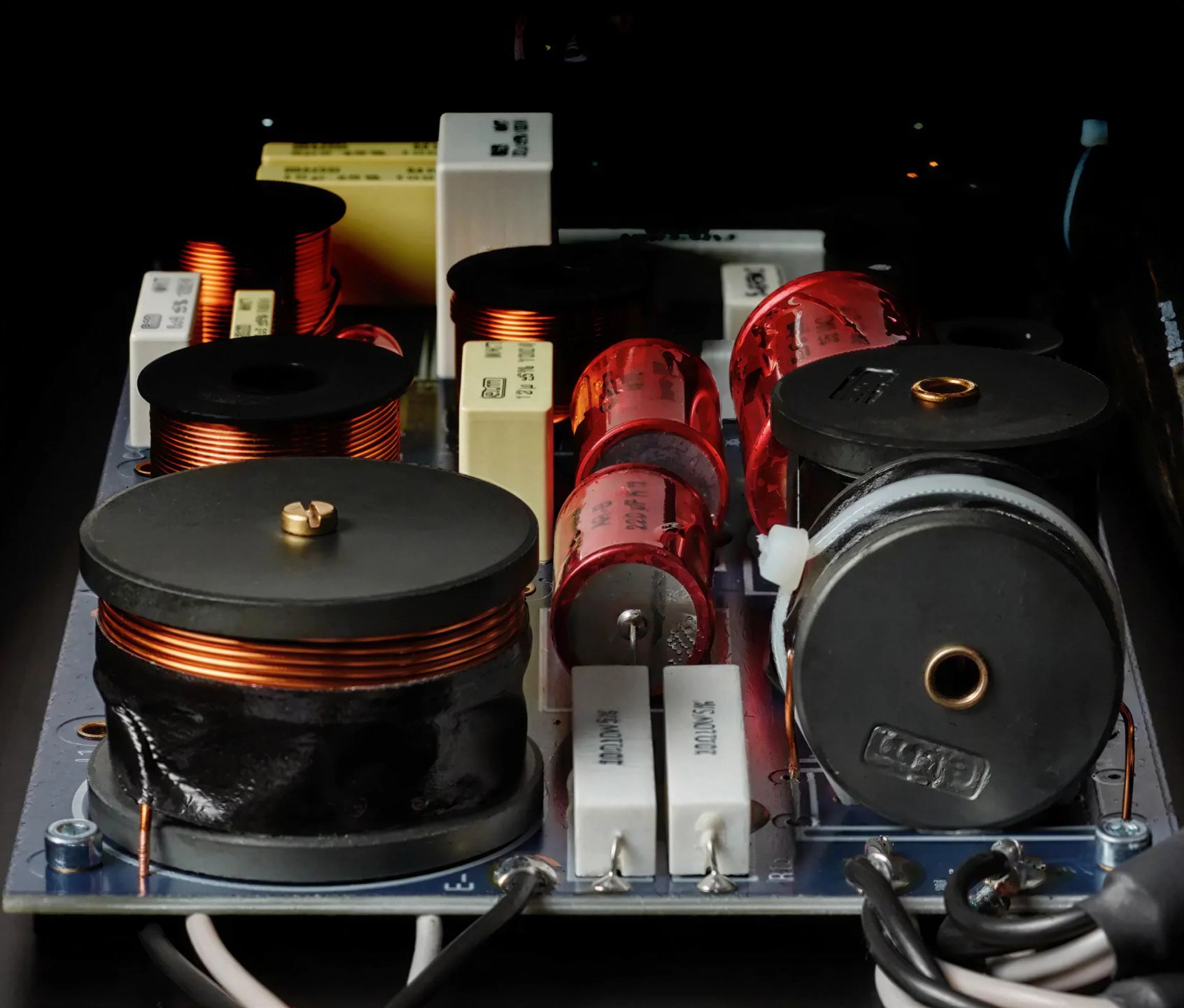
The crossover divides the signal between the two drivers, and the quality of this division has a major impact on the coherence of a two-way speaker. The entire Talis range uses T+A’s FSR (Fast Signal Response) crossover: a double-sided printed circuit board with a dedicated ground plane, which handles the strongest impulses and highest currents without distortion. Dedicated cables connect this crossover to the two drivers.
There are two sets of binding posts, with one pair of inputs for the bass and another for the midrange and treble. Supplied jumpers connect them for a conventional single-cable connection. Separating them allows bi-wiring and bi-amping: in the latter case, one stereo amplifier powers the bass drivers of both speakers and another powers their midrange and treble, with the jumpers removed.
An amplifier that handles a 4-ohm load
With a sensitivity of 85 dB, the R 330 requires power to reach a given level: it needs roughly three times as many watts as a 90 dB speaker to play equally loudly. Its 4-ohm impedance also demands more current than an 8-ohm load. T+A therefore recommends an amplifier that is stable into 4 ohms and capable of delivering more than 10 amperes. A small amplifier pushed to its limits clips the signal, cuts off the tops of musical peaks and produces harsh distortion, which is more dangerous to a tweeter than a powerful amplifier used with headroom. The power handling ratings, 140 W nominal and 200 W music power, leave a comfortable margin for suitably powerful electronics.
Finding the right position in the room
The R 330 can be placed on a shelf or a stand. Its base plate can be removed for screwing onto T+A’s LS 300 stand (67 × 26 × 33 cm, including spikes), whose shaped column conceals the speaker cables. When placed directly on furniture, self-adhesive felt pads protect the surface. The spikes screw in place of the base screws using the supplied tool, and centring discs slip underneath on delicate floors.
A nearby wall boosts the bass by around 3 dB, and a corner by up to 6 dB. The speaker benefits from being kept at least 50 cm from side walls. When the room does not allow this, two foam plugs placed in the ports reduce the bass level. The tweeter should be at ear height, with the two speakers and the listener forming an equilateral triangle and the speakers angled slightly towards the listening position. T+A specifies a minimum listening distance of 3 metres, meaning at least 3 metres between the speakers. This is a living-room speaker rather than a desktop one: at close listening distances, the integration between the bass/midrange driver and the tweeter is not operating under its intended conditions.
Documentation
Technical specifications
Overview
- Type: passive 2-way bookshelf speaker
- Bass loading: bass reflex
- Manufacturer: T+A elektroakustik, Herford (Germany)
Drivers and crossover
- Tweeter: 1 × 25 mm
- Mid-bass driver: 1 × 170 mm
- Crossover frequency: 2000 Hz
Acoustic and electrical performance
- Frequency response: 25 to 40000 Hz
- Sensitivity: 85 dB
- Impedance: 4 Ω
- Nominal power: 140 W
- Music power: 200 W
Amplification and connection
- Recommended amplification: amplifier stable into 4 Ω, current capacity greater than 10 A
- Binding posts: dual, compatible with bi-wiring and bi-amping
Installation and placement
- Spike mounting: screw in place of the bottom screws
- Removable bottom plate for mounting on a speaker stand
- Recommended clearance from side walls: 0.5 m minimum
- Recommended listening distance: 3 m minimum
Included accessories
- 2 removable magnetic grilles
- 8 spikes
- 8 centering discs to protect delicate surfaces when using spikes
- 8 self-adhesive felt pads for direct placement
- 1 spike installation tool
- 2 foam plugs
- Insert into the port to reduce bass output near a wall or in a corner
- Jumpers between the bass and midrange-treble inputs for single wiring
- Warranty card, manual
Finishes, dimensions and weight
- Finishes: black anodized aluminum (42), silver anodized aluminum (43)
- Dimensions without stand (H × W × D): 37 × 21 × 28 cm
- Weight: 15 kg
Frequently asked questions
Is a break-in period necessary?
Yes, up to around 100 hours. The speaker cones, surrounds and spiders become more flexible during this period and settle into their final performance characteristics. Listening at a normal level is sufficient, without trying to push the volume.
Is it better to listen with or without the grilles?
The magnetic grilles protect the drivers and are designed to have as little impact on the sound as possible. T+A still recommends removing them for critical listening. They align with the edges of the cabinet and attach on their own, then can be removed by gently pulling them forward. Vacuum them to remove dust, without applying pressure, as the drivers are directly behind them.
How do I bi-wire the R 330?
Two cables are needed per speaker, one for the bass and the other for the midrange and treble, after removing the jumpers. On an amplifier with two speaker outputs, A and B, each cable connects to one output. On an amplifier with a single output, both cables connect to it in parallel. Regardless of the connection method, the cables must be the same length on both sides.
Can spikes damage parquet flooring?
Yes, their tips are very sharp and can mark wooden or tiled floors. The supplied centering discs fit between the spike and the floor. On furniture or delicate surfaces, felt pads remain the simplest solution. The spikes should be stored out of reach of children.
Why is the bottom plate removable?
It serves as an attachment point on the LS 300 stand, onto which it screws securely to keep the assembly stable. Once its screws are removed, it rests loosely beneath the speaker: it must be held in place whenever handling the speaker to prevent it from falling.
What materials are used inside?
The internal damping is a nonwoven material made of 100% polyester fibre, tested according to Öko-Tex Standard 100 and compliant with the requirements for baby clothing. T+A limits plastics, particularly PVC, in favour of recyclable metals, and excludes chlorinated solvents and CFCs from its production.
- Eco-contribution included in the sale price.


