T+A PS 3100HV
T+A PS 3100 HV: the separate power supply for 3100 HV amplifiers
Beyond a certain power level, adding watts to an amplifier brings little extra to the listening experience: it is the stability of its power supply that determines its composure when the music becomes demanding. T+A puts this principle into practice with a separate 38 kg unit, the successor to the PS 3000 HV, which connects to the A 3100 HV power amplifier or the PA 3100 HV integrated amplifier and takes responsibility for all the current sent to the speakers.
Two power supplies for two clearly separated stages
In an amplifier, the input and voltage amplification stages shape the musical signal: they handle low currents but require a very clean power supply. The output stages deliver the current that moves the speaker diaphragms, and they place the greatest demands on the transformer and capacitors. In an A 3100 HV or PA 3100 HV used on its own, a single internal power supply serves both parts of the circuit.
Once the PS 3100 HV is connected via its Power Link cable, a relay in the amplifier switches the power supply for the output stages to the external unit. The internal power supply then serves only the input and voltage amplification stages, which consume little power: it generates less interference, and sudden current demands from the output stages no longer disrupt the circuits handling the most delicate signals. The amplifier’s sonic signature is still formed in these input stages; the PS 3100 HV improves its ability to deliver current without faltering when the speaker presents a difficult load.
A 240,000 µF reservoir behind every note
The 1200 VA transformer is significantly more powerful than the amplifiers’ internal power supply, and 24 custom-made capacitors, connected in parallel, provide a total of 240,000 µF, twice the amplifier’s filtering capacity. These capacitors act as a reservoir: they store energy and release it instantly on a bass drum attack or an orchestral crescendo, faster than the transformer could supply it alone. Connecting them in parallel reduces their internal resistance and inductance, and the energy reserve reaches 1200 joules.
Such a large capacitance cannot be charged all at once without risk to the electrical installation. A processor-controlled soft-start circuit charges the capacitors gently, preventing the circuit breaker from tripping at switch-on. The front-panel indicator remains orange during this phase, which takes a little time, and may flash briefly while the unit waits for a parameter to reach its set value before continuing.
A galvanometer that keeps an eye on the mains
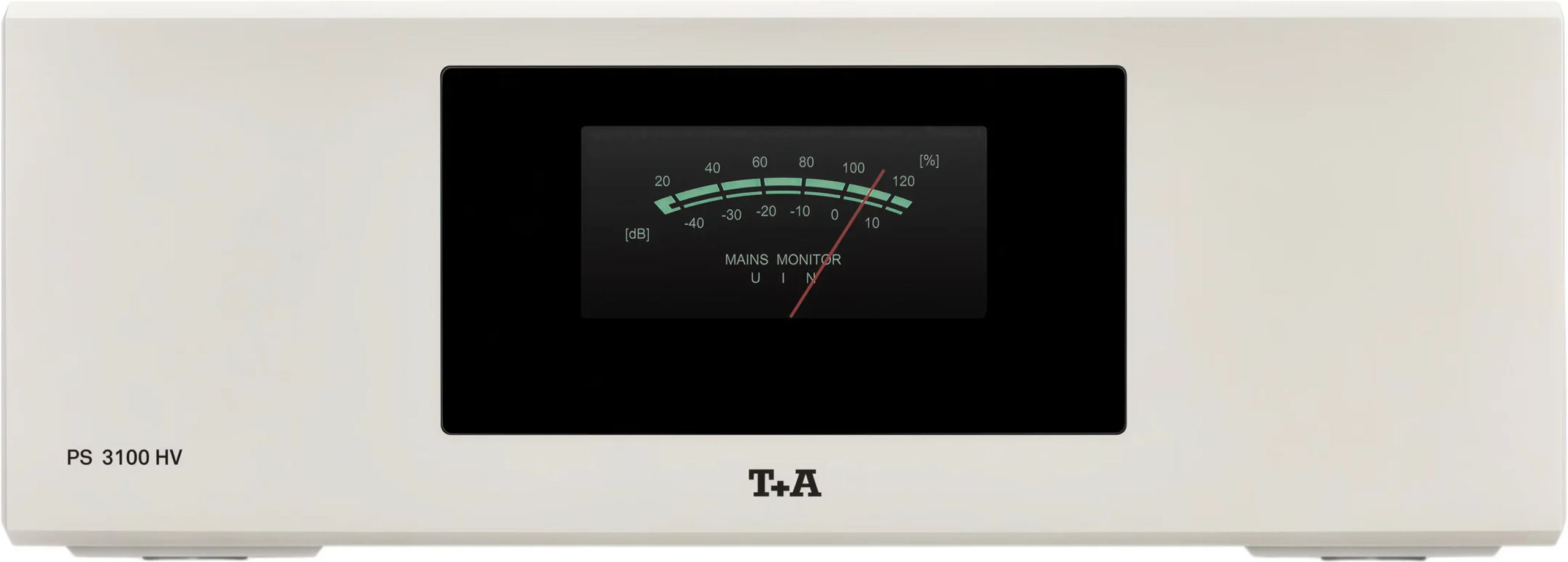
The front panel adopts the large needle galvanometer of the A 3100 HV, redesigned to echo its appearance, and turns it into an instrument for measuring the mains supply. In U mode (indicator off), the needle shows the mains voltage as a percentage of the nominal voltage, with a recommended operating range of 90 to 110%. In I mode (red indicator), it shows the current drawn by the PS 3100 HV relative to its maximum power: brief peaks above 100% pose no problem, but a reading that remains above this level warrants monitoring. In N mode (green indicator), it measures interference on the mains in decibels; above −35 dB, a quality mains filter or a check of the electrical installation becomes necessary.
With no front-panel controls, modes are changed by pressing and holding the button on the A 3100 HV, through the setup menu of the P 3100 HV preamplifier, or via the PA 3100 HV. With two power supplies in mono, the preamplifier sets both units simultaneously, while the button on each A 3100 HV controls only the power supply connected to it: this allows voltage to be monitored on one and interference on the other.
Stereo, mono and A 3100 HV operating modes
The PS 3100 HV works exclusively with the A 3100 HV and PA 3100 HV, because the Power Link connector carries high currents and voltages. With a PA 3100 HV or an A 3100 HV in stereo, one unit is sufficient. In a monophonic configuration, each A 3100 HV receives its own power supply, meaning two PS 3100 HV units for a pair of amplifiers.
With the A 3100 HV, the external unit operates only in High Power mode. The amplifier’s High Current mode prioritizes ample current availability and a high quiescent current (the current that flows continuously through the output transistors, even when no music is playing) rather than maximum power, and its internal power supply is sized to meet these needs: the PS 3100 HV therefore remains off. To reactivate it, switch off the amplifier, select High Power and wait about a minute before switching it back on.
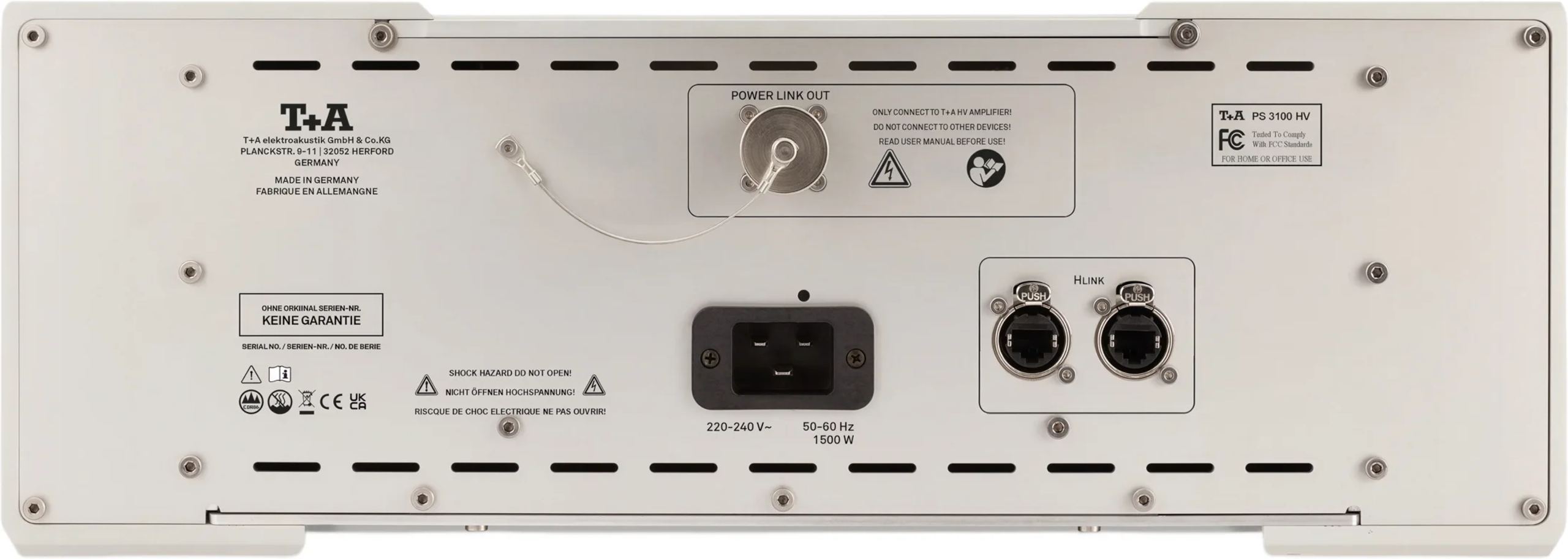
Switch-on and shutdown follow those of the amplifier, which controls the unit via the H LINK connection. With no power switch, completely disconnecting the PS 3100 HV from the mains requires unplugging its power cord; in standby, its consumption remains below 0.5 W.
An electrical installation to prepare in advance
The PS 3100 HV consumes up to 1500 W, and the combined system with the amplifier can reach 3300 W: the wall socket and the circuit supplying it must be able to deliver this. The power supply connects to the same phase as the amplifier, using an earthed socket, and must never be connected downstream of a power conditioner or a similar device connected in series; switched power strips should also be avoided. Phase detection signals a reversed power plug with a flashing green indicator. In France, the hybrid plug fits only one way into a wall socket with an earth pin, so correcting polarity requires an electrician or a mains distributor that allows the plug’s orientation to be selected.
The Power Link connection uses a cable with M-23 high-current connectors, whose locking ring screws onto the socket of each device. Connection must be made with all devices unplugged from the mains, the connector mark facing upwards, and the ring tightened until it conceals the sealing gasket; the power supply socket is in any case de-energized as soon as the cable is removed. The supplied cable, accompanied by the mains cord and manual, is suitable for stacked devices, with the amplifier necessarily positioned on top. An optional longer version (reference 4084-99401) allows side-by-side installation.
Measuring 46 cm in both width and depth, 17 cm in height and weighing 38 kg, the unit requires sturdy furniture and two people to handle it. It needs around ten centimetres of clearance to dissipate heat, a room temperature between 10 and 35 °C, and preferably a stone, glass or metal surface rather than lacquer or delicate wood.
Documentation
Technical specifications
Overview and compatibility
- Device type: external power supply for amplifier
- Compatibility: T+A A 3100 HV power amplifier, T+A PA 3100 HV integrated amplifier
- Operating principle: powers the amplifier’s output stages; its internal power supply then serves only the input and voltage amplification stages
- Mono operation: two PS 3100 HV units for two A 3100 HV units in mono mode
- A 3100 HV modes: power supply inactive in High Current mode, reserved for High Power mode
Power supply and electrical performance
- Transformer rating: 1200 VA
- Filter capacitance: 240000 µF, doubles the amplifier’s filter capacitance
- Mains power supply: 220–240 V, 50 / 60 Hz
- Maximum power consumption: 1500 W
- Standby power consumption: 0.5 W
- Mains connection requirements:
- On the same phase as the amplifier
- Without a mains power conditioner in series
- Socket capable of supplying up to 3300 W for the power supply and amplifier combined
Power-on and safety
- Power-on: automatic, controlled by the connected amplifier
- Soft start: gently charges the capacitors, prevents tripping the electrical installation’s circuit breaker at power-on
- Phase detection: indicator light signals a mains power cord plugged in the wrong way round
- Safety: voltage at the Power Link socket is cut off when the cable is disconnected
Mains monitoring
- Display: front-panel analog meter
- Display modes:
- Mode U: mains voltage as a percentage of nominal voltage, recommended range of 90 to 110%
- Mode I: current drawn by the power supply as a percentage of its maximum power
- Mode N: mains interference level in dB, mains filter recommended above −35 dB
- Mode selection: from the A 3100 HV with a long press, the P 3100 HV preamplifier or the PA 3100 HV
- Indicator light: indicates the display mode, startup status and faults
Connections
- Power output: Power Link Out socket with high-current M-23 connector and threaded locking ring
- Control: H LINK input to the amplifier
- Mains connection: IEC inlet
Accessories
- Supplied accessories: mains power cord, Power Link cable for stacked devices, manual
- Optional accessory: long Power Link cable for side-by-side installation, reference 4084-99401
Dimensions and weight
- Dimensions (W × D × H): 460 × 460 × 170 mm
- Weight: 38 kg
Frequently Asked Questions
Does the PS 3100 HV increase the amplifier's power?
This is not an additional amplification stage: the output transistors remain those of the A 3100 HV or PA 3100 HV. The external unit supplies them with power, with twice the reserves and a power supply that no longer shares its workload with the input stages. Its contribution lies in current delivery and stability when driving demanding speakers, especially during dynamic peaks.
What is the difference compared to the PS 3000 HV?
The PS 3100 HV succeeds the PS 3000 HV in the HV series. It retains its predecessor’s 1200 VA transformer and 240,000 µF of filtering capacitance, adopts a redesigned galvanometer matching that of the A 3100 HV, and pairs with the 3100-generation amplifiers.
Does the galvanometer indicate the power sent to the speakers?
No. In I mode, it displays the current that the PS 3100 HV draws from the mains, relative to its own maximum capacity. It is a power supply load indicator, not an output wattmeter; the A 3100 HV’s meters remain the ones that track the signal sent to the speakers.
What does a flashing orange or red indicator light mean?
A brief orange flash during startup indicates a normal waiting period. If it continues, wait at least three minutes: the voltages of the PS 3100 HV and the amplifier are not yet matched. If the problem persists, the amplifier’s capacitors must discharge before the power supply can start; switching off the amplifier and waiting about five minutes resolves the situation. A flashing red light indicates a fault detected by the soft-start circuit: unplug the mains power cord for at least ten seconds, and if the indicator flashes red again, the unit must be taken to an authorised T+A service centre.
Can the PS 3100 HV be connected to a filtered power strip or a mains regenerator?
Regenerators, conditioners and similar devices connected in series are excluded. Filtering remains an option: a quality filtered power strip such as the T+A Power Bar is among the recommended solutions when mode N exceeds −35 dB, as is identifying devices that introduce noise into the household mains supply (switching power supplies, light dimmers, household appliances).
Is a dedicated electrical circuit required?
At 230 V, 3300 W draws just over 14 A, almost the full rating of a 16 A socket. If other appliances share the same circuit, the circuit breaker may trip during a surge in power consumption. A dedicated circuit checked by an electrician eliminates this risk and also ensures that the power supply and amplifier are on the same phase. It is also best to avoid switching the power off and back on in quick succession, as this can blow the mains fuse in the PS 3100 HV.
What should I do after transport or a long period of disuse?
After exposure to cold, the device must be allowed to return to room temperature before being plugged in, giving any condensation that has formed inside time to evaporate completely. After storage or a period of inactivity lasting more than two years, an inspection at a specialist workshop is required before putting it back into service. Whenever the device is moved, the original packaging, designed for its weight and dimensions, remains the only safe container.
- Eco-contribution included in the sale price.