T+A P 3100 HV silver


Overview
A preamplifier has a simple task on paper: select a source, adjust its volume and pass the signal to the power amplifier without adding or taking anything away. T+A has built this one around operating voltages far higher than normal, two channels handled separately from end to end and a signal path free of any coupling capacitors. The result is a fully analog device weighing 28 kg, succeeding the P 3000 HV.
High voltage applied to transistors
HV stands for High Voltage. In most transistor preamplifiers, the stages operate at a few tens of volts. Here, T+A supplies them with up to 100 V. The benefit is the same as in a tube amplifier: each transistor uses only a small portion of its operating range, less than 20% according to the brand, and stays in the region where its behavior is most linear. Distortion decreases and dynamic headroom increases. The P 3100 HV accepts signals up to 80 V peak-to-peak without clipping, far beyond what any source delivers.
The circuit is entirely discrete, with no operational amplifiers (those small chips that integrate an entire stage into a single component). T+A uses differential cascode circuits with junction field-effect transistors, hand-selected audio JFETs. Their linearity stems from the topology and component selection, so the circuit does almost entirely without global negative feedback, the corrective mechanism that feeds part of the output signal back to the input.
A direct connection from the first to the last stage
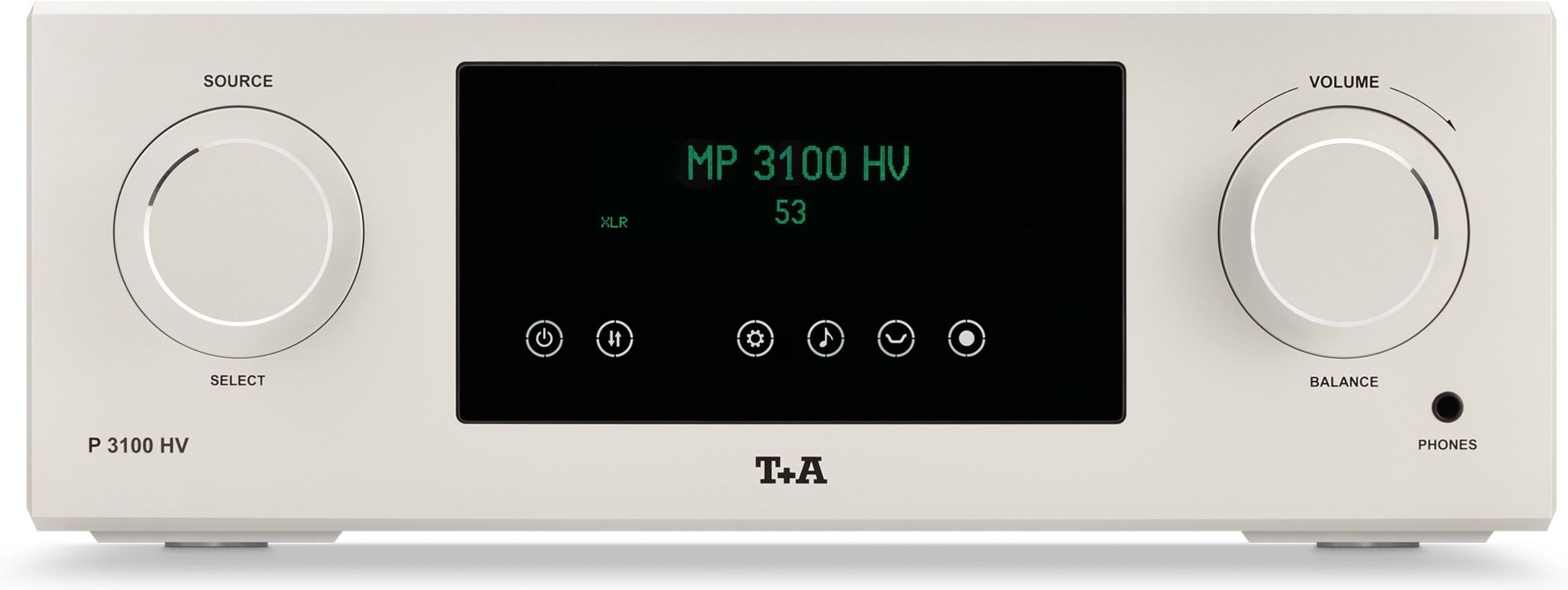
From the outside, the P 3100 HV differs from its predecessor only in the model designation engraved on the front panel. The differences are under the hood. In the P 3000 HV, high-quality capacitors connected the input and output stages to the volume control. The new circuit board compensates for temperature drift in the transistors and precisely sets their operating points: the signal now travels through a DC-coupled path, with no capacitors between the input, volume control and output.
Volume control and source selection use sealed, gas-tight relays with gold-plated contacts, impervious to dust and oxidation. The control section’s power supply gains power and shielding, and the analog section’s already generously sized toroidal transformer increases to 115 VA. The filter capacitors total 75,000 µF.
Two channels kept separate even within the chassis
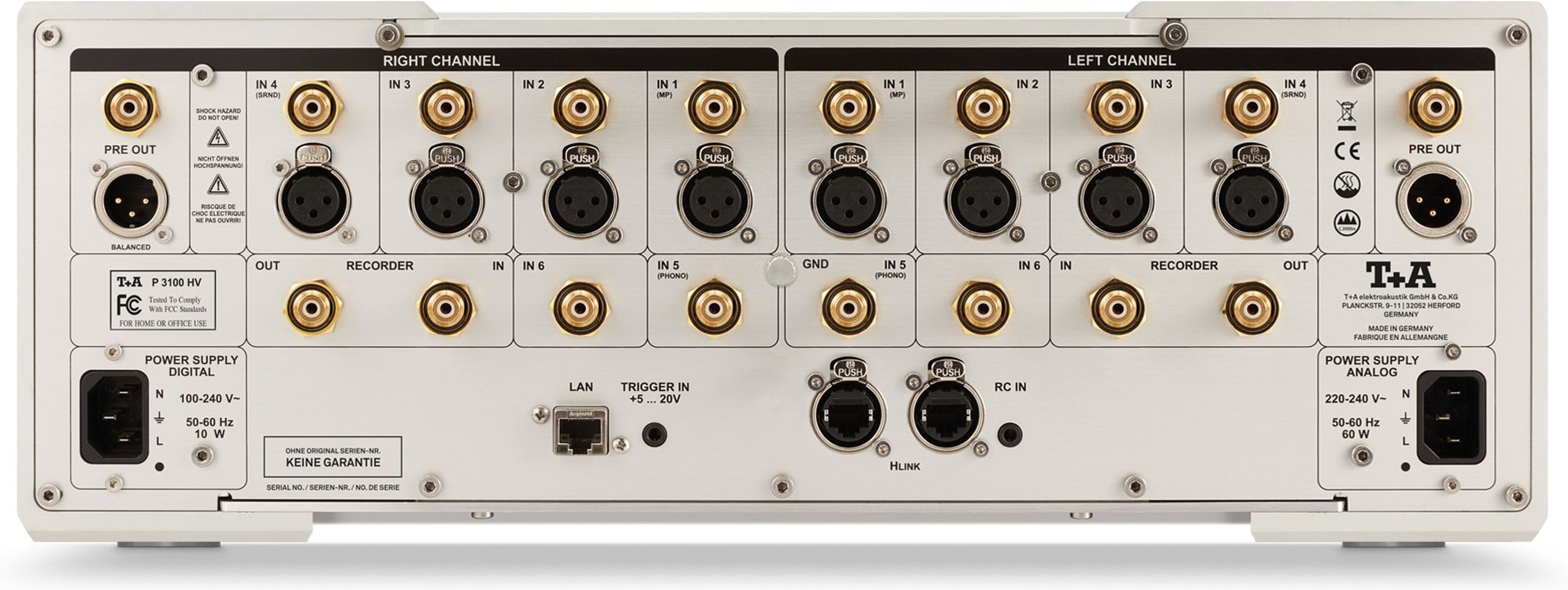
The rear panel immediately reveals the dual-mono construction: the left-channel and right-channel connectors are grouped on opposite sides, and each channel has its own board, strictly identical to the other. The circuit is balanced throughout, resulting in channel separation greater than 108 dB.
The preamplifier boards occupy the upper part of the enclosure, in a compartment closed off by aluminum plates 10 to 15 mm thick. The power supply and mains circuitry are housed below, isolated and shielded. Two mains cables are supplied, as the control and analog power supplies are separate. The enclosure is available in a silver or titanium finish.
Eleven analog inputs and two preamp outputs
The P 3100 HV is a purely analog preamplifier, with no converter or digital input. It combines seven unbalanced RCA inputs (sensitivity from 250 mV to 9 V RMS, 20 kΩ) and four balanced XLR inputs (500 mV to 18 V RMS, 5 kΩ). Digital sources therefore use an external converter, such as the players in T+A’s HV series.
Input 4 can be configured in surround mode. The preamplifier then passes the signal through at a fixed level and leaves volume adjustment to the connected home theater processor: the front left and right channels of a multichannel system benefit from the same amplifiers as stereo listening, without the risk of a conflict between two volume controls.
On the output side, the signal is available via RCA and XLR, both with an impedance of 50 Ω. This low value allows it to drive long cables and any power amplifier without treble loss. The XLR output reaches up to 19.6 V RMS. A fixed-level recorder output completes the setup, along with a trigger input (+5 to +20 V) that switches on the preamplifier at the same time as another device.
Headphones, tone controls and phono
The front panel features a high-current headphone output. An analog processing module adds tone controls and a loudness function adjustable for each channel. They can be disabled completely to restore the most direct signal path, and are useful when an overly reverberant room or low-volume listening calls for an adjustment.
An available slot accommodates an optional phono module for a moving-magnet (MM) or moving-coil (MC) cartridge. Turntables can then be connected directly, without a separate phono preamplifier. The F 3001 remote control and E 2000 remote control receiver are supplied with the device.
Documentation
Technical specifications
Overview and architecture
- Type: high-end stereo preamplifier
- Fully balanced dual-mono architecture with complete channel separation
- Fully discrete audio circuits, without operational amplifiers
- Identical circuit boards for both channels
- Amplification stages with selected audio junction field-effect transistors (JFET)
- Differential cascode topology
- T+A High Voltage (HV) technology
- Operating voltages up to 100 V in the preamplification stages
Preamplification performance
- Frequency response: 0.5 Hz – 300 kHz (+0 / −3 dB)
- Signal-to-noise ratio: 108 / 112 dB
- Total harmonic distortion (THD): < 0.001%
- Intermodulation distortion: < 0.001%
- Channel separation: > 108 dB
- Maximum signal handling voltage: up to 80 V peak-to-peak
Analog inputs and expansion
- 7 × unbalanced RCA
- Input voltage: 250 mV RMS – 9 V RMS
- Impedance: 20 kΩ
- 4 × balanced XLR
- Input voltage: 500 mV RMS – 18 V RMS
- Impedance: 5 kΩ
- Input 4 configurable in multichannel mode (surround)
- Slot for optional moving magnet / moving coil (MM / MC) phono module
Analog outputs
- 1 × recorder output
- Output voltage: 250 mV RMS
- Impedance: 100 Ω
- 1 × RCA preamplifier output
- Nominal voltage: 1 V RMS
- Maximum voltage: 9.5 V RMS
- Impedance: 50 Ω
- 1 × XLR preamplifier output
- Nominal voltage: 1.45 V RMS
- Maximum voltage: 19.6 V RMS
- Impedance: 50 Ω
- 1 × headphone output
- Impedance: 50 Ω
- High current capability
Signal processing and control
- Analog signal processing module
- Trigger input: +5 to +20 V for external power-on
Construction and shielding
- Separate, shielded power supply and preamplification circuits
- Dedicated audio circuit compartment made of 10 to 15 mm thick aluminum
- Filter capacitance: 75000 µF
Power supply and consumption
- Power supply: 110–120 V / 60 Hz or 220–240 V / 50 Hz
- Nominal power consumption: 10 + 60 W
- Standby power consumption: < 0.5 W
Included accessories
- F 3001 remote control
- E 2000 remote control receiver
Dimensions and weight
- Dimensions (height × width × depth): 17 × 46 × 46 cm
- Weight: 28 kg
Frequently Asked Questions
Can the P 3100 HV drive a power amplifier from another brand?
Yes. The RCA and XLR outputs follow the usual standards, and their 50 Ω impedance is suitable for all common input impedances. The XLR connection is preferable if the amplifier has a true balanced input, as it better rejects interference picked up by the cable, especially over long runs.
Does the P 3100 HV work on the French electricity grid?
Yes, it supports the 220-240 V / 50 Hz used in France. T+A also offers it in a 110-120 V / 60 Hz version for other markets.
Which headphones are suitable for the headphone output?
The 50 Ω output impedance is well suited to medium- and high-impedance headphones (250 to 600 Ω), which the output drives easily thanks to its high current. With very low-impedance headphones, around twenty ohms, the difference between the two values may slightly alter the tonal balance, most often in the bass.
Can the phono module be added after purchase?
Yes, space is provided in the chassis. The choice between an MM module and an MC module depends on the cartridge fitted to the turntable: most entry-level and mid-range cartridges are moving magnet, while moving coil cartridges output a much lower voltage and require higher gain.
Why does the absence of coupling capacitors matter?
A capacitor placed in the signal path blocks the DC component but acts as a filter, and its quality affects the sound. Removing it, however, requires a circuit that is perfectly stable with temperature; otherwise, a DC voltage would appear at the output. This is precisely the work carried out on the P 3100 HV’s printed circuit board, whose frequency response extends down to 0.5 Hz.
How much space is needed to install it?
The P 3100 HV measures 17 cm high, 46 cm wide and 46 cm deep, and weighs 28 kg. A cabinet or shelf capable of supporting this weight without sagging is required, with a few centimetres of clearance at the rear for the XLR plugs, which are bulkier than RCA plugs, and for the two power cords.
How much power does it consume?
The rated power consumption is 10 W for the control section and 60 W for the analog section. In standby, it drops below 0.5 W.
- Eco-contribution included in the sale price.