

Sendy Audio Peacock Black




Sendy Audio Peacock Doré, open-back planar headphones
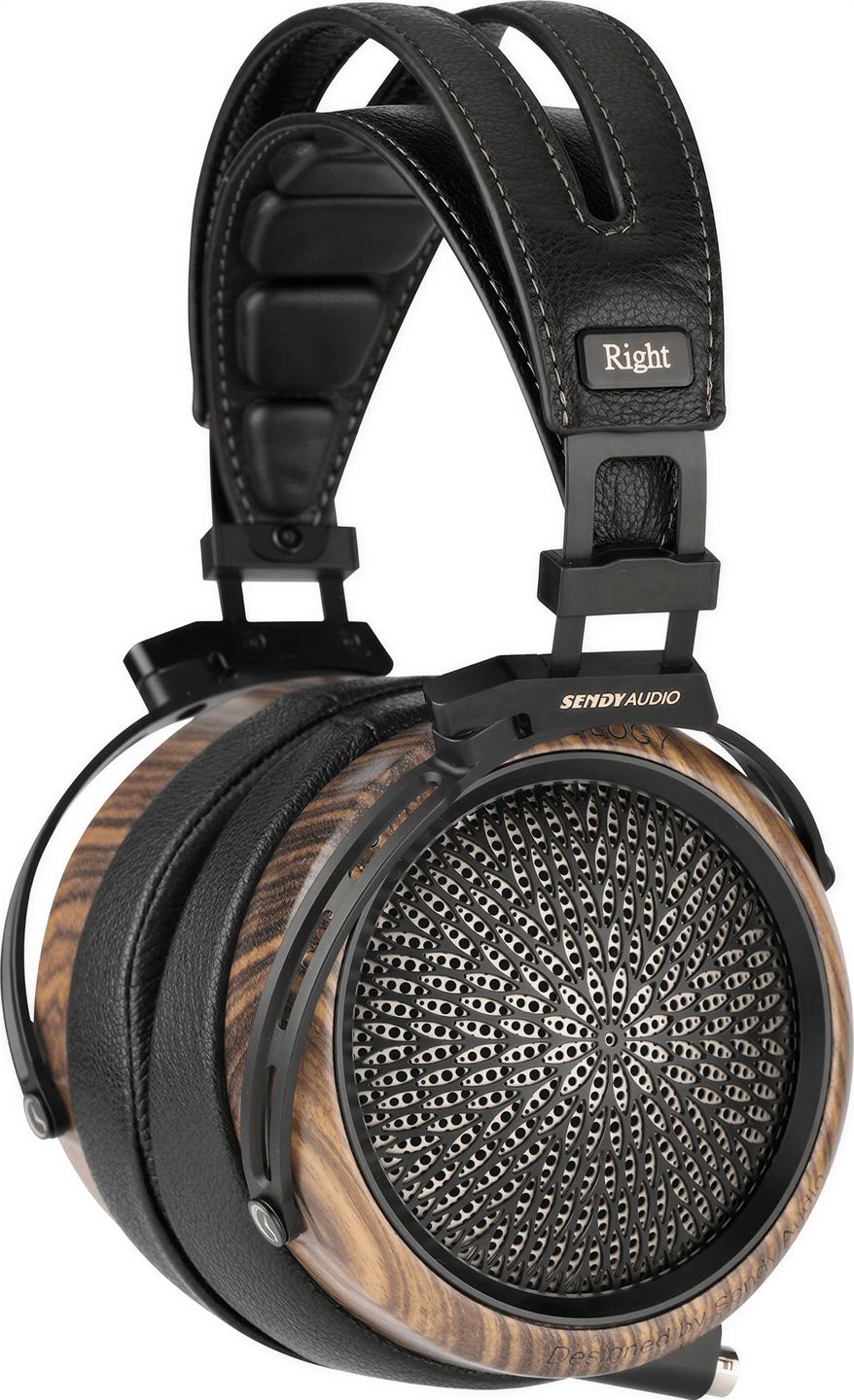
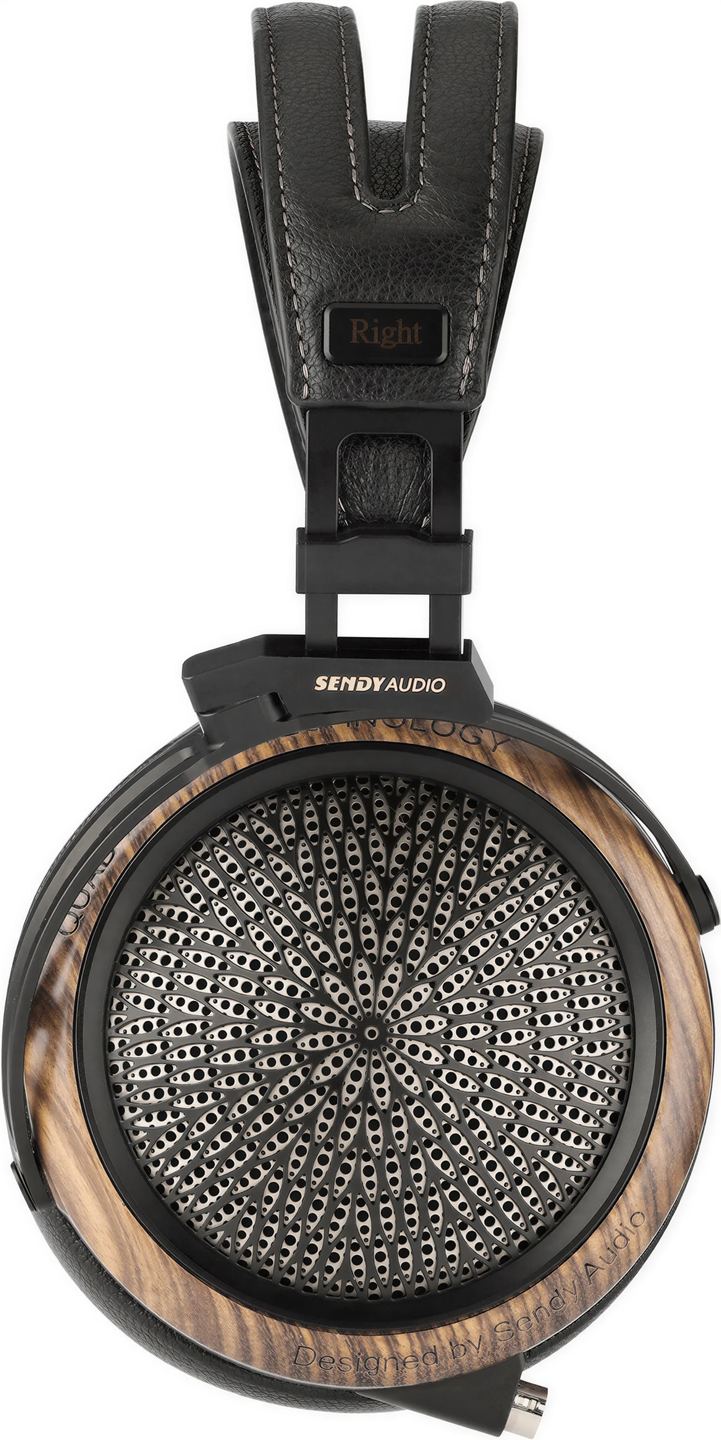
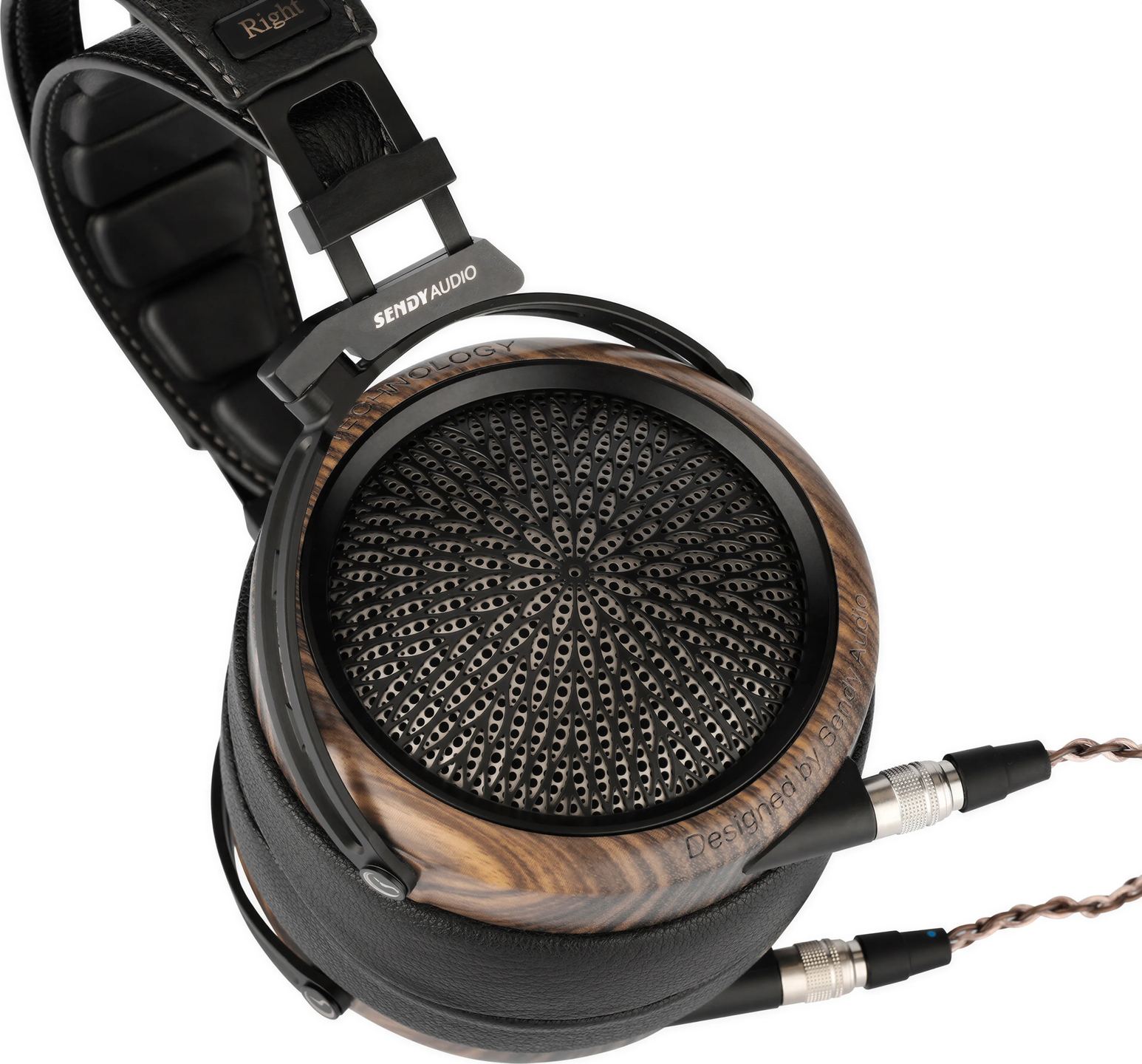
The name comes from the outer grille. Pierced with small oval openings radiating from the centre, it recalls a peacock’s fanned tail. Beneath this decorative exterior, Sendy Audio, the high-end label of Chinese manufacturer SIVGA, houses an 88 mm planar driver in solid zebrawood earcups, making this its top-of-the-range over-ear model. The Doré version pairs this light-coloured wood with 24-carat gold-plated metal parts.
A planar driver with four coils
In planar headphones, sound does not come from a cone driven by a central coil: a very thin diaphragm carrying a conductive circuit is moved across its entire surface by magnets placed on either side. Sendy Audio calls its version of this principle Quad-Former. The diaphragm has coils on both sides, with two coils per side, making four in total, facing a double row of magnets that exerts equal force on both sides. The brand’s stated aim is for every area of the diaphragm to vibrate in the same way at a given frequency, limiting distortion.
The diaphragm itself is a composite developed over more than two years. A layer with high internal damping handles vocals and bass, while another, thinner and stiffer layer extends the response up to 40 kHz. The driver is housed in a mount machined from solid aircraft-grade aluminium, with the size and position of each opening determined after several rounds of testing to distribute sound evenly across the entire spectrum.
Zebrawood, goatskin and 24-carat gold
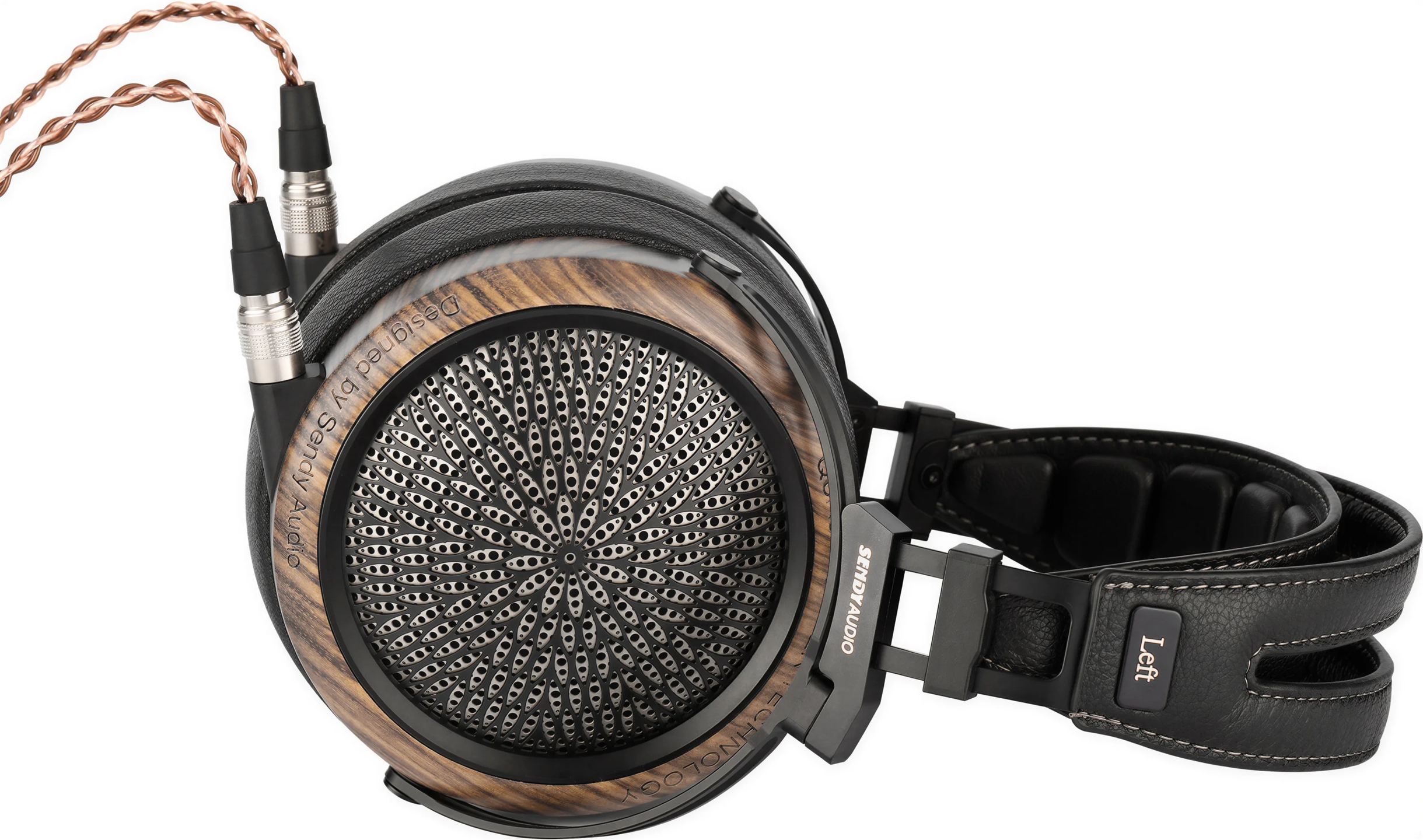
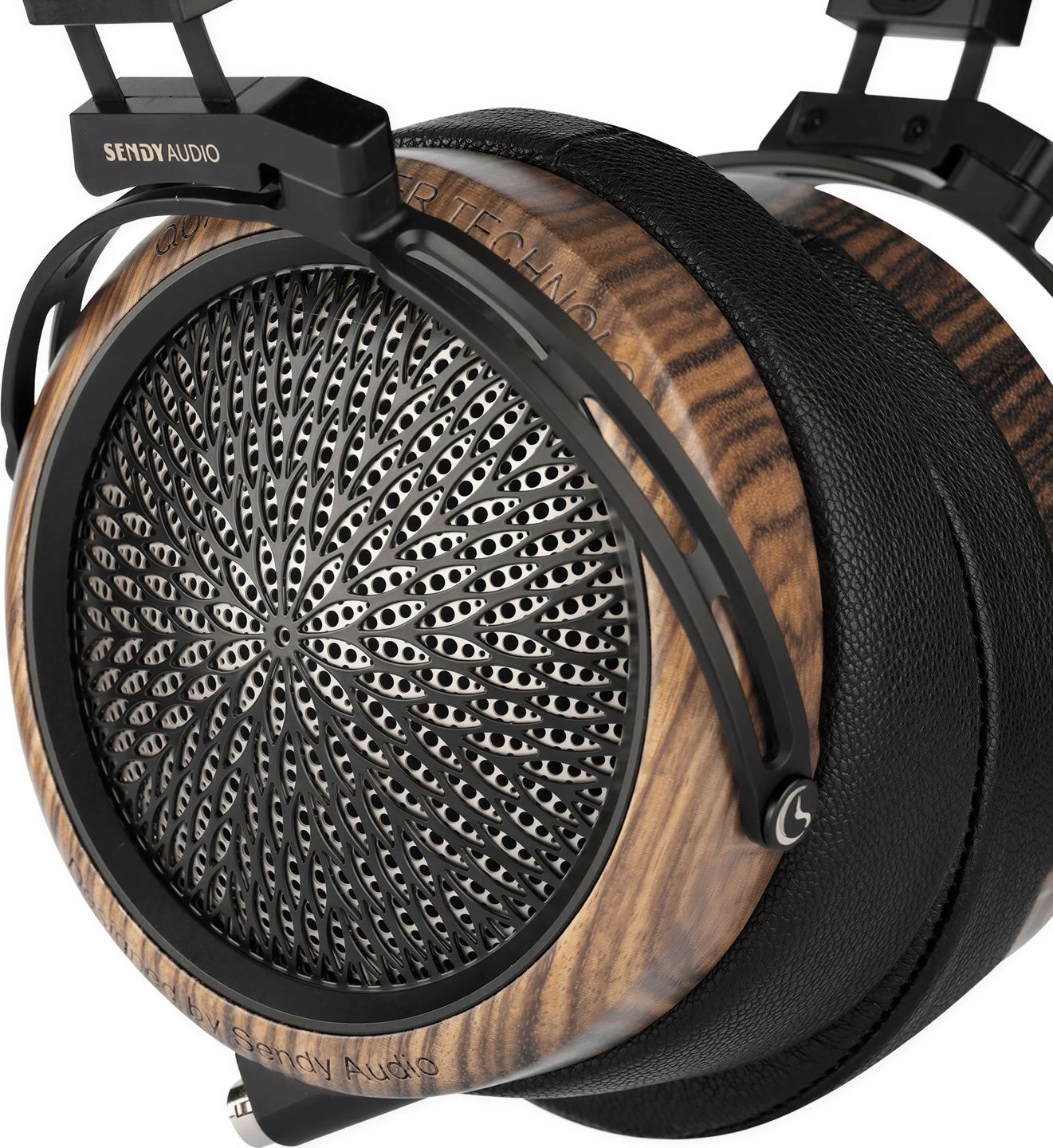
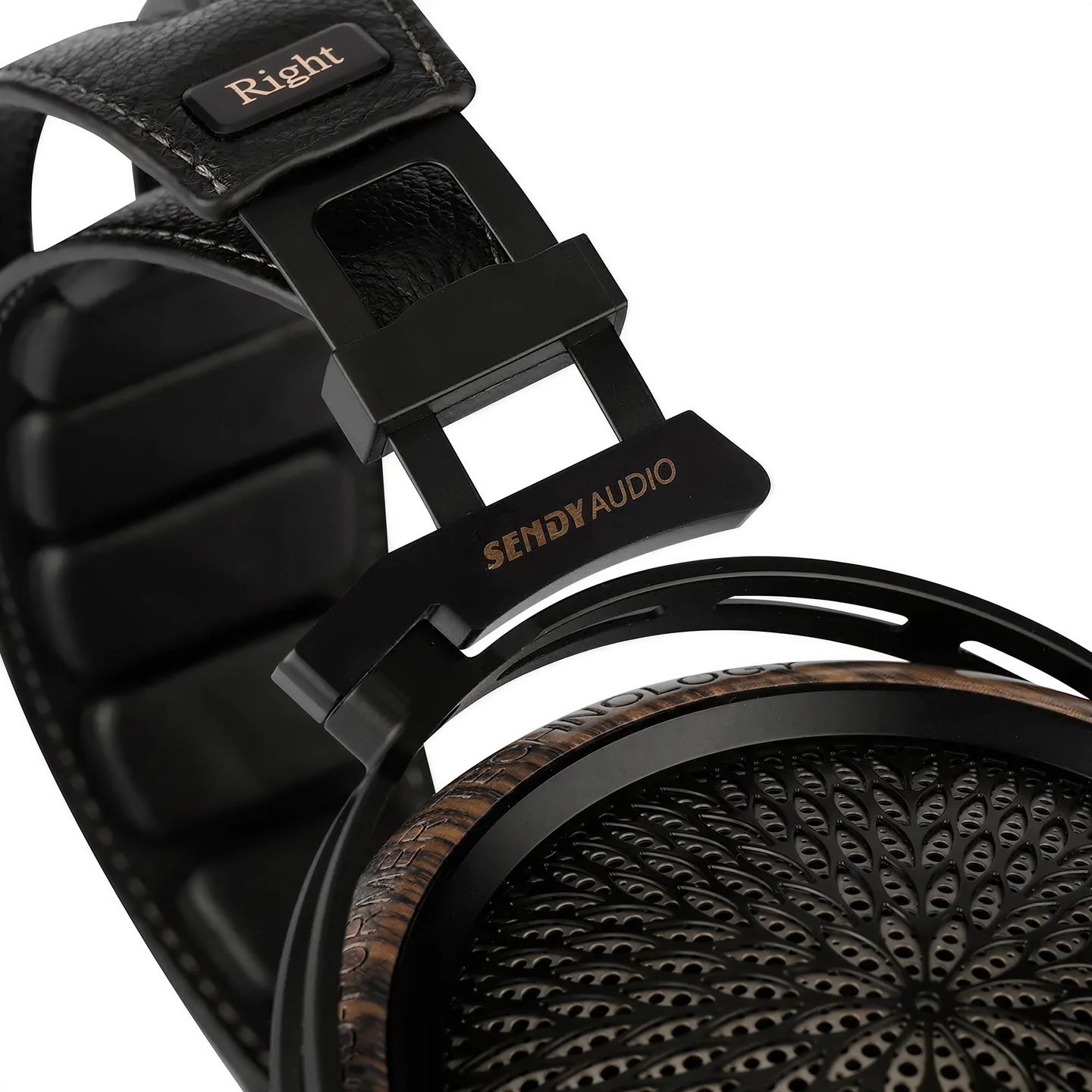
The earcups are CNC-carved from solid zebrawood, then sanded, varnished and left to dry naturally. This wood, with its light and dark grain, gives each pair a slightly different pattern. Over it, the grille combines two layers of steel, one black and the other gold, whose perforations also contribute to the headphones’ tuning. On this Doré version, all gold-coloured parts are plated with 24-carat gold, including the logo and the left and right markings.
The yoke and connecting parts are made from machined aluminium, with cut-out windows that give them a lighter appearance. The headband is covered in supple goatskin, stitched with gold thread to match the grilles. A black version shares exactly the same driver, materials and accessories; only the colour of the metal parts changes.
Headphones to wear for hours at home
The earpads combine goatskin and memory foam, with an ergonomic shape that follows the contours of the ear and distributes pressure. They detach for replacement, and left/right markings prevent mistakes when refitting them. Weighing 578 g, the Peacock Doré remains a heavy pair of headphones: the leather and foam offset this weight over time, but it does not disappear entirely.
The open-back design lets air and sound pass in both directions. Those nearby hear what you are listening to, and you hear the room around you. These are headphones for relaxed listening in the living room or a home office, not a companion for public transport.
A balanced 4.4 mm connection as standard
The 2 m cable connects to each earcup via a locking 4-pin mini-XLR connector. The sockets face forwards, so the cable drops in front of the shoulder rather than rubbing against it. It is an eight-conductor braid of 6N OCC copper, terminated with a balanced 4.4 mm Pentaconn plug, the format used by recent portable music players and portable DACs. Two adapters complete the package: one for the 6.35 mm jack on conventional headphone amplifiers, the other for the 4-pin XLR on desktop amplifiers.
With an impedance of 50 Ω and a sensitivity of 103 dB, the Peacock Doré requires less power than most planar headphones. A portable music player or portable DAC with a 4.4 mm output is enough to listen at a good volume, while a desktop amplifier provides more headroom for dynamic passages. The headphones come in a rigid brown leather carrying case with bronze-coloured hardware, accompanied by a hemp cover.
Technical Specifications
Acoustic Design
- Type: open-back over-ear planar magnetic headphones
- Drivers: “Quad Former” planar technology
- Magnets positioned on both sides of the diaphragm
- Coils on both sides, four in total
- Diameter: 88 mm
- Diaphragm: composite, thickness not specified by Sendy
- Magnets: double row, material not found
- Driver mounts: CNC-machined aircraft-grade aluminium
Audio Performance
- Impedance: 50 Ω ± 15%
- Sensitivity: 103 dB ± 3 dB
- Frequency response: 20 Hz to 40 kHz
Connectivity
- Headphone-side connections: 4-pin mini-XLR, one per ear cup
Materials and Finishes
- Ear cups: CNC-machined solid wood, polished, varnished and naturally dried
- Wood species not named by Sendy, zebrawood according to retailers
- Grille: black and gold steel with a peacock tail pattern
- Gold elements: 24-carat gold plating on the Gold version
- Yokes and metal parts: CNC-machined aircraft-grade aluminium
- Headband: lambskin with gold stitching
- Ear pads: lambskin and memory foam, removable, left / right markings
- Logo and left / right markings: produced using photolithography
- Colours: Gold (gold), Black (black)
- Sendy does not detail the differences in finish
- Retailers describe a silver grille and non-gold elements on the black version
Box Contents
- Peacock headphones
- Detachable audio cable
- Conductors: 6N OCC copper, 8-conductor braid
- Length: 2.0 m ± 0.2 m
- Termination: 4.4 mm balanced connector
- Adapters: 4.4 mm to 6.35 mm, 4.4 mm to 4-pin XLR
- Leather carrying case
- Hemp pouch
Weight
- Weight: 578 g
Frequently asked questions
What is the difference between the Gold Peacock and the black Peacock?
Only the aesthetics. The driver, zebrano earcups, cable, ear pads and accessories are identical. On the Gold version, the visible metal parts are plated in 24-carat gold, whereas on the black version they have a black finish.
Can it be connected to a smartphone?
Not directly, since the cable ends in a 4.4 mm plug and most phones no longer have a headphone jack. A small USB-C converter with a 4.4 mm output solves the problem and can power the headphones thanks to their high sensitivity.
What difference does a balanced connection make compared to a standard jack?
With a balanced connection, each earpiece has its own return path rather than sharing a common ground with the other, reducing interaction between the two channels. On many amplifiers, the balanced output also delivers a higher voltage. The supplied 6.35 mm adapter converts the connection to unbalanced: the headphones work perfectly, but without these benefits.
What is the 4-pin XLR adapter used for?
It allows you to connect the headphones to desktop amplifiers with a 4-pin XLR balanced output, a common connector on desktop equipment. The headphones then maintain a balanced connection from end to end.
Can the cable be replaced with a different model?
Yes. The cable is detachable and the 4-pin mini-XLR connector is a widely used format, allowing you to choose cables with different lengths or terminations. Simply check that the cable you choose is designed for a 4-pin mini-XLR connection on each earcup.
What does OCC 6N mean for the cable?
6N refers to 99.9999% pure copper. OCC refers to the Ohno continuous casting process, which produces copper with very long crystals, with far fewer boundaries between crystals than ordinary copper over the same length of wire.
Is there any benefit to a frequency response up to 40 kHz when human hearing only reaches around 20 kHz?
These frequencies cannot be heard as such. The extension mainly indicates that the diaphragm remains well controlled far beyond the audible limit, suggesting a smooth treble response in the range we can actually hear.
- Eco-contribution included in the sale price.
- Manufacturer reference: SENDY-PEACOCK-BK
- GTIN / EAN: 6973869470540


