

Block Éléments CD black


Block Elements CD black: a compact aluminium CD player
Twenty-five centimetres in width is all this player needs to spin a collection of discs in a living room where space is at a premium. Its sapphire black aluminium chassis has exactly the same dimensions as the Elements 2.1 connected amplifier from Block, making it possible to build a small system with a consistent look. It does just one thing, play CDs, and offers one analogue output and two digital outputs for connection to the amplifier of your choice.
A half-width all-aluminium chassis
Audioblock, the family business based in Hude, Lower Saxony, built the Block brand around devices housed in substantial metal chassis. The Elements CD follows this approach with an all-aluminium enclosure measuring 250 × 80 × 260.5 mm. That is half the width of a conventional hi-fi component, and this format allows it to fit on a bookshelf, beside a television or in a shallow cabinet.
The front panel is understated: a horizontal disc tray, a display and a few buttons, with no frills. This sapphire black version is also available in diamond silver, with identical electronics. The player is part of the Elements series, which also includes the Elements 2.1 connected amplifier, the Elements Blu-ray player and the Elements 5.1 home cinema receiver, all with the same styling.
The discs the player accepts
The tray accepts commercially released audio CDs, home-burned CD-Rs and CD-RWs, as well as HDCDs. This format, developed in the 1990s, encodes part of the audio information to extend the dynamic range while remaining playable on any player. The player also recognises CDs containing MP3 files, allowing several albums to be combined on a single burned disc. FLAC or WAV files burned as data are not among the supported formats. For these, you need to burn a standard audio CD.
The player plays neither SACDs nor video discs, and it has no USB port for a flash drive or hard drive. The brand’s wider C-250 offers this USB connection on the front panel. For DVDs and Blu-rays, Block has created the Elements Blu-ray player in the same series.
Three outputs for connection to almost any system
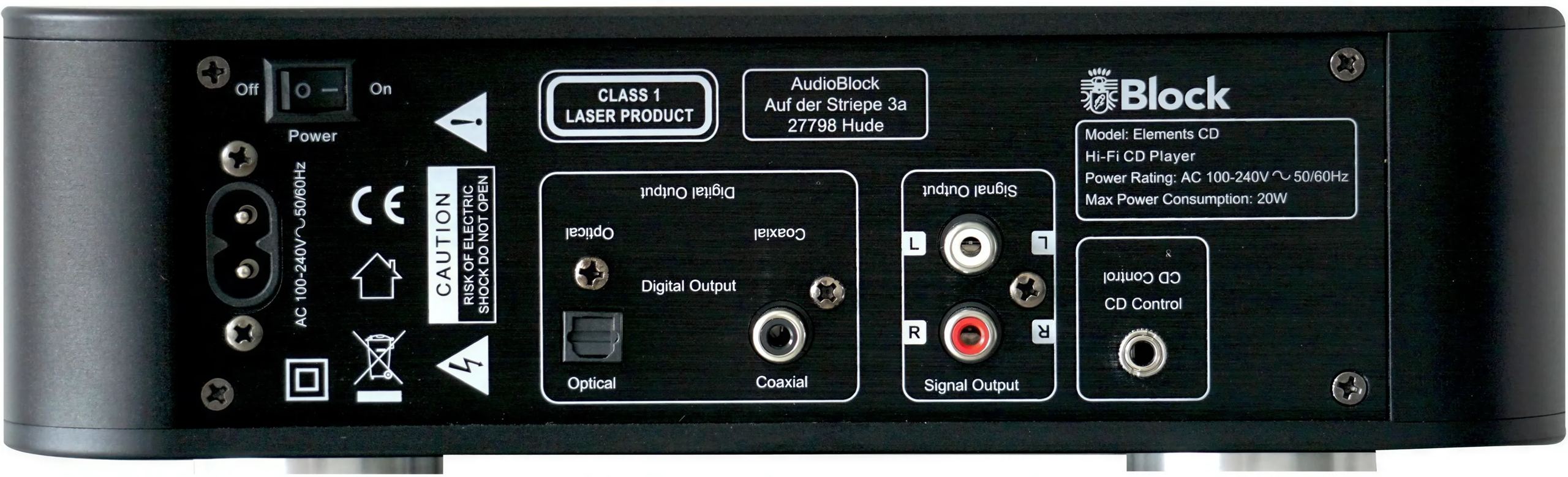
On the rear, a pair of RCA sockets delivers the stereo analogue signal, ready to connect to any amplifier line input (often labelled AUX, CD or LINE). In this case, the player’s built-in converter transforms the disc’s data into an audio signal.
The two digital outputs, coaxial (RCA socket) and optical (Toslink), transmit the disc’s data unchanged, without converting it. They connect to an external converter, an amplifier with digital inputs or a network player that accepts an S/PDIF source. Conversion is then handled by the device receiving the signal, leaving the option of improving playback quality later by changing just that component, without touching the player. Both sockets carry the same information: 16-bit and 44.1 kHz, the resolution of a CD.
A fourth socket, called CD-Control, connects the player to other Block devices to send them commands. The features are deliberately kept simple: no balanced XLR output (reserved for the C-120, higher up the Block range), no headphone output and no digital input. The player therefore cannot serve as a converter for a television or computer.
Pairing with the Elements 2.1 amplifier
The player was designed with the Elements 2.1 in mind, and the two devices share the same dimensions and finishes. The simplest connection uses an RCA cable to the amplifier’s analogue input. The two devices can also be connected via the optical or coaxial output, leaving conversion to the electronics in the Elements 2.1. With the amplifier’s radio and streaming features, this creates a complete system just 25 cm wide, to be complemented by a pair of bookshelf speakers or floorstanding speakers.
The player works just as well with an amplifier from another range or brand, provided it has a spare line input or digital input.
Block’s published performance figures, explained
Block specifies a frequency response of 20 Hz to 20 kHz, covering the entire audible spectrum and everything a CD can contain. The signal-to-noise ratio, greater than 85 dB, measures the difference between the music and the electronics’ background hiss: the higher it is, the quieter the silences. Channel separation, greater than 60 dB, indicates how much the left channel bleeds into the right, and vice versa. These figures are minimums guaranteed by the brand. On paper, they remain below the CD’s theoretical ceiling (around 96 dB), a common gap for a player of this size.
The power supply accepts 100 to 240 V, and power consumption does not exceed 20 W during playback.
Technical specifications
Overview
- Product: Elements CD player
- Minimalist and modern design
- Matches the Elements 2.1 smart amplifier
Audio playback
- Disc playback formats: CD, HDCD, CD-R, CD-RW, MP3
Audio performance
- Frequency response: 20 Hz – 20 kHz
- Signal-to-noise ratio (SNR): > 85 dB
- Channel separation: > 60 dB
Connectivity
- Outputs:
- 1 coaxial output
- 1 CD control output
- 1 analog output
- 1 optical output
Power supply
- Operating voltage: 100–240 V AC ~ 50/60 Hz
- Maximum power consumption: 20 W
Construction
- Compact enclosure: technology in a small space
Frequently asked questions
What’s in the box?
The player, power cord and user manual. Analog or digital audio cables must be purchased separately, depending on the connection chosen.
Should you choose the coaxial output or the optical output?
Both transmit exactly the same data. The optical connection, made of fiber, electrically isolates the two devices and prevents ground loops, which can cause a slight hum. The coaxial connection uses a 75-ohm cable terminated with RCA connectors, which is more robust and less sensitive to bending. The choice depends mainly on the available inputs on the device that will receive the signal.
Can the player play CDs burned with FLAC files?
No. For data discs, it only plays MP3 files. To listen to FLAC or WAV files, you need to burn them as a standard audio CD, which the player can read like a commercially released disc, with a limit of around 80 minutes per disc.
Can the player be used without the Elements 2.1 amplifier?
Yes. The RCA output connects to the line input of any integrated amplifier, receiver or powered speaker with an analogue input. The digital outputs are compatible with any device equipped with a coaxial or optical S/PDIF input.
Can the player be used as a converter for other sources?
No. It has no inputs, either analog or digital. To improve the sound of a TV or computer, you need a separate converter or an amplifier with digital inputs.
What does the HDCD label mean?
HDCD (High Definition Compatible Digital) is an encoding process used on some discs, especially in the late 1990s and early 2000s. These discs remain playable on all players. The HDCD logo on the cover makes them easy to identify.
- Eco-contribution included in the sale price.
- Manufacturer reference: ELEMENTS CD NOIR
- GTIN / EAN: 721688882046


