

Townshend Maximum Supertweeters silver (pack of 2)


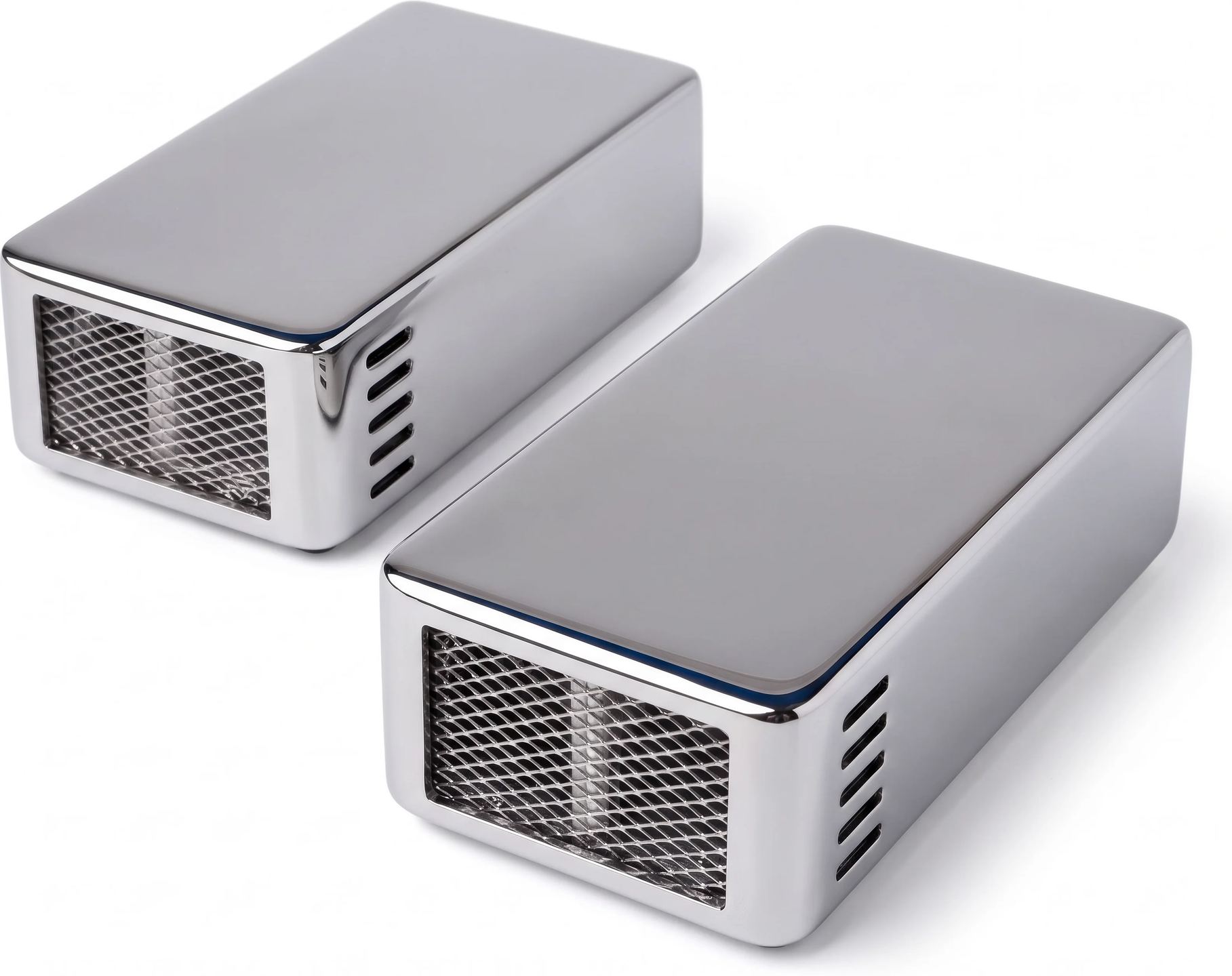
Townshend Maximum Supertweeters: the ribbon that extends the treble
Adding a tweeter on top of a speaker that already has one may seem superfluous. Yet the gamble is about time more than frequency: a virtually massless aluminium ribbon starts and stops in exact step with the signal, whereas a dome keeps vibrating for a brief moment. Placed on the speaker and connected in parallel, this small enclosure extends the treble up to 90 kHz and tightens the outline of every attack.
A three-milligram aluminium ribbon
The moving element is a strip of pure aluminium 5 mm wide and 25 mm long, one hundredth of a millimetre thick, with a mass of 0.003 grams. This ribbon serves as both diaphragm and conductor: when current flows through it, it moves within the field of the neodymium magnets on either side, with no voice coil glued to the back of a diaphragm as on a dome tweeter. Its very low electrical resistance requires a matching transformer between the amplifier and the ribbon, housed inside the enclosure.
With so little material to set in motion and then bring to rest, the ribbon follows the rising edges of the signal and stops as soon as the signal ends. On a dome, the energy that is not converted into sound spreads as ripples across the diaphragm’s surface before dissipating as heat, and this residue slightly blurs the tail of each transient. The super tweeter does not replace the speaker’s tweeter: it overlays a clean attack onto the existing sound, which the ear, highly sensitive to differences in arrival time, latches onto. Plucked strings, cymbals and piano attacks gain definition, and the harmonics that give an instrument its timbre stand out more clearly.
A bandwidth reaching up to 90 kHz
The filter is first-order, the gentlest slope possible. The super tweeter begins blending into the sound from 6 kHz, then its level rises gradually from around twelve kilohertz and extends up to 90 kHz. This wide overlap with the speaker’s tweeter avoids any abrupt cut-off, and the speaker’s original crossover does not need to be modified.
Above 20 kHz, an adult can no longer hear a pure tone, so the benefit does not lie in hearing these frequencies directly. High-resolution files and vinyl do carry information beyond this limit, which the ribbon reproduces; with CD or CD-quality streaming, capped at around 20 kHz, it is the ribbon’s speed of response that does the work. The improvement is most noticeable on speakers whose treble rolls off early, such as some older electrostatics or full-range driver models; on a speaker whose tweeter already reaches very high, the difference lies more in the clarity of attacks than in extension.
Six settings to match the level to the speaker
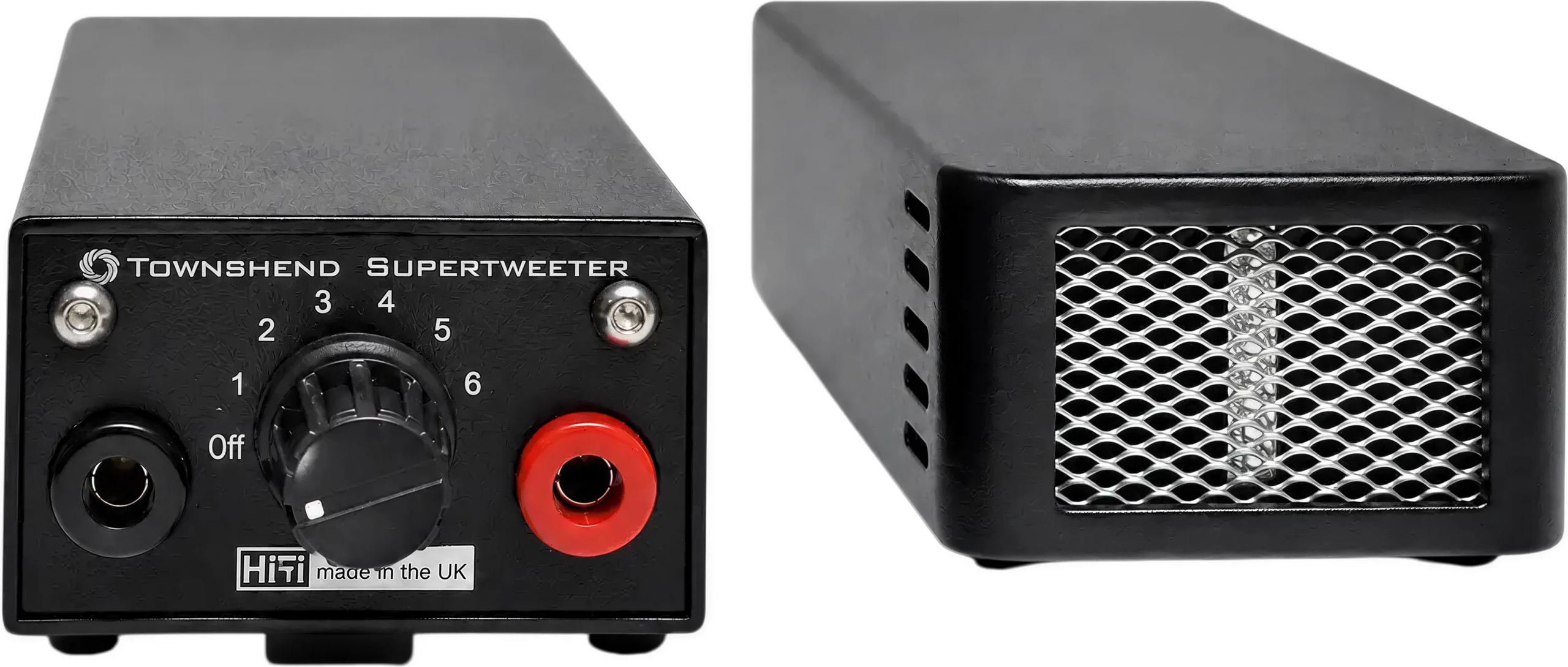
A switch on the back adjusts the sensitivity across six positions: 74, 79, 83, 85, 87 and 89 dB (measured at 2.83 V / 1 m). The choice is based on the sensitivity of the main speaker, starting from a low or intermediate position and then moving up one step at a time. A level set too high is quickly recognisable, as violins and voices take on a hard, metallic glare; when properly adjusted, the super tweeter is no longer perceived as a separate source, and it is when you disconnect it that its contribution becomes obvious, with a soundstage that narrows and treble that dulls.
Parallel connection, without touching the speaker
Each super tweeter comes with a 1.5 m connecting cable, terminated with banana plugs or spades. It connects in parallel either to the amplifier’s output terminals or to the speaker’s binding posts, in which case to the pair dedicated to the treble if the speaker is bi-wirable. Red to red and black to black is the starting rule, but on some speakers reversing the polarity gives better integration: trying both ways is worthwhile.
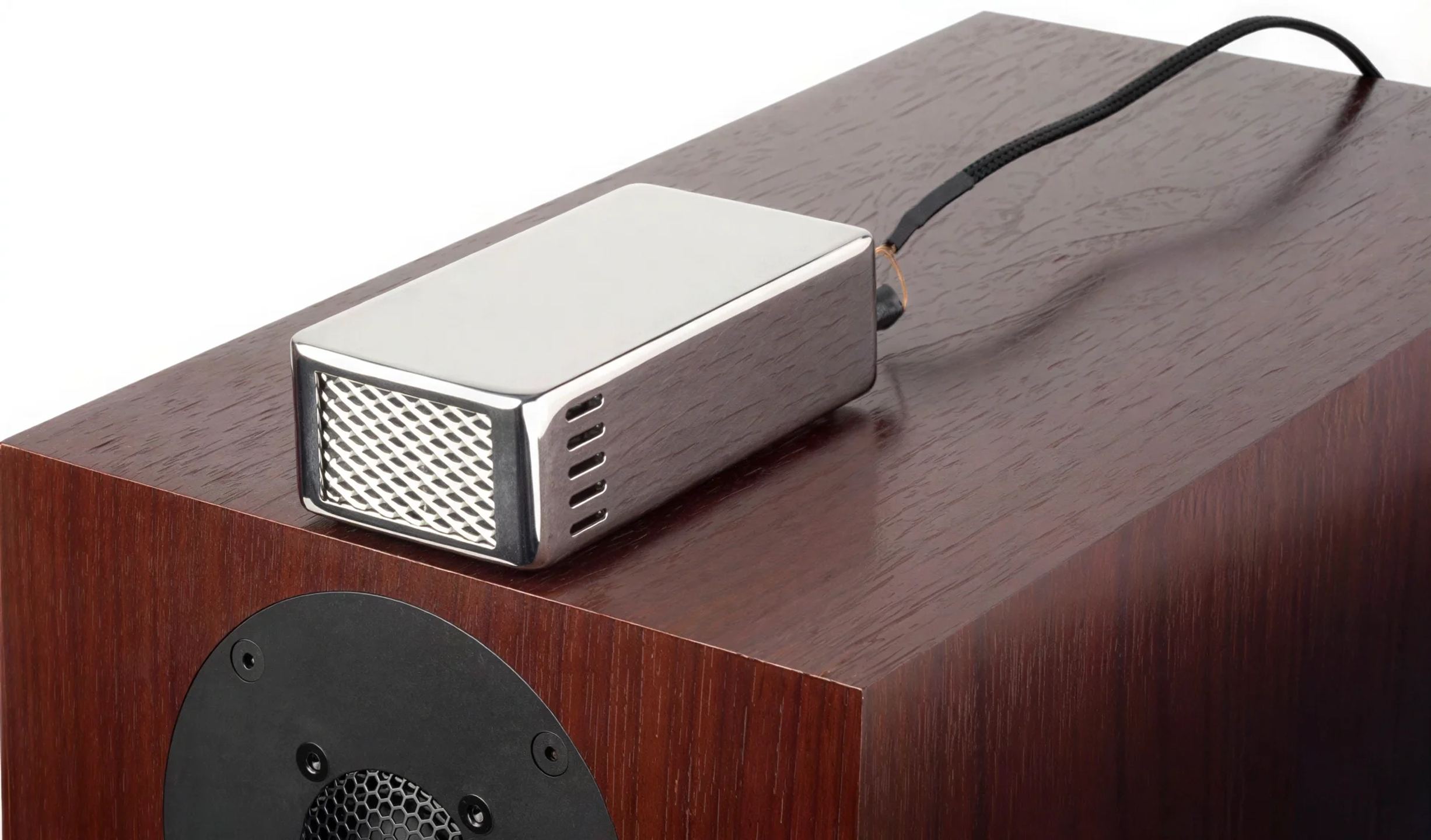
The enclosure sits on top of the speaker, centred, with its front face aligned with the baffle. It measures 5 × 3 × 10 cm and weighs 0.5 kg, fitting on most speakers, bookshelf and floorstanding alike. A metal grille protects the ribbon, and the magnets are strong enough to attract a tape measure or a screwdriver placed nearby. The super tweeters are sold in pairs, in satin black or matt silver.
Overview and application
- Type: aluminum ribbon supertweeter
- Function and application: extension of the high-frequency response of high-fidelity speaker systems
Acoustic performance
- Extended bandwidth: up to approximately 90 kHz
- Acoustic objective: improve transient reproduction and preserve harmonic and timing information
Transducer technology
- Moving element: extremely lightweight aluminum ribbon
- Operating principle: conductive ribbon operating in a powerful magnetic field
- Voice coil: no separate voice coil attached to the diaphragm
- Moving mass: extremely low for very rapid acceleration and stopping
Available finishes
- Finishes: satin black, matte silver
Dimensions and weight
- Dimensions (W × D × H): 30 × 20 × 6 cm
- Weight: 1.2 kg
Frequently asked questions
What amplifier power can be used?
The super-tweeter handles up to 400 W of unclipped music power and 500 W peak power according to the DIN IEC 268 standard. The real danger to the ribbon is clipping: an amplifier pushed beyond its limits generates high-energy, high-frequency harmonics, even at modest power levels. A self-resetting fuse protects the ribbon in the event of an overload.
Does the super-tweeter change the load seen by the amplifier?
Its impedance does not drop below 11 ohms and rises to 20 ohms in the extreme treble. Connected in parallel, it slightly lowers the total impedance only at the top end of the spectrum, which poses no difficulty for an amplifier capable of driving 4-ohm speakers.
Does it work with powered or connected speakers?
It requires a speaker-level signal, the kind an amplifier sends to passive speakers. An active or connected speaker, which receives a line-level or digital signal and has its own built-in amplifiers, does not have terminals to connect it to.
Can cables longer than those supplied be used?
The 1.5 m cables are long enough to connect to the speaker terminals. For a direct connection to the amplifier, which is often farther away, a longer cable is needed; a good-quality speaker cable terminated with suitable plugs will work, as the current sent to the super-tweeter remains low.
Is there a mounting solution for electrostatic speakers?
The top of a Quad ESL-57 electrostatic speaker cannot accommodate the unit. Townshend offers dedicated stands for this model, sold separately; other speakers do not need them.
Should you equip the rear speakers or the center speaker of a home theater system?
The focus is on the two front speakers, which handle most of the music and high-frequency effects. A pair is enough for most setups; adding a super-tweeter to the center speaker requires careful level adjustment to avoid making dialogue sound harsh.
How long has the Maximum Supertweeter been around?
It has been manufactured in the United Kingdom since 1999, initially in a polished stainless steel housing. The ribbon principle, six-position switch and miniature format have remained unchanged; satin black and matte silver finishes have since been added.
- Eco-contribution included in the sale price.


