

Atoll Electronique IN800 Evolution black


Overview
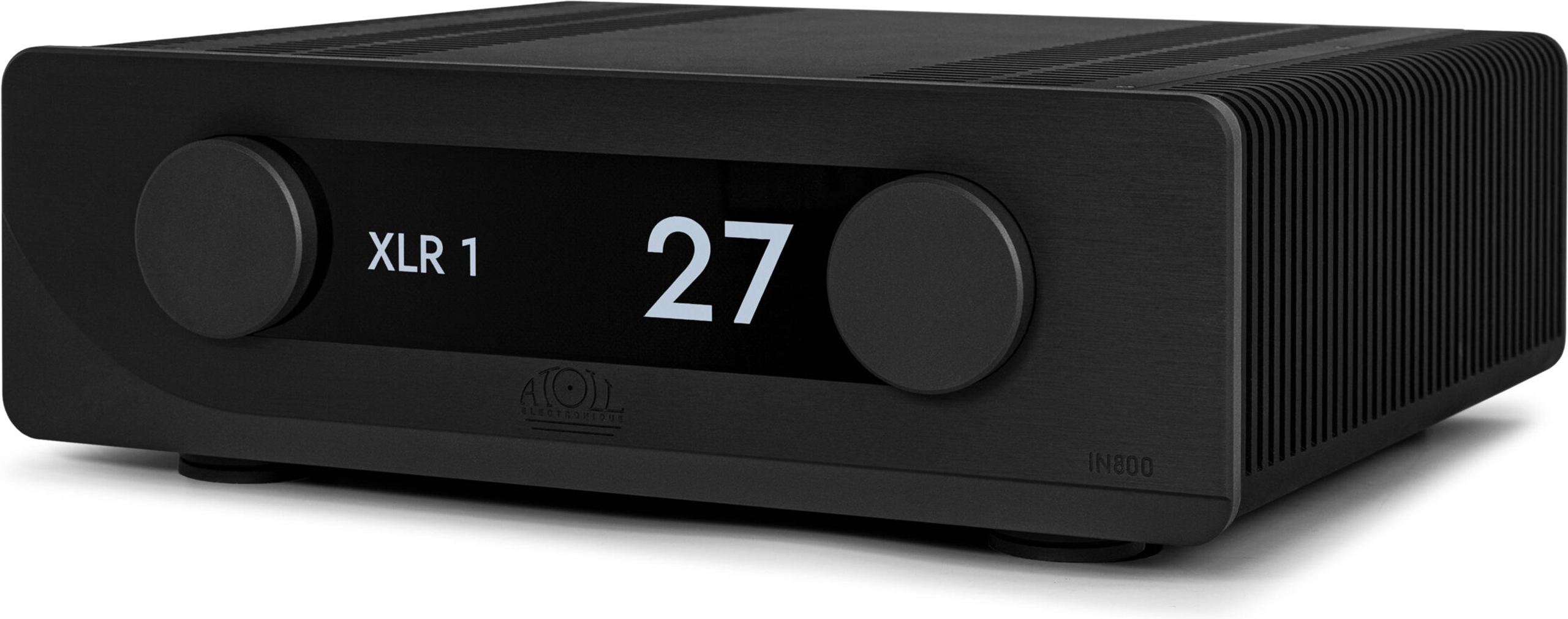
Sixteen power transistors per channel and a 1,200 VA transformer: never before had Atoll Electronique taken an integrated amplifier this far. Assembled in Brécey, Normandy, the IN800 Evolution sits above the IN400 Evolution and brings together in a single chassis the solutions the brand had previously reserved for its separate preamplifier and power amplifiers. Everyday operation remains that of an integrated amplifier, with a remote control, a large color screen and optional boards for digital audio and vinyl.
The principles of separate components in a single chassis
The IN800 Evolution adopts the core design of the PR400 Evolution preamplifier and the AM400 Evolution power amplifier. Everything has been reworked to fit into a single enclosure. The dual-mono construction extends right through to the power supply: the main 1,200 VA toroidal transformer has separate windings for the left and right channels. Each channel therefore draws its power without being affected by the other’s current demands. This transformer is mechanically decoupled from the chassis to prevent its vibrations from reaching the circuits.
Three small transformers accompany it. The first, rated at 1.6 VA, powers the control logic. The second, rated at 25 VA, powers the digital section (screen, microcontroller, optional boards), and the third, rated at 7 VA, powers the analog control circuitry. This separation keeps interference generated by the digital electronics away from the audio stages. The 128,000 µF of filter capacitors form an energy reserve that the amplifier draws on during musical peaks, a kick drum attack or an orchestral tutti, without waiting for the transformer.
Compared with the IN400 Evolution, the difference is clear: the number of output transistors increases from 8 to 16 per channel, the audio transformer from 1,050 to 1,200 VA, and the filter capacitance from approximately 96,700 to 128,000 µF. Power more than doubles, from 2 × 160 W to 2 × 350 W into 8 ohms.
Sixteen MOSFETs per channel to handle demanding speakers
The signal passes through a chain made up entirely of discrete components. It enters through bipolar transistors. Current sources combining bipolar transistors and light-emitting diodes, whose highly stable threshold voltage serves as a reference, maintain the circuits’ operating point. Darlington transistors, which provide a high drive current, then drive the power stages. These use sixteen MOSFET transistors per channel, individually matched to share the load equally. The entire circuit is fully symmetrical and operates with very low negative feedback, meaning little overall correction of the output signal by the input signal.
With 2 × 350 W into 8 ohms and 2 × 550 W into 4 ohms, power increases significantly as impedance drops. This indicates a power supply capable of delivering substantial current. This current matters with low-sensitivity floorstanding speakers, speakers whose impedance drops sharply in the bass, and in large rooms. With easier-to-drive speakers, this power mainly serves as a reserve: the amplifier operates well below its limits, even at high listening levels.
The frequency response extends from 5 Hz to 100 kHz at −3 dB, well beyond the audible spectrum, and the 2 µs rise time indicates how quickly the amplifier follows a sudden change in the signal. The signal-to-noise ratio reaches 100 dB and distortion is 0.05% at 1 kHz. This much power generates heat. The side heatsinks, machined from solid aluminum blocks, dissipate it while absorbing vibrations, and active thermal protection monitors the temperature.
Volume controlled by switched resistors
The IN800 Evolution does not use a conventional volume potentiometer. Each channel has its own high-precision MUSES attenuator, which selects fixed-value resistors through switching. A conventional potentiometer often has a slight mismatch between the left and right channels, especially at low volume, which shifts the stereo image. With switched resistors, the two channels remain matched throughout the adjustment range. The balance can be finely adjusted and stored, which is useful if the listening position is not centered between the speakers.
In the signal path, the coupling capacitors are shielded MKP (polypropylene film) models. The internal connection to the speaker terminals uses cable from Absolue Créations, a French manufacturer specializing in audio cables.
Analog connectivity with home theater integration
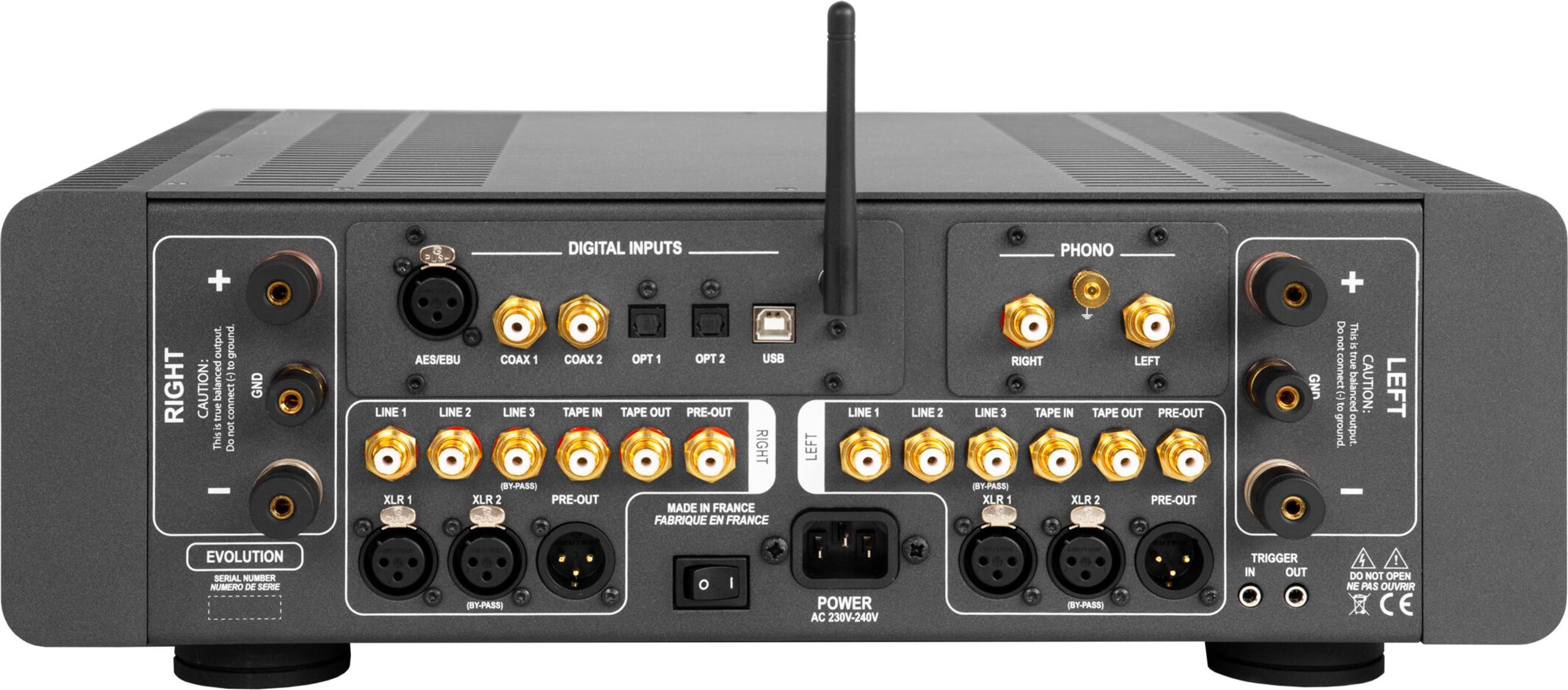
Two balanced XLR inputs and three unbalanced RCA inputs accommodate sources, while an RCA recording loop (input and output) remains available for a recorder or an external processor. With a sensitivity of 400 mV and an input impedance of 220 kΩ, the IN800 Evolution easily accepts all line-level sources: CD player, network player, DAC or phono preamplifier. Inputs can be renamed to display the name of the connected device rather than a number.
One RCA input and one XLR input can be switched to bypass mode. Their gain becomes fixed, and a processor or home theater amplifier controls the volume. The same speakers can then be used for stereo listening and as the two front channels of a multichannel system, without having to readjust levels every time you switch uses.
The XLR and RCA preamplifier outputs feed an additional power amplifier or an active subwoofer. A 12 V trigger input and output synchronize power-up with other devices. The IN800 Evolution comes without a digital input: the optional DA800 conversion board adds one, while the P800 and P820 phono boards are also available for moving magnet (MM) or moving coil (MC) cartridges. Without these boards, a network player or external DAC connects to one of the analog inputs.
A 12 mm front panel and a high-resolution screen
The 12 mm aluminum front panel is brushed, bead-blasted and then anodized, with precisely engraved markings. The knobs are machined from solid metal, as are the side heatsinks, and the chassis is made of 2 mm steel. The IN800 Evolution weighs 27 kg and is available in Silver or Black finishes. The 480 × 1,280-pixel color TFT screen displays the source and volume in large characters that are readable from a distance, and its brightness can be adjusted to avoid distraction in a dark room. All functions are accessible from the front panel: power, source selection, volume, balance, screen settings and standby mode. The aluminum remote control is included.
Technical specifications
Product overview
- Type: integrated amplifier-preamplifier.
- Positioning: the brand’s ultimate integrated amplifier-preamplifier, designed to reproduce the musical message in all its fullness, combining energy and refinement.
- Differential electronic stages delivering considerable power to drive the most prestigious loudspeakers.
Amplification and audio architecture
- Fully dual-mono design:
- Separate windings for the left and right channels.
- High-precision MUSE switched-resistor attenuators, one per channel.
- Bipolar transistor input stages.
- Bipolar transistor and light-emitting diode (LED) current sources to ensure perfect stability.
- Darlington transistor driver stages.
- Perfectly symmetrical audio stages with very low negative feedback.
- Rigorously matched MOSFET transistor power stages: 16 per channel.
- High-quality shielded MKP coupling capacitors.
- Internal connection to the speaker outputs via Absolue Créations cable.
- Active thermal protection.
Audio performance
- RMS power:
- 2 × 350 W into 8 Ω.
- 2 × 550 W into 4 Ω.
- Bandwidth at −3 dB: 5 Hz to 100 kHz.
- Rise time: 2 µs.
- Input impedance: 220 kΩ.
- Sensitivity: 400 mV.
- Signal / noise ratio: 100 dB.
- Distortion at 1 kHz: 0.05%.
Power supply
- Toroidal transformers:
- Audio: 1200 VA, mechanically decoupled.
- Control logic: 1.6 VA.
- Digital control: 25 VA.
- Analog control: 7 VA.
- Total capacitance: 128000 µF.
- Power consumption in low-power standby: < 0.5 W.
Connections
- Inputs:
- 2 XLR inputs.
- 3 RCA line inputs.
- 1 RCA tape input / output.
- Bypass mode configuration available: 1 RCA input and 1 XLR input.
- Outputs:
- Preamplifier outputs: XLR, RCA.
- Stereo speaker outputs.
- Ground terminals for subwoofer.
- Trigger:
- Input: 12 V.
- Output: 12 V.
Controls and display
- Front-panel controls: power on / off, source selection, volume adjustment, balance adjustment, display management, low-power mode selection.
- Precise balance adjustment with memory function.
- Inputs can be renamed.
- Selectable standby modes: low-power, warm-up.
- High-resolution color TFT display:
- Resolution: 480 × 1280.
- Adjustable brightness.
Optional expansions
- Digital-to-analog converter (DAC) boards and phono boards for moving magnet (MM) or moving coil (MC) cartridges.
- Boards that can be added:
- DA800 digital-to-analog converter board.
- P800 and P820 phono boards.
- Specifications coming soon.
- Configuration shown: IN800 EVO with optional DA800 and P800 boards.
Included accessories
- Aluminum remote control supplied as standard.
Construction, dimensions and weight
- 12 mm aluminum front panel, brushed, bead-blasted and anodized, with high-precision engraving.
- Side heatsinks and knobs machined from solid aluminum.
- Heatsinks machined from solid aluminum blocks to absorb vibrations and ensure optimal heat dissipation.
- 2 mm steel chassis.
- Dimensions: 443 × 440 × 147 mm.
- Weight: 27 kg.
Frequently asked questions
What is the difference between low-power standby and preheating modes?
In low-power mode, the IN800 Evolution consumes less than 0.5 W in standby. The circuits then need time to warm up after switching on. Preheating mode keeps the stages powered in standby: the amplifier is at operating temperature as soon as it is switched on, at the cost of higher power consumption. This mode is well suited to daily listening, while low-power mode is better for more occasional use.
How much space is needed for installation?
The IN800 Evolution measures 443 mm wide, 440 mm deep and 147 mm high. Allow a few extra centimetres at the rear for cables, particularly XLR connectors and thick speaker cables. With the heatsinks located on the sides, leave space for airflow on either side and above, and avoid an enclosed compartment. At 27 kg, the shelf must be able to support this weight without sagging.
How do I add a subwoofer?
The active subwoofer connects to the RCA or XLR preamp output, depending on its inputs. The subwoofer’s volume then follows that of the IN800 Evolution. The signal sent covers the entire frequency range: the subwoofer’s built-in low-pass filter limits it to the bass frequencies, while the main speakers continue to operate full-range. Simply adjust the subwoofer’s crossover frequency so that it takes over where the speakers begin to roll off.
Do the preamp outputs support bi-amping?
Yes, with speakers equipped with dual binding posts. The IN800 Evolution powers one section of the speaker, for example the bass, and a power amplifier connected to the preamp output powers the other. The jumpers between the binding posts must then be removed. Preferably choose an amplifier with a similar gain, otherwise the tonal balance will change and must be compensated for.
What do a signal-to-noise ratio of 100 dB and a distortion of 0.05% mean in practical terms?
The signal-to-noise ratio measures the difference between the music signal and the background noise from the electronics. At 100 dB, this hiss remains inaudible from the listening position, even with high-efficiency speakers. The distortion rate measures unwanted signals added to the original sound: 0.05% at 1 kHz represents a tiny fraction, well below what the ear can perceive when listening to music.
Do you need balanced XLR inputs to enjoy the IN800 Evolution?
No, the RCA inputs provide access to the entire amplification chain. The XLR connection carries the signal over two conductors in opposite phase plus a ground, which eliminates interference picked up along the way. It is especially useful with long cables or in an environment with lots of electrical equipment. If your source has an XLR output, you might as well take advantage of it, as the IN800 Evolution’s electronics are fully balanced.
- Eco-contribution included in the sale price.


