

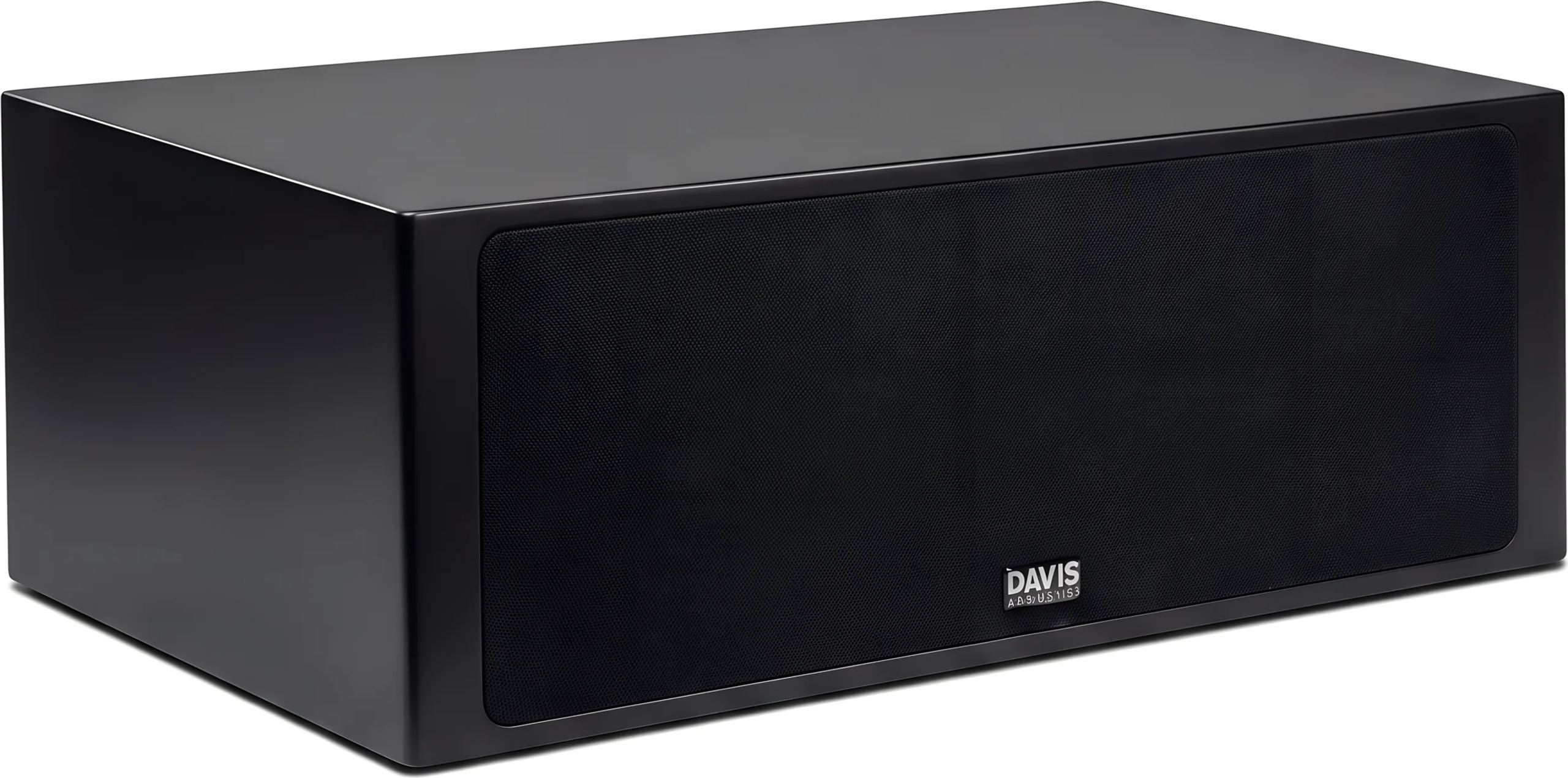
Davis Acoustics Courbet C S2 black


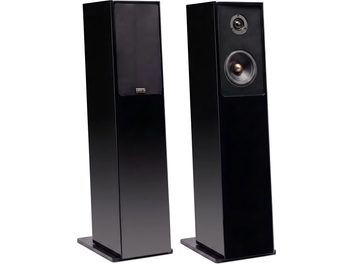
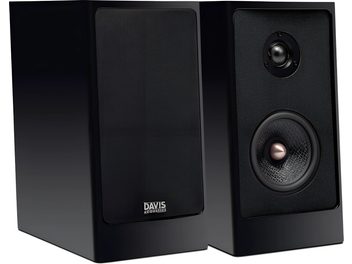
Complementary products
Overview
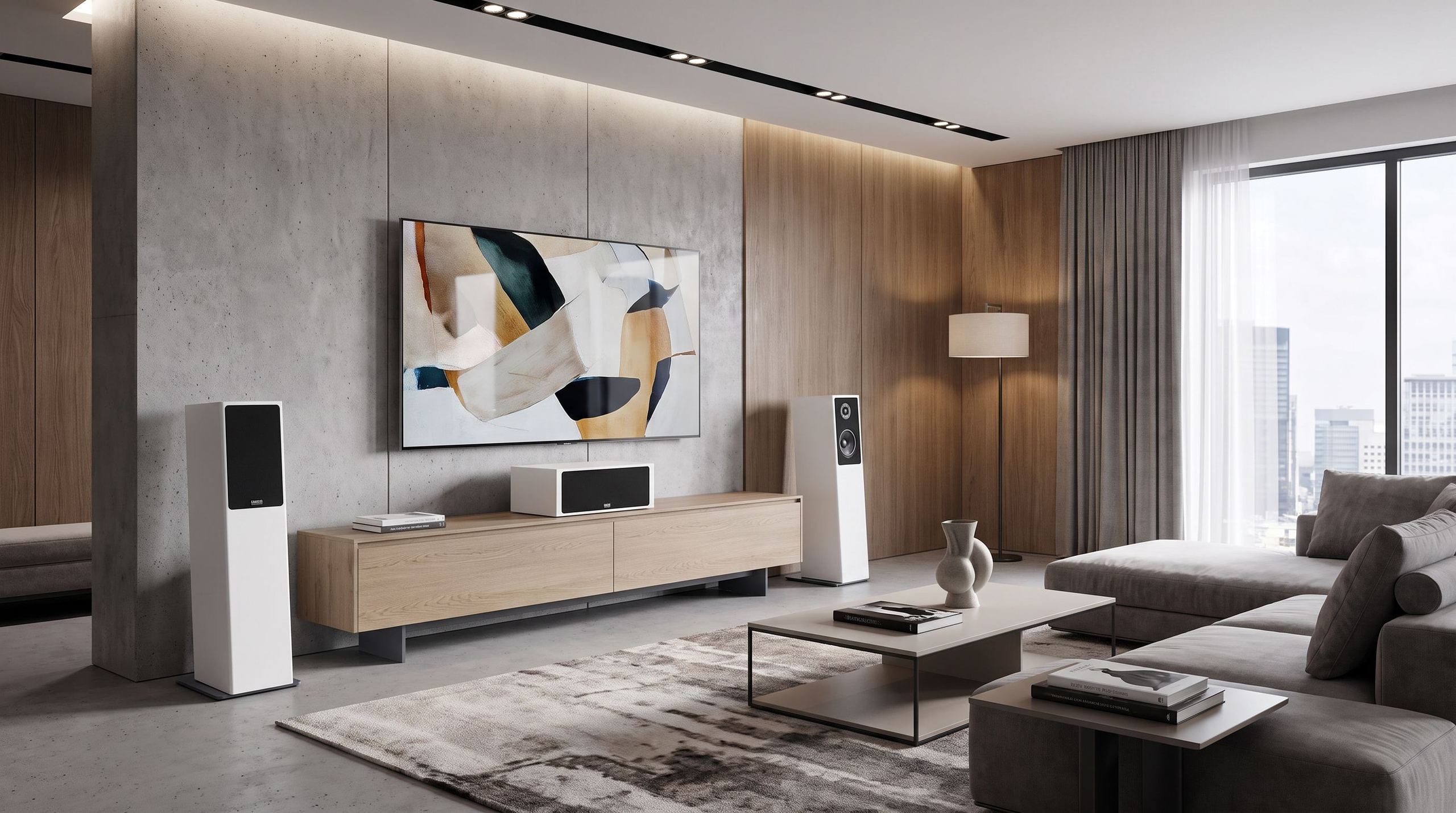
In a home theater system, the center channel reproduces most of the dialogue. Even the slightest tonal mismatch with the front speakers becomes audible as soon as a voice or sound moves from one side of the screen to the other. For this center speaker, Davis Acoustics has used the exact same drivers as the Courbet 3 S2 and Courbet 4 S2, in a cabinet with the same lines and the same four lacquer finishes.
The drivers from the Courbet 3 S2 and 4 S2
The front panel houses three drivers: a 28 mm textile dome tweeter in the center, between two 13 cm mid/bass drivers with Kevlar cones. These two 13 cm drivers are identical to those in the other models in the range. The tonal character therefore remains the same from one speaker to another, and a voice moving from the left speaker to the center retains the same color. Kevlar is a stiff, lightweight aramid fiber. Davis Acoustics has used it since its beginnings in 1986: its very first driver was already a 13 cm model with a Kevlar cone. At the center of each cone, a fixed, bullet-shaped phase plug replaces the usual dust cap. It limits resonances in the central cavity and broadens upper-midrange dispersion.
The tweeter comes from the work carried out for the Olympia One Master 35, a high-end model from the brand. It features a revised rear chamber, positioned behind the dome to absorb the rearward sound wave. With this wave better controlled, less unwanted energy is reflected back toward the diaphragm. Distortion is reduced and the treble gains finesse.
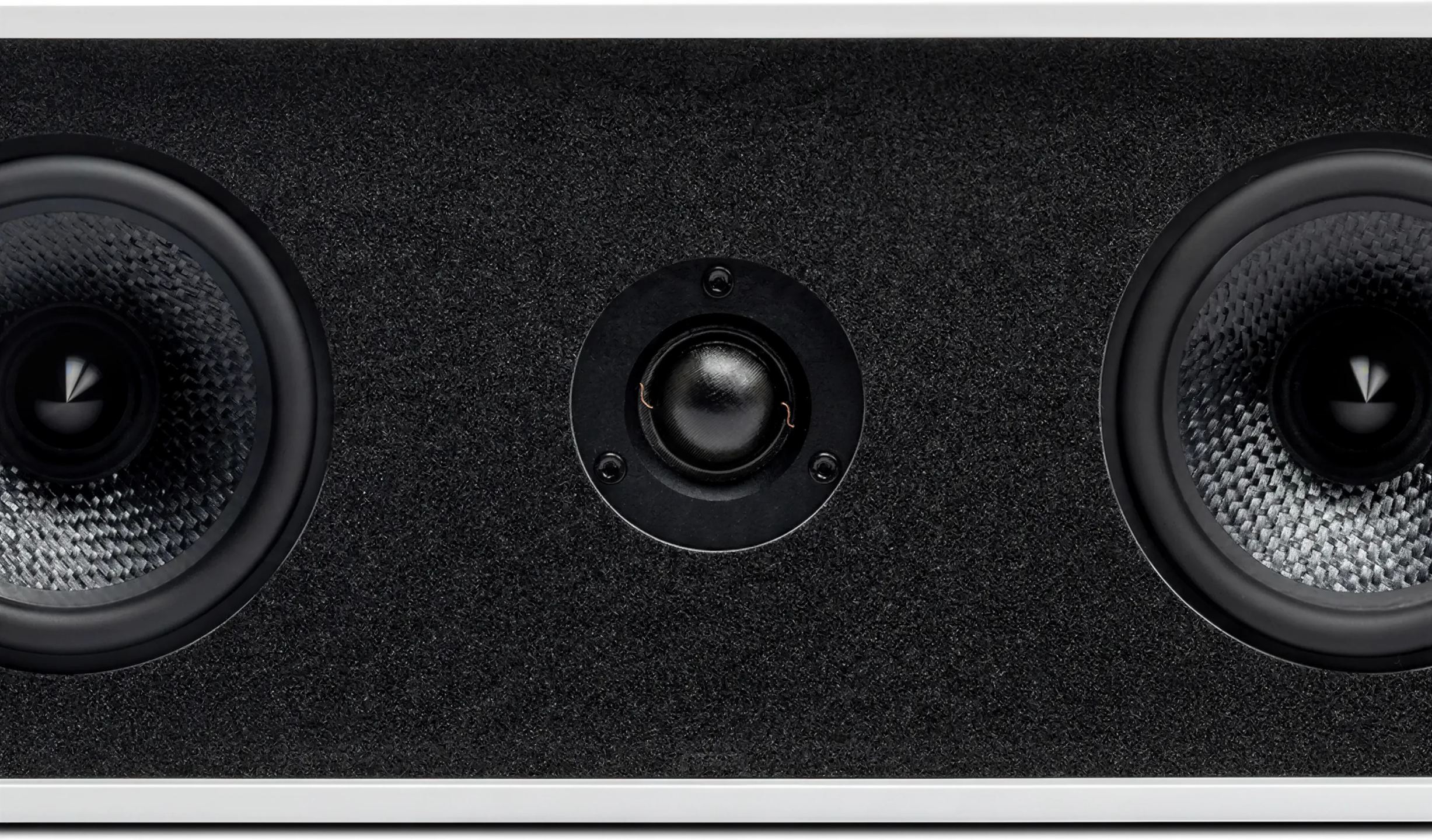
A 3,500 Hz crossover that leaves voices to the two 13 cm drivers
The crossover hands over from the mid/bass drivers to the tweeter at 3,500 Hz. The fundamental frequencies of the human voice and most of its harmonics therefore remain with the two Kevlar cones. The tweeter reproduces sibilant consonants, breath sounds and upper-frequency detail. This crossover is point-to-point wired: its components are connected directly to one another, through their leads or with wire, without a printed circuit board, using parts selected for this purpose.
As with any horizontal center speaker with two mid/bass drivers, the sound is most consistent for seats directly facing the speaker or at a moderate angle. On a typical-sized sofa, all seats remain within this area. For a seat far off to one side, it is better to angle the speaker slightly toward it.
Rear ports and placement below the screen
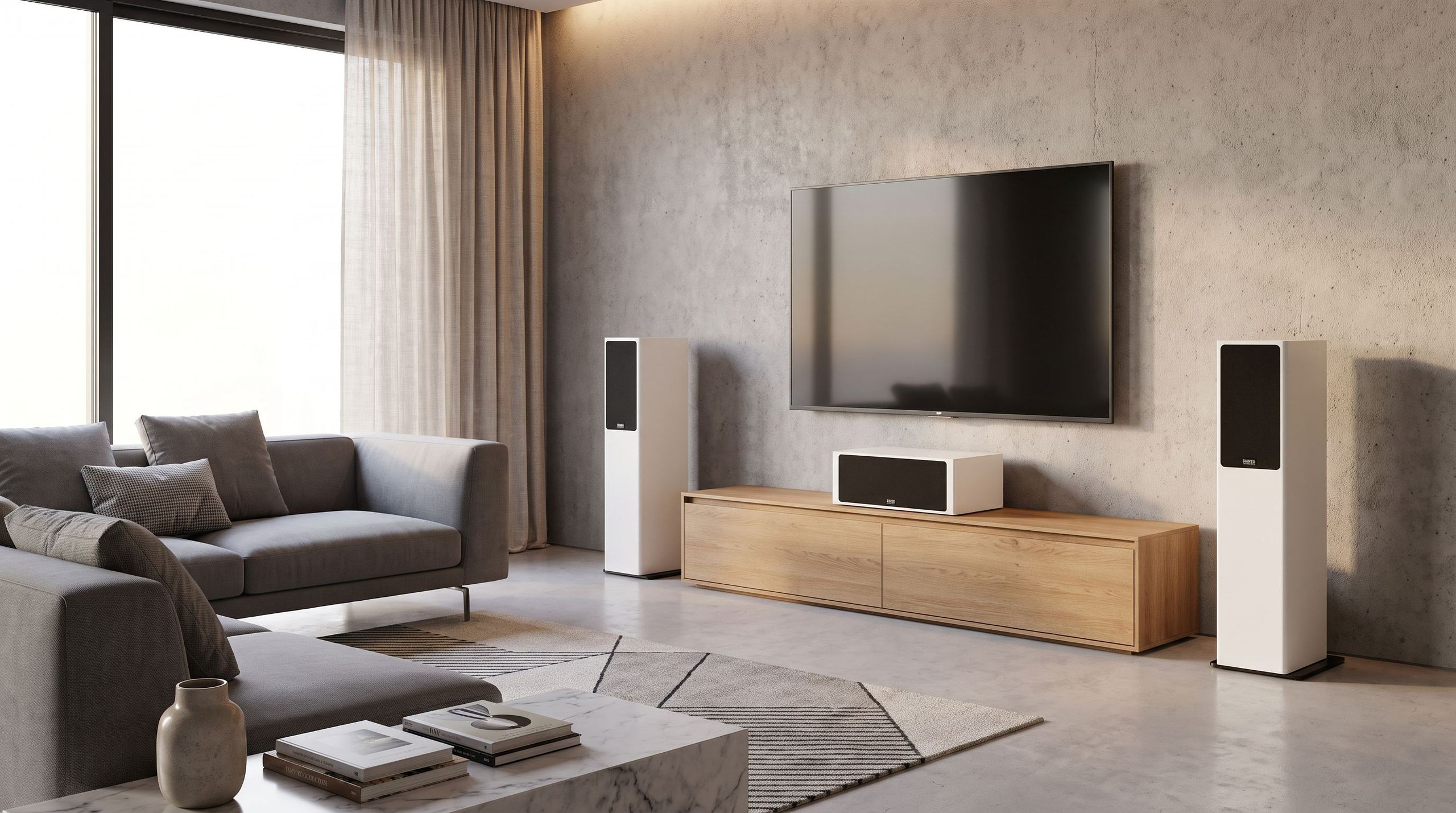
The enclosure uses a bass-reflex design, with two rear-facing ports. A bass-reflex port is a duct that uses the air inside the cabinet to extend bass response, here down to 52 Hz. These openings must remain unobstructed. Placed in an enclosed recess or against a wall, the speaker would produce more bloated, less defined bass. An open shelf, with space behind the speaker, is a better fit.
The speaker measures 18 cm high, 54 cm wide and 29 cm deep, and weighs 12 kg. Before buying, check the clearance between the supporting surface and the bottom of the TV, as well as the shelf depth. The entire underside is covered with a bonded foam pad. It decouples the speaker from its support, prevents it from slipping and protects the shelf surface from scratches.
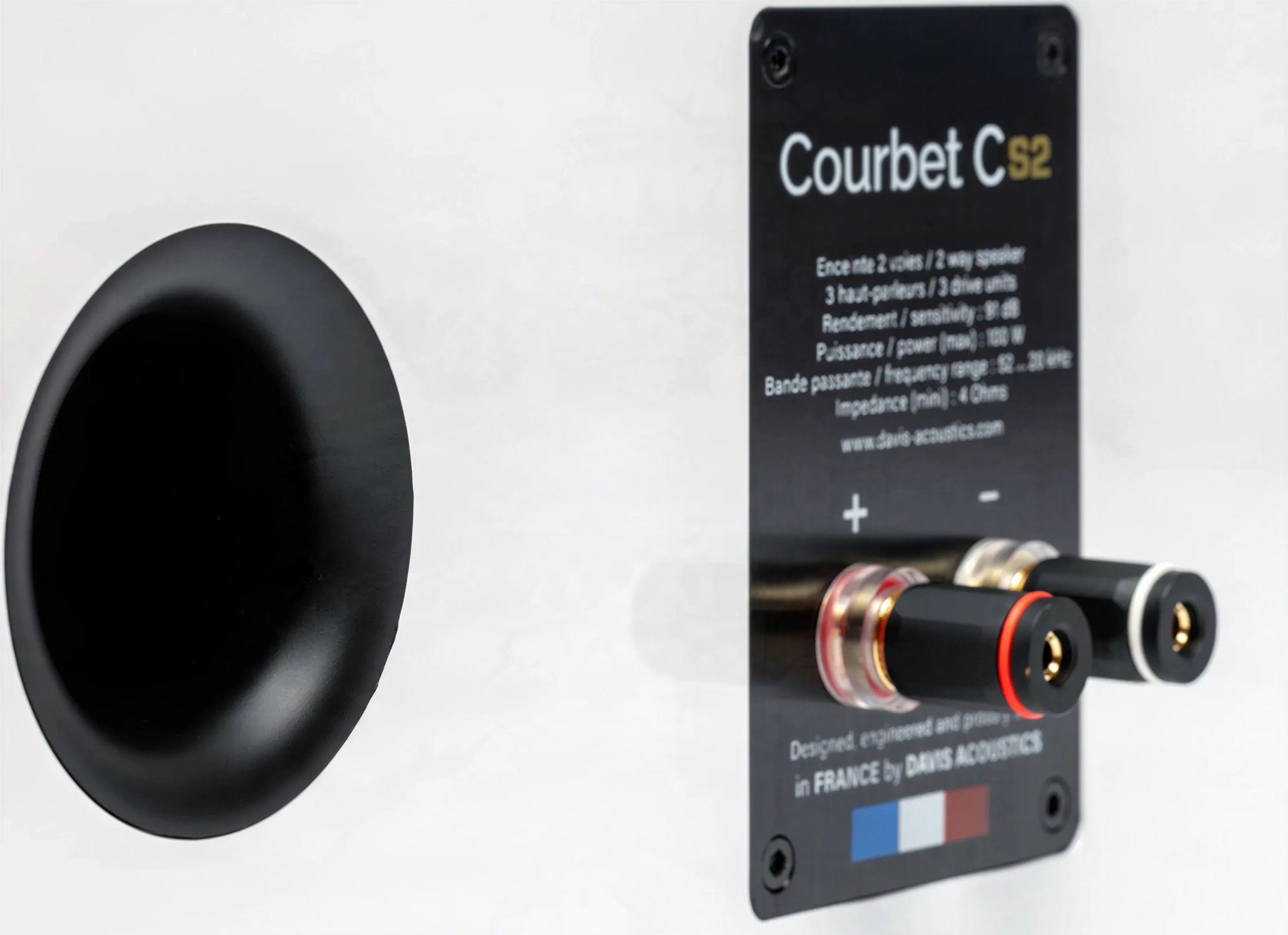
A lacquered cabinet with rounded corners
The cabinet’s rounded edges serve an acoustic purpose. A sharp edge reflects part of the sound wave, slightly blurring imaging precision. A rounded edge limits this diffraction. The protective grille is integrated into the cabinet, sits flush with the front panel and follows the cabinet’s rounded corners. The original Courbet C was only available in matte black, with a fully fabric-covered front panel. The S2 adopts the series’ four lacquer finishes: white, black, gunmetal gray and orange.
91 dB sensitivity, easy to drive
With a sensitivity of 91 dB, the Courbet C S2 produces high sound levels from modest power. It therefore handles dialogue and action scenes effortlessly. Its nominal impedance is 8 Ω, with a minimum of 4 Ω, and it handles up to 100 W. It is suitable for mainstream home theater AV receivers. The binding posts accept heavy-gauge cables.
Documentation
Technical specifications
Overview
- Type: passive center speaker
- Number of ways: 2
- Number of drivers: 3
- Acoustic loading: bass reflex, two rear ports
Drivers and crossover
- Tweeter:
- 28 mm soft textile dome
- Optimized rear loading, derived from the Olympia One Master 35
- Central position
- Mid-bass drivers:
- 2 × 13 cm, Kevlar cones, dispersion phase plugs
- Identical to those in the Courbet 3 S2 and 4 S2
- Crossover frequency: 3500 Hz
- Crossover: point-to-point wired, selected audiophile components
Acoustic and electrical performance
- Frequency response: 52 Hz to 20 kHz
- Sensitivity: 91 dB
- Nominal impedance: 8 Ω
- Minimum impedance: 4 Ω
- Maximum power: 100 W
Connectivity
- Binding posts: high quality, compatible with thick-gauge cables
Design and finishes
- Cabinet: rounded edges
- Grille: inset into the cabinet, flush with the front baffle, rounded corners
- Decoupling: foam covering the entire underside to ensure stability and protect surfaces
- Finishes: white lacquer, black lacquer, gunmetal gray lacquer, orange lacquer
Dimensions and weight
- Dimensions (H × W × D): 18 × 54 × 29 cm
- Weight: 12 kg
Frequently asked questions
Can it be paired with speakers other than the Courbet 3 S2 or Courbet 4 S2?
Yes, it can be connected to any speakers. However, an exact timbre match is only possible with models that use the same drivers, namely the Courbet 3 S2 and 4 S2. With other speakers, the home cinema amplifier’s automatic calibration reduces the difference without eliminating it.
Should you add a subwoofer?
For movies, yes. The low-frequency effects track (the LFE channel, the “.1” in a 5.1 system) can only be reproduced by a subwoofer. With a subwoofer, the center speaker is generally set to “small” in the amplifier menu, with a crossover around 80 Hz. The subwoofer then reproduces the deepest bass, while the Courbet C S2 focuses on voices.
How do I install it if the TV stand is low?
If the tweeter is significantly below ear level, the speaker should be placed at the front edge of the shelf. This prevents the top of the stand from reflecting some of the sound. It should also be mounted as high as possible beneath the screen. Running the amplifier’s calibration once the speaker is in place allows the center channel level and delay to be set correctly.
Is it compatible with bi-wiring?
No. The speaker has only one pair of binding posts. It connects using a single cable per channel.
What cable gauge should I choose?
For typical home theater cable lengths of up to around ten meters, a cross-section of 2.5 mm² is sufficient. The binding posts also accept thicker cables, banana plugs or spade connectors, depending on how the amplifier is connected.
- Eco-contribution included in the sale price.


