

GigaWatt Powersync ULTRA (IEC C19) 1.5m
Overview
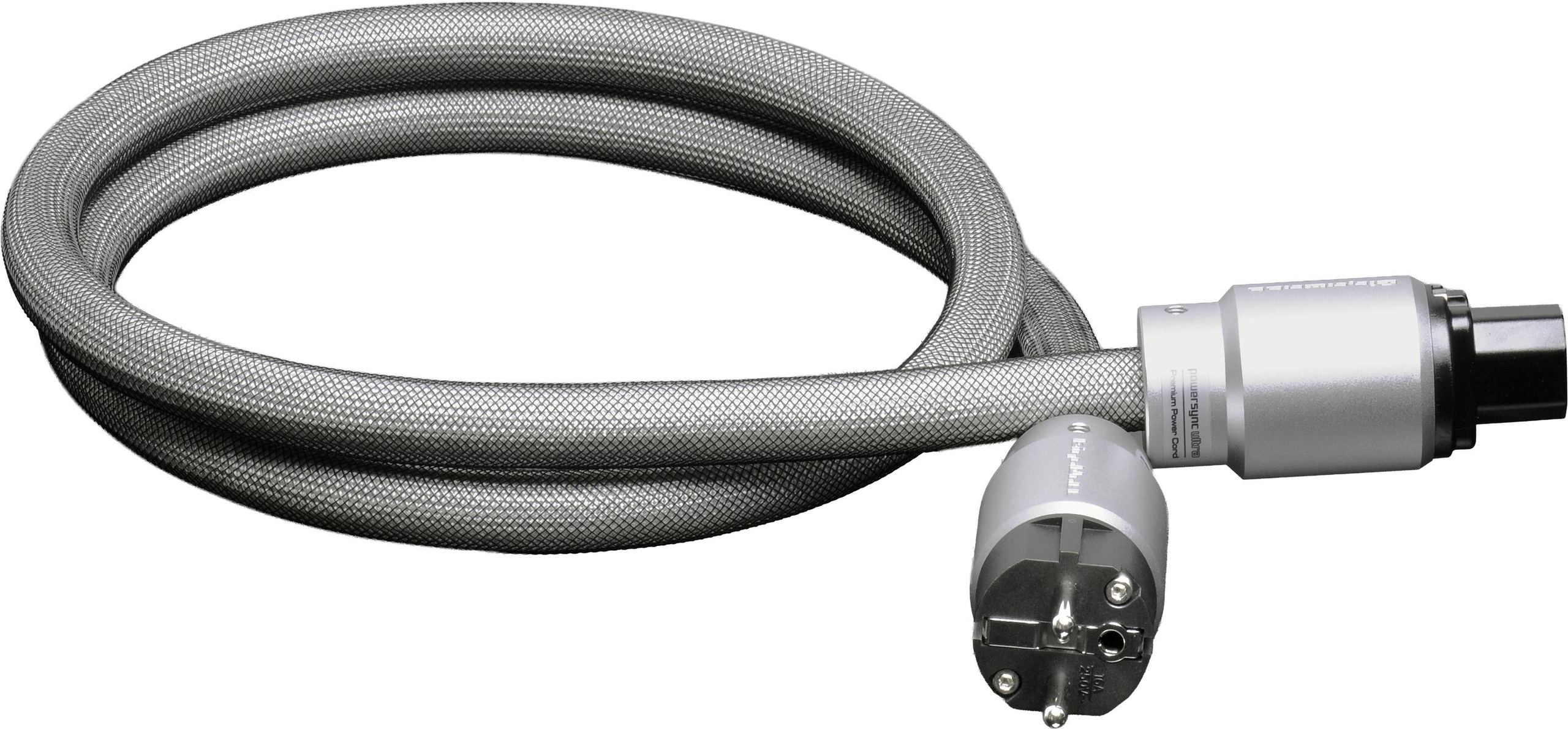
A power amplifier or a power conditioner supplying an entire system draws much higher current peaks than a source or streamer. This version of the highest-end copper power cable in the GigaWatt range has an IEC C19 connector at the equipment end, the 16 A connector used on power-hungry equipment, and a Schuko plug at the wall end. Between the two are eight twisted copper conductors, full shielding and solid aluminium connector housings, all made in Poland.
An IEC C19 connector for 16 A inlets
The IEC 60320 standard defines several pairs of mains connectors. Most hi-fi equipment has a C14 inlet, which accepts a C13 or C15 connector rated at 10 A. The C19 connector is wider, with more substantial contacts, and only fits a C20 inlet, rated at 16 A. This inlet is found on certain power amplifiers and power conditioners, such as the GigaWatt PowerControl and PC-4 EVO+. The cable handles 16 A continuously, matching the connector’s rating, at a voltage of 110 to 240 V. Before choosing this version, simply check the back of the equipment: the C19 will not fit a standard C14 inlet. An IEC C15 version of the same cable is available for C14 inlets.
Eight twisted OFHC copper conductors
The cable has eight 1.5 mm² conductors, giving a total of 12 mm² of copper. By comparison, the PowerSync PLUS has three 2.5 mm² conductors. Each conductor consists of seven tightly twisted strands, and the conductors themselves are twisted together. This twisting reduces the cable’s inductance, meaning its tendency to resist rapid changes in current. These include the brief peaks drawn by an amplifier’s power supply each time it recharges its capacitors.
The metal is OFHC C10100 copper (oxygen-free high-conductivity copper) with a purity of 99.997%. It is annealed, meaning heated after the wire is drawn. Drawing distorts the metal’s crystalline structure, and annealing makes it more uniform, slightly improving conductivity.
Full shielding that routes interference to earth
A laminated aluminium foil covers the cable’s entire surface. It blocks electromagnetic and radio-frequency interference, both from outside sources (switch-mode power supplies, internet routers) and from within the cable, and routes these interference currents to earth. For this to work, the wall socket must be properly earthed: without an earth connection, the shielding cannot discharge what it picks up.
The conductors and shielding are embedded in an elastic material that dampens vibrations. An antistatic outer braid covers the assembly and prevents charges from accumulating on the surface. The cable remains passive: it does not stabilise a fluctuating voltage or remove interference already present on the mains. That is the job of a power conditioner or filter.
Solid aluminium connectors, clamped without solder
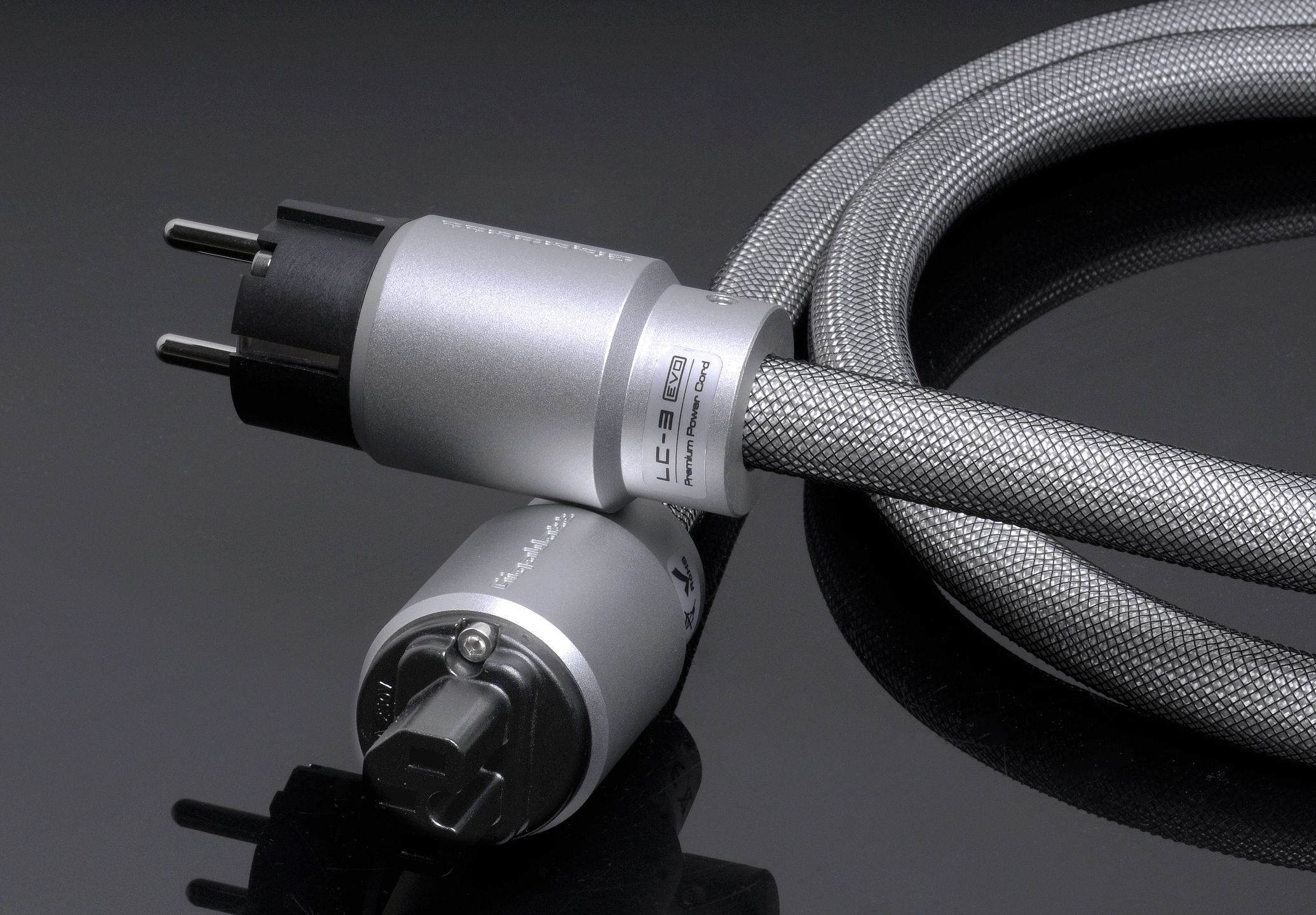
The Schuko and C19 connectors have solid aluminium housings, which are more rigid and less susceptible to vibrations than moulded plastic housings. Their contacts are made of rhodium-plated brass. This very hard metal withstands repeated connections without the contact quality deteriorating. The contacts also undergo cryogenic treatment (exposure to very low temperatures) followed by demagnetisation.
Assembly uses no solder: each conductor is clamped by a screw directly onto the bare copper. A tinned wire trapped under a screw eventually deforms slowly under pressure and loosens. Bare copper stays firmly clamped, and the connection maintains low resistance over time.
The top of the PowerSync family
Before being named PowerSync ULTRA, this model was called LC-3 EVO, and the entire PowerSync family originated from it. The entry-level PowerSync has three 2 mm² conductors within an 11.5 mm diameter, while the PowerSync PLUS has three 2.5 mm² conductors within 15 mm. These two models use the brand’s own nickel-plated G-010 and G-030 connectors. The ULTRA is the first in the family to feature aluminium connectors with rhodium-plated contacts. Its construction using multiple seven-strand 1.5 mm² conductors comes from the higher-tier LS series. The LS series moves to silver-plated copper: seven conductors on the LS-1 EVO+, nine with FEP Teflon insulation on the LS-2 EVO. The ULTRA remains the brand’s highest-end bare copper model.
A 17 mm cable that needs careful installation
With its 17 mm diameter, shielding and vibration-damping jacket, the cable cannot bend tightly. Allow enough space behind the equipment for it to run without putting strain on the inlet. The aluminium C19 connector also has some weight to it: resting the cable on the floor or a shelf, rather than leaving it hanging behind the amplifier, avoids pulling on the C20 inlet and stressing the contact.
Technical specifications
Electrical specifications
- Mains supply voltage: 110–240 V AC, 50–60 Hz
- Maximum continuous current: 16 A
Conductors
- Material: oxygen-free high-conductivity copper (OFHC C10100), 99.997% purity
- Treatment: annealed for a more homogeneous structure and better conductivity
- Architecture: 8 conductors of 1.5 mm², each composed of 7 tightly twisted strands
- Twisted conductors to reduce cable inductance
Insulation and protection
- Conductors and shielding encased in an elastic material that dampens vibrations
- Full shielding: laminated aluminum foil covering 100% of the cable surface
- Protection against electromagnetic interference (EMI), radio-frequency interference (RFI) and internal noise; stray currents routed to ground
- Antistatic outer braid
Connectivity and assembly
- Connectors: 1 Schuko plug, 1 IEC C19 connector
- Connector bodies: solid aluminum
- Rhodium-plated brass contacts, cryogenically treated and demagnetized
- Tin-free connections, plugs with screw terminals
Dimensions and weight
- Outer diameter: 17 mm
- Gross weight: 1.60 kg (version with wooden box)
Frequently asked questions
How do you identify a C20 inlet on the back of a device?
The C20 inlet has three flat pins positioned horizontally in a rectangular housing wider than that of a C14, whose pins are vertical. If in doubt, the device’s manual specifies the inlet type in its electrical specifications.
Is it better to connect it to the power conditioner or directly to a device?
Both uses work. At the start of the setup, between the wall outlet and a power conditioner or power strip, it carries the current for the entire system, and its continuous 16 A rating covers this use. The devices plugged into the power conditioner then have their own power cords. On a power amplifier fitted with a C20 inlet, it directly powers the device that draws the most current.
Is the cable available with other terminations?
Yes. In addition to this Schuko to C19 version, it is available in Schuko to C15 for standard C14 inlets, with American or Australian plugs on the wall side, and in a PowerCon 32 A version for devices equipped with this locking connector.
Does the Schuko plug obstruct the other socket on a double wall socket?
Its solid aluminium body is bulkier than a standard moulded plug, and the 17 mm cable is somewhat stiff where it exits. On a double socket or a wall-mounted socket block with closely spaced outlets, it is best to check that the neighbouring socket remains usable.
What can a power cable add to a hi-fi system?
Its electrical role is twofold: to carry current without a voltage drop when the device draws a peak, and to limit interference picked up or radiated along this final stretch. The effect depends on the setup: it is more noticeable with an amplifier whose power supply draws high currents, or in an environment full of devices with switching power supplies, than with a small source component that consumes just a few watts.
- Eco-contribution included in the sale price.


