

EverSolo DAC-R8
Specifications and features


Overview
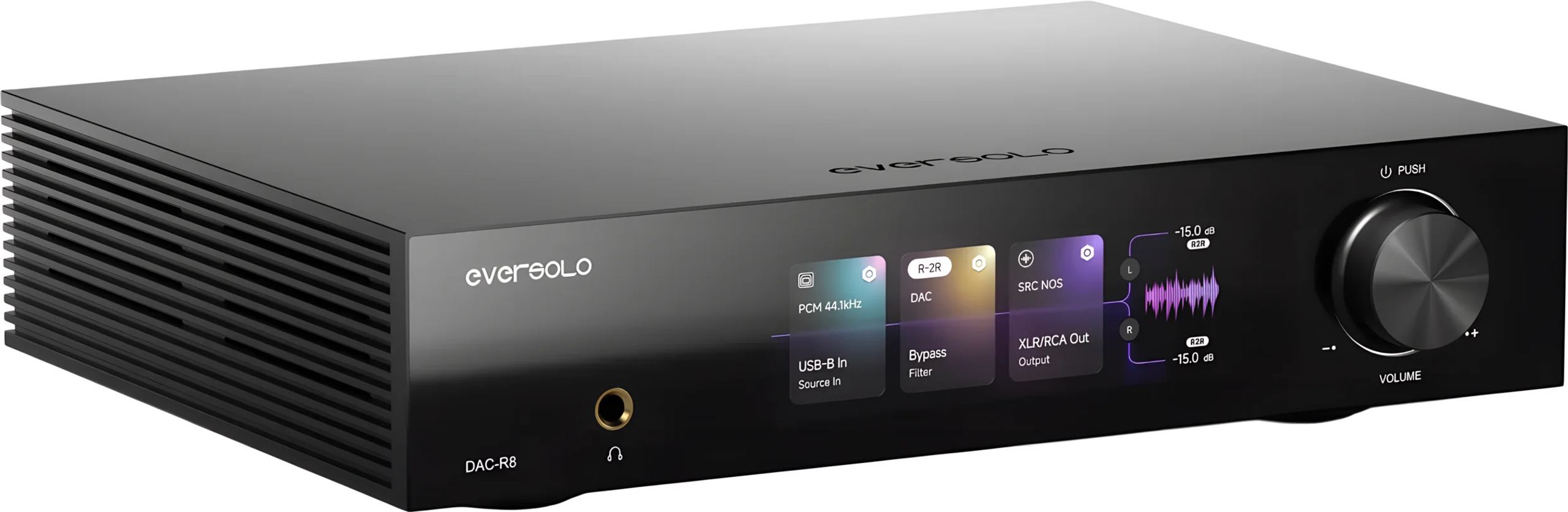
For its first R2R converter, Eversolo does not use an off-the-shelf chip. Conversion is handled by a discrete resistor ladder developed by the brand and controlled by a programmable component. The DAC-R8 also serves as a preamplifier, with analog volume control, and as a headphone amplifier. Its digital processing is configured from a web browser. It accepts a network transport, a computer, a television, a CD player or a smartphone via Bluetooth.
A resistor ladder developed by Eversolo
Until now, Eversolo has entrusted conversion in its network players and converters to ESS or AKM chips. The DAC-R8’s OriginR2R circuit is different: it is a network of precision discrete resistors, designed by the brand and controlled by an FPGA. This programmable component receives the audio data and distributes it to the resistor ladder. In an R2R converter, each bit of a sample switches a resistor branch whose contribution to the signal is proportional to its bit significance. The output voltage is therefore built directly, sample by sample. A delta-sigma converter, by contrast, recalculates the signal at a very high frequency.
Everything depends on resistor matching. A tolerance mismatch in the most significant bit branches, which control the largest voltage changes, appears in the signal as distortion. Eversolo has chosen a segmented 5 + 20-bit design: one section handles coarse resolution over five bits, while another handles fine resolution over twenty bits. The circuit is fully differential, from conversion through to the balanced outputs. The brand specifies total harmonic distortion plus noise of 0.000316% (-110 dB), with a signal-to-noise ratio and dynamic range of 130 dB. The DAC-R8 decodes PCM up to 768 kHz at 32 bits and DSD up to DSD512.

NOS, OS and BEST: three processing options
In NOS (non-oversampling) mode, samples reach the resistor ladder just as they were recorded, without a digital filter. This is how R2R converters originally operated. The impulse response does not exhibit the ringing that a digital filter creates before each transient. The trade-off is a slight roll-off in the highest treble frequencies with 44.1 kHz files. In OS mode, the signal is oversampled by 2, 4 or 8 before conversion. Unwanted frequencies caused by sampling are pushed far beyond the audible band, and the treble roll-off of NOS is reduced. A third mode, BEST, completes the selection. These processing operations are handled by AuralEngine, Eversolo’s USB audio interface, which also manages data reception and clocking. The easiest way to choose a setting is to listen to the same album while switching modes.
Volume control in the analog domain
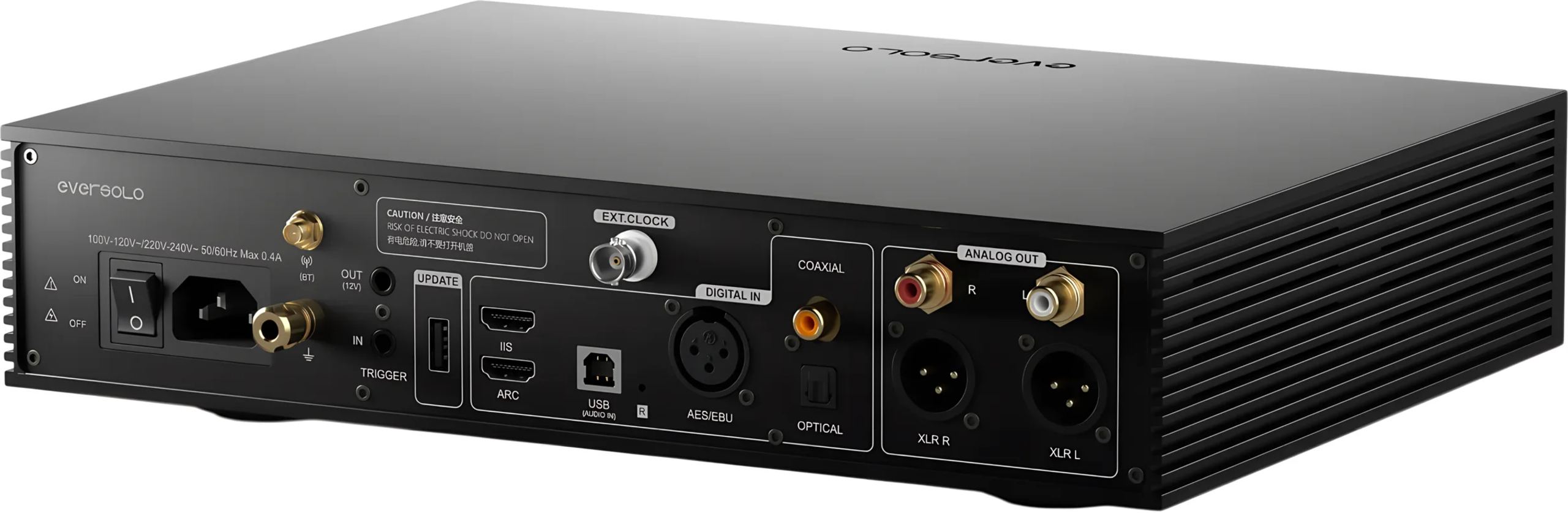
The volume control is a fully balanced R2R network. Precision resistors, switched in steps, attenuate the signal after conversion, in the analog domain. Digital volume control, by contrast, reduces sample values before conversion and loses usable resolution at low levels. The DAC-R8 can therefore act as a preamplifier. Its XLR and RCA outputs connect directly to a power amplifier or active speakers. It pairs with the same brand’s AMP-F8 stereo power amplifier, which has no volume control. Its XLR and RCA analog inputs can accommodate, for example, a turntable with its phono preamplifier: it can be selected and its level adjusted just like a digital source, from the screen or remote control.
Seven digital inputs for a single converter
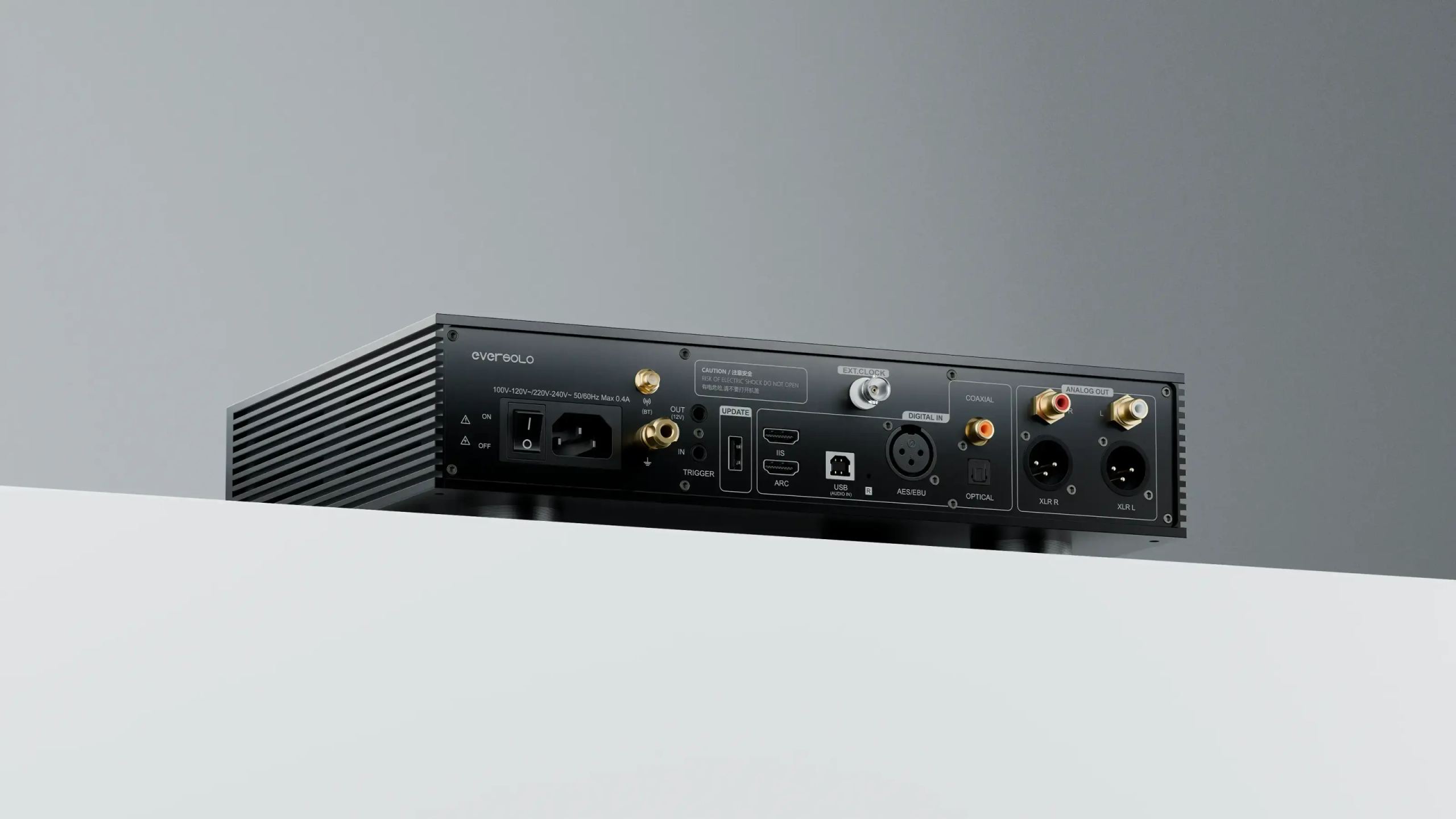
The DAC-R8 has neither Wi-Fi nor an Ethernet port, so streaming services require a connected source. Eversolo pairs it with its T8 network transport, connected via USB or I²S (IIS). This connection carries audio data and clock signals on separate conductors. A computer connects to the USB-B input. A CD player, console or older network player connects to the coaxial, optical or AES/EBU input, the professional balanced version of the digital connection. The HDMI ARC/eARC input receives TV sound through an HDMI cable connected to the screen’s ARC or eARC port. Via Bluetooth 5.4, the DAC-R8 receives aptX, aptX HD and aptX Adaptive from a compatible Android smartphone. An iPhone, which does not support aptX, uses the basic SBC codec.
OCXO clock and O-Core linear power supply
The main clock is a 10 MHz oven-controlled crystal oscillator (OCXO). The crystal is kept at a constant temperature in a small heated enclosure, stabilizing its frequency and reducing its phase noise. A PLL (phase-locked loop) circuit then locks the audio clocks to this reference. An external clock input accepts a 10 MHz or 25 MHz signal. It is used to synchronize several devices to a master clock, such as the C10 Precision Master Clock introduced by Eversolo.
The O-Core linear power supply was developed for Eversolo. It powers the digital and analog circuits through several regulation stages, and internal shielding limits interference. The DAC-R8 consumes 32 W.
A headphone amplifier delivering 1 W into 32 ohms
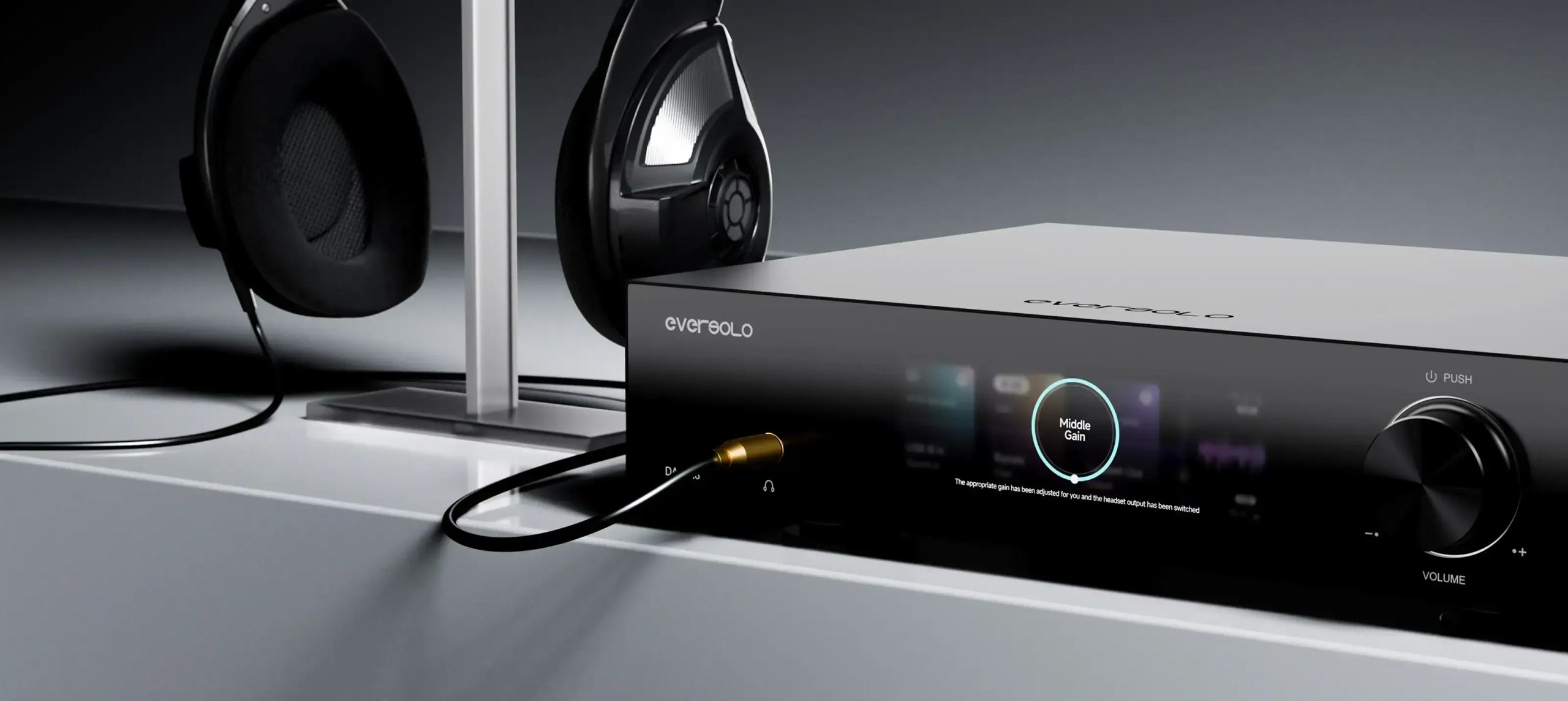
The front-panel 6.35 mm jack delivers up to 1 W into 32 Ω. Three gain levels are available. Low gain suits sensitive in-ear monitors: it provides a useful adjustment range and a low noise floor. High gain suits low-sensitivity headphones. Automatic impedance detection recognizes the connected load. The headphone output is unbalanced only: headphones supplied with a balanced 4.4 mm or 4-pin XLR cable require a cable terminated with a jack plug.
Equalization and room correction from a browser
Digital processing is configured from a web browser, with no software or drivers to install. It includes a 20-band parametric equalizer and FIR (finite impulse response) filters. These filters are used to load room correction calculated from a measurement. There are also dynamics settings and delays, which can compensate, for example, for one speaker being positioned farther away than the other. These tools primarily correct room-induced bass peaks and dips. When disabled, they leave the samples untouched until conversion.
5.2-inch touchscreen and aluminum chassis
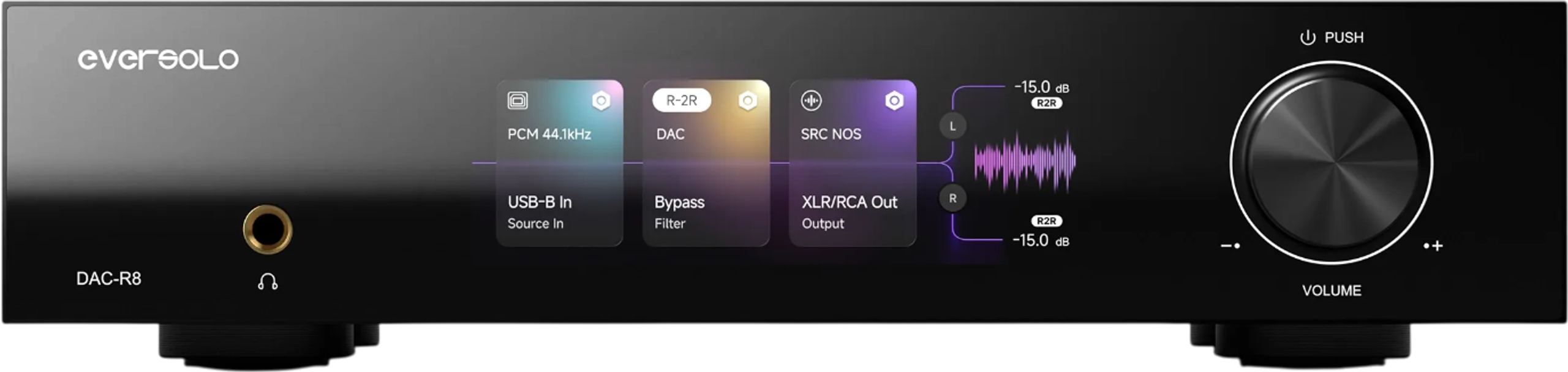
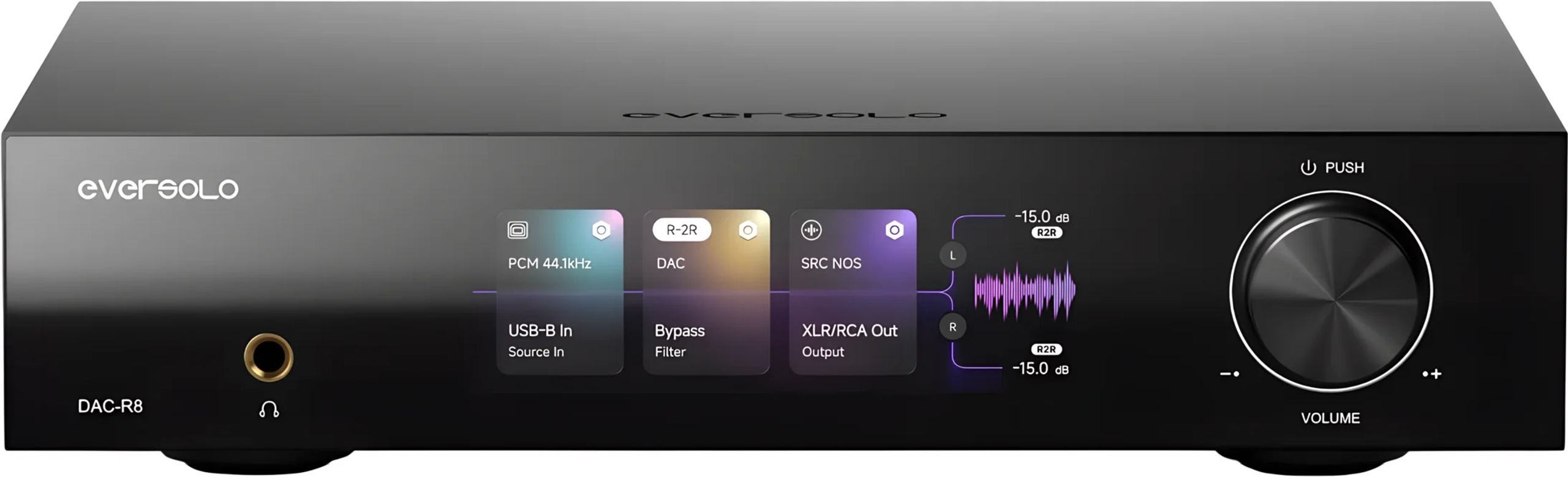
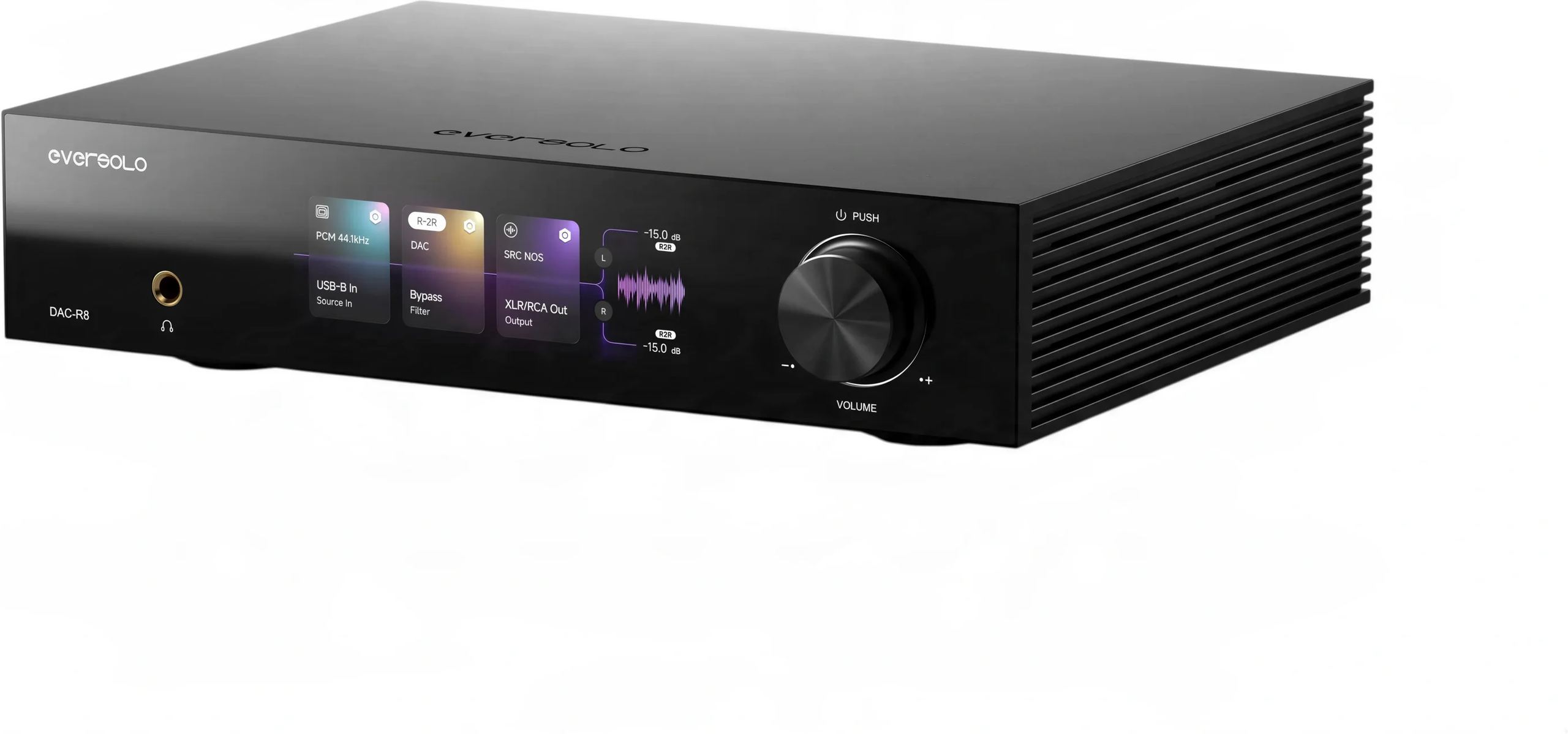
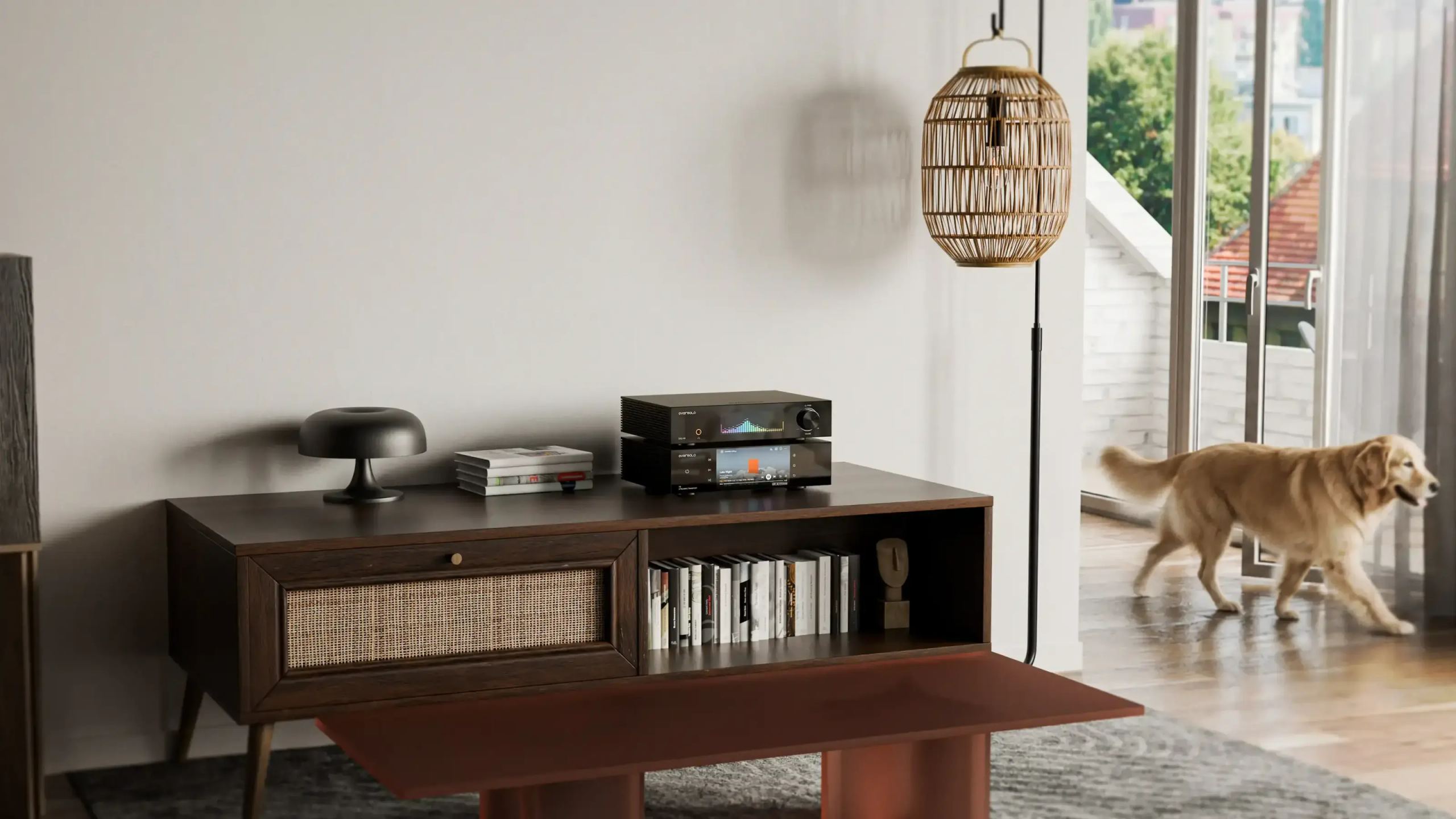
The aluminum chassis measures 315 mm wide and 230 mm deep. It stands 75 mm high with its feet (65 mm without) and weighs 4 kg. Narrower than the standard 430 mm hi-fi format, the DAC-R8 is equally at home on a desk beside a computer or in a hi-fi cabinet. On the front, a 13.21 cm (5.2-inch) color touchscreen controls the device. A remote control, power cable and trigger cable are included.
Technical specifications
Design and audio conversion
- Type: R2R digital-to-analog converter (DAC), preamplifier, headphone amplifier
- Conversion architecture: proprietary OriginR2R™
- Resolution: 5 + 20 bits
- Fully differential architecture
- PCM decoding: up to 768 kHz / 32 bits
- DSD decoding: up to DSD512
- Conversion modes: NOS, OS, BEST
Digital inputs and wireless connectivity
- 1 × USB-B
- 1 × IIS
- 1 × AES / EBU
- 1 × coaxial input
- 1 × optical input
- 1 × HDMI ARC / eARC
- 1 × Bluetooth 5.4
- Supported codecs: aptX, aptX HD, aptX Adaptive
Analog inputs and outputs
- Inputs:
- 1 × stereo RCA
- 1 × stereo XLR
- Outputs:
- 1 × stereo RCA
- 1 × stereo XLR
- 1 × 6.35 mm headphone jack output
Headphone amplification
- Power: up to 1 W into 32 Ω
- Three gain levels
- Automatic impedance detection
Audio performance
- Total harmonic distortion and noise (THD+N): up to 0.000316% (−110 dB)
- Signal-to-noise ratio: up to 130 dB
- Dynamic range: up to 130 dB
- Frequency response: 20 Hz – 20 kHz
Controls and signal processing
- Color touchscreen: 13.21 cm diagonal
- R2R analog volume control
- 20-band parametric equalizer
- Finite impulse response (FIR) filters
- Dynamics and delay settings
- Digital signal processing (DSP) accessible from a web browser
Clock and synchronization
- 10 MHz oven-controlled crystal oscillator (OCXO)
- Phase-locked loop (PLL) circuit
- 1 × external clock input: 10 MHz / 25 MHz
Power supply
- Custom O-Core linear power supply
- Supply voltage: 100–240 V AC
- Mains frequency: 50 / 60 Hz
- Power consumption: 32 W
Included accessories
- Remote control
- Power cable
- Trigger cable
- Quick start guide
- Warranty card
Construction, dimensions and weight
- Aluminum chassis
- Dimensions (W × D × H): 315 × 230 × 75 mm
- Height without feet: 65 mm
- Weight: 4 kg
Frequently asked questions
Can the DAC-R8 play Qobuz, Tidal or Spotify without another device?
No, it has no network connectivity. Streaming services are accessed through a source: a transport such as the T8, a network player with a digital output, a computer via USB or a smartphone via Bluetooth. With Bluetooth, quality depends on the codec used.
How does it differ from the DAC-Z10 from the same brand?
The DAC-Z10 handles conversion using AKM chips, an AK4191 and AK4499 pair per channel, and uses three separate linear power supplies. The DAC-R8 uses the OriginR2R discrete resistor ladder, with a choice of NOS, OS and BEST modes. Both have R2R volume control and XLR and RCA outputs. The choice is therefore mainly between two ways of converting the signal.
How does the DAC-R8 compare to the DMP-A8 Gen 2?
The DMP-A8 Gen 2 is an all-in-one network player with an AKM converter, an SSD slot and evotune PRO room correction. The DAC-R8 does not support network playback, but it offers R2R conversion and an OCXO clock, which is reserved for the Master version of the DMP-A8 Gen 2. The two can complement each other: the network player sends its digital signal to the DAC-R8, which handles the conversion.
Does the DAC-R8 reproduce multichannel sound from a TV?
No, it is a two-channel stereo device. On the TV, the audio output must be set to stereo PCM. Sound from movies and TV series is then played through the system’s two speakers.
Which mode should I choose for high-resolution files?
At 96 kHz or higher, the treble roll-off inherent to NOS mode occurs well beyond the range of human hearing. The difference between NOS and OS therefore narrows. The choice matters most for 44.1 kHz files, meaning CD quality and a large portion of streaming catalogs.
What is the supplied trigger cable used for?
It connects to the trigger input of a power amplifier. The DAC-R8 sends it power-on and standby commands: switching on the converter also switches on the amplifier. Eversolo’s AMP-F8 has this input.
- Eco-contribution included in the sale price.
- GTIN / EAN: 6975200360275


