Jean-Louis
Good value for money. Neutral with a warm tendency
Comment from March 13, 2025 — Experience from May 24, 2021
Automatically translated — Show original (French)
Bon rapport qualité/prix. Neutre tendance chaude
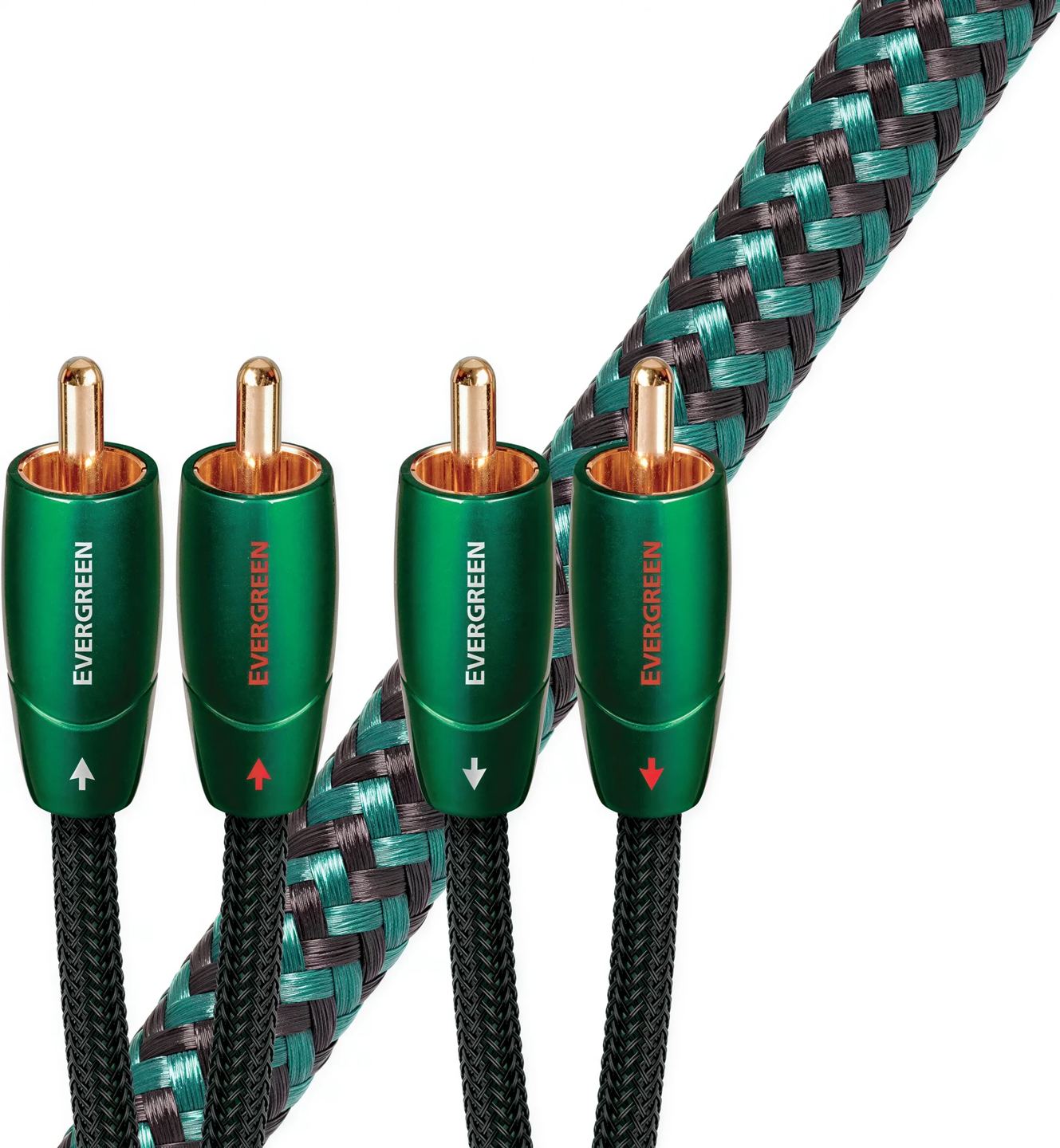
AudioQuest’s Evergreen RCA cable uses Asymmetrical Double-Balanced geometry and solid Long-Grain Copper (LGC) conductors. It is part of the Bridges & Falls series, named after the Evergreen Point Bridge linking Seattle to Bellevue. The cable features cold-welded connectors and a metal-layer Noise-Dissipation System. Its outer jacket uses a black-and-green braid for quick visual identification.
The Evergreen cable uses solid Long-Grain Copper (LGC) conductors. Unlike multi-strand conductors, where each strand can generate electrical interactions, a solid conductor avoids this phenomenon. LGC copper has an elongated crystalline structure that reduces the number of grain boundaries—areas where conduction can be locally disturbed. By comparison, standard OFHC (Oxygen-Free High-Conductivity) copper has shorter grains, multiplying these interfaces.
The insulation is made from foamed polyethylene, a material with a high proportion of micro air bubbles distributed throughout the polymer mass. Since air has a low dielectric constant, this structure limits losses and energy storage compared to solid polyethylene. It helps reduce phase shift effects introduced by the absorption and delayed release of electromagnetic energy within the dielectric.
The cable employs Asymmetrical Double-Balanced geometry. Unlike conventional unbalanced cables where ground and shield share the same conductor, the Evergreen separates the return conductor from the shield. This separation reduces the shield’s influence on the signal path and helps limit the pickup of electromagnetic interference.
Unlike traditional soldering, which uses heat and a tin-lead or silver alloy as filler, AudioQuest’s “cold-weld” method relies on the application of high mechanical pressure. This creates a direct bond between the copper conductor and the gold-plated RCA plug, without interposing a solder alloy.
With a traditional solder joint, two dissimilar metals meet, introducing a transition zone with electrical properties different from copper’s. Cold-welding, on the other hand, relies on plastic deformation of the metal to promote a continuous metallurgical contact between the conductor and the plug. The RCA ground shells are produced by stamping, allowing the use of metals chosen for their electrical or mechanical characteristics rather than their machinability.
The Evergreen cable incorporates a metal-layer Noise-Dissipation System designed to reduce the impact of radio-frequency (RF) interference. With the growing presence of wireless devices, switching power supplies, and variable-speed drives, signal conductors can be exposed to a dense domestic electromagnetic spectrum. The metal layer acts by absorbing and reflecting interference before it reaches the conductors.
The shielding is asymmetrically designed and connected to ground only on the source side. This configuration creates a one-way drain path for interference, limiting ground loops between components. The cables are marked with an arrow indicating the recommended signal direction, corresponding to this shield orientation.
The Evergreen cable is designed for systems where signal fidelity is paramount. It is often used to connect turntables to a phono preamp, where reducing background noise can be particularly helpful for low-level signals. It can also be used between a digital-to-analog converter (DAC) and an amplifier, helping to limit loss of detail and precision in spatial layering.
The Evergreen’s RCA plugs are joined under a single jacket, with a maximum spacing of about 7.6 cm. This may require adjustment on some equipment with more widely spaced inputs. It results from grouping both channels under a single jacket—a compromise aimed at optimizing electrical performance while keeping manufacturing costs in check.
The cable is available in several standard lengths from 0.6 m to 20 m. Shorter lengths have lower total capacitance and lower series resistance. Lengths up to 3 m maintain performance suitable for most home systems. Beyond 5 m, the cable’s characteristic impedance becomes a factor to consider, especially with sources that have a high output impedance.
Generic cables typically use multi-strand conductors of variable copper quality with basic PVC insulation. The Evergreen delivers a noticeable reduction in sonic haze, better instrument separation in the stereo soundstage, and more faithfully preserved dynamics, especially on fast transients. The difference is mostly heard in what disappears: grain in the highs, muddiness in the lows, and compressed soundstage. The improvement scales with your system’s resolution—the more transparent your components, the more obvious the benefits.
The arrows indicate the optimal signal direction, from the source to the amplifier or preamplifier. This directionality comes from the shield architecture, connected to ground only on the source side to avoid ground loops. Installing the cable backwards won’t damage it but may slightly increase background noise, especially in electromagnetically noisy environments. AudioQuest controls this directionality during manufacturing to optimize RF interference drainage.
Within Bridges & Falls, the Evergreen is a substantial step up from the Tower thanks to its more advanced foamed polyethylene insulation. Golden Gate goes further with Perfect-Surface Copper (PSC) conductors, delivering higher micro-detail resolution. Big Sur, with PSC+ copper and plugs made of pure Purple Copper, pushes refinement even further. For most systems, Evergreen offers the best performance-to-price ratio; the higher models deliver perceptible improvements mainly in very revealing setups.
The Evergreen is perfectly suitable for active subwoofer connections. Its ability to preserve phase information and its low distortion in the bass are particularly beneficial below 100 Hz. For longer runs to a distant subwoofer, 3 to 5 meter versions maintain signal integrity without significant attenuation. The cable’s mechanical robustness also withstands vibrations generated by high-powered subs.
The Evergreen’s gold-plated RCA plugs are built to tight tolerances for optimal contact. On some vintage gear with worn RCA jacks or looser tolerances, the fit may feel less snug. Conversely, on new or high-end equipment with precision jacks, insertion may require slightly more pressure. This design prioritizes contact quality over ease of insertion. The plugs fit standard RCA chassis with an insertion depth of 15 mm.
The Evergreen makes sense as soon as your system goes beyond all-in-one mini systems and includes quality separates. On a Project Essential II turntable with a Cambridge Audio or NAD preamplifier, the improvements are proportional and justify the investment. The cable won’t turn a modest system into a high-end rig, but it will let each component perform to its potential without being held back by a subpar connection. It’s often the overlooked link that, once optimized, reveals capabilities you didn’t know your system had.
Jean-Louis
Good value for money. Neutral with a warm tendency
Comment from March 13, 2025 — Experience from May 24, 2021
Lambo Tiana Fabien
Hello,
These cables are of very high quality. With an unbeatable value for money. Highly recommended.
Comment from August 12, 2024 — Experience from October 09, 2023
Thierry
High-quality RCA cable that helps avoid signal loss in your Hi-Fi system.
Comment from April 09, 2024 — Experience from March 08, 2024