

Bryston 28B³ 2.0 silver


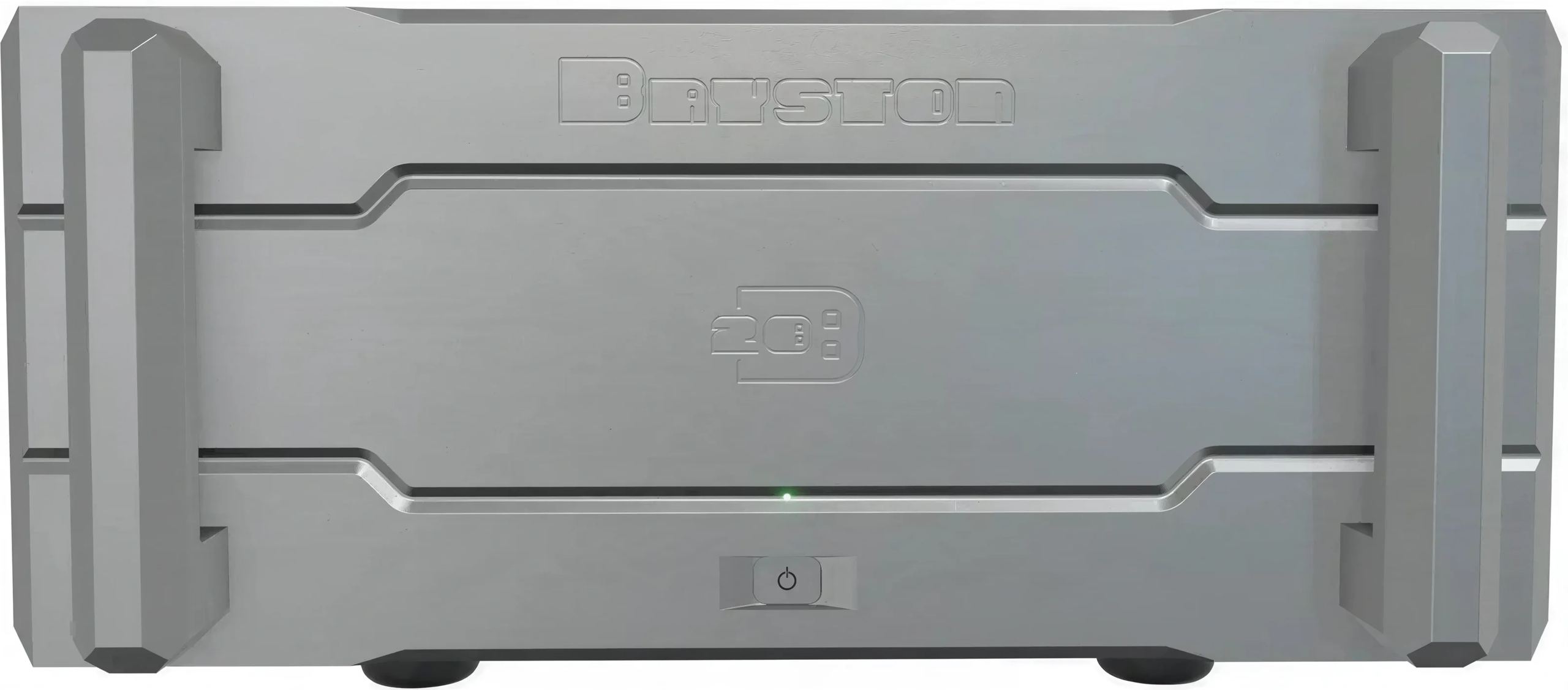
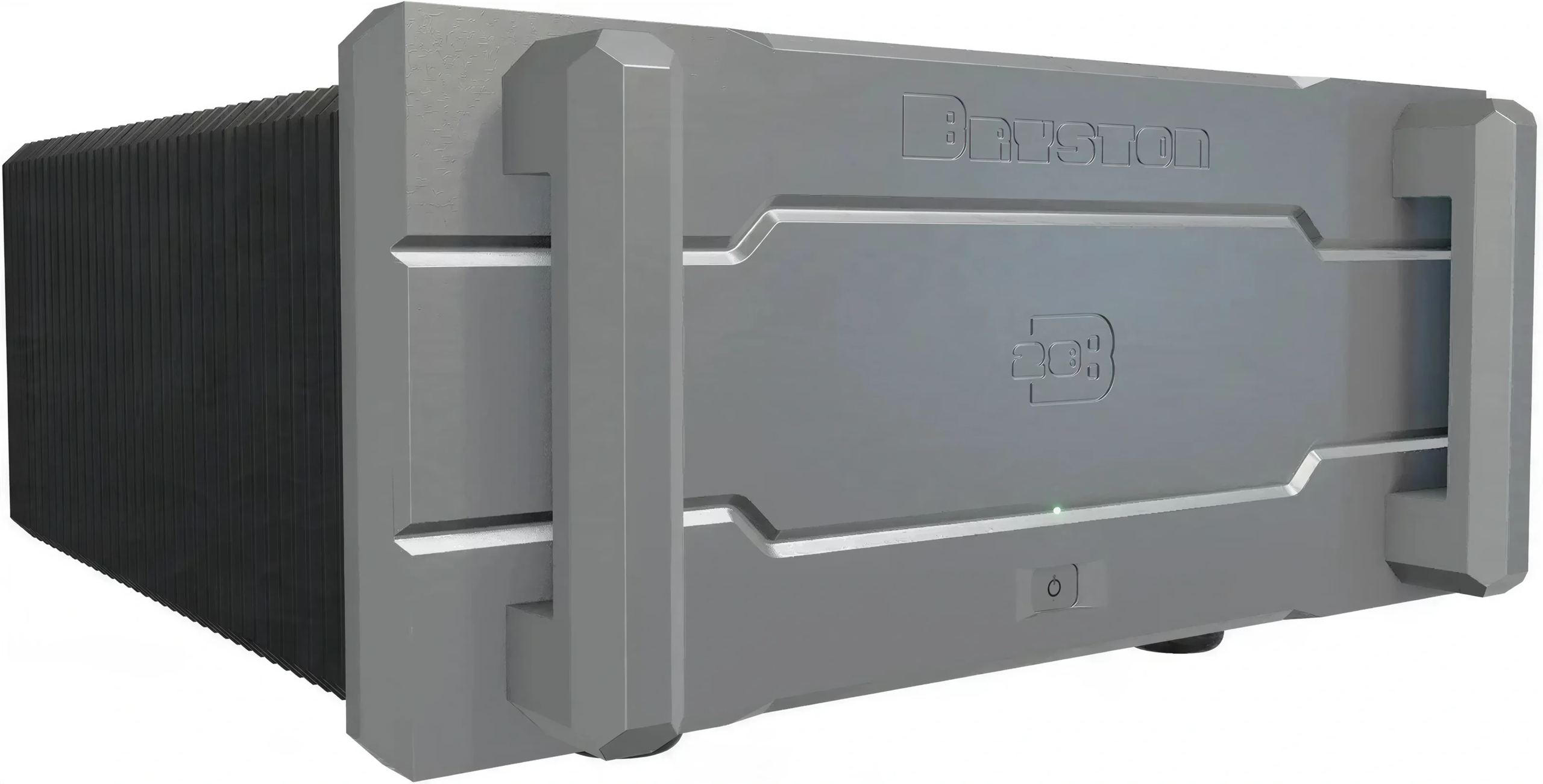
Bryston 28B 2.0: the 1000 W monoblock amplifier
One thousand watts into 8 ohms on a single channel: no Bryston amplifier goes further. The Canadian manufacturer is celebrating its fiftieth anniversary with a 2.0 version of its Cubed series, including its most powerful monoblock amplifier. The electronics remain those of the 28B³. The front panel, chassis and heat dissipation have been redesigned. One monoblock powers one speaker, so two are needed for a stereo system.
One thousand watts into 8 ohms, 1800 into 4 ohms
This much power is not about playing louder. It is about keeping power in reserve. A low-sensitivity speaker, a large room or a track with wide dynamic swings can demand current peaks in a fraction of a second that most amplifiers cannot deliver without clipping. The 28B 2.0 delivers 1000 W into 8 ohms and rises to 1800 W into 4 ohms: when impedance drops, it supplies the current required instead of collapsing.
Bryston sums up its approach with one rule, “from the first watt to the last”: the amplifier must sound the same at low volume as it does at full power. Total harmonic distortion plus noise remains below 0.005% from 20 Hz to 20 kHz, and this is measured at rated power into 8 ohms, not at just a few watts. Bandwidth extends from below 1 Hz to 100 kHz at -3 dB, well beyond what the ear can perceive. This preserves the full phase margin in the treble.
The output stage operates in Class AB, the configuration Bryston has always used. The brand uses its Quad-Complementary topology, which improves output transistor matching and reduces the stage’s capacitance by a factor of four. It tackles crossover distortion, the typical Class AB flaw that occurs as the signal moves from one half-cycle to the other. Transient response benefits as a result.
The Salomie circuit at the signal input
All Cubed amplifiers share a patented input stage developed by Bryston with engineer and physicist Ioan Alexandru Salomie. It provides the first six decibels of gain and matches the amplifier to the preamplifier. Bryston developed it to reject common-mode noise and radio interference in a modern home: Wi-Fi, phones, switching power supplies.
The 28B 2.0 accepts a balanced XLR connection and an unbalanced RCA connection. The difference is clear in the figures: the signal-to-noise ratio exceeds 111 dB over XLR, compared with 106 dB over RCA. The balanced connection is therefore preferable, especially as the two monoblocks are often placed near the speakers, far from the preamplifier. Input impedance is 30 kΩ (+) and 6 kΩ (-) over XLR, and 7.5 kΩ over RCA. This latter value remains an easy load for the vast majority of solid-state preamplifiers. With a tube preamplifier with high output impedance, it is best to check compatibility with its manufacturer.
Switchable gain between 23 and 29 dB
Gain indicates how much the amplifier multiplies the voltage received at its input. At 29 dB, it multiplies it by approximately 28. At 23 dB, by approximately 14. The setting does not change the available power, but it changes the point in the volume control’s travel at which a given listening level is reached.
The 23 dB setting suits home theater processors and preamplifiers with high output voltage, especially over XLR. The volume control then operates higher in its range, where it is more precise, and residual hiss is reduced with sensitive speakers. The 29 dB setting suits lower-level sources and passive preamplifiers, which provide no gain.
18-inch front panel and redesigned chassis
Version 2.0 evolves the Cubed series without replacing it. The electrical specifications of the 28B 2.0 are identical to those of the 28B³: power, distortion, bandwidth and the Salomie circuit have not changed. The work focuses on mechanical design.
The 28B³ was available with two front panels, measuring 17 and 19 inches. These give way to a single 18-inch (45.72 cm) front panel, offered with or without handles. This front panel is now removable, making maintenance easier and leaving the door open to other finishes. Its design is the same as that of the other 2.0 amplifiers and Bryston’s Class D range: several Bryston components stacked or lined up in a rack form a consistent whole. The 28B 2.0 is available in black or silver.
The machined aluminum chassis has been redesigned, and the front panel is anodized aluminum. Inside, Bryston has reduced wiring, adopted stainless steel fasteners and switched all hardware to metric sizes. The heatsink has a new shape and improved heat paths: the amplifier runs cooler under load, reducing long-term stress on the components. Made in Canada, the 28B 2.0 carries a 10-year warranty.
Fanless, but with 42 kg to position
Cooling relies on natural convection. There is no fan, so no mechanical noise in the listening room. In return, air must circulate freely around the heatsinks. A closed cabinet or a shelf with too little clearance is unsuitable.
Each monoblock measures 457.2 mm wide, 203.2 mm high and 426.7 mm deep, or 467.4 mm with the handles. It weighs 42 kg: installation requires two people, on a support capable of bearing this weight, or directly on the floor beside each speaker. This latter position shortens the speaker cables and leaves the XLR connection to cover the distance to the preamplifier.
With a transformer this size, switching on draws a large surge of current. The microprocessor-controlled SoftStart soft-start system limits it to avoid tripping the circuit breaker at startup. In standby, the 28B 2.0 consumes less than 500 mW. Its DC trigger input allows it to turn on and off at the same time as the preamplifier or processor.
Technical specifications
Amplification and power
- Type: monophonic power amplifier (mono power amp)
- Number of channels: 1
- Output power
- Into 8 Ω: 1000 W
- Into 4 Ω: 1800 W (stated maximum power)
- Selectable gain: 23 dB or 29 dB
- Switchable to match the amplification to the system
- Design intended for demanding high-fidelity speakers
- Ability to drive the most demanding loudspeakers
- Excellent driver control, outstanding speaker control capability
Connections and audio inputs
- Audio inputs: balanced XLR, unbalanced RCA
- Compatibility with preamplifiers equipped with RCA or XLR outputs
- Input impedance
- RCA: 7.5 kΩ
- XLR: 30 kΩ+ / 6 kΩ-
Audio performance
- Frequency response: below 1 Hz – 100 kHz at -3 dB
- Total harmonic distortion plus noise (THD+N): less than 0.005%
- Measurement conditions: 20 Hz – 20 kHz at rated power into 8 Ω
- Signal-to-noise ratio
- RCA input: greater than 106 dB
- XLR input: greater than 111 dB
Musical qualities
- Large power reserve
- Excellent bass control
- Dynamic, precise and detailed reproduction
- Highly refined sound reproduction
- Good resolution of microdetails
- Subtle, non-aggressive highs
- Neutral tonal balance
- Fluid and refined reproduction
- Ability to maintain good precision at different listening levels
Technologies and design
- Amplification circuit: Bryston-patented Salomie, technology derived from the Cubed series
- Electronic design focused on reducing distortion: very low distortion levels
- SoftStart soft start
- Electronically controlled, microprocessor-managed startup
- Protection against nuisance circuit breaker tripping at power-on
Cooling and power supply
- Natural convection cooling
- No mechanical fan
- Heat dissipation without forced ventilation
- Fanless design to limit noise
- Standby power consumption: less than 500 mW
Controls and integration
- DC trigger input for external control
- Automated power-on and power-off capability
- Can be integrated into a high-fidelity or home theater system
Construction and finish
- Machined aluminum chassis
- Anodized aluminum front panel
- Robust mechanical construction
- High-end finish
- Design and manufacturing focused on reliability, longevity and lasting use
- Format: 45.72 cm (18 inches), with or without handles
Manufacturer and warranty
- Manufacturer: Bryston Ltd.
- Country of manufacture: Canada
- Manufacturer’s warranty: 10 years
Dimensions and weight
- Dimensions (H × W × D): 46 cm × 72 cm × 46 cm
- Width: 457.2 mm
- Height: 203.2 mm
- Depth
- Without handles: 426.7 mm
- With handles: 467.4 mm
- Weight
- 50 kg
- 42 kg
Frequently asked questions
Can the 28B 2.0 be paired with an integrated amplifier?
Yes, if the integrated amplifier has a preamplifier output (pre-out). It then acts as a preamplifier and controls the volume, while two 28B 2.0 units drive the speakers. A balanced XLR output on the integrated amplifier is an advantage. Otherwise, the connection is via RCA.
Can a 28B 2.0 be used alongside first-generation Cubed amplifiers?
Electrically, yes: the audio specifications are the same as those of the 28B³, and the gain is switchable between 23 and 29 dB on both generations. Simply set all amplifiers in the same system to the same gain. The only difference is visual: the 2.0’s 18-inch front panel does not line up exactly with the 17- or 19-inch front panels of older models.
Could a thousand watts damage speakers with a lower power handling capacity?
It is the listening level that determines the power delivered, not the amplifier’s maximum power. At normal volume, a 28B 2.0 delivers only a few watts. An underpowered amplifier that clips often sends a signal that is more dangerous to tweeters than a powerful amplifier operating within its limits. Having power in reserve does not mean you can stop watching the volume: with a speaker rated for low power handling, the knob must not be turned up without limit.
Does the 28B 2.0 have a place in a home theater?
Yes, on the front left and right channels of a home theater processor or amplifier equipped with preamp outputs. The DC trigger input connects to the processor for automatic power-on. Since processors often deliver a high voltage via XLR, the 23 dB gain setting is generally the most suitable.
Is a special electrical installation required?
SoftStart allows the 28B 2.0 to be plugged into a standard outlet without tripping the circuit breaker at startup. For a pair of monoblocks driven hard into low-impedance speakers, a dedicated electrical circuit from the breaker panel is a wise choice, with each monoblock plugged directly into a wall outlet rather than an ordinary power strip.
Can the 28B 2.0 be installed in a rack?
The 18-inch consumer front panel does not match the standard width of a 19-inch rack. Bryston offers a rack-mount PRO front panel, with or without handles. Given the weight, a rack cabinet must have rails or shelves that support 42 kg, and the space around the heat sinks must remain clear.
- Eco-contribution included in the sale price.


