

Bryston 7B³ 2.0 silver



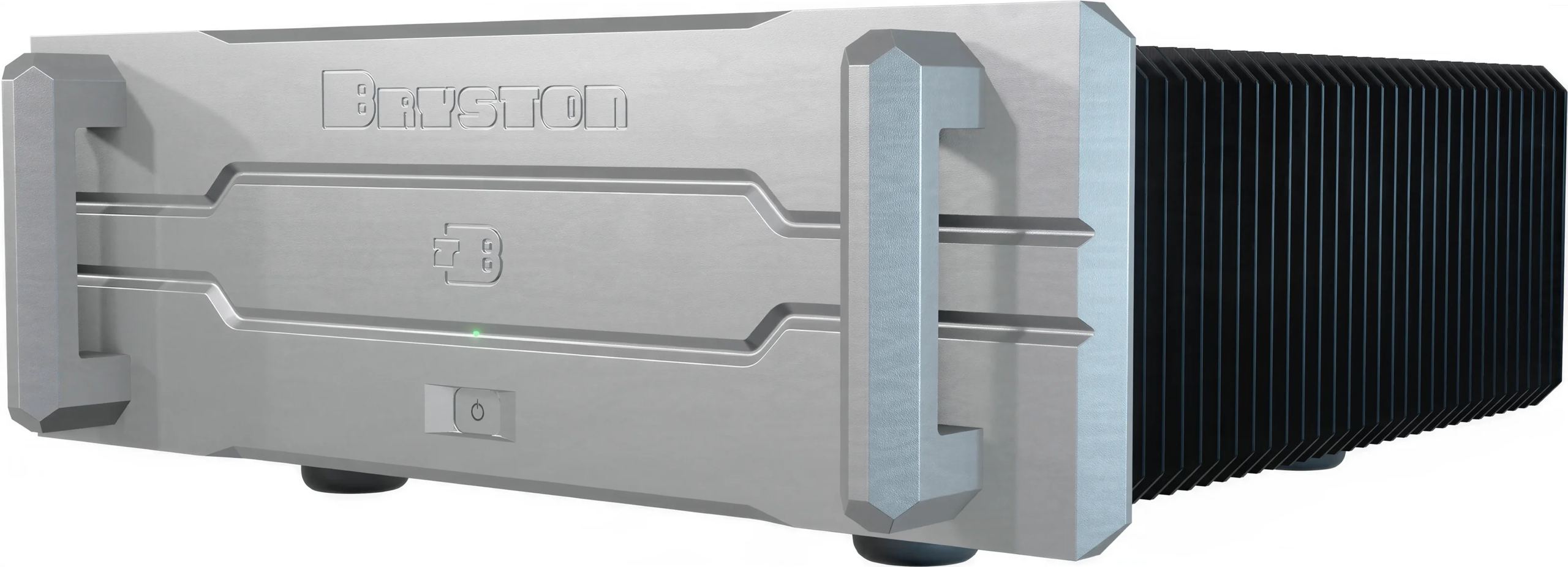
Bryston 7B 2.0: the 600 W monoblock amplifier
A single channel per chassis, 600 watts into 8 ohms and 900 watts into 4 ohms: this Canadian power amplifier is used in pairs, with each unit driving a single speaker. Version 2.0 retains the electronics of the Cubed series, including the patented input circuit at its core, while revising the front panel, chassis and cooling. It also features Bryston’s 50th-anniversary styling.
Six hundred watts dedicated to a single speaker
With a stereo amplifier, the two channels usually share a power supply and a transformer. Here, the left and right speakers each have their own amplifier, with its own power supply and transformer. When a powerful bass passage places demands on one channel, the other does not draw on the same energy reserve. Nor can the two channels interfere electrically with each other, since they share no circuitry.
The increase from 600 to 900 watts as impedance drops from 8 to 4 ohms shows that the power supply keeps up when the speaker demands more current. This is what matters with large floorstanding speakers with multiple bass drivers, low-sensitivity speakers or those whose impedance drops sharply at certain frequencies: an amplifier short on current first loses bass control and ease on peaks. This level of power is also justified in a large room, where listening positions are farther from the speakers.
Choosing monoblock amplifiers comes with constraints. You need two units, two mains sockets and enough space for two chassis weighing over 25 kg each, which cannot be placed on ordinary furniture.
The Salomie circuit and quadruple-complementary output stage
Bryston’s previous generation, the SST² series, focused its efforts on the output stage. The Cubed series, from which the 7B 2.0 descends, tackled the input stage with a patented circuit developed with Dr Ioan Alexandru Salomie and named after him. This circuit reduces distortion right from the signal input. It also provides better rejection of common-mode noise, meaning interference picked up equally by both conductors of a balanced connection.
The output stage operates in Class AB, with a configuration Bryston calls quadruple-complementary. It improves linearity, reduces crossover distortion (the glitch that occurs when the signal passes from one transistor to the other) and limits higher-order harmonics, which are more objectionable to the ear than lower-order harmonics. The transistors are better matched and output capacitance is reduced by a factor of four. The amplifier therefore tracks transients better.
The measurements bear this out. Total harmonic distortion plus noise remains below 0.005% from 20 Hz to 20 kHz at full power into 8 ohms. Bandwidth extends from below 1 Hz to 100 kHz at -3 dB, well beyond human hearing, preventing any phase shift at the top of the audible spectrum. The noise floor is very low, a benefit appreciated both at low volume and with sensitive speakers, on which even the slightest hiss is audible.
Two gain settings and two inputs to suit the preamplifier
The 7B 2.0 has a balanced XLR input and an unbalanced RCA input. Gain can be set to 23 or 29 dB. At 29 dB, the amplifier reaches full power with a weaker signal, making it suitable for preamplifiers or sources with modest output levels. With a balanced preamplifier delivering a higher voltage, the 23 dB setting reduces noise and allows the volume control to be used farther up its range, where adjustments are more precise.
This setting comes from Bryston’s professional heritage, with its amplifiers equipping recording studios since the 1970s. The 7B 2.0 is also available with a PRO front panel for rack mounting, in addition to the two consumer front panels, with or without handles. The DC Trigger input switches both monoblocks on and off together with the preamplifier.
A power supply with a gentle start
The transformer is custom-wound for this amplifier and is more efficient than a conventional transformer. A transformer of this size draws a high current at power-up, and two monoblocks switched on together can trip a circuit breaker. The microprocessor-controlled SoftStart system gradually increases the current to avoid this problem. In standby, each unit consumes less than 500 mW.
A redesigned chassis for version 2.0
Generation 2.0 leaves the circuitry untouched. The changes are mechanical. The front panel now comes in a single width of 18 inches (45.7 cm), replacing the 17- and 19-inch options previously offered. It is removable, making servicing easier and opening the way to other finishes. The fasteners are stainless steel, internal wiring has been reduced and the heatsink geometry has been revised to dissipate heat more effectively. The amplifier runs cooler under load, reducing stress on its components and keeping its operation stable during long listening sessions. Its appearance now matches that of Bryston’s Class D amplifiers, so several units from the brand line up neatly in the same system.
This model has a silver-anodised aluminium front panel on a machined aluminium chassis. Cooling relies entirely on convection, with no fan, so the amplifier remains silent. In return, air must circulate freely around the heatsinks: an enclosed cabinet or a shelf above another hot-running component is unsuitable.
Technical specifications
Overview
- Type: high-end monophonic power amplifier (monoblock)
- Number of channels: 1
- Purpose: drive demanding loudspeakers with power, precision and control
- Design focused on three essential qualities
- Power: ample reserves to reproduce wide dynamics
- Precision: amplification circuit designed to limit distortion
- Control: robust power supply to drive loudspeakers effectively
- Integration into a high-end hi-fi system
- Can be used in a stereo configuration with two monoblocks
Amplification and power
- Output power
- 600 W into 8 Ω
- 900 W into 4 Ω
- Switchable gain: 23 dB or 29 dB
- Adaptable to different preamplifier configurations
- Amplification circuit: Bryston’s patented Salomie circuit, technology derived from the Cubed series
- Architecture designed to deliver substantial power with stability
- Electronic design focused on precision and reliability
Power supply
- Specially wound transformer
- Higher efficiency than conventional designs
- Power supply designed to provide substantial power reserves
- SoftStart soft-start system
- Microprocessor-controlled startup
- Reduced risk of tripping circuit breakers at power-on
- Standby power consumption: less than 500 mW
Audio performance
- Frequency response: below 1 Hz – 100 kHz at -3 dB
- Total harmonic distortion plus noise (THD+N): less than 0.005%
- Measurement conditions: 20 Hz – 20 kHz at rated power into 8 Ω
- Signal-to-noise ratio
- RCA input: greater than 106 dB
- XLR input: greater than 111 dB
Musical qualities
- Ample power reserves, wide dynamic capability
- Excellent loudspeaker control, suitable for pairing with particularly demanding loudspeakers
- Precise, detailed, fluid and refined reproduction
- Good resolution and clarity of fine detail
- Subtle reproduction of musical nuances, even at low volume
- Neutral tonal balance
- Delicate, non-fatiguing highs
- Good ability to reproduce complex musical passages
Connections and controls
- Audio inputs
- Balanced XLR, input impedance: 30 kΩ+ / 6 kΩ-
- Unbalanced RCA, input impedance: 7.5 kΩ
- Compatible with preamplifiers equipped with XLR or RCA outputs
- DC trigger input: automated remote power on and off
Cooling
- Natural convection cooling
- No fan or mechanical ventilation
Construction and finish
- Machined aluminium chassis
- Anodised aluminium front panel, silver finish
- Robust mechanical construction, high-end design, meticulous finish
- Architecture designed for lasting use, focused on robustness and longevity
- Construction suited to demanding audiophile installations
Front panel sizes and options
- 18-inch (45.7 cm) format, with or without handles
- Consumer front panel: without handles, with handles
- Professional PRO front panel: for rack mounting, without handles
Dimensions and weight
- Dimensions (H × W × D): 26 cm × 61 cm × 54 cm
- Width: 45.72 cm
- Height: 20.57 cm
- Depth
- Without handles: 15.24 cm
- With handles: 19.69 cm
- Weight
- 25 kg
- 29.5 kg
Frequently asked questions
Do I need to buy two 7B 2.0 units for a stereo setup?
Yes. The 7B 2.0 is sold individually and handles only one channel. A pair of speakers requires two units, one for the left and one for the right. In a multichannel system, one can be added for each speaker.
Can it be paired with an integrated amplifier or a home theater amplifier?
Yes, provided the device has RCA or XLR preamp outputs. With a home theater amplifier, the 7B 2.0 handle the front left and right channels, while the amplifier continues to power the other speakers. At 29 dB, the gain is suited to the preamp outputs of home theater amplifiers, whose voltage is often lower than that of a balanced preamplifier.
Is it better to connect it via XLR or RCA?
The XLR input has a signal-to-noise ratio greater than 111 dB, compared with 106 dB for RCA. The balanced connection also rejects interference picked up along the cable, and the Salomie circuit is designed for this mode of transmission. This is useful because a monoblock amplifier is often placed next to its speaker: you can then run a long XLR cable from the preamplifier and keep the speaker cables short.
What is the difference compared to the Bryston 4B?
The 4B is a stereo amplifier from the same Cubed family. It delivers 300 W per channel into 8 ohms in a single chassis. A 7B 2.0 delivers twice that to a single speaker, with a power supply dedicated entirely to it. Choose the 4B for a single unit with ample power, or a pair of 7B 2.0 amplifiers for a much greater power reserve.
Does the amplifier get hot and make noise?
It has no fan and therefore produces no mechanical noise. Its heatsinks get hot during listening, especially at higher volumes. The revised geometry of version 2.0 lowers the temperature under load, but you should still leave free space above and around each unit.
What warranty does Bryston offer on the 7B 2.0?
Bryston provides a ten-year warranty on the 7B 2.0. This generation’s removable front panel makes it easier to access the electronics for servicing.
Can it be installed in a rack?
The version with the PRO front panel mounts in a standard 19-inch rack. The consumer versions, with or without handles, can be placed on a sufficiently sturdy, well-ventilated cabinet or stand.
- Eco-contribution included in the sale price.


