

Bryston 14B³ 2.0 silver



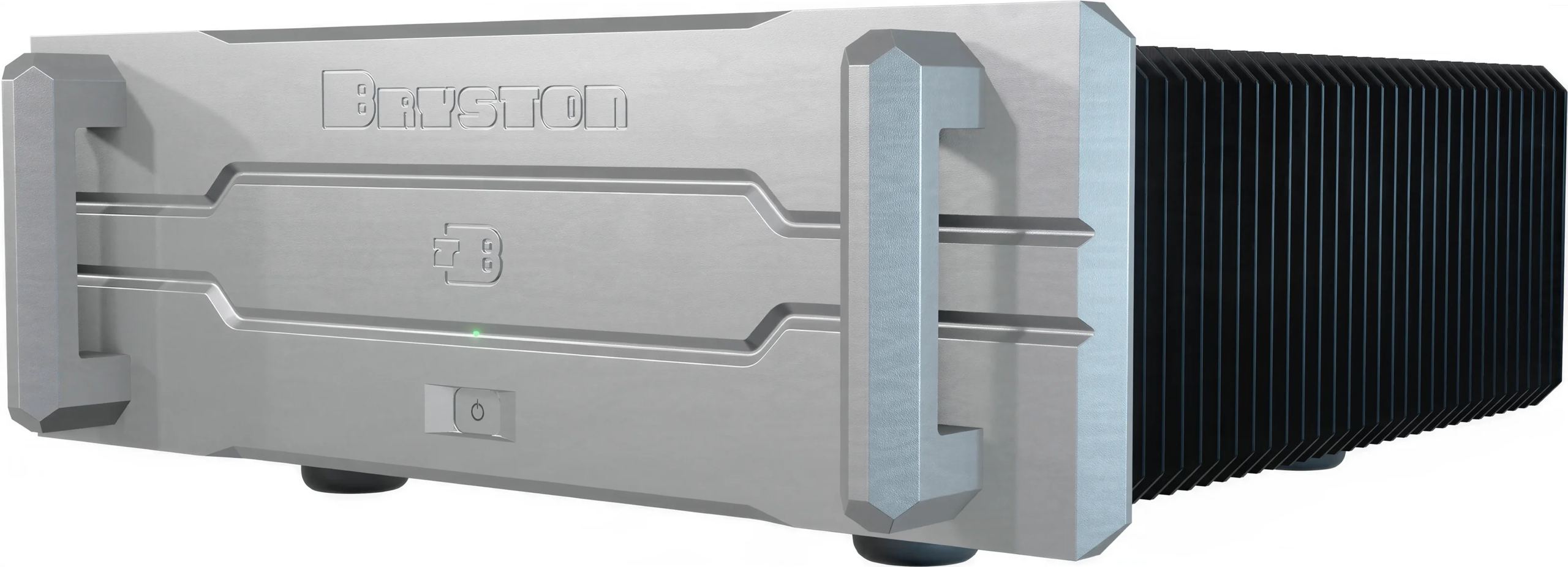
Overview
Two times 600 watts into 8 ohms in a single chassis: this Canadian stereo amplifier has the power of a monoblock for each of its two channels, with a complete power supply per channel. It is designed to drive demanding speakers in large rooms or at high volumes, without background noise becoming audible during quiet passages. Version 2.0 retains the Cubed series electronics and revises the chassis, heat dissipation and front panels.
Two channels that do not share a power supply
In many stereo amplifiers, a single transformer powers both channels. When a very loud bass note arrives on the left channel, the right then receives less energy. On the 14B 2.0, each channel has its own transformer and power supply. Electrically, these are two mono amplifiers housed in the same enclosure. This separation largely explains the 41 kg weight.
The rated power is 600 W per channel into 8 ohms and 900 W into 4 ohms. It does not double when the impedance is halved, which is normal for an amplifier of this size. The 900 W available into 4 ohms is more than enough for low-efficiency floorstanding speakers or those whose impedance drops low in the bass. The 14B 2.0 operates in Class AB, like all Bryston power amplifiers. This choice generates more heat than a Class D stage, but maintains linear behavior at all listening levels.
In the Cubed series, the 14B is the most powerful stereo model. Above it sits the 28B monoblock. The 7B monoblock offers the same power as one channel of the 14B, but with a separate chassis for each speaker.
The Salomie circuit and low distortion
All Cubed amplifiers use a patented input stage developed by Bryston’s engineers with Dr. Ioan Alexandru Salomie. This is the first stage to receive the signal, and its flaws are amplified by every subsequent stage. Bryston claims distortion of less than one thousandth of a percent for this circuit alone. For the complete unit, total harmonic distortion plus noise remains below 0.005% from 20 Hz to 20 kHz, at full power into 8 ohms.
The bandwidth extends from below 1 Hz to 100 kHz at -3 dB. The 14B 2.0 therefore does not cut off the deepest bass and remains linear well beyond the range of human hearing. The signal-to-noise ratio exceeds 106 dB on the RCA input and 111 dB on the XLR input. In practical terms, with your ear right up against the tweeter, no hiss is audible when the music stops.
Setting the gain to suit the preamplifier
A switch on the rear sets the gain to 23 or 29 dB. This setting determines the input voltage needed to reach full power. At the 29 dB setting, around 2.5 V is enough to produce 600 W into 8 ohms. A preamplifier delivering 2 V, a common value over RCA, can therefore already drive the amplifier to deliver around 400 W per channel. At the 23 dB setting, nearly 5 V is required. This setting suits preamplifiers and home theater processors with high output voltages, studio equipment and high-efficiency speakers. With lower gain, more of the volume control’s travel is used, and preamplifier noise is amplified less.
The balanced XLR input is the best option when the preamplifier has one: it provides a 5 dB improvement in signal-to-noise ratio and better resistance to interference over the cable lengths used in a rack or dedicated room. The RCA input has an impedance of 7.5 kΩ. This value is low for a power amplifier. Most solid-state preamplifiers handle it without difficulty. With a tube preamplifier with high output impedance, however, compatibility needs to be checked, otherwise the bass may weaken. A DC trigger input switches the amplifier on and off along with the preamplifier or processor.
Passive cooling and soft start
The 14B 2.0 has no fan. Heat is released solely through the heatsinks, which have been redesigned for generation 2.0 to dissipate heat more effectively and maintain a more stable temperature during long listening sessions. The amplifier therefore remains completely silent in a listening room or quiet living room. In return, it needs airflow: it must not be enclosed in a closed cabinet, and its sides must remain unobstructed.
At startup, capacitors of this size draw a very high current. The microprocessor-controlled SoftStart sequence charges the power supply gradually so that the installation’s circuit breaker does not trip at switch-on. In standby, the amplifier consumes less than 500 mW.
Changes in generation 2.0
The electronics remain those of the Cubed series. The changes concern the construction. The chassis has been redesigned in machined aluminum with an anodized aluminum front panel. All front panels now have a width of 18 inches (457 mm), replacing the previous 17- and 19-inch versions. They are also removable, making servicing easier. Inside, Bryston has reduced the wiring, and the fasteners are now metric stainless steel. The 2.0 amplifiers have the same appearance as Bryston’s Class D range, providing a uniform front when several units are stacked.
Front panels, rack mounting and system placement
Three front panels are available. The Consumer front panel comes without handles or with handles (which increase the depth from 432 to 470 mm). The PRO front panel, without handles, is intended for rack mounting. The unit measures 457 mm wide and 203 mm high. At 41 kg, it requires a shelf or rack capable of supporting this load, and two people to install it.
In a stereo system, the 14B 2.0 sits after a preamplifier or a network player with adjustable volume. In a home theater system, it powers the front left and right channels from a processor’s preamp outputs, and the trigger switches it on with the rest of the system. It is made in Canada by Bryston and comes with a 10-year manufacturer’s warranty.
Technical specifications
Overview
- Model: Bryston 14B³ 2.0 (14B Cubed)
- Type: high-end stereo power amplifier
- Number of channels: 2
- Architecture: stereo with two independent power supplies
- Power comparable to that of many monoblock amplifiers
- Power capabilities of monoblock amplification combined with the convenience of a two-channel unit
- Positioning: a particularly ambitious solution for a reference high-fidelity system
- Key strengths: considerable power, channel independence, sonic control (low distortion, low noise floor, highly accurate reproduction)
Amplification and power
- Power per channel
- Into 8 Ω: 600 W (2 × 600 W)
- Into 4 Ω: 900 W (2 × 900 W)
- Total power
- Into 8 Ω: 1200 W
- Into 4 Ω: 1800 W
- Switchable gain: 23 dB / 29 dB
- Large power reserve on both channels
- Ability to drive particularly demanding speakers
- Excellent speaker control
Power supply
- Two fully independent power supplies
- Separate left / right power supplies
- One dedicated transformer per channel
- Substantial energy reserves
- Stable power supply during demanding musical passages
- SoftStart soft start
- Microprocessor-controlled startup
- Reduced risk of tripping circuit breakers at power-on
- Standby power consumption: less than 500 mW
Technologies and design
- Amplification circuit: Bryston-patented Salomie, from the Cubed series
- Electronic design intended to reduce distortion
- Design prioritizing stability, reliability and longevity
Connectivity and integration
- Audio inputs: balanced XLR, unbalanced RCA
- Input impedance
- RCA: 7.5 kΩ
- XLR: 30 kΩ+ / 6 kΩ-
- Compatibility with high-fidelity preamplifiers equipped with XLR or RCA outputs
- DC trigger input: automated remote power-on and power-off
- Suitable for high-end stereo high-fidelity systems
Audio performance
- Frequency response: below 1 Hz – 100 kHz at -3 dB
- Total harmonic distortion plus noise (THD+N): less than 0.005%
- Measurement conditions: 20 Hz – 20 kHz at rated power into 8 Ω
- Signal-to-noise ratio
- RCA input: greater than 106 dB
- XLR input: greater than 111 dB
- Extremely low noise floor
Musical qualities
- Reproduction: detailed, precise, dynamic, fast, nuanced, fluid and refined
- Excellent resolution of musical detail, even at low listening levels
- Powerful, articulate and controlled bass
- Subtle, non-fatiguing highs
- Neutral tonal balance
- Good separation of musical information
- Ability to reproduce complex passages with ease
Cooling and thermal management
- Natural convection cooling
- Fanless design, heat dissipation without forced ventilation
- Silent operation, suitable for audiophile systems
Construction and finish
- Machined aluminum chassis
- Anodized aluminum front panel
- Robust mechanical construction
- High-end finish
- Substantial size and weight
- Designed for long-term use
Front panel options
- Consumer front panel: without handles, with handles
- PRO professional front panel: for rack mounting, without handles
Manufacturing and warranty
- Manufacturer: Bryston Ltd.
- Country of manufacture: Canada
- Manufacturer’s warranty: 10 years
Dimensions and weight
- Width: 457.2 mm
- Height: 203.2 mm
- Depth
- Without handles: 431.8 mm
- With handles: 469.9 mm
- Weight: 41 kg
Frequently asked questions
Can the 14B 2.0 be connected directly to a network player or a DAC?
Yes, if the source has a variable-volume output. It then acts as a preamplifier. A converter with a fixed output and no volume control would send the signal at full level, which should be avoided. With a variable-volume XLR output, the 23 dB setting is often the most comfortable.
Is a 14B 2.0 or a pair of 7B monoblocks better?
The power per channel is the same. Two 7B units are each placed near their respective speaker, with shorter speaker cables and longer interconnect cables. They require two power outlets and two spaces. The 14B 2.0 combines everything in a single chassis, with a single power cord, while retaining a separate power supply for each channel.
Is a dedicated electrical circuit required?
It is not mandatory, as the SoftStart sequence prevents the circuit breaker from tripping at power-up. However, an amplifier capable of delivering a total of 1,800 W into 4 ohms can draw significant current during peaks. Connecting it to a circuit that supplies neither household appliances nor heating is a sensible precaution, along with using a power cord of an appropriate gauge.
Does the 14B 2.0 get very hot?
It operates in Class AB and is cooled without a fan. Its heatsinks become lukewarm at idle and hot during extended listening at high volumes. It should be placed in the open air, with no other equipment on top and space left on either side.
Which input should I choose if the preamplifier has XLR and RCA outputs?
The XLR input. It offers a higher signal-to-noise ratio (111 dB versus 106 dB) and better rejection of interference picked up by the cable. This matters when the connection exceeds a few metres or runs near mains cables.
Can the device be used in a studio or control room?
Yes. Bryston has been equipping recording studios and broadcasting facilities since its earliest days. The PRO front panel is rack-mountable, the XLR input accepts professional levels, and the 23 dB gain is suitable for consoles and interfaces with high output voltages.
Is the 14B 2.0 more powerful than the first-generation 14B Cubed?
No. The power output, Salomie circuit and two separate power supplies are the same. Version 2.0 introduces the new chassis, redesigned heatsinks, a removable 18-inch front panel and reduced internal wiring.
- Eco-contribution included in the sale price.


