

Bryston 4B³ 2.0 silver


Overview
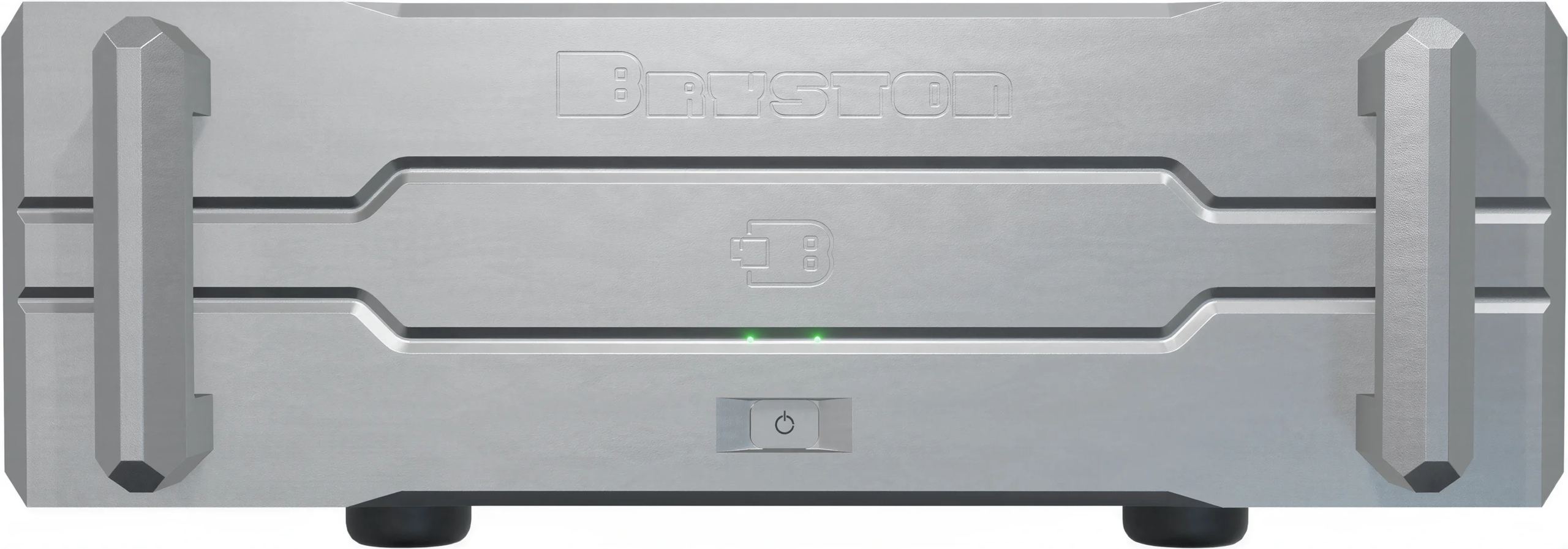
Since 1978, Bryston has continuously produced its 4B amplifier, refining it with each generation. Version 2.0 retains the Cubed series electronics, with two fully separate channels delivering 300 W each into 8 ohms. However, everything around them has been revised: the chassis has been redesigned, the heatsinks reworked, the front panel made removable, and the width standardized. This is a standalone power amplifier, with no volume control, designed to follow a preamplifier or home theater processor.
Two mono amplifiers in one chassis
Each channel of the 4B³ 2.0 has its own transformer and power supply. The left and right channels share only the enclosure and power cord. A bass-heavy passage on one speaker therefore does not draw on the other channel’s energy reserves.
Rated power is 300 W per channel into 8 ohms and 500 W into 4 ohms. A speaker’s impedance indicates the load it presents to the amplifier: the lower it is, the more current the speaker requires. A perfect amplifier would double its power when going from 8 to 4 ohms. The 4B gains two-thirds, leaving ample headroom for floorstanding speakers whose impedance drops in the bass. Total harmonic distortion plus noise remains below 0.005% from 20 Hz to 20 kHz, at full power into 8 ohms. Bandwidth extends from below 1 Hz to 100 kHz at -3 dB, well beyond audible frequencies, and such a wide bandwidth limits phase shift in the treble.
The Salomie circuit at the signal input
All Cubed amplifiers share a patented input stage developed with Ioan Alexandru Salomie. This circuit provides the initial gain, when the signal is still weak and even the slightest error would then be multiplied by every subsequent stage. Its principle is to trap distortion components in the main signal path before amplification, preventing them from reaching the speakers. It also rejects the interference found in today’s homes: Wi-Fi, mobile phones, and switching power supplies in chargers and routers.
23 or 29 dB gain and balanced inputs
A selector sets the gain to 23 or 29 dB. This 6 dB difference corresponds to a two-to-one voltage ratio: in the 29 dB position, the amplifier reaches full power with an input signal half as strong. This setting suits preamplifiers with relatively low maximum output levels. The 23 dB position serves the opposite case, with a network player or processor that delivers a high output level. The volume control then works across a wider range rather than remaining at its first few steps. In a home theater system, this setting also helps match the 4B to the sensitivity of the system’s other amplifiers.
The amplifier has a balanced XLR input and an unbalanced RCA input. The signal-to-noise ratio exceeds 106 dB via RCA and 111 dB via XLR. A balanced connection carries the signal twice, once in phase and once with the phase inverted, and the input retains only the difference between the two. Interference picked up along the way reaches both conductors identically and cancels out. The XLR connection is the right choice whenever the cable between preamplifier and amplifier exceeds a few meters, or when the 4B is installed at the back of a rack or in another room.
Changes in the 2.0 generation
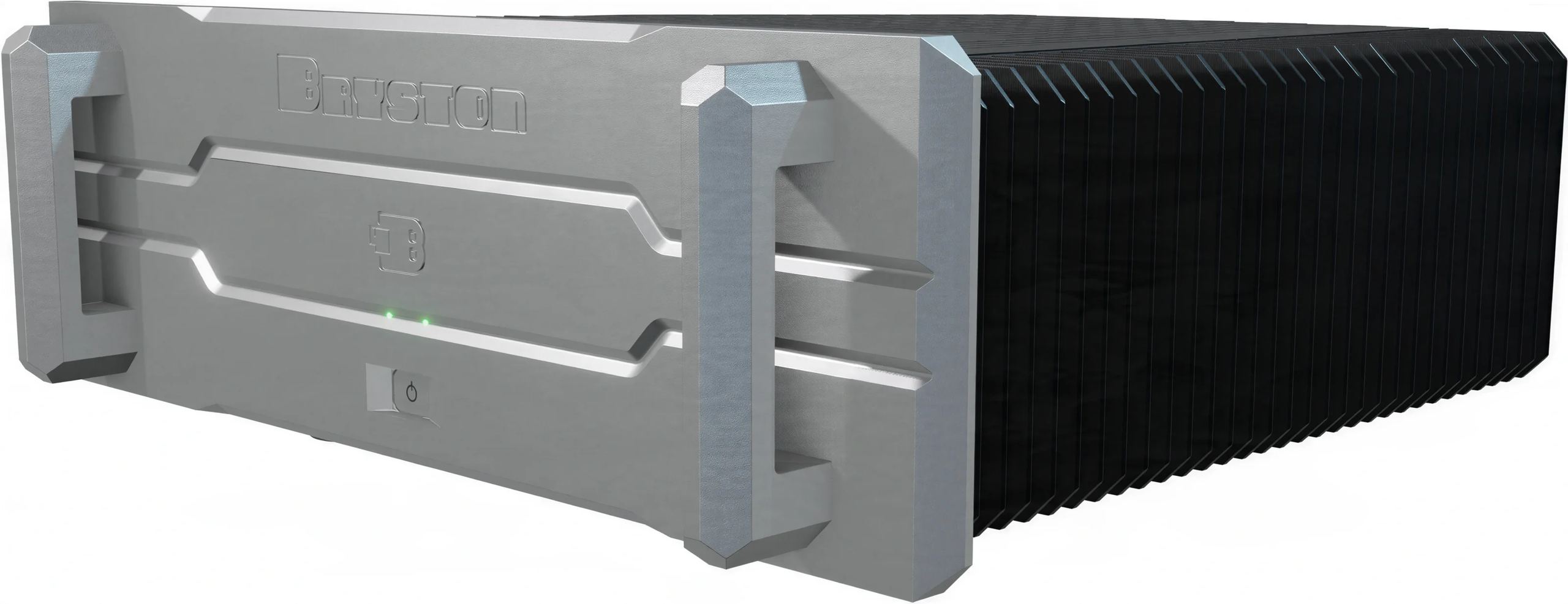
Compared with the previous 4B³, the electronics remain unchanged: the same power, gain settings, inputs, and Salomie circuit are retained. The work focused on the machined aluminum chassis, redesigned with cleaner proportions. The front panel is now removable and reinforced, making servicing easier. The previous generation’s two consumer widths, 17 and 19 inches, are replaced by a single 18-inch width, with or without handles.
The heatsinks have a new shape that dissipates heat more effectively and maintains a more stable temperature during long listening sessions at sustained high levels. Inside, there is less wiring, and the fasteners are now metric-thread stainless steel. The design is now the same across all the brand’s 2.0 amplifiers and Class D models: multiple stacked Bryston power amplifiers form a cohesive whole. The enclosure is also slightly more compact, measuring 15.2 cm high instead of 16 cm and 38.1 cm deep instead of 39.4 cm.
Front panels, installation, and startup
Four front panels are available: consumer without handles, consumer with handles, PRO in a 19-inch rack format, and PRO rack without handles. In the consumer version, the amplifier measures 45.7 cm wide, 15.2 cm high, and 38.1 cm deep, or 42.5 cm with the front handles. This 45.7 cm width exceeds the usual 43 cm of hi-fi components, so it is best to check the shelf’s usable width before purchasing. The chassis and front panel are made of machined, anodized aluminum, in black or silver depending on the version.
The amplifier has no fan. Heat dissipates through natural convection, without any mechanical noise, provided air is allowed to circulate above and around the enclosure. A closed cabinet or a shelf with insufficient clearance raises the operating temperature.
At power-up, the two transformers and their capacitors draw a large current all at once. The microprocessor-controlled SoftStart system spreads out this current draw to avoid tripping the circuit breaker. The DC trigger input switches the 4B on and off along with the preamplifier or processor, and standby consumption remains below 0.5 W. The amplifier is made in Canada and carries a 10-year manufacturer’s warranty.
Technical specifications
Overview
- Type: stereo power amplifier, 2 channels
- Dual-mono architecture
- Iconic Bryston model, continuously marketed since 1978
- Sixth generation of this amplifier, with numerous technical improvements
- Powerful and versatile amplifier, designed to drive a very wide variety of speakers
- Positioning: power, precision, reliability
Amplification
- Number of channels: 2
- Output power
- 2 × 300 W into 8 Ω
- Up to 2 × 500 W into 4 Ω
- Patented Salomie circuit, featured in Cubed series amplifiers
- Switchable gain: 23 dB, 29 dB
- Design aimed at ensuring precision, stability and speaker control
Technical performance
- Frequency response: below 1 Hz – 100 kHz (−3 dB)
- Total harmonic distortion + noise (THD + N): less than 0.005%
- Measurement conditions: 20 Hz – 20 kHz at rated power into 8 Ω
- Signal-to-noise ratio (values according to the manufacturer’s data sheet)
- RCA input: greater than 106 dB
- XLR input: greater than 111 dB
- Input impedance
- RCA: 7.5 kΩ
- XLR: 30 kΩ + / 6 kΩ -
Connectivity
- Balanced XLR inputs
- Unbalanced RCA inputs
- DC trigger input (DC Trigger) for automatic power on and off
- Compatibility with various hi-fi system configurations
Power supply and startup
- Fully independent power supply for each channel, with a dedicated transformer per channel
- Standby power consumption: less than 500 mW
- Microprocessor-controlled SoftStart system
- Gradual startup
- Inrush current limiting
- Prevention of nuisance circuit breaker trips
Cooling
- Cooling entirely by natural convection
- Fanless
- Silent operation, with no mechanical fan noise
Construction and finish
- Machined aluminum chassis
- Machined and anodized aluminum front panel
- Robust and durable construction, meeting Bryston manufacturing standards
- Indicator options: blue LED, green LED
- Front panel options: 4 configurations available
- Consumer front panel (Consumer) without handles
- Consumer front panel (Consumer) with handles
- Professional rack-mount front panel (PRO)
- Professional rack-mount front panel (PRO) without handles
Musical impressions
- Testimonials published by Bryston, explicitly referring to the 3B³ model and not the 4B³ (these are not reviews specific to the 4B³)
- Generous power reserves and excellent robustness
- Precise and detailed reproduction
- Sound described as smooth, warm and neutral
- Excellent high-frequency finesse
- Good ability to bring out the qualities of the paired speakers
Dimensions and weight
- Width: 45.7 cm
- Height: 15.2 cm
- Depth
- Without handles: 38.1 cm
- With front handles: 42.5 cm
- Dimensions (H × W × D): 26 cm × 61 cm × 54 cm
- Weight: 23.6 kg, 27 kg
- Weight also listed on the manufacturer’s data sheet: 18 kg
Frequently asked questions
Can a source be connected directly to the 4B³ 2.0?
Yes, if it has a variable-level output, like some network players or converters equipped with a volume control. A CD player or converter with a fixed output constantly sends its maximum level, and the amplifier reproduces it at full power with no way to turn it down. With this type of source, a preamplifier is required.
Does the 4B³ 2.0 work with a tube preamplifier?
Yes, provided you check the preamplifier’s output impedance. The RCA input has an impedance of 7.5 kΩ, which is lower than the average for amplifiers. To avoid a loss of level and weakened bass, the preamplifier’s output impedance should be about ten times lower, meaning less than 750 Ω. Some tube preamplifiers exceed this threshold, others remain below it, and the value is listed in their specifications.
Is it suitable for high-sensitivity speakers?
With speakers rated at 95 dB or higher, a few watts are enough for listening at normal levels, and even the slightest amplifier hiss is audible close to the speakers. The 23 dB gain setting reduces this residual noise, and the XLR input, which is 5 dB quieter than the RCA input, adds even more headroom. The full 300 W remain available for peaks, well short of clipping.
Can you bi-amp a pair of speakers with two 4B³ 2.0 amplifiers?
Yes, if each speaker has two pairs of binding posts. Once the jumpers are removed, each amplifier powers a single speaker: one channel for the bass, the other for the midrange and treble, while the speaker’s passive crossover continues to distribute the frequencies. The preamplifier must have two outputs, or the signal must be split. Both amplifiers must be set to the same gain, otherwise the balance between bass and treble will shift.
What are the benefits of pairing the 4B³ 2.0 with a home theater receiver?
Connected to an AV receiver’s preamp outputs, the 4B handles the front left and right channels, which receive most of the music and effects. The receiver’s internal amplifiers only power the center and surround channels, placing less demand on their power supply. During stereo listening, the main speakers benefit from the 4B’s current reserves rather than those of the receiver.
What sets the 4B³ 2.0 apart from other amplifiers in the Bryston range?
Power first. The 3B³ 2.0 delivers 200 W per channel into 8 ohms and 300 W into 4 ohms, with a reduced depth that makes it easier to install in shallow cabinets. The 14B³ 2.0 steps up to 600 W per channel into 8 ohms and 900 W into 4 ohms. The 7B³ 2.0 and 28B³ 2.0 are monoblock amplifiers to be used in pairs, and the 28B³ 2.0 is rated at 1,000 W into 8 ohms. All feature the Salomie circuit and switchable 23 or 29 dB gain.
- Eco-contribution included in the sale price.


