

Sugden Audio A21 L Signature titanium


Awards

Diapason d'Or
The number 1 in classical music and hi-fi. It is a benchmark in the field of classical music and hi-fi, as well as the distinction it awards to the best devices each year
Overview
In 1967, Sugden launched the first production transistor amplifier to operate entirely in Class A. The A21 L Signature is its current incarnation: a 25-watt-per-channel stereo integrated amplifier, handmade at the brand’s factory in Heckmondwike, Yorkshire. This L version has only line inputs, five in total, but a phono board can be added later if a turntable joins the system.
Pure Class A, a choice maintained since 1967
In most amplifiers, known as Class AB designs, the output transistors share the work: each handles half of the sound wave and hands over to the other as the signal crosses zero. This handover can create a small amount of distortion, known as crossover distortion. In Class A, the output transistors conduct continuously throughout the entire waveform, even when no music is playing. This handover disappears, but a large proportion of the energy consumed is dissipated as heat, hence the modest power output for a chassis of this size.
Sugden adds a single voltage rail circuit (“single ended voltage rail”): the output stage is powered by a single voltage rather than two symmetrical voltages, positive and negative. The brand has retained this configuration from the outset for its bass and the vigour of its attacks. The aim is a wide soundstage and a listening experience that can last for hours without fatigue. The A21 was followed in 1990 by the A21a, whose circuit design is used in the A21 Signature with a few improvements. Many first-generation A21 amplifiers still work today, more than fifty years after they were made.
Pairing 25 watts with the right speakers
The A21 L Signature’s 25 watts into 8 ohms cannot be compared directly with the figures for a Class AB or Class D amplifier. They are enough to drive most living-room speakers, provided they are chosen carefully. For a medium-sized room, Sugden recommends speakers with a sensitivity of at least 86 dB (the sound level a speaker produces for a given power input). The brand considers it more natural-sounding with medium-sensitivity models. For a large room or high-volume listening, a more sensitive speaker with a consistent impedance is the right match. Speakers with very high current demands are not suitable. Listening with your own speakers before buying remains the best way to confirm the pairing.
In terms of measurements, the frequency response stays within ±1 dB between 10 Hz and 20 kHz, and the bandwidth extends from 6 Hz to 200 kHz. The signal-to-noise ratio exceeds 83 dB.
Five line inputs and provision for a phono board
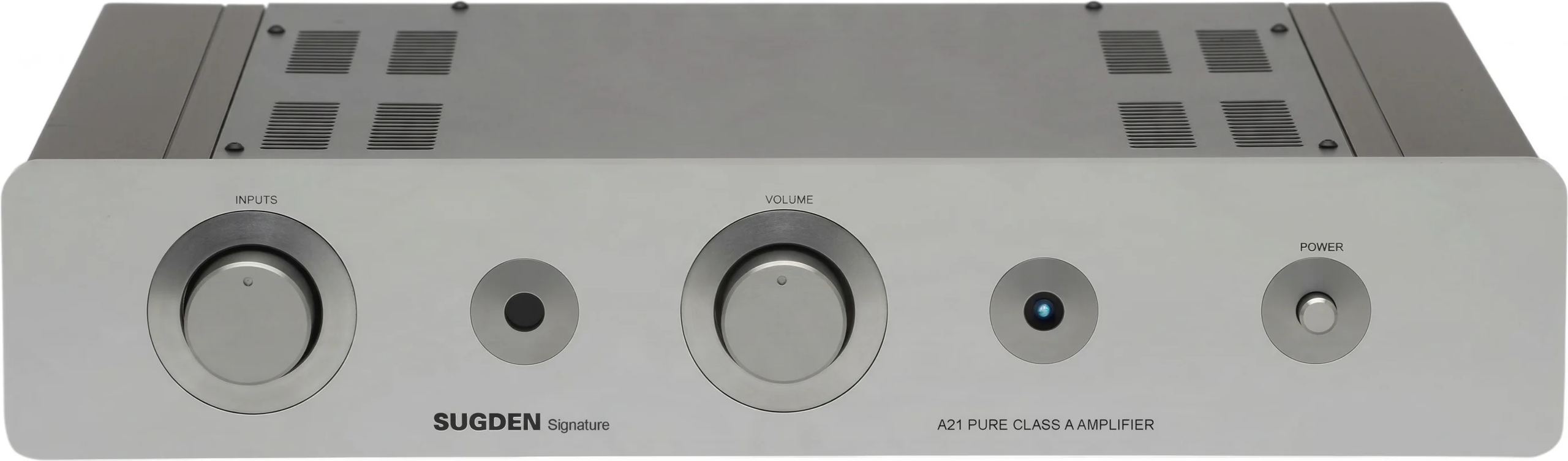
On the rear panel, five RCA line inputs accommodate a CD player, a network player, a tuner or the output of an external phono preamplifier. Their sensitivity is 170 mV for maximum power output. Sources are selected using the rotary knob on the front panel, next to the volume control, power switch and power indicator. The supplied infrared remote control adjusts only the volume.
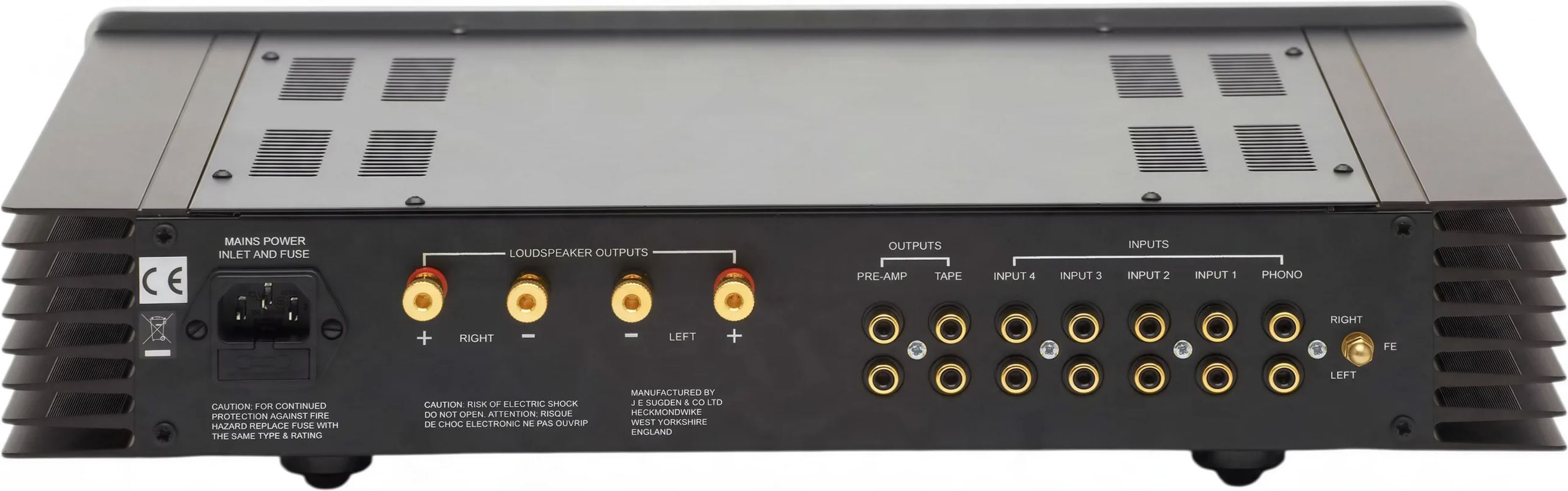
A phono board can be fitted later. The amplifier then has four line inputs and one phono input, configured for a moving magnet cartridge (MM, 3 mV, 47 kΩ load) or a moving coil cartridge (MC, 0.2 mV, 470 Ω load). The ground terminal for the turntable’s earth wire is already fitted to all versions.
Outputs include a pair of speaker binding posts, which accept bare wire, 4 mm banana plugs and spade connectors. There is also a variable-level preamplifier output for a subwoofer or an additional power amplifier, and a fixed-level recording output. The A21 L Signature has neither a digital input nor a headphone output: a network player or a digital-to-analogue converter with analogue outputs handles the digital side.
A compact chassis that runs hot
Measuring 92 × 430 × 355 mm (H × W × D) and weighing 11 kg packed, the A21 L Signature has the standard width of a hi-fi component with a low profile. Its Class A operation makes it hot to the touch, even at low volume, and it needs around ten minutes to reach its operating temperature. It must be placed on a stable, well-ventilated support, outside an enclosed cabinet, away from heat sources and never on a carpet. No other equipment should be placed on its top cover, and its ventilation slots must remain unobstructed.
Technical specifications
Overview
- Integrated architecture combining amplification and preamplification
- High-end design in a compact chassis
- Traditional, elegant design
- Long-established A21 range: some original models are still in use after more than 50 years
- Focus: listening quality rather than raw power, with an emphasis on sound reproduction quality, refinement and musicality
Amplification and performance
- Technology: pure Class A
- Single voltage rail output circuit (Single Ended Voltage Rail)
- Output power: 25 W per channel into 8 Ω
- Frequency response: ± 1 dB from 10 Hz to 20 kHz
- Bandwidth: 6 Hz – 200 kHz
- Signal / noise ratio: greater than 83 dB
Claimed musical qualities
- Dynamic reproduction, with substantial dynamic range despite moderate power
- Deep, controlled bass
- Expansive soundstage, good depth of reproduction
- Detailed reproduction, richly nuanced musical delivery
- Natural, smooth, pleasant and non-fatiguing listening, even over long periods
- Suitable for different musical styles
Inputs
- Line-level inputs
- A21 Signature: 5
- A21 Integrated: 4
- MM / MC phono input: optionally available
- Input sensitivity
- Line: 170 mV for maximum power
- MM phono: 3 mV
- MC phono: 0.2 mV
- Phono loading
- MM: 47 kΩ
- MC: 470 Ω
Outputs
- Speaker terminals: one stereo pair, compatible with plugs and multi-contact cables
- Variable-level preamplifier output (Pre-Out)
- Fixed-level recording output (Tape-Out)
- Ground terminal
Controls and supplied accessories
- Remote control included
- Remote volume adjustment: increase, decrease
Available versions
- A21 i Signature: with or without MM / MC phono stage
- A21 L Signature: line inputs only
- Option to add a phono board later
Dimensions and weight
- Dimensions (H × W × D): 92 mm × 430 mm × 355 mm
- Gross packed weight: 11 kg
Frequently asked questions
How do I choose between MM and MC if I add the phono board?
The setting is adjusted using four jumpers on the phono board, factory-set to MM. It is best to specify the cartridge type when ordering. To switch from MM to MC later, the unit must be opened: this should be done by a qualified technician.
Can the amplifier be left on all the time?
Sugden advises against it. In Class A, the amplifier consumes as much power and generates as much heat at idle as it does during playback, so leaving it on wastes energy and shortens the lifespan of its components. It is best to turn it on about ten minutes before a critical listening session.
How do I connect a subwoofer?
Via the variable-level preamp output, which follows the volume set on the amplifier. The subwoofer then follows volume changes along with the main speakers.
How do I listen with headphones?
A separate headphone amplifier is required, connected to the recording output. As its level is fixed, the headphone volume is adjusted on the headphone amplifier, without changing the speaker volume setting.
What can you do with the remote control?
It raises and lowers the volume. To select the source and turn the device on or off, you need to use the front panel.
What's the difference compared to the A21SE Signature?
The A21SE Signature is the next model up in the A21 series. It retains Class A operation and the single voltage rail circuit, but with a 50% larger power supply, more power and a revised preamp stage. For speakers that are harder to drive or a large room, this is the model to consider.
- Eco-contribution included in the sale price.
- Manufacturer reference: S001T


