

Sugden Audio MasterClass iA-4 titanium


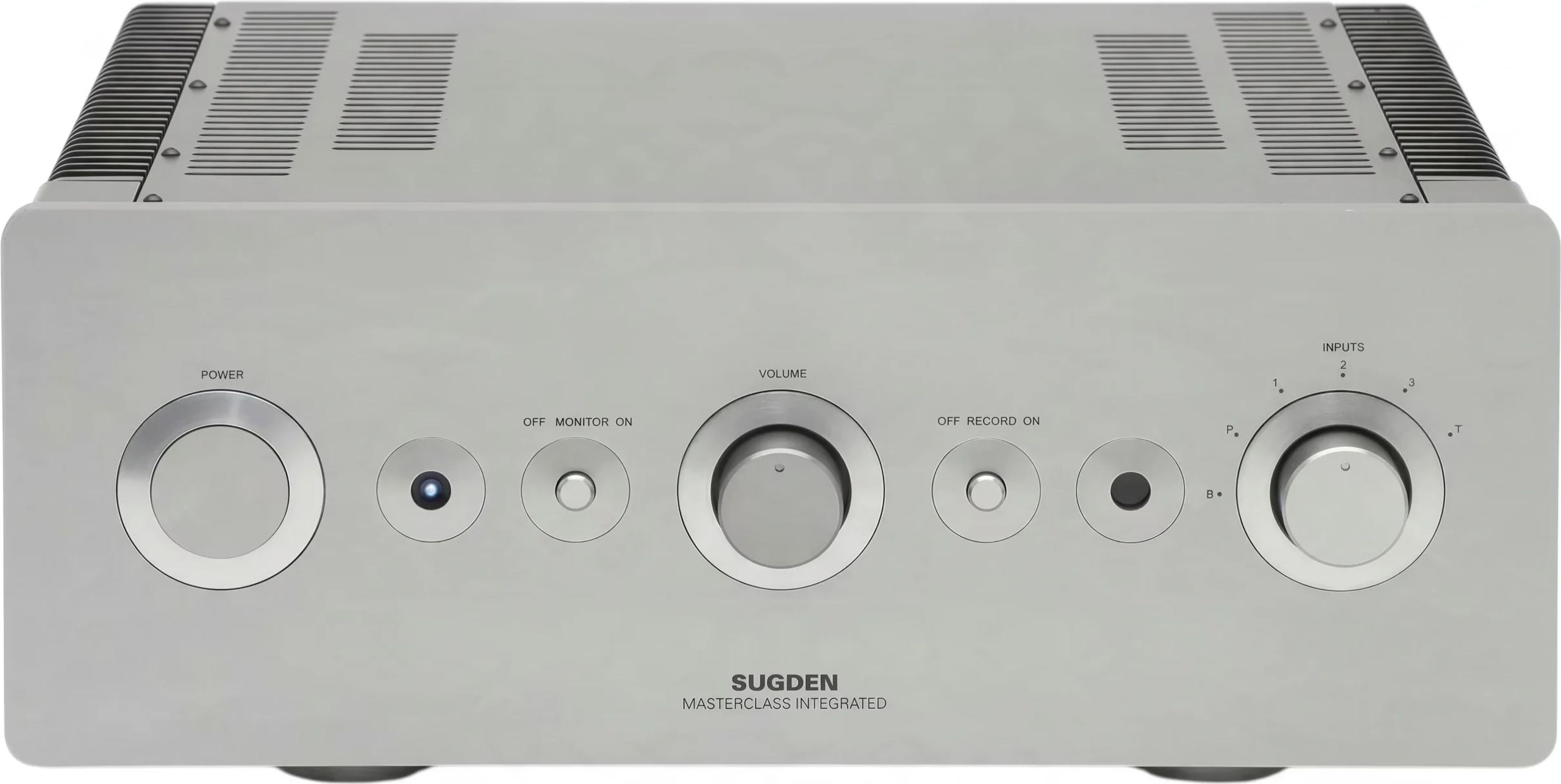
Sugden Masterclass IA-4: a pure Class A integrated amplifier
Thirty-three watts per channel in a chassis weighing nearly twenty kilos is a surprising ratio until you understand how the unit operates. The IA-4 is the most powerful of Sugden’s integrated amplifiers. It operates in pure Class A, the English company’s specialty since the A21. The chassis, manufactured in Heckmondwike, Yorkshire, houses a dedicated preamplifier, a phono input and five other analog inputs.
Thirty-three watts in Class A and nineteen kilos of hardware
In a conventional transistor amplifier (Class AB), each output transistor reproduces one half of the waveform and switches off during the other. The handover between the two halves creates what is known as crossover distortion, particularly audible at low volume. In pure Class A, the transistors conduct continuously and at the same current, whether music is playing or not: this handover no longer exists. There is a trade-off: heat. Most of the energy drawn from the mains is dissipated through the heatsinks, even at idle, and a generously sized power supply is needed to maintain this current. The unit weighs 19 kg unpacked and 20 kg in its packaging, despite its modest power rating on paper.
Sugden pioneered this technical approach: the A21, launched in the late 1960s, was the first production transistor amplifier to operate in pure Class A. The IA-4 is its most powerful version. Its frequency response stays within ±1 dB from 14 Hz to 200 kHz, and its -3 dB bandwidth extends from 6 Hz to 300 kHz. This margin, far beyond the range of human hearing, limits phase shifts within the audible band. The signal-to-noise ratio exceeds 84 dB.
A power stage derived from the A21, with an enlarged power supply
The output circuit builds on the A21 series design, with several developments. The power supply has increased capacity, providing a larger current reserve for peaks. The smoothing capacitors, which smooth the voltage after the mains current has been rectified, are of higher quality, as are the output capacitors positioned between the power stage and the speakers. The rest of the construction follows the same approach: gold-plated circuit boards, input switching handled entirely by relays and a precision input selector. With relays, switching takes place as close as possible to the sockets, without the signal having to travel around the chassis to the front-panel knob.
Sugden developed a preamplifier stage specifically for the IA-4, rather than using one from another model in the range. The stated goal is sonic: clear, detailed reproduction and a wide soundstage in which the depth and height of the layers are easier to perceive, regardless of musical genre.
Six analog inputs, including balanced XLR and MM phono
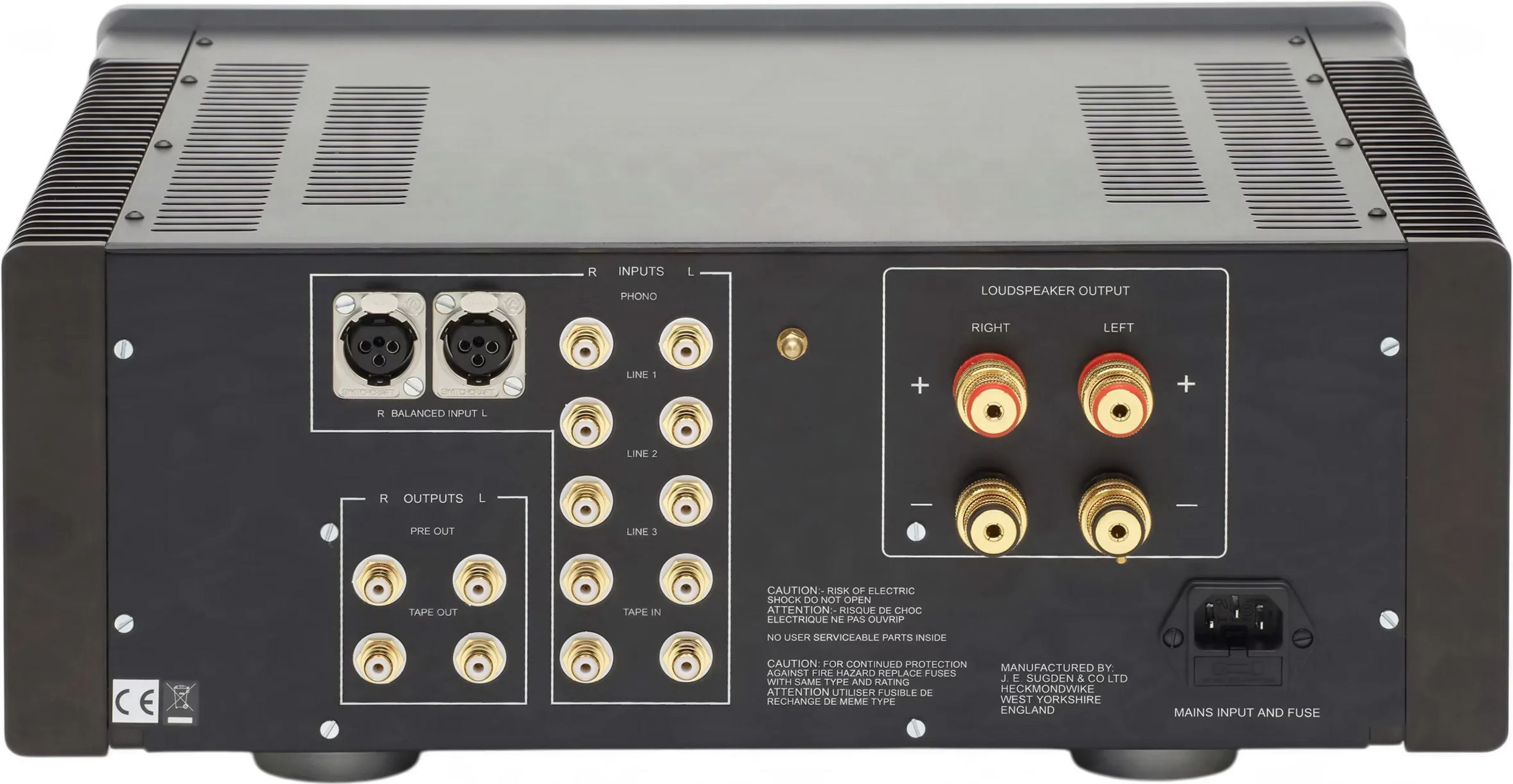
The rear panel has no digital sockets. It features three RCA line inputs, a tape input, a phono input for a moving magnet (MM) cartridge and a balanced XLR input wired with pin 2 hot. The XLR input can accommodate, for example, the Masterclass range’s CD player or any other device with a balanced output. A signal of 125 mV is required to reach full power through the line inputs, which have an impedance of 50 kΩ. A CD player or digital-to-analog converter typically delivers 2 V, or 24 dB above this threshold: there is ample gain in reserve. The phono input has a sensitivity of 2 mV, a value suited to the most common MM cartridges.
For outputs, the IA-4 has a variable-level preamp output, which follows the volume setting, and a fixed-level tape output. Speakers connect to gold-plated locking WBT binding posts, one pair per channel, and Sugden recommends a load between 4 and 16 Ω. Volume can also be adjusted remotely using the supplied remote control, which uses the RC5 protocol.
Choosing speakers and positioning the amplifier correctly
Going from 1 W to 33 W adds around 15 dB. A speaker rated at 88 dB/W/m can therefore reach nearly 103 dB at one meter on peaks, which is more than enough for an average-sized living room. With a less efficient speaker or a larger space to fill, the margin is reduced. Models with medium or high efficiency, without excessively steep impedance dips, make the most of the IA-4.
The heat generated continuously calls for a few precautions. Leave around ten centimeters of clearance on each side and above, place nothing on the top cover, and avoid enclosed cabinets where hot air recirculates, carpets that block the vents and proximity to a radiator. Measuring 430 mm wide, 165 mm high and 440 mm deep, the IA-4 takes up the space of a standard hi-fi component but requires a sturdy shelf. Allow around fifteen minutes of warm-up time for the stages to reach their operating temperature.
Technical Specifications
Overview
- Type: high-end integrated amplifier
- Positioning: flagship model in the range
- Construction: meticulous build quality, robust design
Architecture and Amplification
- Pure Class A amplification
- Improved power circuit compared to the A21 series
- Higher-capacity, generously sized power supply
- Optimized filtering circuits
- Upgraded output and smoothing capacitors
- Gold-plated circuit boards
- Relay input switching
- Precision input selector
Preamplifier Stage
- Preamplifier stage specially developed by Sugden
- Sonic objectives:
- Excellent sonic clarity
- Detailed reproduction
- Expansive soundstage
- Improved perception of sound image depth and height
Performance
- Output power: 33 W per channel into 8 Ω
- Input sensitivity:
- Line: 125 mV
- MM phono: 2 mV
- Frequency response: 14 Hz – 200 kHz (± 1 dB)
- Bandwidth: 6 Hz – 300 kHz
- Signal-to-noise ratio: greater than 84 dB
Connectivity
- Inputs:
- 3 line inputs
- 1 Tape input
- 1 MM phono input
- 1 balanced input (Balanced)
- Outputs:
- 1 variable preamplifier output (Pre-Out)
- 1 fixed output
- Speaker outputs
Features
- RC5-compatible remote control
- Monitor function
- Recording function (Record Off)
Dimensions and Weight
- Dimensions (H × W × D): 165 × 430 × 440 mm
- Packed weight: 20 kg
Frequently asked questions
Can you connect a moving coil (MC) cartridge to it?
Not directly. The phono input is designed for moving magnet cartridges, and the output voltage of an MC cartridge is often ten times lower. You need to place a step-up transformer before the phono input, or use an external MC phono preamp connected to a line input.
Does the IA-4 have a headphone output?
No. To listen through headphones, connect a headphone amplifier to the fixed-level tape output. Its volume then remains independent of the speaker volume.
How do I listen to a digital source or a streaming service?
The IA-4 is fully analog: it has no DAC, Bluetooth, or network connectivity. A network player or DAC with an analog output provides the connection, plugged into an RCA line input or, if it has one, the XLR input.
Can a subwoofer be added?
Yes, via the variable preamp output. Since it follows the IA-4’s volume, the powered subwoofer’s level rises and falls along with the main speakers, with no need to readjust it each time the volume changes.
Can it be used with a separate power amplifier?
The same preamp output can feed a power amplifier. It can be used for passive bi-amping, with the IA-4 connected to one pair of speaker terminals and the power amplifier to the other, or to drive a second pair of speakers in another listening zone.
What are the Monitor and Record Off functions used for?
They relate to the tape loop. Monitor allows you, with a three-head tape recorder, to listen to the tape just after it passes the recording head, and to compare the original and the copy while recording. Record Off mutes the tape output when no recording is in progress: the device connected to this output no longer loads the circuit during listening.
Is bi-wiring possible?
The IA-4 has only one pair of binding posts per channel. A bi-wire cable with both conductors joined at the amplifier end is suitable. The jumper bars connecting the two pairs of binding posts on the speaker must then be removed.
- Eco-contribution included in the sale price.
- Manufacturer reference: S007T


