

Sugden Audio MasterClass ANNV-50 titanium


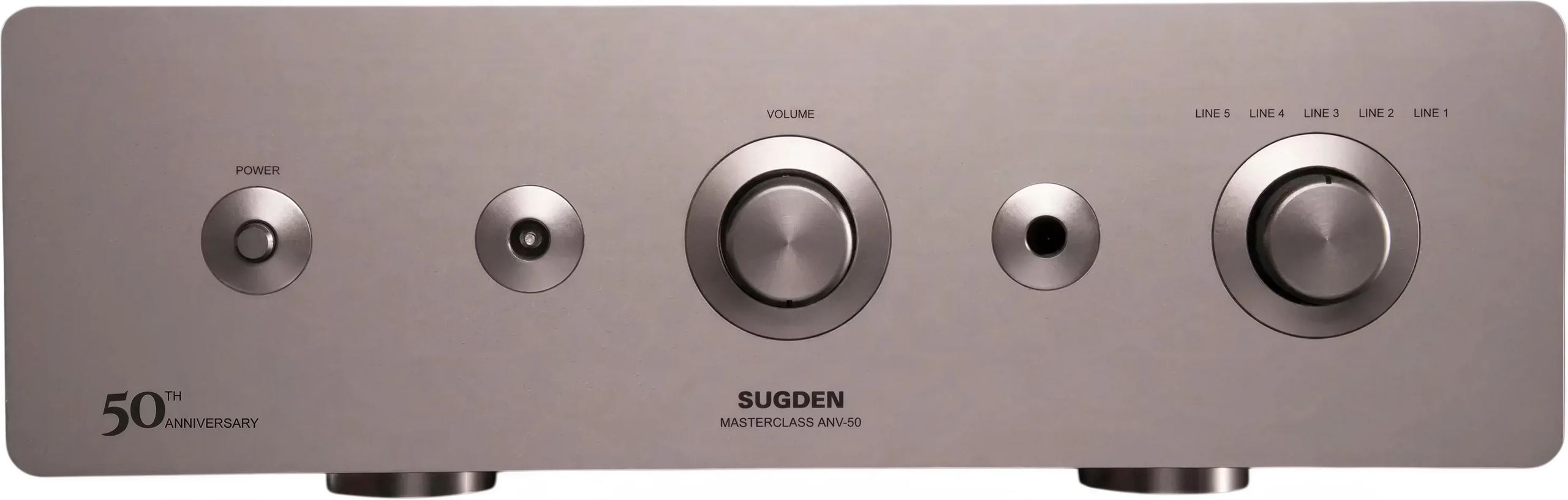
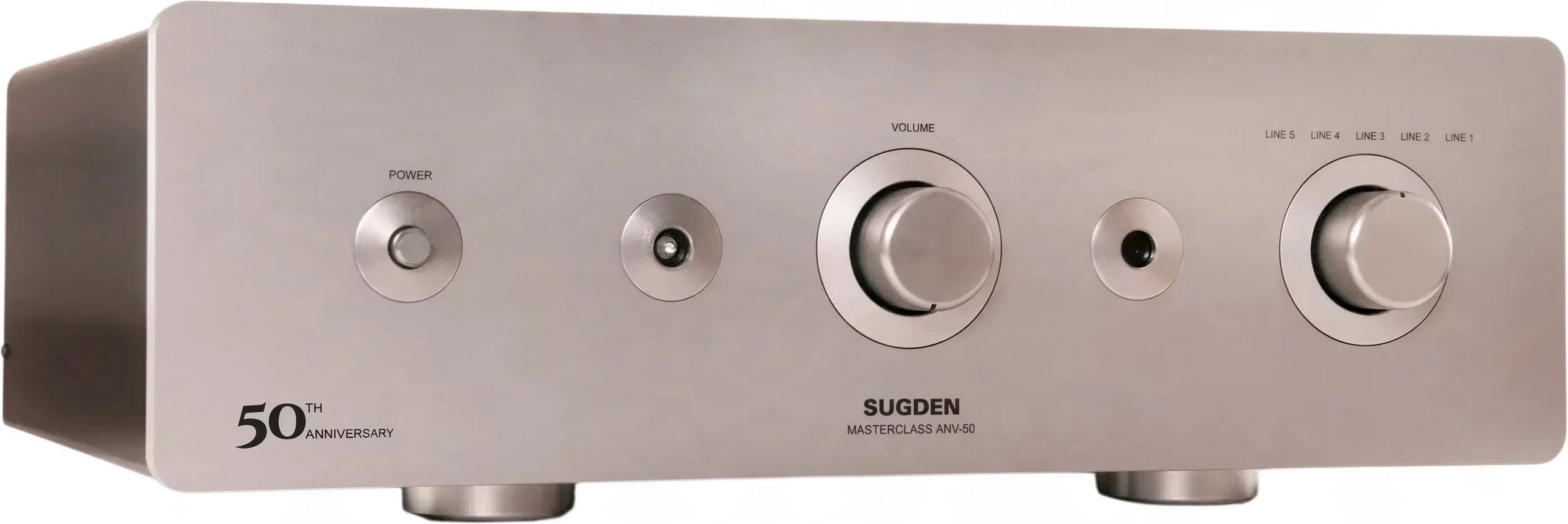
Overview
In 1967, Sugden launched the A21, the first transistor amplifier to operate in pure Class A. For its fiftieth anniversary, the workshop in Heckmondwike, Yorkshire, retained this operating principle but moved it elsewhere in the circuit. Here, Class A drives an output stage that delivers 50 W per channel into 8 ohms, and twice that into 4 ohms. The unit stays barely warm, consumes 20 W at idle and can drive a much wider range of speakers than earlier Sugden models.
A small Class A stage in control of the power
In a pure Class A amplifier, the output transistors continuously carry their maximum current, with or without music. They never switch off, eliminating the crossover distortion inherent in Class AB, when two transistors hand over to each other on each half-cycle of the signal. The price to pay is well known: a few dozen watts in Class A require a continuous draw of several hundred watts from the mains, which end up as heat.
Sugden splits the work between two stages. A pure Class A amplifier rated at around 4 W, according to the brand, processes the signal. A second stage, called the “Ideal Output Stage”, reproduces its waveform on a larger scale and supplies current to the speakers. The 50 W are therefore not delivered in Class A, as the idle power consumption of 20 W confirms. To ensure that the output stage faithfully follows the first, a comparator measures the difference between the two and continuously corrects it. This circuit, called Sugden Error Correction, compensates for errors caused by variations in speaker impedance and distortion in the power stage. Current feedback is applied across the entire amplifier, whose bandwidth extends from 8 Hz to 86 kHz.
A switching power supply clocked at 1 MHz
Most amplifiers draw their energy from a transformer operating at mains frequency (50 Hz), followed by a bridge rectifier and smoothing capacitors. The ANV-50 uses a switching power supply developed by Sugden for this model. Its oscillator operates at 1 MHz, well above the few tens or hundreds of kilohertz usual for this type of circuit. Switching noise is therefore far outside the audible band and easier to filter out. As the Class A stage remains powered at all times, the power supply responds without delay to current peaks from a percussion attack or an orchestral crescendo.
Sugden states an MTBF (mean time between failures) of 100 years for this power supply. The absence of a large transformer also explains the weight of 11 kg including packaging. The heatsinks are mounted inside the chassis and barely touch the case, so the cover remains almost at room temperature during normal operation.
No capacitors in the signal path
The preamplifier and power amplifier are DC-coupled from end to end. The signal does not pass through any coupling capacitors, components that block DC voltage but whose quality and ageing affect the sound. The “line drive” preamplifier was developed for this unit with as few components as possible. Relays switch the five line inputs: the signal passes through a closed, isolated contact rather than a mechanical rotary selector, whose contacts wear and oxidise over time.
The frequency response stays within ±1 dB between 12 Hz and 45 kHz, and the signal-to-noise ratio exceeds 85 dB.
4- or 8-ohm speakers without complicated calculations
Power doubles when impedance is halved, and that is no small detail. A 4-ohm speaker requires twice as much current as an 8-ohm speaker for the same volume, and many amplifiers reach their limit before that. Sugden specifies very low output impedance and a high damping factor. In plain terms, the amplifier controls the movement of the woofer cone and stops it dead rather than letting it oscillate. To give an idea of scale, with 50 W, a speaker with a sensitivity of 88 dB reaches around 105 dB at one metre, a level well above normal home listening, even in a large living room.
Sugden’s pure Class A models, with their 20 to 30 W, often required high-efficiency speakers. With the ANV-50, bookshelf or floorstanding models with medium sensitivity are also suitable.
Five line inputs and analogue-focused connectivity
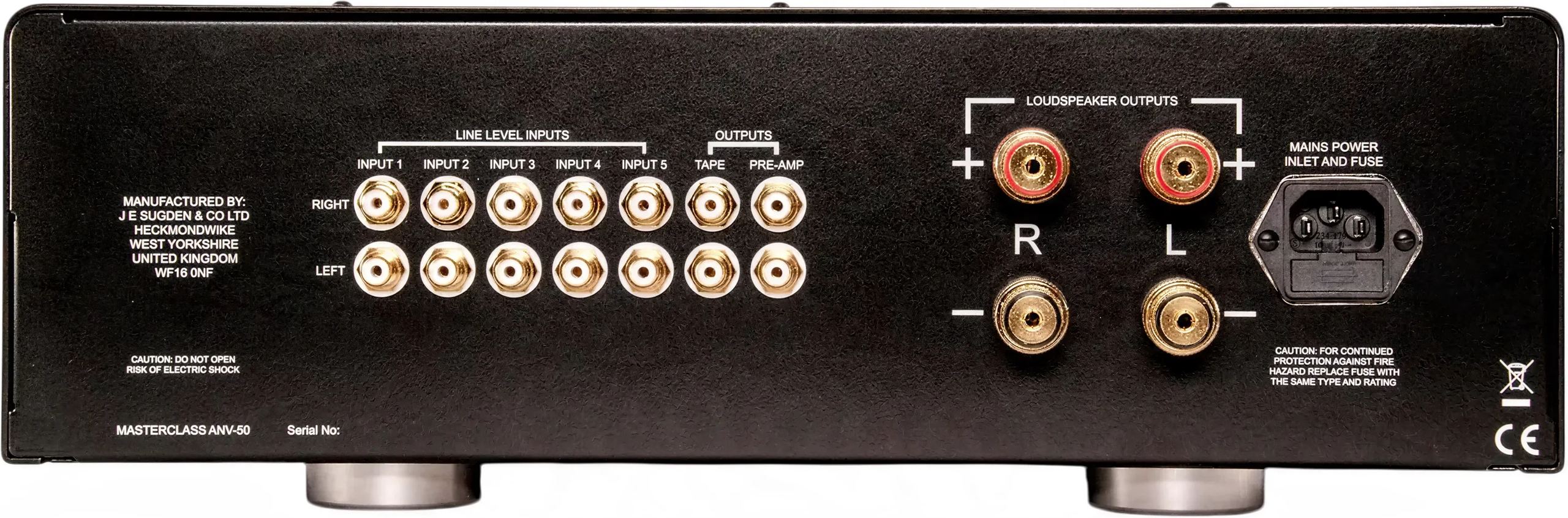
The ANV-50 is an analogue integrated amplifier with no additional modules. It has no phono preamplifier, digital converter, Bluetooth or headphone output. A turntable requires an external phono preamp, and a digital source (network player, CD player, transport) must have its own converter. The rear panel features five RCA line inputs, a variable-level preamplifier output, a fixed-level recording output and a pair of multi-contact binding posts per channel. The supplied RC5-compatible remote control adjusts the volume.
The unit measures 143 × 430 × 370 mm (H × W × D). Its 43 cm width allows it to fit into standard-sized hi-fi cabinets and shelving.
Technical specifications
Architecture and amplification
- Pure Class A amplification
- Two-stage amplification system
- Dedicated final output stage of the “Ideal Output Stage” type
- Sugden error correction circuit (Sugden Error Correction)
- Current feedback operation (Current Feedback)
- Fully DC-coupled amplifier and preamplifier (DC Coupled)
- No capacitors in the audio signal path
- Very low output impedance and high damping factor
- Architecture objective: maintain signal fidelity and operational stability, even when speaker impedance varies
Output power and audio performance
- Output power
- 50 W per channel into 8 Ω
- 100 W per channel into 4 Ω
- Power doubles into 4 Ω: drive capability for powering a wide variety of loudspeakers
- Line input sensitivity: 110 mV at zero attenuation
- Frequency response: 12 Hz – 45 kHz (± 1 dB)
- Bandwidth: 8 Hz – 86 kHz
- Signal-to-noise ratio: greater than 85 dB
Preamplifier stage
- Built-in preamplifier specially designed for the ANV-50
- Line Drive architecture
- Reduced component count
- High-quality components
- Design aimed at natural, open and transparent reproduction
Power supply
- High-frequency switching power supply specially developed for the ANV-50
- Switching frequency: 1 MHz
- High current reserve
- Fast response to musical demands
- Stable power supply designed to last
- Reliability: MTBF (mean time between failures) stated as 100 years according to Sugden
- Idle power consumption with no signal: approximately 20 W
Thermal management
- Distinctive thermal design, unlike some traditional Class A amplifiers
- Heat sinks mounted inside the chassis
- Limited contact with the outer casing
- Moderate external temperature during normal operation
Connections
- Inputs: 5 relay-switched line inputs
- Outputs
- 1 variable preamplifier output (Pre-Out)
- 1 fixed recording output (Tape Out)
- 1 pair of multi-contact stereo binding posts
Features
- Remote volume control
Supplied accessories
- RC5-compatible remote control
Dimensions and weight
- Dimensions (H × W × D): 143 × 430 × 370 mm
- Packed weight: 11 kg
Frequently asked questions
What does the name ANV-50 mean?
The letters ANV refer to the anniversary, and 50 to the half-century of Sugden, founded in 1967. The unit belongs to the Masterclass line, the brand’s higher-end range, alongside the IA-4 integrated amplifier.
Can you change the input using the remote control?
The supplied remote control adjusts the volume, while input selection is done on the front panel. It uses the Philips RC5 infrared protocol, which most universal or learning remote controls can reproduce.
Is an input sensitivity of 110 mV a problem with a network player or a converter?
No. The amplifier reaches full power with 110 mV at the input and the volume at maximum. A source delivering 2 V, the typical output of a CD player or DAC, gets it there well before that. The volume control therefore operates mainly in the first part of its range for normal listening.
Can a subwoofer be added?
Yes, via the variable-level preamplifier output. It follows the volume set on the ANV-50, so the subwoofer follows the main speakers. The crossover is adjusted on the active subwoofer itself. The main speakers continue to receive the full frequency range, as the ANV-50 does not apply any high-pass filter.
How do I listen with headphones?
By connecting a headphone amplifier to the recording output (Tape Out). It provides a fixed level, independent of the ANV-50’s volume, and the headphone amplifier then handles its own volume adjustment.
Do the binding posts accept banana plugs and support bi-wiring?
The multi-way binding posts accept bare wire, spade connectors and banana plugs. There is only one pair per channel: for a speaker with dual binding posts, keep the original jumpers or use a bi-wire cable that joins at the amplifier end.
- Eco-contribution included in the sale price.
- Manufacturer reference: S006T


