

Sugden Audio MasterClass SPA-4 titanium


Sugden Masterclass SPA-4: Class A stereo power amplifier
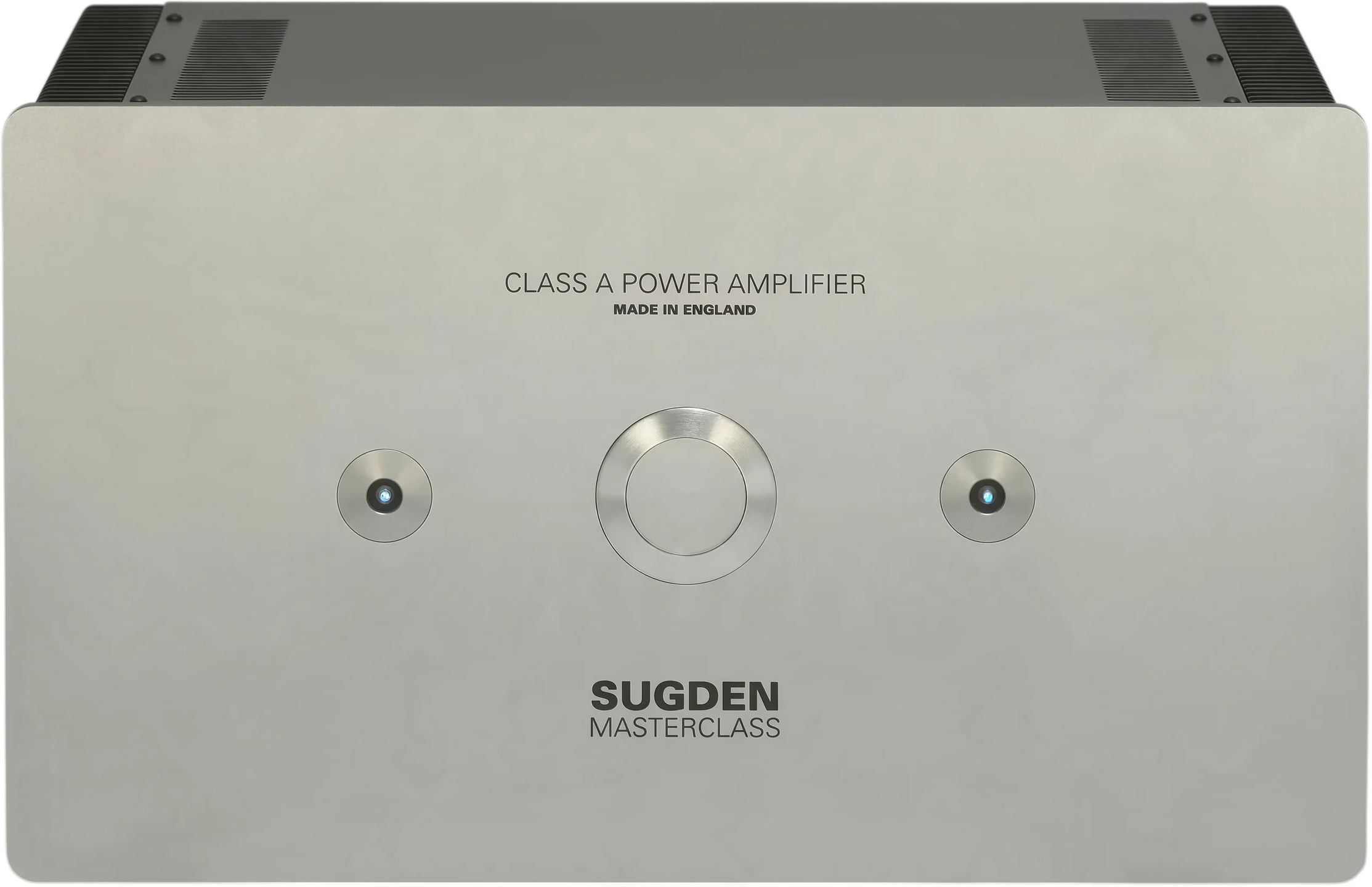
Both channels operate in pure Class A and are housed in a single chassis measuring 43 cm wide. This power amplifier uses the circuit from the Masterclass series MPA-4 monoblocks. Its output is reduced to 50 W per channel into 8 Ω to accommodate stereo operation. It is handmade at the Sugden factory in Heckmondwike, Yorkshire. It connects to a preamplifier via RCA or XLR and drives both bookshelf speakers and floorstanding speakers.
Class A amplification, Sugden’s specialty since 1967
In most transistor amplifiers, which operate in Class AB, each output transistor handles one half of the signal, either the positive or the negative part. It hands over to its partner each time the signal crosses zero. This handover produces a small amount of crossover distortion, which mainly affects low-level signals. In Class A, the output transistors conduct continuously, at a constant current, regardless of volume. The signal is therefore handled in one continuous process, without any handover. The trade-off is that the amplifier continuously converts a large proportion of its energy into heat, even when silent, and its output remains modest for its weight and size.
Sugden built its reputation on this choice. The A21, released in 1967 from James Sugden’s workshop in Yorkshire, was the first mass-produced pure Class A transistor amplifier. The Masterclass series, which includes the SPA-4, has been in continuous production for more than seventeen years.
The MPA-4 monoblock circuit, brought together in a single chassis
The MPA-4 is a fully balanced monoblock amplifier delivering 165 W into 8 Ω and accepting only XLR connections. The SPA-4 uses the same Class A circuit. It differs in two respects: its output, adapted to two channels in a single enclosure, and the addition of RCA inputs alongside the XLR inputs. A pair of MPA-4s means two units weighing 25 kg each including packaging, to be installed near the speakers. The SPA-4 takes up just one space on the hi-fi rack.
With a balanced connection, the signal travels along two conductors, with an inverted copy on the second. Any interference picked up along the way affects both conductors equally and is cancelled out when the amplifier input takes the difference between the two. With a preamplifier equipped with XLR outputs, the entire chain operates in balanced mode right through to the SPA-4.
50 W into 8 Ω, 75 W into 4 Ω: what Class A delivers
These power ratings are measured with both channels operating and a 230 V mains supply. When the speaker impedance drops from 8 to 4 Ω, output rises from 50 to 75 W per channel: the power supply provides the extra current required by a lower load. Sugden highlights speaker control and soundstage depth, and has tested the SPA-4 with both compact models and large speakers. For low-sensitivity speakers played loudly in a large room, a pair of MPA-4s provides more headroom.
The frequency response is specified with no deviation (± 0 dB) from 15 Hz to 30 kHz, making it perfectly linear across the entire audible range. The bandwidth, measured at the – 3 dB points, extends from 2 Hz to 200 kHz. The signal-to-noise ratio exceeds 85 dB.
RCA or XLR inputs, 1 V input sensitivity
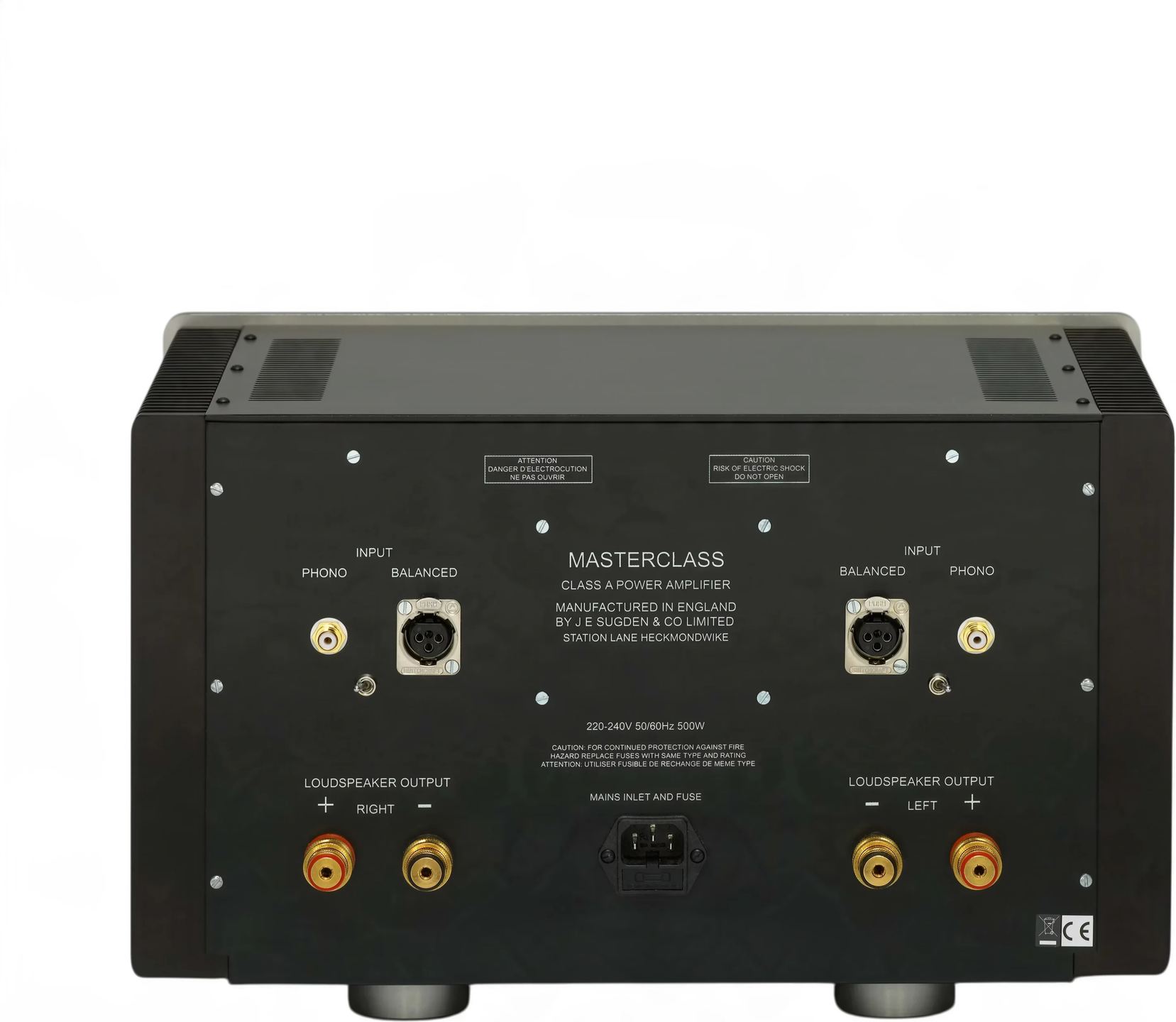
On the rear, a pair of RCA sockets and a pair of XLR sockets are separated by a selector switch. The XLR sockets are wired to the usual standard: pin 1 ground, pin 2 hot, pin 3 cold. Input sensitivity is 1 V for full output. With a conventional preamplifier, the SPA-4 therefore reaches its maximum output well before the end of the volume control’s travel.
The SPA-4 has no volume control. It must be connected to a preamplifier or a source with a variable output. The Masterclass LA-4 line preamplifier, from the same series, also operates in Class A and has an XLR output. For the speakers, two pairs of red and black locking binding posts are labelled L and R. They accept bare wire, spades and plugs. At power-on, a delay circuit disconnects the speaker outputs for approximately five seconds to prevent startup noise through the speakers. Two red indicator lights flank the front-panel switch.
Installation, ventilation and chassis finishes
The SPA-4 measures 250 × 430 × 350 mm (H × W × D) and weighs 25 kg including packaging. As it produces heat continuously, it must be well ventilated. It must not be enclosed in a closed cabinet, placed on a carpet or have the vents in the top and bottom panels cleared. It must also be kept away from radiators and direct sunlight. An open hi-fi shelf, with space above it, is ideal.
The enclosure is made from powder-coated zinc-plated steel, and the aluminium parts are anodised. The Masterclass series is available in two finishes: titanium (silver) and graphite (black). For cleaning, a barely damp cloth with a little soapy water is sufficient. Abrasive or chemical cleaners must not be used. In Heckmondwike, Sugden carries out its own machining, screen printing and assembly. Each unit is assembled from start to finish by a single technician.
Technical specifications
Overview
- Type: stereo power amplifier
- Origin: derived from the MPA-4 monophonic model
- Same amplifier architecture and design philosophy
- Power output adapted to a stereo configuration
- Range: Masterclass series, over seventeen years of continuous production
Design and sound reproduction
- Technology: Class A
- Detailed reproduction
- Well-structured soundstage
- Substantial power reserve
- Effective speaker control
- Accurate reproduction of complex musical passages
- Compatibility: compact speakers, larger models
- Qualities highlighted by Sugden: speaker control, soundstage depth
Audio performance
- Output power: 75 W into 4 Ω, both channels driven
- Input sensitivity: 1 V for full power
- Frequency response: 15 Hz – 30 kHz (± 0 dB)
- Bandwidth (– 3 dB): 2 Hz – 200 kHz
- Signal-to-noise ratio: > 85 dB
Connections
- Inputs
- Unbalanced stereo line inputs
- Balanced stereo inputs
- Stereo speaker outputs: locking multiway binding posts
- Both unbalanced and balanced connections: great flexibility for integration into different hi-fi systems
Dimensions and weight
- Dimensions (H × W × D): 250 × 430 × 350 mm
- Packed weight: 25 kg
Frequently asked questions
Can a converter (DAC) be connected directly to the SPA-4?
Yes, if the converter has a variable-level output (its own volume control), either RCA or XLR. Avoid fixed-level outputs, however, often called “Line Out”. They generally deliver 2 V or more, which is more than the one volt needed to reach full power, and the amplifier would run at maximum power all the time.
Can the RCA and XLR inputs be connected at the same time?
You can leave both pairs of cables connected, but the rear selector switch only activates one input at a time. To switch between them, turn off the unit before flipping the selector switch, which is located on the rear panel, not the front.
Is bi-wiring possible?
The SPA-4 has only one pair of terminals per channel. With speakers that have dual binding posts, there are two options. The first is to use a bi-wire cable, with two ends at the speaker and just one at the amplifier. The second is to connect a single cable and leave the jumpers in place on the speaker.
Can you upgrade your system to a pair of MPA-4 units later on?
Yes, provided you have a preamplifier with XLR outputs, as the MPA-4 has no RCA input. The increase from 50 to 165 W into 8 Ω per channel is mainly worthwhile for low-sensitivity speakers or a large room. The basic circuit remains the same.
Why does the spec sheet list both frequency response and bandwidth?
The two values do not measure the same thing. The frequency response (15 Hz-30 kHz at ± 0 dB) indicates the range where the output level does not vary at all. The bandwidth (2 Hz-200 kHz) gives the limits where the level has dropped by 3 dB. The further this range extends beyond audible frequencies, the less the amplifier’s behavior between 20 Hz and 20 kHz is affected, including its phase response.
What should I do if a fuse blows?
The mains inlet contains a 5 A time-delay fuse (20 × 5 mm) and a spare fuse in the same drawer. Inside, four 5 A fast-blow fuses protect the power supply stages. The most common cause is a short circuit in the speaker cables, often a stray strand of bare wire. Always connect or disconnect the speakers with the unit switched off. If a new fuse blows as soon as the unit is switched on, do not try again and have the unit checked.
- Eco-contribution included in the sale price.
- Manufacturer reference: S008T


