

Sugden Audio MasterClass MPA-4 (set of 2) titanium


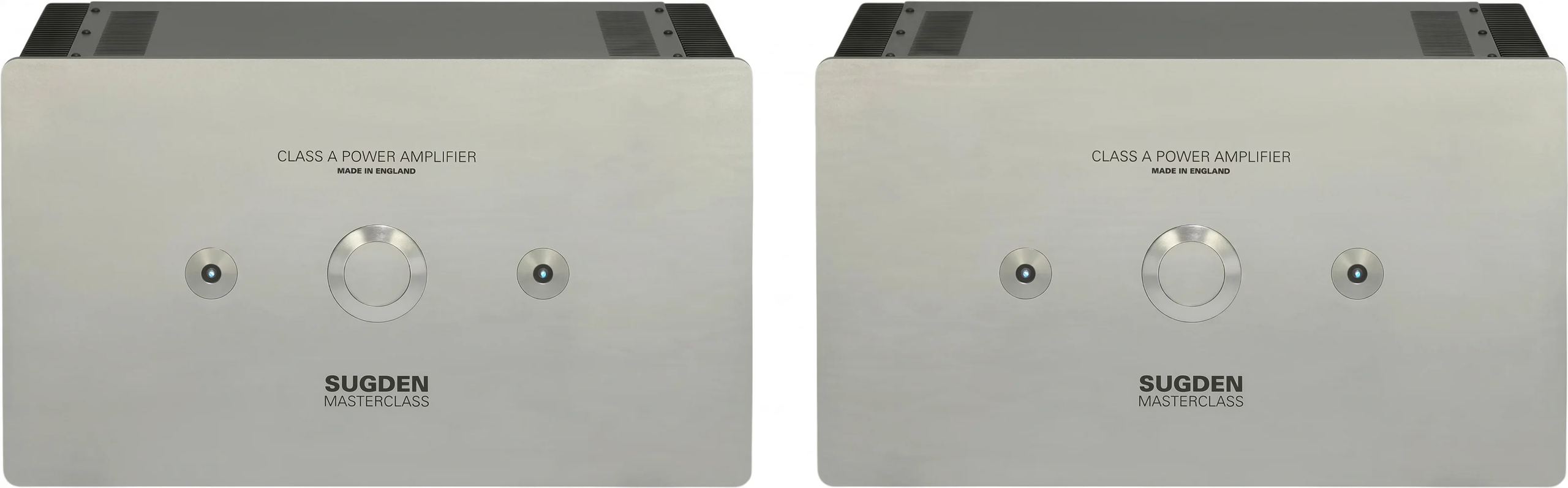
Sugden Masterclass MPA-4: a pair of Class A monoblocks
Each MPA-4 uses the Class A circuit from the Masterclass series SPA-4 stereo amplifier. The circuit’s two channels are combined in a single chassis to drive one speaker. Each monoblock thus delivers 165 watts into 8 ohms. The pair connects exclusively via balanced XLR connections. You therefore need a preamplifier with these outputs, and two well-ventilated locations, as a Class A amplifier generates heat as soon as it is switched on.
Two SPA-4 channels bridged together
The SPA-4 has two channels, one per speaker. To create the MPA-4, Sugden retains the same circuit and connects its two output stages in balanced mode to a single pair of terminals. The first drives the speaker’s positive terminal, while the second sends the same signal inverted to the negative terminal. This arrangement, known as bridging, increases the voltage available across the speaker terminals. It accounts for each monoblock’s 165 watts into 8 ohms. Each channel also has its own chassis, power supply and mains cable. The left and right channels therefore no longer share any resources.
Class A operation keeps the output transistors conducting continuously, even when no music is playing. The signal never switches from one transistor to another, eliminating the crossover distortion inherent in conventional designs. In return, the unit draws current continuously and generates heat even at idle. The gain stages have a symmetrical (complementary) structure and use current feedback. Sugden has used this technique for decades. They are also DC-coupled: there are no capacitors in the signal path. A servo circuit continuously corrects the DC offset voltage to prevent it from reaching the speakers. The output stage uses multi-emitter transistors.
The frequency response remains flat, at ±0 dB, from 15 Hz to 30 kHz. It therefore covers the entire audible spectrum without attenuation, from the lowest bass to the highest treble. The bandwidth measured at -3 dB extends from 2 Hz to 200 kHz.
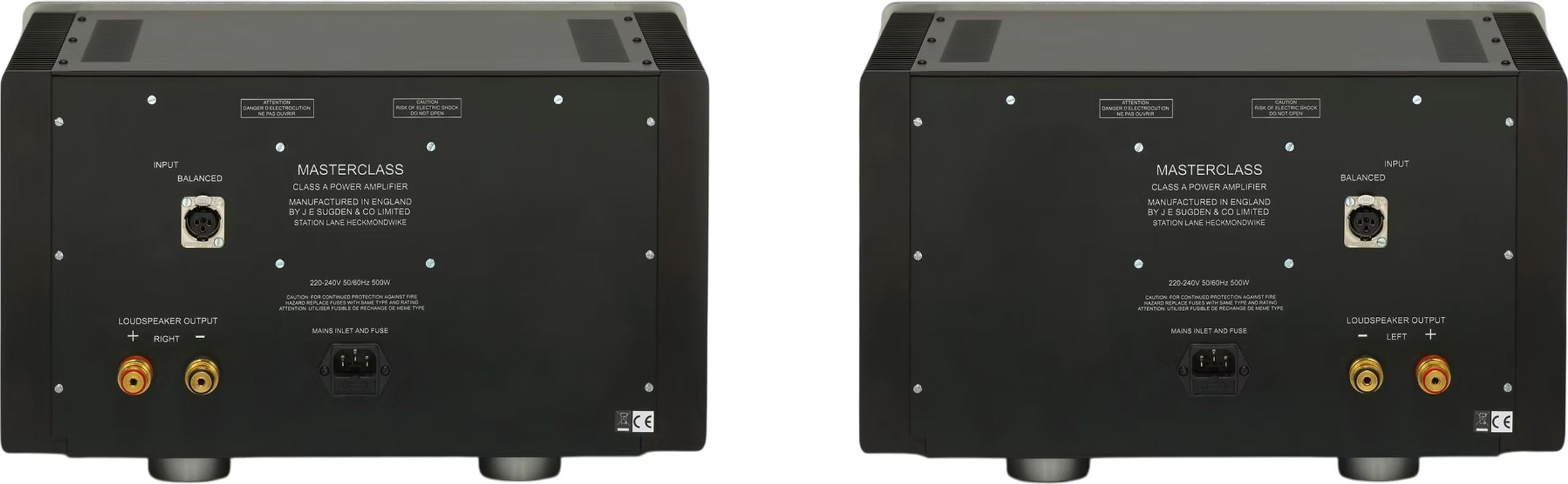
A single balanced XLR input per monoblock
Each MPA-4 has just one input: a balanced XLR socket. Pin 1 is ground, pin 2 is hot and pin 3 is cold. Unlike the SPA-4, there is no RCA input. This input uses a “virtual transformer” circuit. This discrete-component design acts as an input transformer without containing one. It retains only the difference between the hot and cold conductors. Interference picked up equally by both conductors along the cable is therefore cancelled out. This allows you to run long XLR cables from the preamplifier, place each monoblock near its speaker and use short speaker cables.
The preamplifier must have XLR outputs. Within the Sugden range, the Masterclass LA-4 line preamplifier, which is also fully balanced, is the intended partner. Input sensitivity is 1 volt for full power. Most preamplifiers with balanced outputs comfortably deliver this level.
165 watts per channel, with speakers rated at least 4 ohms
With 165 watts into 8 ohms per channel, the MPA-4 maintains a power reserve for peaks in highly dynamic recordings, such as a full orchestra or hard-hitting drums. Speaker choice still matters, however. At high volume and with an impedance below 4 ohms, the output fuses may blow. Speakers rated at a nominal 8 ohms, or those whose impedance does not drop below 4 ohms, are therefore the most suitable.
Each monoblock has a single pair of locking multiway speaker terminals, marked red and black to maintain correct phase. With a speaker designed for bi-wiring, you must leave the jumpers in place on the speaker or secure both cables to the same amplifier terminals.
Steel, anodised aluminium and room to breathe
Each monoblock measures 250 mm high, 430 mm wide and 360 mm deep. It weighs 25 kg including packaging, or 50 kg for the pair. The steel parts of the case are zinc-plated and then powder-coated, while the aluminium parts are anodised. The series is available in titanium and graphite finishes. The front panel features only the power switch, flanked by two red indicator lights. The MPA-4 units are made in England by J E Sugden & Co, in Heckmondwike, West Yorkshire. This is the town where James Sugden created the A21, a Class A integrated amplifier, in 1967.
The heat generated by Class A operation imposes placement requirements. The heatsinks and the vents on the top and bottom must remain unobstructed. Do not place anything on the top cover, enclose the monoblock in a cupboard or place it on carpet, which would block the bottom openings. Sugden recommends a stable, level hi-fi stand, away from radiators, direct sunlight, moisture and vibration. With two monoblocks, you need two such locations, ideally near each speaker.
Two MPA-4 units or one SPA-4: the choice within the Masterclass series
The Masterclass series has been in continuous production for more than seventeen years. It also includes the LA-4 preamplifier, the PA-4 phono preamplifier and the IA-4 integrated amplifier. The SPA-4 uses the same Class A circuit as the MPA-4, but its two channels share a single chassis. It delivers 75 watts per channel into 4 ohms. It accepts both RCA and XLR inputs, allowing it to be paired with a preamplifier without balanced outputs. The pair of MPA-4 units provides considerably more power per channel and a separate power supply for each speaker. In return, it takes up more space and requires a preamplifier with XLR outputs.
Technical specifications
General
- Model: MPA-4
Connectivity
- Inputs: balanced mono
- Outputs: one pair of locking multi-way binding posts
Audio performance
- Input sensitivity: 1 V for full power
- Output power: 165 W into 8 Ω, both channels driven
- Frequency response: ± 0 dB, 15 Hz – 30 kHz
- Bandwidth: −3 dB points, 2 Hz – 200 kHz
- Signal-to-noise ratio: > 85 dB
Dimensions and weight
- Dimensions (H × W × D): 250 × 430 × 360 mm
- Gross weight (packed): 25 kg × 2
Frequently asked questions
Can a source be connected directly to the MPA-4 without a preamplifier?
The MPA-4 have no volume control. They need a device that adjusts the level upstream and transmits it via XLR. This can be a preamplifier or a digital-to-analog converter (DAC) with built-in volume control and balanced outputs. A fixed-output player connected directly would send the signal at full power.
Do the MPA-4 get hot even without music?
Yes. In Class A, the output transistors draw current continuously, even with no signal. The heat sinks therefore heat up shortly after power-on, regardless of the listening volume.
Why do the speakers remain silent for a few seconds after being switched on?
A delay mutes the outputs for about five seconds after power-on. This prevents a pop from reaching the speakers while the circuits stabilize. It does not operate at power-off. It is therefore best to turn the power amplifiers on after the preamplifier and turn them off before it.
Which speaker cables should I use with the MPA-4 terminals?
The locking multi-way binding posts accept spade connectors and bare wire. Always turn off the power before connecting or disconnecting a speaker. Also check that no wire strands touch the adjacent terminal: a short circuit between terminals is the most common cause of a blown output fuse.
What should I do if a fuse blows?
The mains fuse is a 5 A slow-blow type, measuring 20 × 5 mm. It is located in the drawer of the power inlet at the rear, along with a spare fuse. Each unit also has four internal 5 A fast-blow fuses of the same size. Always replace a fuse with an identical type, with the unit switched off and unplugged from the mains. If the new fuse blows as soon as the power is switched on, do not try again and contact the dealer.
Can the MPA-4 be used in a home theater setup?
Yes, if the AV processor or amplifier has XLR preamp outputs for the front left and right channels. The pair of MPA-4 units then powers the two main speakers, while the AV amplifier handles the other channels.
- Eco-contribution included in the sale price.
- Manufacturer reference: S009T


