

Sugden Audio MasterClass DAC-4 titanium


Specifications and features


Awards

Diapason d'Or
The number 1 in classical music and hi-fi. It is a benchmark in the field of classical music and hi-fi, as well as the distinction it awards to the best devices each year
Sugden Masterclass DAC-4, non-oversampling converter
In most converters, the digital signal is first oversampled, then smoothed by a digital filter before becoming an analog voltage. Sugden has eliminated both of these steps. The English manufacturer from Heckmondwike, which also makes Class A amplifiers, has incorporated this principle into a home audio converter with six digital inputs. Its resolution is deliberately capped at 24-bit / 96 kHz, and everything else about the unit follows from this choice.
Conversion without oversampling or digital filtering
In a conventional converter, oversampling artificially multiplies the number of samples. The digital filter that follows then removes unwanted frequencies generated above the audible band. This method delivers very good laboratory figures, but adds calculations between the file and the analog output. The DAC-4 converts samples as they arrive, using conversion circuits developed by Sugden and a proprietary data reformatting stage. The brand sums up its philosophy with the motto “Rescuing music from technology”: saving music from technology. The aim here is a fluid listening experience, close to that of an analog source.
This choice comes with a trade-off, visible in the measurements. The frequency response from 20 Hz to 20 kHz is specified at ±1.5 dB, a wider tolerance than that of converters with digital filters, which remain almost perfectly flat up to 20 kHz. The signal-to-noise ratio, above 80 dB, is modest on paper. These figures describe a unit tuned by ear rather than for record-breaking measurements, and this is the approach Sugden embraces with the DAC-4.
Six inputs for digital sources in the living room
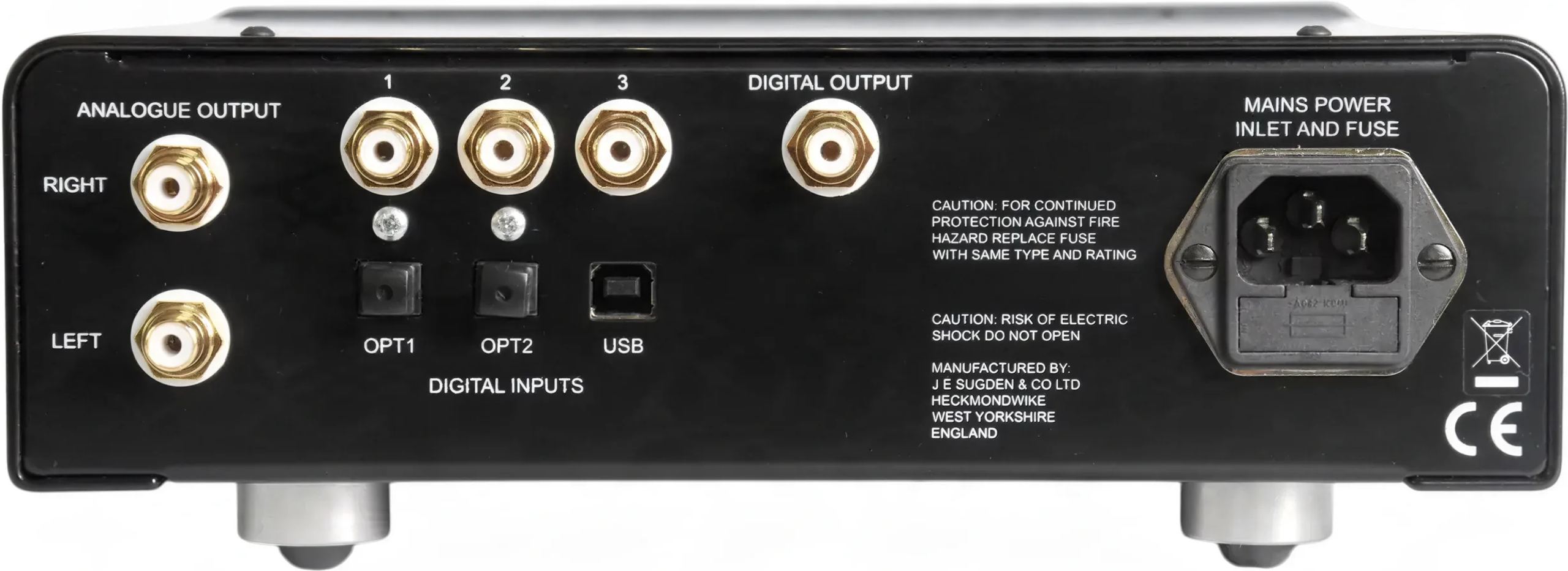
The rear panel has three coaxial S/PDIF inputs, two optical inputs and a USB Type-B port. The coaxial and optical inputs accept signals from 16 to 24 bits and from 32 to 96 kHz. They are suitable for a CD player used as a transport, a network player, a TV or a console. If a network player can output 192 kHz, it must be set so that its output does not exceed 96 kHz.
The USB input works without a driver on most operating systems. It is limited to 16-bit / 44.1 kHz, CD quality, which is sufficient for lossless streaming at this resolution. To play 24-bit / 96 kHz files from a computer, a USB-to-S/PDIF converter connected to a coaxial input is the right solution. It also handles playback software updates more easily.
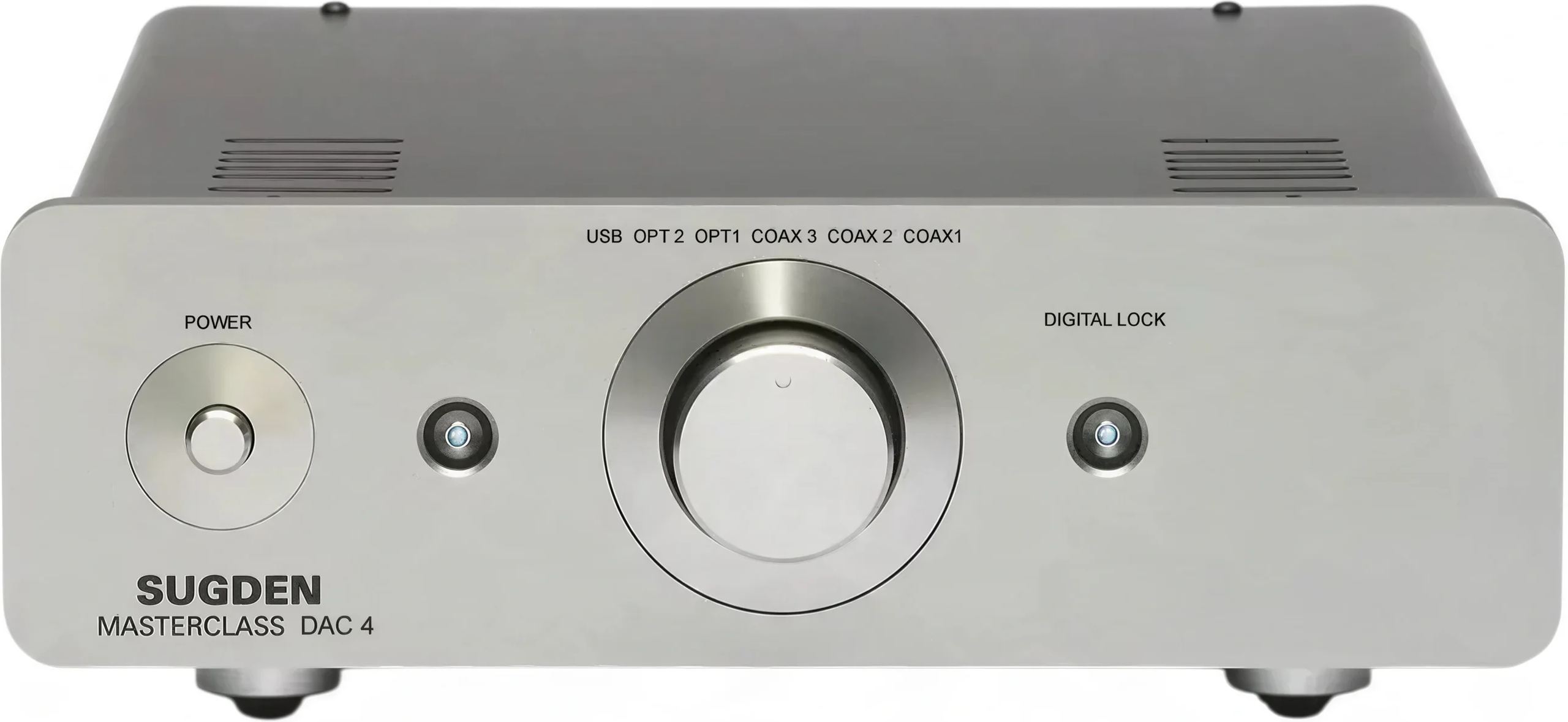
The source is selected using a large rotary knob in the center of the front panel, whose marker indicates the active input. Relays with gold-plated contacts mute the signal during switching, preventing pops and unwanted noise in the speakers when changing inputs.
Fixed-level output and coaxial digital output
The analog output consists of a pair of gold-plated RCA sockets with Teflon insulation, delivering a fixed level of 2.15 V. The DAC-4 has no volume control. It therefore connects to a line input on an integrated amplifier or preamplifier, like any other source. It has neither balanced XLR outputs nor a headphone jack.
The coaxial digital output remains active at all times, even when the analog output is in use. It transmits the signal from the selected input at the same sample rate and resolution. Before being output, this signal passes through the DAC-4’s digital interface, which reclocks it and reduces its jitter (small timing irregularities in the digital stream). It can be sent to a recorder or a second converter. The DAC-4 then also serves as a selector for multiple digital sources.
Machined aluminum front panel and installation guidelines
The enclosure measures 25 cm wide, 9 cm high and 33 cm deep. The front panel is made of machined and anodized solid aluminum, while the rest of the chassis is powder-coated metal. The front panel is available in titanium or graphite finishes, the two colors of the Masterclass series. The unit consumes 12 W and weighs 5 kg packaged.
The circuits operate in Class A and generate heat continuously. Adequate ventilation is therefore necessary: do not place any equipment on the top cover, do not place the unit on carpet, and keep the vents clear. It is also best to avoid placing it directly on a power amplifier. A shelf or open cabinet will do, away from heat sources, direct sunlight and vibrations. The DAC-4 is designed and manufactured in England by J E Sugden & Co, in West Yorkshire.
Technical specifications
Overview
- Type: digital-to-analog converter
- Design priority: musical reproduction quality
- Manufacturer’s philosophy: “Rescuing music from technology”
- Design favoring music over extensive digital processing
- Approach that runs counter to certain digital market trends
- Goal: natural listening, close to the feel of analog
Design and digital processing
- Conversion circuits developed by Sugden
- Digital data reformatting system
- Oversampling (oversampling): none
- Digital filtering (digital filtering): none
- Architecture goal: preserve the natural character and fluidity of reproduction, with an approach described by Sugden as close to analog
Format compatibility
- Coaxial and optical S/PDIF inputs
- Resolution: 16 to 24 bits
- Sampling rates: 32 to 96 kHz
- Signals accepted up to 24 bits / 96 kHz
- USB input: up to 16 bits / 44.1 kHz (limited compared with the S/PDIF inputs)
- Digital files: up to 24 bits / 96 kHz
Connectivity
- Digital inputs
- 3 coaxial S/PDIF inputs
- 2 optical S/PDIF inputs
- 1 USB type B input
- Outputs
- 1 stereo analog RCA output
- 1 coaxial digital output
Front panel controls
- On / off switch
- Power indicator
- Digital source selector
- Digital signal lock indicator (Digital Lock)
Audio performance
- Output level: 2.15 V
- Frequency response: 20 Hz – 20 kHz (±1.5 dB)
- Signal / noise ratio: > 80 dB
Power supply
- IEC mains connector
- Power consumption: 12 W
Dimensions and weight
- Dimensions (H × W × D): 90 × 250 × 330 mm
- Packed weight: 5 kg
Frequently asked questions
What is the Digital Lock indicator on the front panel for?
It lights up when the converter has locked onto the signal from the selected source. If it stays off, there is no digital signal at the selected input or the received signal is incompatible, for example a sampling rate above 96 kHz. If the sound cuts out intermittently while the indicator is lit, the input is probably not locked onto the correct frequency: check the source’s output setting.
Can a TV be connected to the optical input?
Yes, provided the TV’s audio output is set to stereo PCM. The DAC-4 is a stereo converter and does not decode Dolby Digital or DTS. A compressed multichannel stream will produce no sound.
Does the DAC-4 play DSD files?
No. The inputs accept a PCM signal, up to 24 bits / 96 kHz via S/PDIF and 16 bits / 44.1 kHz via USB. To play a DSD library, the playback software or network player must convert it to PCM at a maximum of 96 kHz before sending it.
How many fuses does the device have?
Three: two internal fuses for the power supply and one mains fuse, housed in a drawer in the IEC inlet at the rear, along with a spare fuse. A blown fuse generally indicates a fault, not necessarily in the converter itself. It is best to identify the cause before replacing it, always with a fuse of the same type and rating.
- Eco-contribution included in the sale price.
- Manufacturer reference: S012T


