

Sugden Audio Sapphire DAP-800 titanium



Specifications and features

Sugden Sapphire DAP-800, analogue preamp and integrated DAC
Six analogue inputs, six digital inputs and two power supplies that do not interact: the Sapphire DAP-800 combines a stereo preamplifier and a digital converter in the same enclosure, keeping each section separate from the other. Sugden manufactures it in its Yorkshire workshops. It sits at the centre of a system comprising a CD player, phono preamp, computer or network player, and drives a power amplifier through its RCA or XLR outputs.
Two independent devices in one chassis
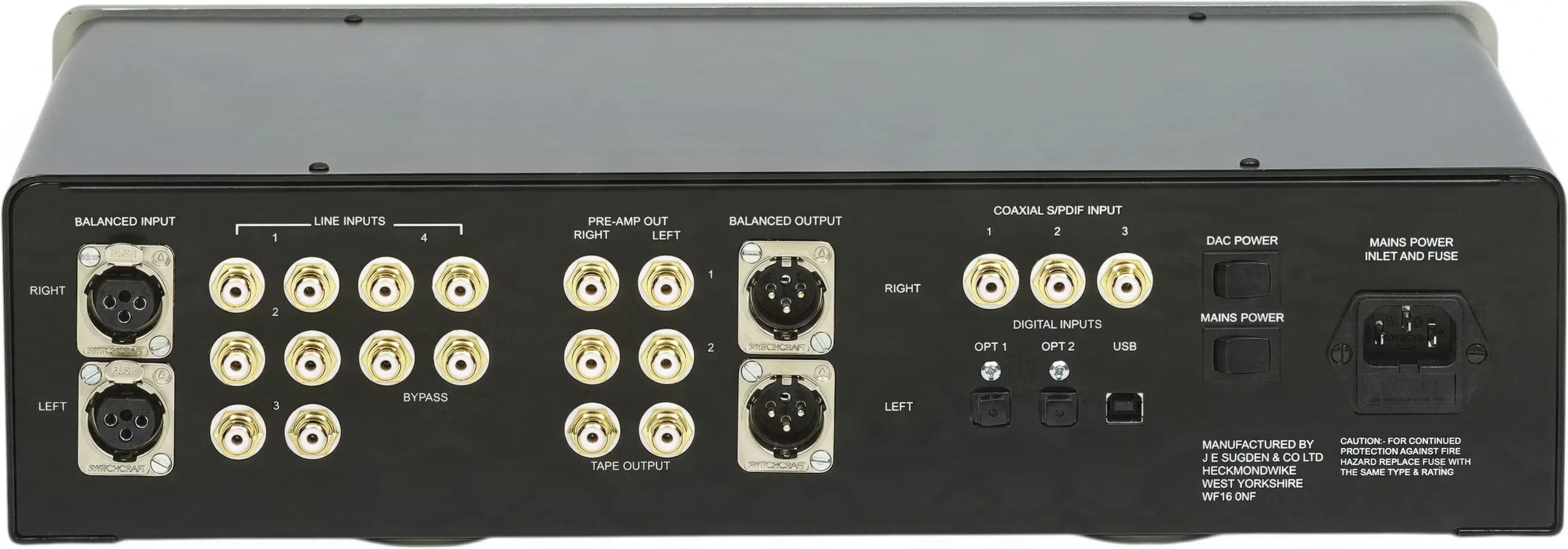
The analogue and digital sections of the DAP-800 share almost nothing. Each has its own circuit board and power supply: a 50 W toroidal transformer powers the preamplifier, a 15 W E-core transformer powers the converter, and the digital power supplies are isolated from the analogue stage. The aim is to prevent high-frequency interference from the digital circuits from reaching the analogue signal. The converter even has its own mains switch on the rear, next to the power socket. When listening only to analogue sources, it can be switched off completely, and the DAP-800 operates as a purely analogue preamp.
The unit is assembled in Heckmondwike, West Yorkshire. Wherever possible, Sugden uses through-hole components, soldered through the circuit board, rather than surface-mounted components. This choice is intended to extend the unit’s lifespan.
A Class A preamplifier with VCV circuitry
The analogue stage uses the latest version of Sugden’s VCV circuit. The signal passes through four stages. A high-impedance input places no load on the source, followed by a current gain stage, a folded cascode stage and a Class A output. The folded cascode isolates the stage’s input from its output, reducing parasitic capacitance between the circuits: bandwidth remains wide and sudden changes in the music’s level pass through without being compressed. In Class A, the output transistors conduct continuously, eliminating the crossover distortion found in Class AB designs. The trade-off is that the unit runs hot. It therefore needs space around it for ventilation: no enclosed cabinet and nothing placed on the top cover.
The frequency response is flat (0 dB) from 15 Hz to 98 kHz, and bandwidth extends from 8 Hz to 125 kHz. An input of 120 mV is required to produce 1 V at the output, giving a moderate gain of around 18 dB, but the output can reach up to 9 V. Any power amplifier therefore receives a sufficient signal, well below clipping. Distortion remains below 0.05% at 1 kHz and the signal-to-noise ratio exceeds 85 dB.
Conversion without oversampling or digital filtering
The DAP-800 uses the same conversion as the DAC-4, the standalone converter from Sugden, which has more than twenty-five years of experience in digital equipment. Most converters oversample the signal, then pass it through a digital filter before conversion. The DAP-800 does neither. The data is reshaped, then converted at its original sampling rate, with filtering taking place afterwards in the analogue output stage. With this approach, Sugden aims for very wide bandwidth and a presentation close to that of an analogue source.
Upstream, a Wolfson transceiver circuit reduces jitter, the small clock irregularities that compromise conversion, and checks for read errors. The USB stream first passes through a Texas Instruments chip, then is reclocked before reaching the converter.
Not all inputs have the same capabilities. The coaxial and optical inputs accept up to 24-bit / 96 kHz. The USB input is limited to 16-bit / 44.1 kHz, or CD quality. For high-resolution files, it is better to connect the computer or network player via a coaxial output.
Twelve inputs and three outputs on the rear
On the rear are four line-level RCA inputs, one balanced XLR input and one Bypass input for analogue sources. For digital sources, there are three coaxial S/PDIF inputs, two optical inputs and one USB type B input. The analogue inputs accept line-level signals only: a turntable must be connected through an external phono preamp. The DAP-800 has no network module either. A network player therefore connects to a coaxial or USB input.
The Bypass input is used when the stereo speakers also serve a home cinema system. When the preamp is switched off, the signal from this input passes directly to the RCA outputs with no change in level. The processor or AV amplifier then retains control of the volume and uses the stereo power amplifier for the front channels. When the preamp is switched on, the Bypass input is disconnected.
On the output side, two pairs of variable-level RCA outputs can feed two power amplifiers for bi-amping, or an amplifier and a subwoofer. The XLR pair (pin 1 ground, 2 hot, 3 cold) is better suited to long cable runs between the preamp and power amplifier. A fixed-level Tape output completes the arrangement.
A front panel with direct controls and no display
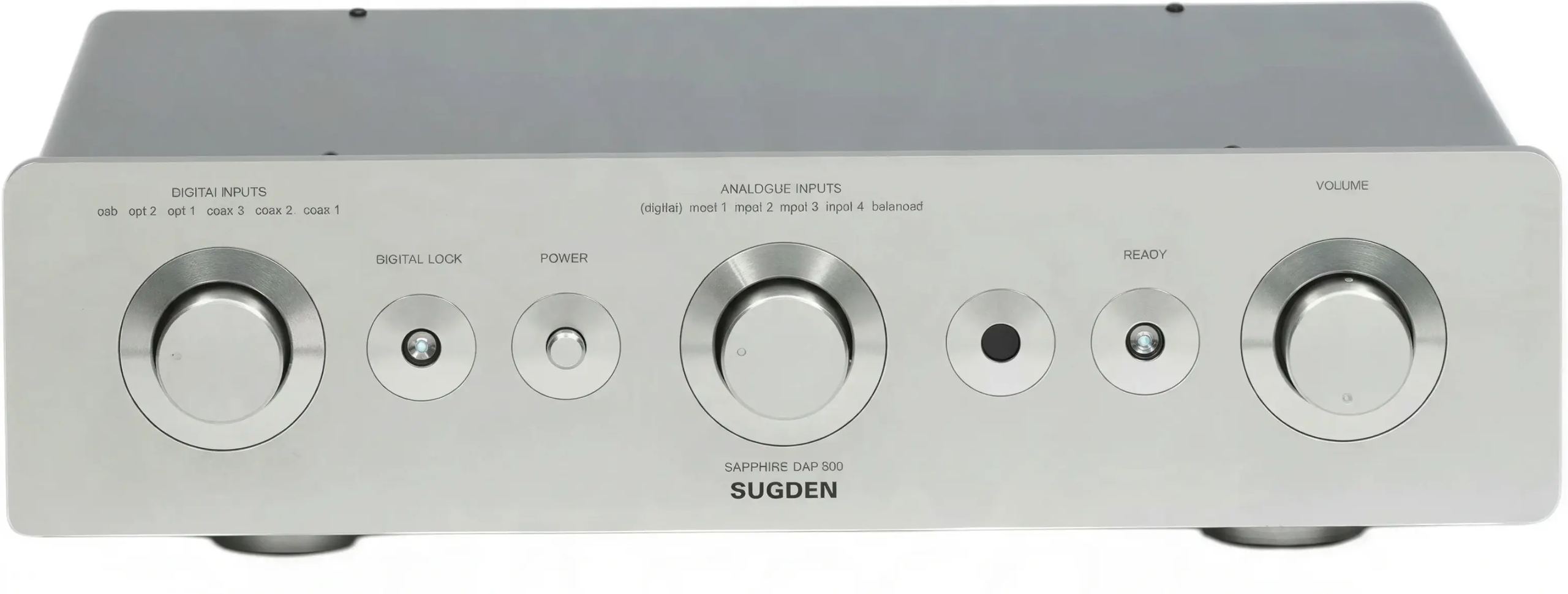
The front panel has a volume knob, an analogue input selector, a digital input selector, the power switch, the power indicator and a DIGITAL LOCK indicator. The latter lights up when the converter recognises a digital signal. There is no display or menu. The volume control is motorised: the RC5-compatible remote turns the actual potentiometer, so the front-panel knob always indicates the actual level. The supplied remote controls only the volume; its other buttons are for Sugden CD players. Source selection is therefore carried out on the front panel. The unit has no headphone output.
Technical specifications
Overview
- Type: high-end analog and digital preamplifier
- Role: control center for a high-fidelity system, centralizing analog or digital sources
- Architecture: analog preamplifier and high-performance digital-to-analog converter (DAC) housed in a single chassis
Design and power supply
- Complete separation of analog and digital sections
- Independent power supplies for each section to limit interactions between circuits and preserve signal quality
- Two separate electronic assemblies: a DAC and an analog preamplifier
- Functions combined in a single device without being treated as a single electronic assembly
Analog preamplifier section
- Circuit: most advanced version of the proprietary Sugden VCV circuit
- Successive stages:
- High-impedance input
- Current gain stage
- Folded Cascode stage
- Output stage operating in Class A
- Benefits of Folded Cascode technology: wide bandwidth, excellent dynamics, low parasitic capacitance between the different circuit stages
- Sound reproduction according to Sugden: neutral, transparent and refined, without altering the characteristics of the musical signal
Digital section and conversion
- Conversion technology derived from Sugden’s DAC-4
- Manufacturer’s experience: more than twenty-five years in digital product design
- Approach: preserving natural, analog-like sound reproduction
- Digital processing:
- Transceiver circuit dedicated to jitter reduction and read error control
- Data reformatting before conversion
- Conversion without oversampling
- No digital filtering
- Analog filtering at the converter output
- Result: very wide bandwidth, in keeping with Sugden’s own conversion philosophy
Connectivity
- Analog inputs (6):
- 4 unbalanced line inputs
- 1 balanced input
- 1 bypass input
- Digital inputs (6):
- 3 coaxial S/PDIF inputs
- 2 optical S/PDIF inputs
- 1 USB Type B input for direct connection to a computer or compatible network music player
- Digital compatibility:
- S/PDIF: up to 24-bit / 96 kHz
- USB: up to 16-bit / 44.1 kHz
- Outputs:
- 2 unbalanced line outputs
- 1 balanced output
- 1 tape output
Controls
- Motorized volume control
- RC5-compatible remote control
- Separate power-on for analog and digital circuits
Audio performance
- Input sensitivity: 120 mV for 1 V output
- Maximum output level: 9 V
- Frequency response: 15 Hz – 98 kHz (±0 dB)
- Bandwidth: 8 Hz – 125 kHz
- Signal-to-noise ratio: > 85 dB
Dimensions and weight
- Dimensions (H × W × D): 120 × 430 × 340 mm
- Packed weight: 10 kg
Frequently asked questions
Can you connect a turntable directly to the DAP-800?
No. The analog inputs only accept line-level signals, whereas a phono cartridge outputs a few millivolts and requires RIAA equalization. A phono preamp must be placed between the turntable and one of the RCA inputs. If the phono preamp has an XLR output, it can use the balanced input.
How can I listen to Qobuz, TIDAL or Spotify with the DAP-800?
Via a network player or a computer. A network player connected via coaxial or optical sends up to 24-bit / 96 kHz. A computer connected via USB is recognized without needing to install a driver, at 16-bit / 44.1 kHz. Turn on the preamp and the computer before connecting them, then select the DAP-800 as the audio output in the system or player settings.
Can 24-bit / 192 kHz files be played?
Not at their original sample rate. The S/PDIF inputs support up to 96 kHz, so the source must convert 192 kHz files to 96 kHz before sending them. Most network players and playback software offer this setting.
Can the DAP-800 be paired with an integrated amplifier rather than a power amplifier?
Yes, but the volume is then controlled in two places and the signal passes through two preamplifiers. The DAP-800 performs at its best with a power amplifier, or with an integrated amplifier that has a direct power amplifier input (power in) bypassing its own volume control.
Should the converter be left on all the time?
It’s not necessary. The rear switch only turns off the digital section. When listening only to analog sources, you switch off the converter, so its power supplies are no longer energized next to the analog stage.
How do I listen with headphones on the DAP-800?
By connecting an external headphone amp to the Tape output. This output has a fixed level, and the volume is adjusted on the headphone amp. The main outputs remain reserved for the power amp.
What precautions should be taken during installation?
The Class A output stage generates heat: space must be left above and around the unit. Before starting playback, it is best to set the volume to minimum (knob turned fully counterclockwise). The DAP-800 has four power supply fuses. If one of them blows, the cause must be identified before replacing it with a fuse of the same rating.
- Eco-contribution included in the sale price.
- Manufacturer reference: S014T


