

Taga Harmony HTA-1200B black



Specifications and features


Overview
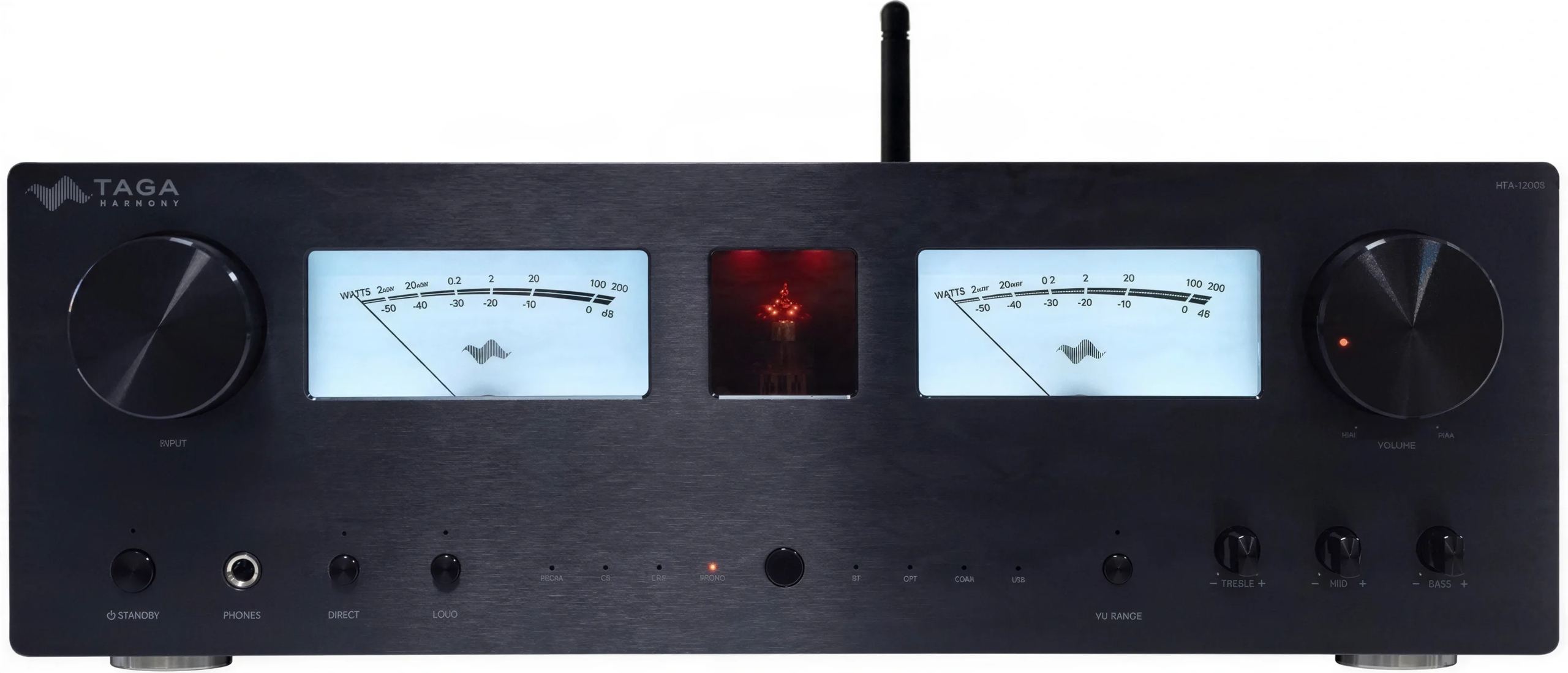
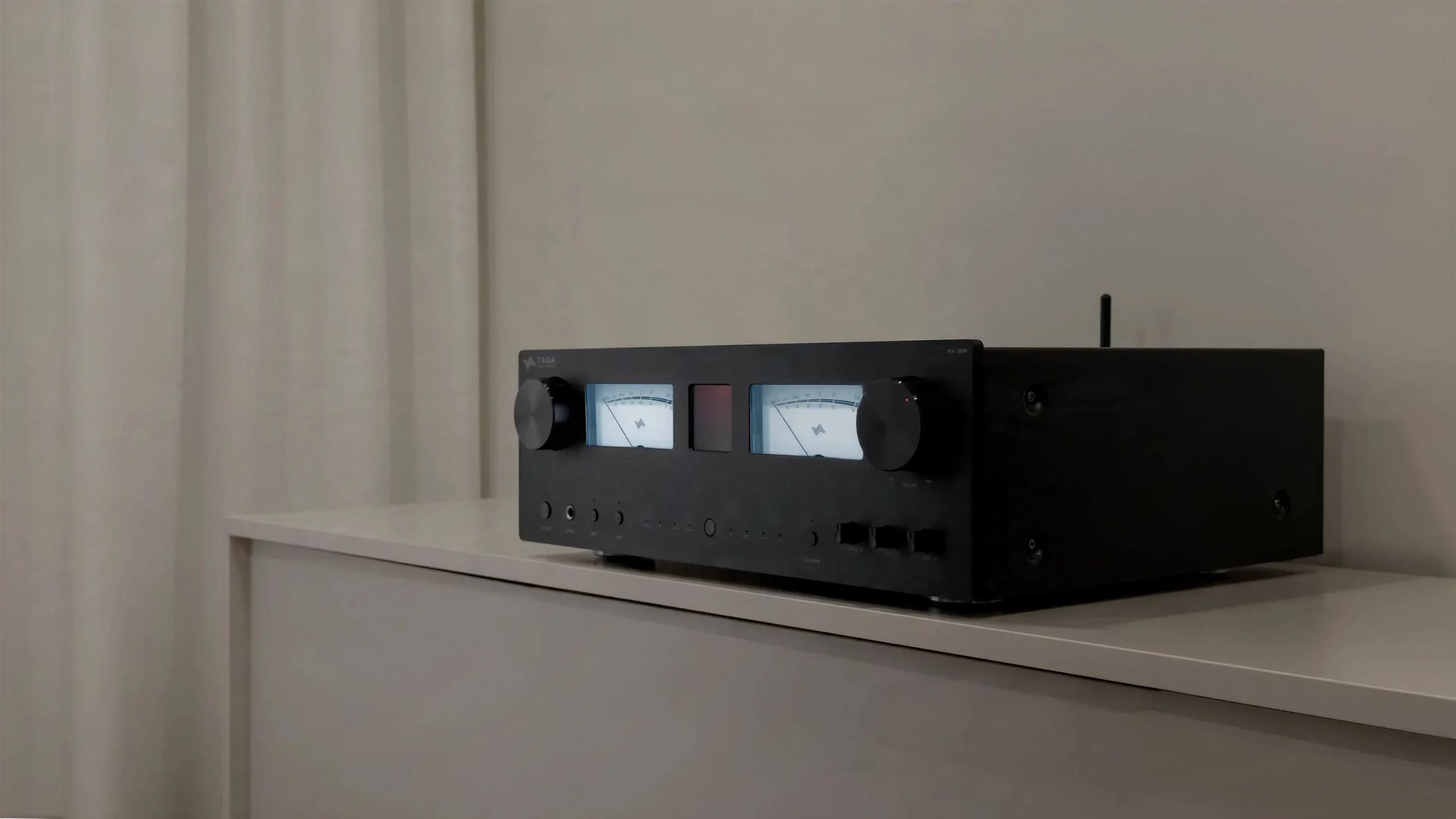
Three tubes prepare the signal and two pairs of Toshiba transistors power the speakers: this stereo amplifier combines the smoothness of tubes with the power of transistors. It succeeds the HTA-1200 with 40 W more per channel, a converter that reads high-resolution files via USB and Bluetooth aptX HD reception. A turntable, computer, television and smartphone can all be connected at the same time.
Tubes at the input, transistors at the output
An integrated amplifier does two things in sequence. First, it amplifies the voltage of the signal received from the source (the preamplifier’s role), then it supplies the current the speaker drivers need (the power stage’s role). The HTA-1200B entrusts the first stage to three Beijing 6N2 dual triodes. The second is handled by a complementary pair of Toshiba 2SA1943 and 2SC5200 transistors per channel, operating in class AB. This is the most common operating class for transistor amplifiers: it limits heat output while avoiding the distortion that occurs when the two halves of the signal pass from one transistor to the other.
The stated power output is 2 × 120 W into 8 Ω and 2 × 180 W into 4 Ω. When speaker impedance drops, the speakers demand more current. A substantial increase in power shows that the power supply can deliver that current. It uses a large toroidal transformer and two 6,800 µF capacitors per channel, which serve as an energy reserve during peaks in loud passages. Cooling is entirely passive: heatsinks dissipate heat without a fan, so there is no mechanical noise during listening. The amplifier weighs 14 kg and can consume up to 600 W.
Compared with the HTA-1200, power increases from 80 to 120 W into 8 Ω. The 12AX7 and 12AU7 tubes are replaced by 6N2 tubes, and the digital section has been completely redesigned. The phono section, however, has lost its compatibility with moving-coil (MC) cartridges: the HTA-1200B now only accepts moving-magnet (MM) cartridges.
A Sabre converter that reads DSD via USB
The digital-to-analog converter (DAC) is an ESS Sabre ES9038Q2M. It is paired with a CT7601PR asynchronous USB receiver. In asynchronous mode, the amplifier sets the clock for the computer, rather than the other way around, reducing variations in signal timing (jitter). Via the USB-B input, it accepts PCM up to 32-bit / 768 kHz and DSD up to DSD512. DSD is the format used for SACDs, also available to download from specialist online music stores. These specifications cover all commercially available high-resolution files.
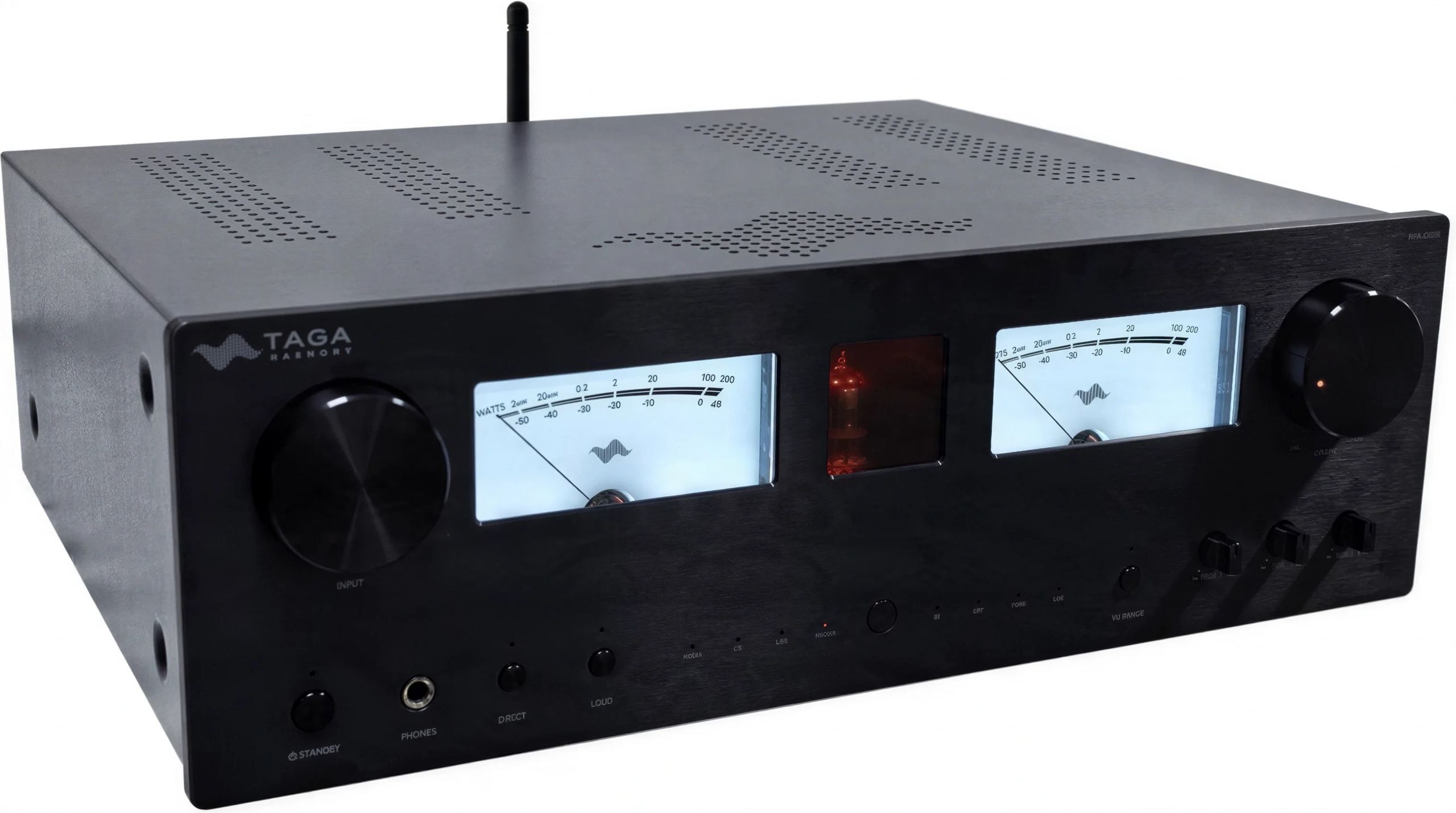
The optical and coaxial inputs support up to 24-bit / 192 kHz. They can be used to connect a television, console, network player or CD transport. Bluetooth 5.0 wirelessly receives music from a smartphone, tablet or computer. aptX HD transmits at 24-bit when supported by the phone. aptX Low Latency reduces the delay between picture and sound when watching a video on a compatible tablet. AAC, the codec used by iPhones, aptX and SBC complete the list. The supplied antenna screws onto the back.
Turntable, headphones and subwoofer
The MM phono input has a gain of 40 dB, an impedance of 47 kΩ and a sensitivity of 5 mV. These are the standard values for the vast majority of moving-magnet cartridges, whether supplied with a turntable or purchased as replacements. A ground terminal, right next to the phono sockets, accepts the turntable’s ground wire: connecting it eliminates the hum that would otherwise be heard. A turntable equipped with a built-in preamplifier connects to the line input, as does an external phono preamplifier. The other three analog inputs (CD, Media and Line) use machined, gold-plated brass RCA sockets.
The front-panel headphone output delivers 1 W into 160 Ω and accepts impedances from 32 to 320 Ω. Most wired headphones can be connected, from portable models to high-impedance studio headphones, which require more voltage to reach a comfortable listening level. On the back, a stereo RCA preamplifier output sends the signal to an active subwoofer or a power amplifier.
Backlit VU meters, tone controls and Direct mode
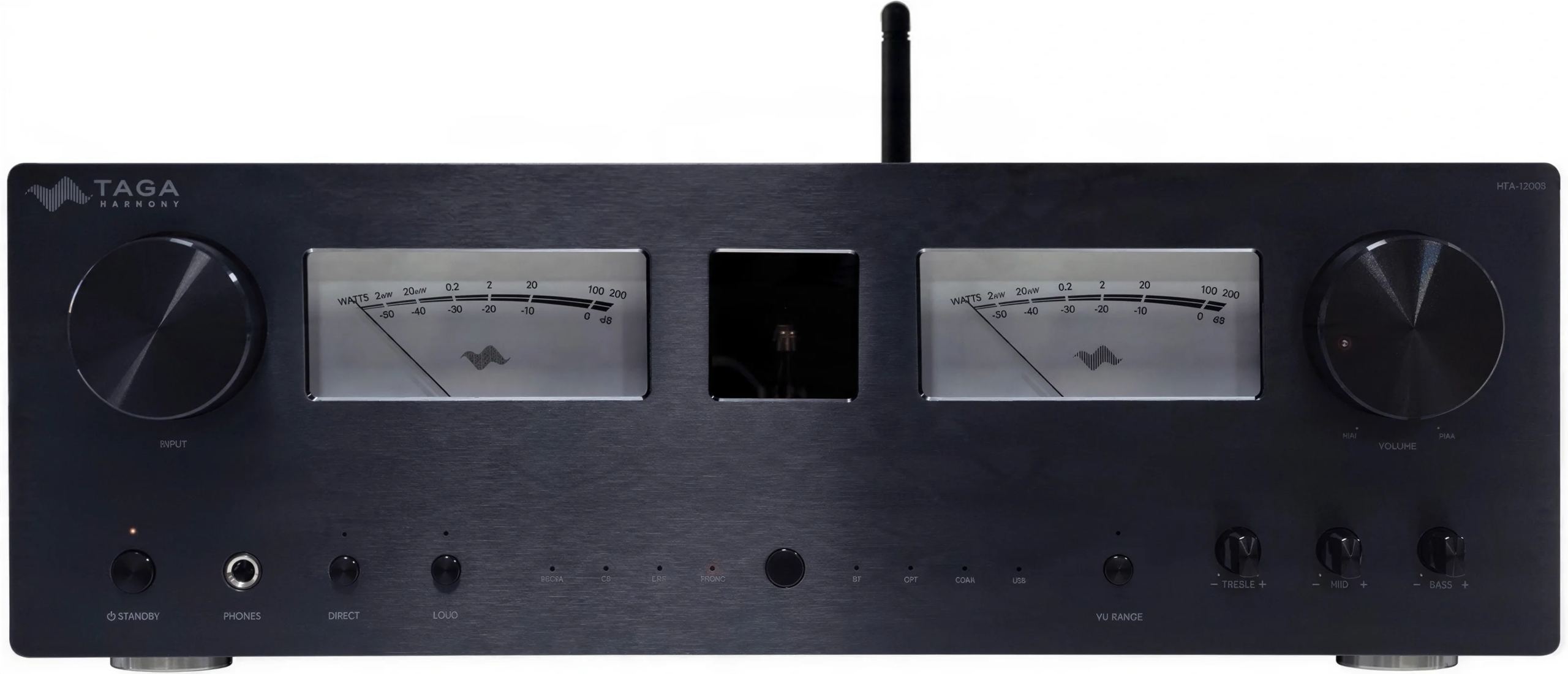
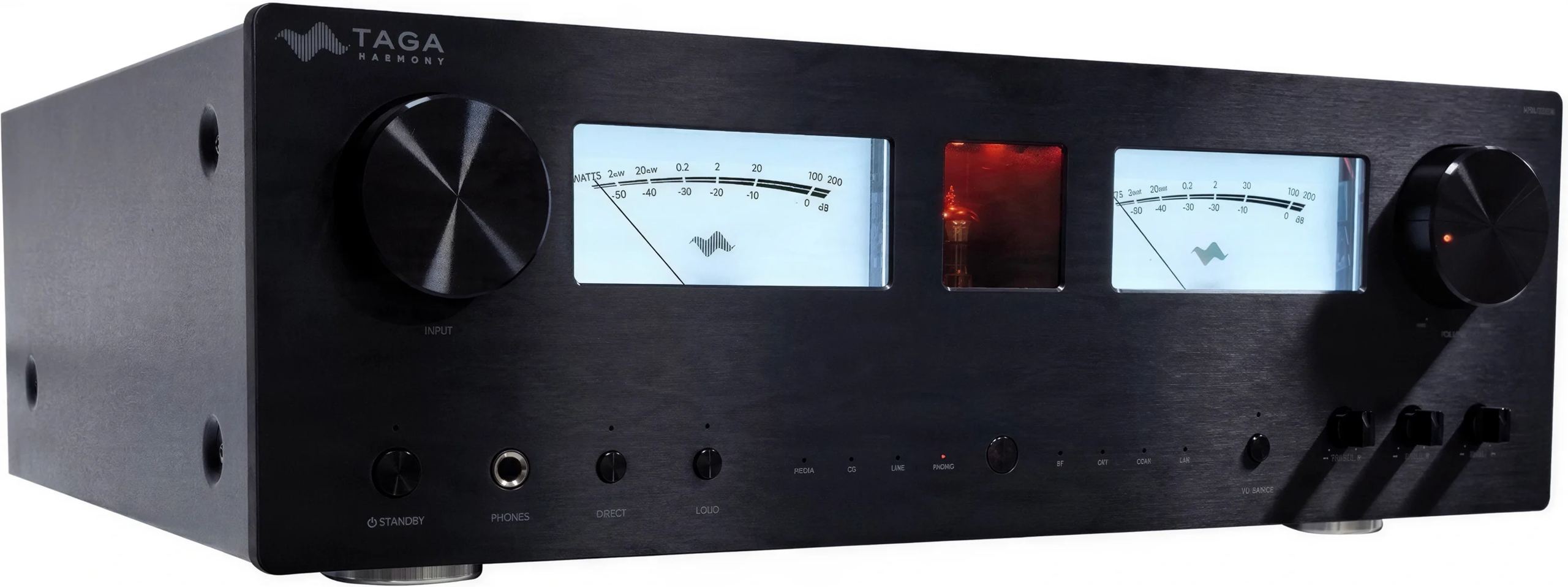
Between the two VU meters, an illuminated window reveals one of the three tubes. The VU meters indicate the power delivered to each channel, in watts and decibels. Their scale is calibrated for 8 Ω: with 4 Ω speakers, the wattage reading is an indication rather than an exact measurement. The VU Range function changes the display scale so that the needles move even at low volume.
The tone controls act separately on bass (65 Hz), midrange (1 kHz) and treble (15 kHz), over a range of ± 6 dB. They can compensate for a room that lacks bass or speakers that sound a little bright. The Loudness button boosts the lowest bass and highest treble at low volume, where the ear is less sensitive to them. Direct mode bypasses this entire section for those who prefer the signal to pass through without adjustment. Volume is controlled by a Panasonic potentiometer. Frequency response extends from 20 Hz to 25 kHz at ± 0.5 dB, with 0.05% harmonic distortion and a signal-to-noise ratio of 93 dB.
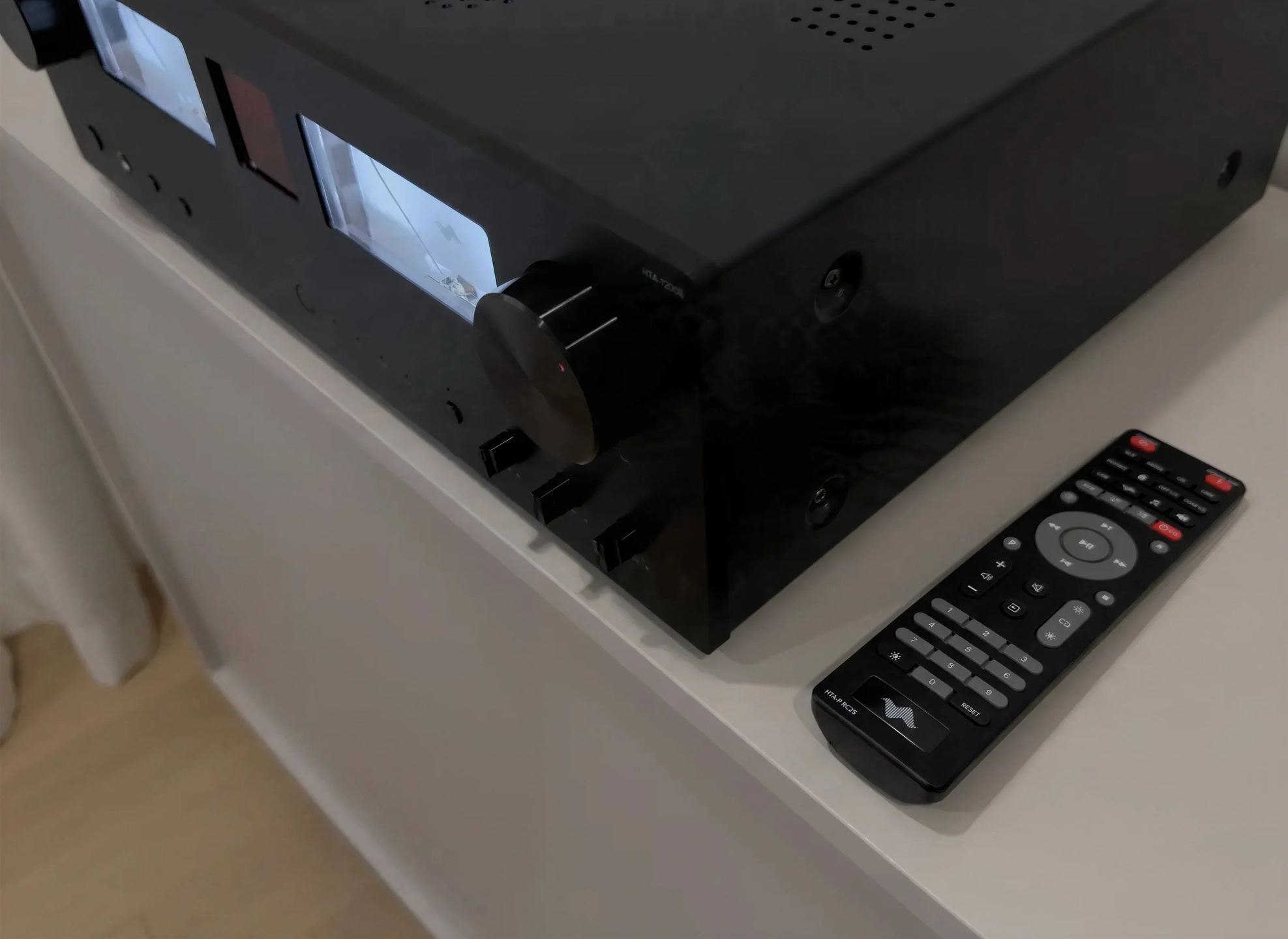
The supplied remote controls most of the amplifier’s functions. It also controls certain functions on Taga Harmony CD players and power amplifiers, avoiding the need for multiple remotes when the entire system is from the same brand. The chassis measures 43 cm wide, 14.8 cm high and 39 cm deep, and is available in black or silver.
Technical specifications
Architecture and amplification
- Type: integrated hybrid amplifier
- Preamplification: analog tube stage
- Tubes: 3 × 6N2
- Power stage: Toshiba 2SA1943 and 2SC5200 bipolar transistors (one pair per channel)
- Amplification class: class AB
- Output power
- 2 × 120 W into 8 Ω
- 2 × 180 W into 4 Ω
- Power transformer: oversized toroidal transformer
- Power supply capacitors: 2 × 6800 µF / 63 V per channel
- Heat dissipation: oversized passive heatsink, fanless
Audio performance
- Frequency response: 20 Hz – 25 kHz (± 0.5 dB)
- Total harmonic distortion: 0.05%
- Signal-to-noise ratio: 93 dB
- Volume control: Japanese Panasonic precision potentiometer
Analog connectivity
- Inputs
- 1 × MM phono
- 1 × CD
- 1 × Media
- 1 × Line
- RCA connectors: gold-plated machined brass sockets
Digital connectivity
- Inputs: 1 × USB-B, 1 × optical, 1 × coaxial
- USB DAC
- PCM: up to 32-bit / 768 kHz
- DSD: up to DSD512
- Optical and coaxial inputs: up to 24-bit / 192 kHz
Bluetooth
- Version: Bluetooth 5.0
- Supported codecs: aptX, aptX HD, aptX Low Latency, SBC, AAC
- Function: wireless audio streaming from a smartphone, tablet or computer
Outputs
- Headphone output: 1 × front-panel headphone jack
- Output power: 1 W / 160 Ω
- Supported impedance: 32 to 320 Ω
- Preamplifier output (pre-out): 1 × RCA, for connecting an active subwoofer or a power amplifier
- Speaker outputs: high-end binding posts ensuring optimal audio signal transmission
Functions and controls
- Tone controls: independent bass, midrange and treble adjustment
- Loudness function: low- and high-frequency compensation at low volume
- Direct mode: bypasses tone controls
- Backlit VU meters: power display in watts and dB into 8 Ω
- VU Range function: adjusts the VU meter display range
- Multifunction remote control: controls most amplifier functions as well as certain functions of TAGA Harmony power amplifiers and CD players
Power supply
- Mains inlet: IEC C14
- Power cable: detachable, Schuko to IEC C13
- Mains cable can be replaced with a compatible audiophile model
- Maximum power consumption: 600 W
Dimensions and weight
- Dimensions (H × W × D): 14.8 × 43 × 39 cm
- Net weight: 14 kg
- Gross weight: 15.5 kg
Frequently asked questions
Can you use a turntable equipped with a moving coil cartridge?
Yes, with an external MC phono preamp or a step-up transformer, which brings the signal up to the level of an MM cartridge. The MC preamp connects to the Line or CD input, while the transformer connects to the Phono input. The signal from an MC cartridge is about ten times weaker than that of an MM cartridge: it cannot be fed directly into the amplifier’s phono input.
In what order should I turn the devices on and off?
Turn on the source devices first, then the amplifier last. When switching off, do the reverse and turn off the amplifier first. This way, the pop sometimes produced by a player or subwoofer when powered on is neither amplified nor sent to the speakers. Also set the volume to minimum before switching on.
How much space should be allowed in a hi-fi cabinet?
Passive cooling dissipates heat through the top and sides. Leave a few centimetres of clearance above the amplifier, and avoid an enclosed compartment or placing another device directly on top. The 39 cm depth includes the knobs and terminals. Allow approximately 10 cm extra at the rear for speaker cables and RCA plugs.
How do I connect a TV?
Connect the TV’s digital audio output to the amplifier’s optical input using an optical cable. In the TV’s audio settings, select PCM (or “stereo”) as the digital output format. The amplifier’s converter does not decode Dolby Digital or DTS streams: without this setting, some programs would remain silent.
How do I add a subwoofer?
Connect the RCA preamp output to the subwoofer’s line input. The main speakers remain connected to the amplifier’s speaker terminals. Then set the subwoofer’s crossover frequency slightly below the speakers’ lower frequency limit, so the subwoofer extends their bass without duplicating it.
Which speakers should I pair it with?
The amp works with 4 to 8 Ω speakers. Its 120 W into 8 Ω suits both bookshelf models and floorstanding speakers with moderate sensitivity in a living room. With low-sensitivity speakers (around 84–85 dB), the 180 W of headroom into 4 Ω allows for loud listening without clipping.
Can the supplied power cable be replaced?
Yes. The power inlet is a standard IEC C14 socket, and the supplied Schuko to IEC C13 cable is detachable. Any IEC C13 power cord with a sufficient cross-sectional area can replace it, including a shielded hi-fi power cable.
- Eco-contribution included in the sale price.
- GTIN / EAN: 5907529268025


