

Volumio Rivo Ultra

Specifications and features


Volumio Rivo Ultra, network transport with femto clock
It retrieves music from a streaming service, a network drive or its own SSD, then sends it digitally to the converter (DAC) you already own. It produces no analog signal itself. The first model in the Ultra series, it sits above the Rivo Plus in Volumio’s range. It adds an internal linear power supply, a precision clock, seven digital outputs and a large front-panel touchscreen.
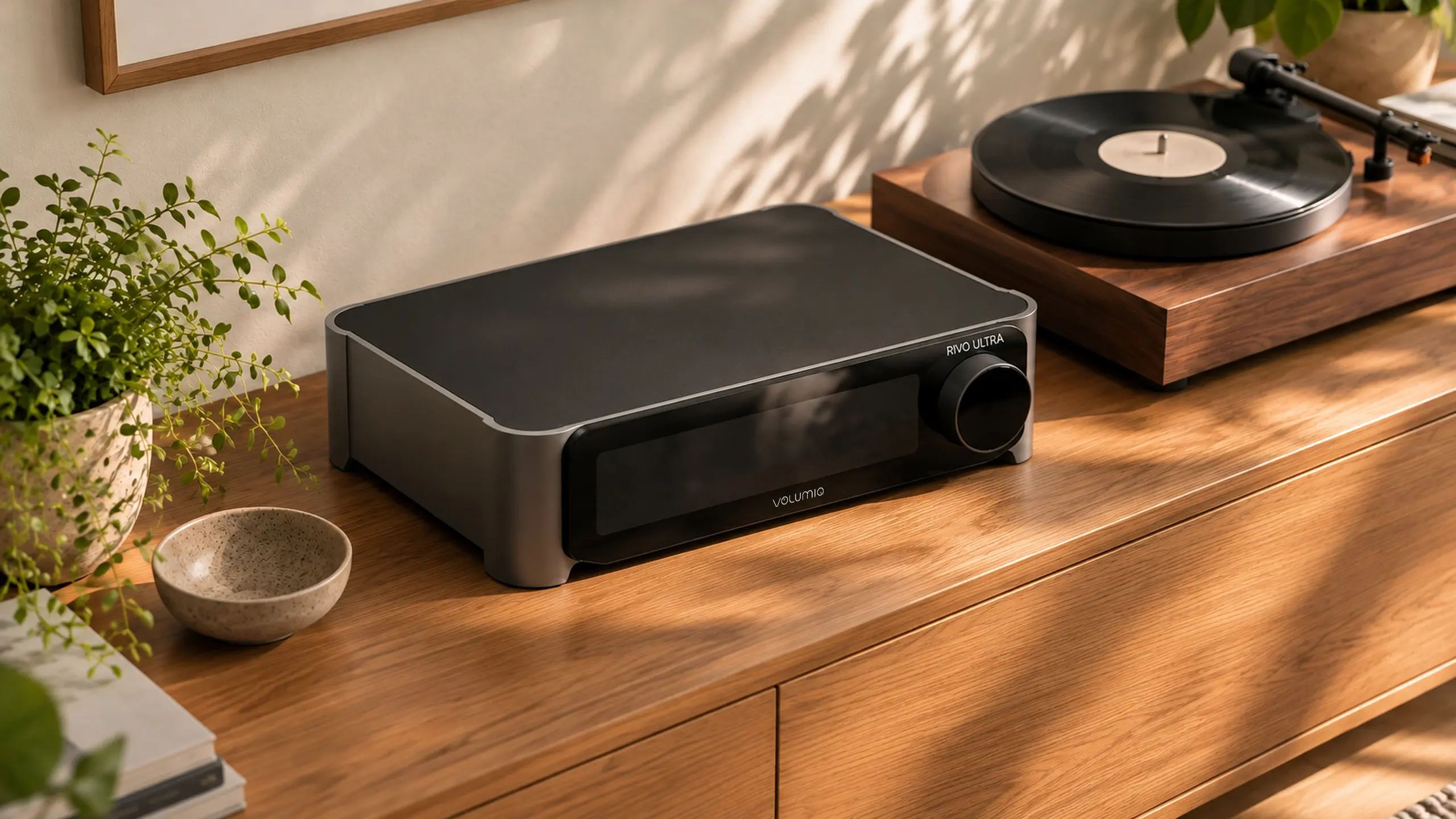
Seven digital outputs for every DAC
Volumio first wrote playback software, Volumio OS, before manufacturing its own network players in Florence, where the Rivo Ultra is assembled and tested by hand. The Rivo Ultra is a transport: it contains no DAC and must be connected to an external DAC. Its job is to read the file or stream, then pass it to the DAC without altering it.
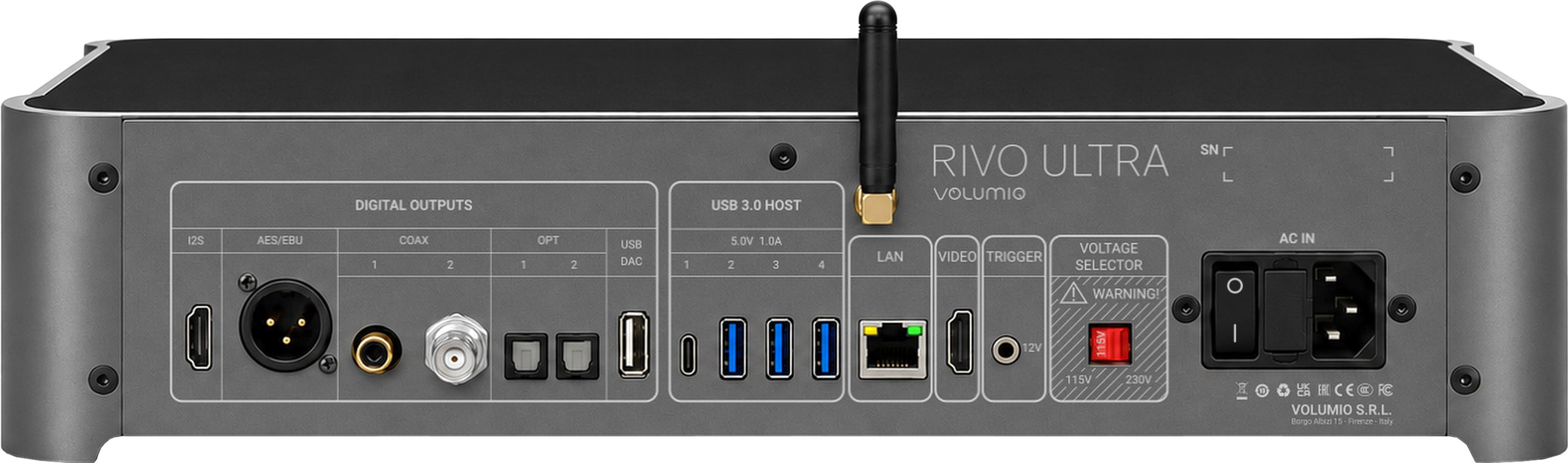
The USB output is the most versatile. It supports up to PCM 1536 kHz / 32-bit and DSD1024, dropping to DSD256 when multiroom is enabled. For DACs without a USB input, the rear panel offers a balanced AES/EBU output on XLR, two coaxial S/PDIF outputs (one RCA, one BNC) and two Toslink optical outputs. All support PCM up to 192 kHz / 24-bit and transmit DSD64 via DoP, a method that embeds DSD in PCM frames to pass through a connection originally designed for PCM. With five connector types, both newer and older DACs can find a suitable connection. A 12 V trigger output on a 3.5 mm jack switches a compatible device on and off at the same time.
I2S over HDMI, a direct connection to certain DACs
Inside a DAC, chips exchange data in I2S format, which carries the clock and music on separate lines. S/PDIF, on the other hand, combines them into a single stream that the DAC must then separate. Some DACs accept I2S directly through an HDMI connector, and the Rivo Ultra sends them up to PCM 768 kHz / 32-bit and DSD1024. This HDMI connector carries no picture. Each DAC manufacturer has chosen its own I2S pin wiring, so the Rivo Ultra lets you change the pin assignment to suit the connected DAC. A second HDMI connector, this one for video, mirrors the Volumio interface on a television at up to 4K / 60 frames per second.
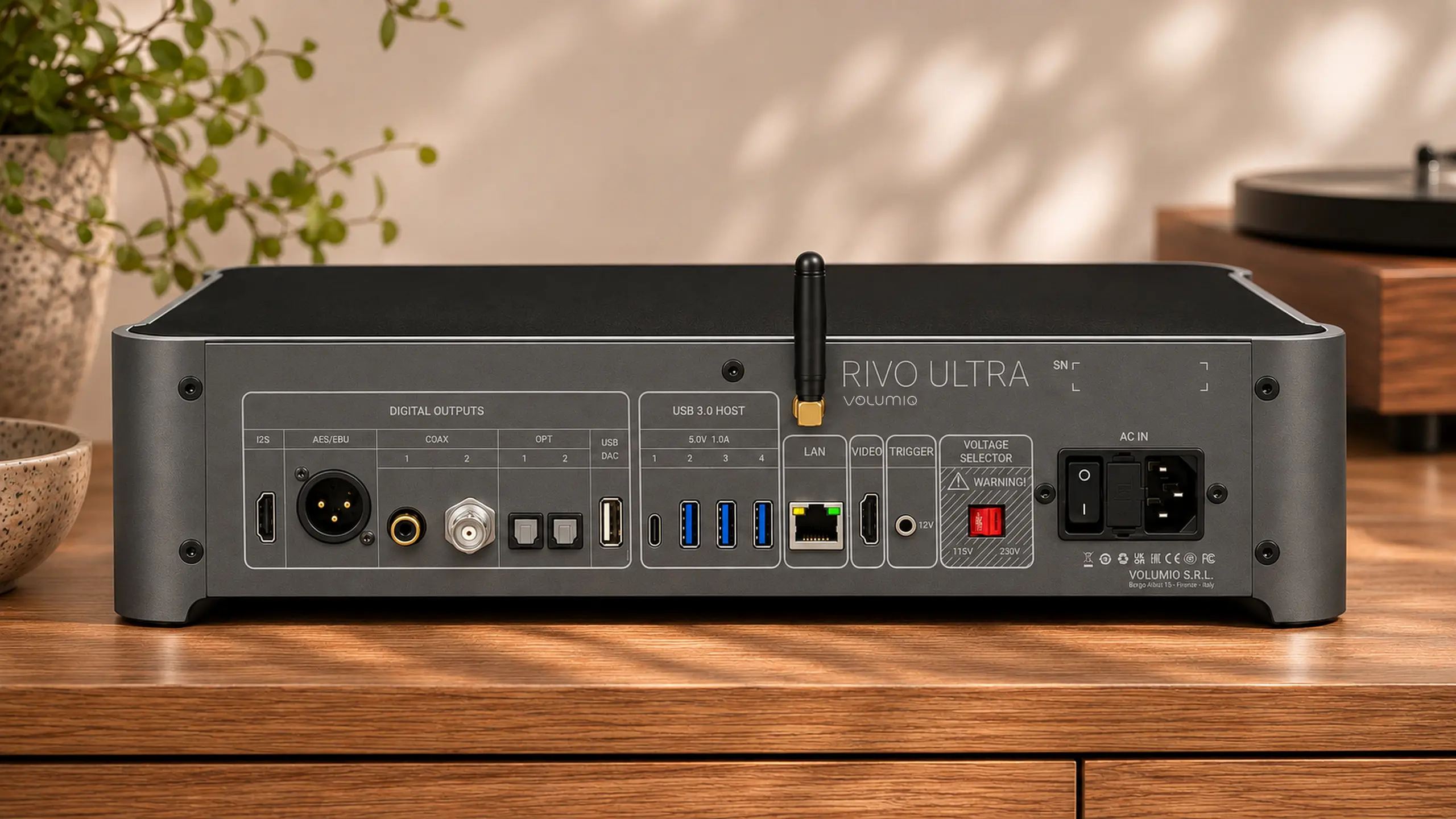
A femto clock to combat jitter
A digital signal is a sequence of samples that must arrive at perfectly regular intervals. Small timing irregularities are called jitter, and they depend mainly on the clock that sets the pace. The Rivo Ultra’s built-in outputs are timed by a femto clock with phase noise of 54 fs RMS, or 54 femtoseconds, millionths of a billionth of a second. The USB output has its own clock, a temperature-compensated crystal oscillator (TCXO), which maintains its frequency as the device warms up. The digital interface is a custom integration of the Amanero768, and the USB output also receives power supply filtering and signal reconstruction.
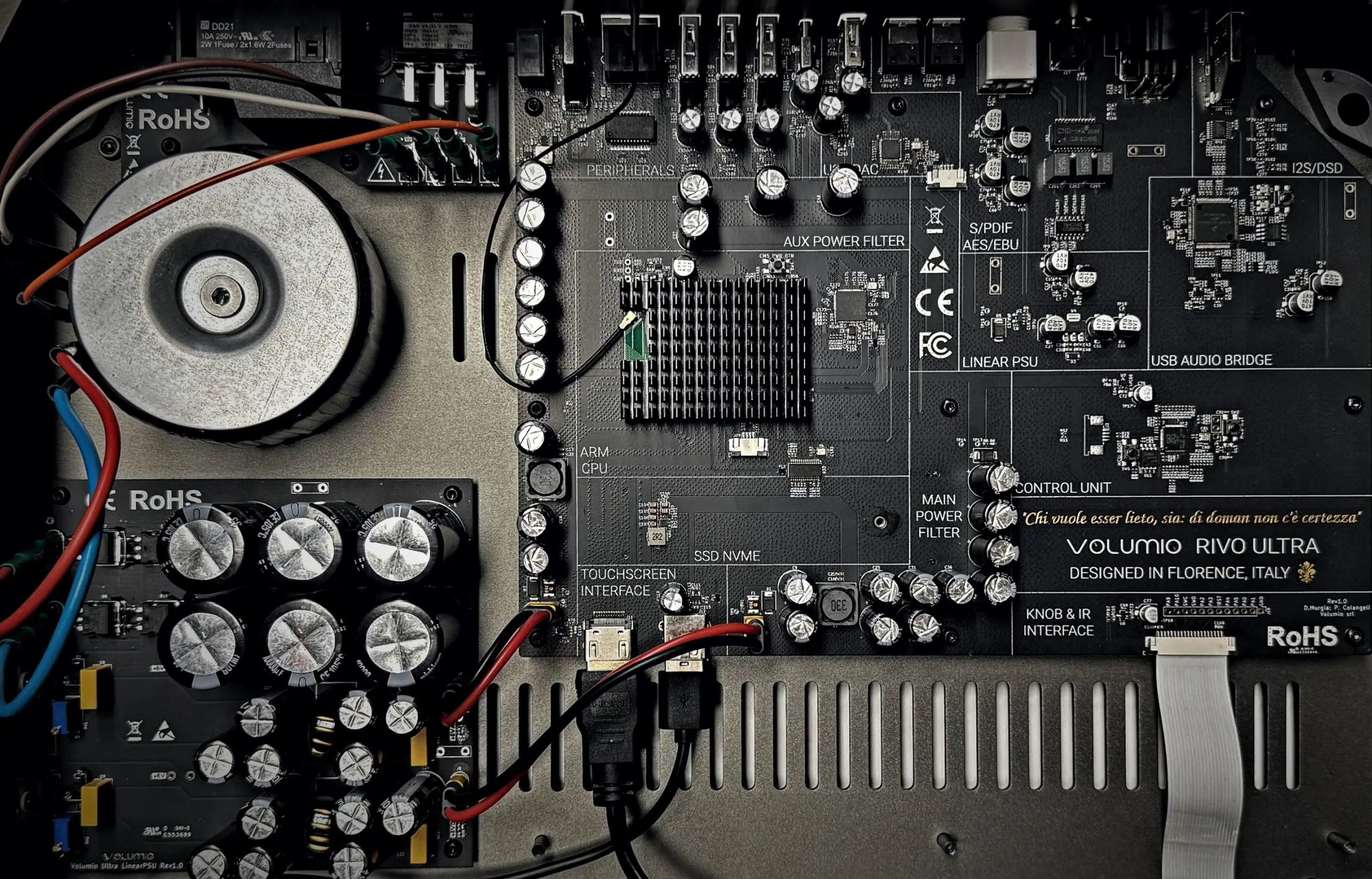
A dual linear power supply inside the chassis
Many network players are powered by an external switching power supply, which is compact but generates electrical noise. The Rivo Ultra connects directly to the mains through an IEC C13 inlet. Its internal power supply is linear and dual, with a toroidal transformer and two regulation stages. A manual selector on the rear switches between 115 V and 230 V: in France, it must be set to 230 V before powering on for the first time.
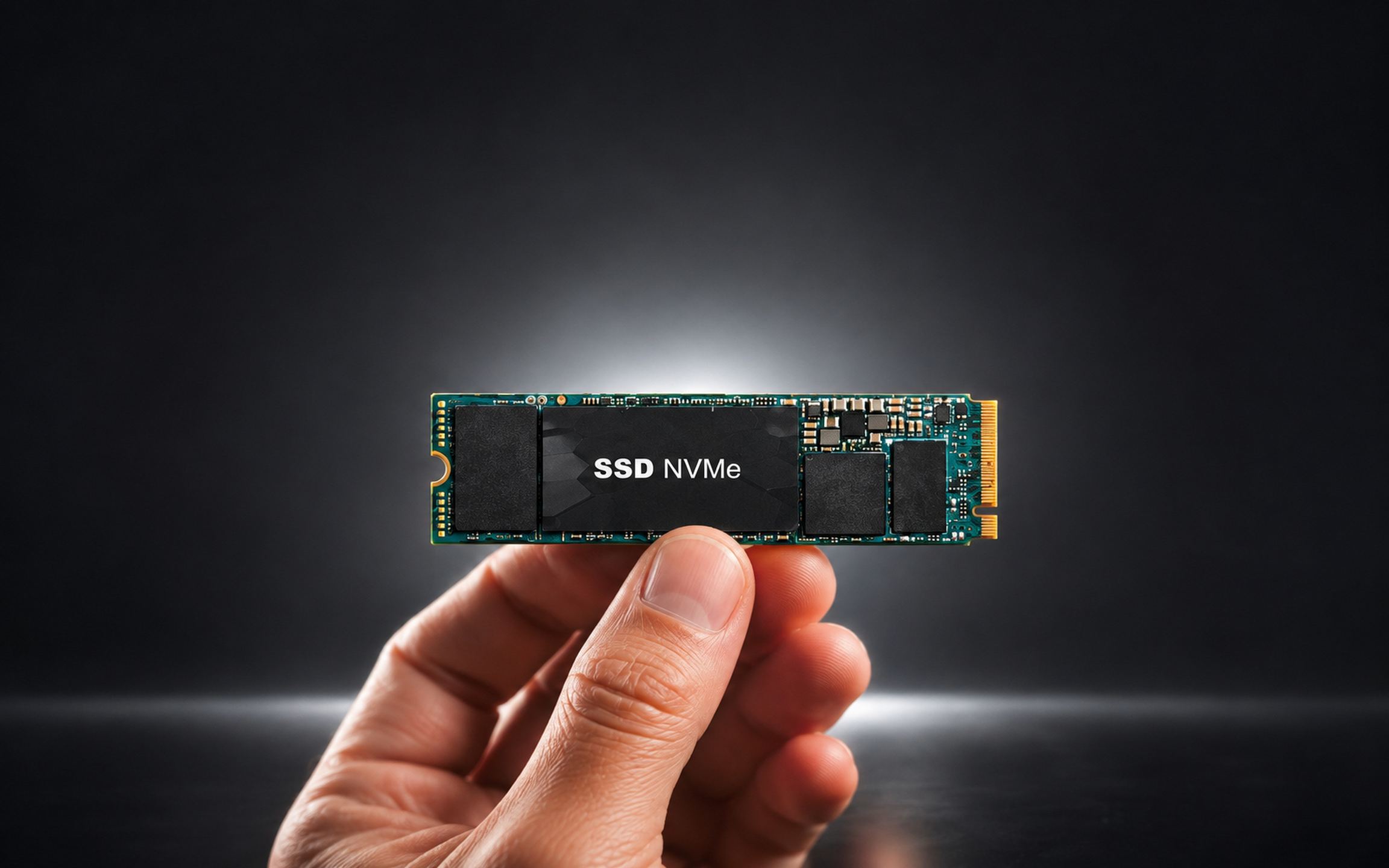
An internal SSD to store your library
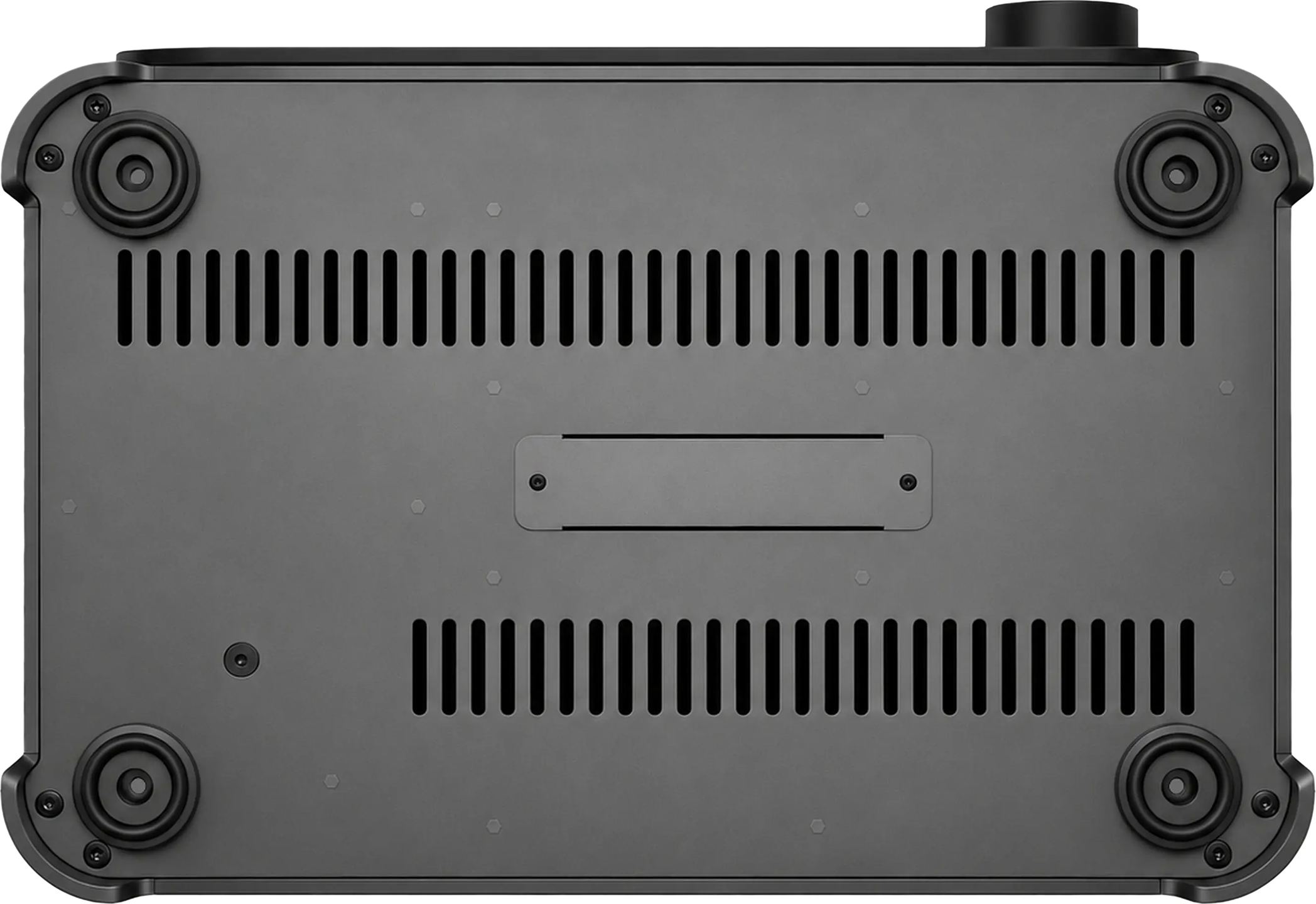
Underneath the Rivo Ultra, an M.2 NVMe slot accepts a PCIe SSD up to 16 TB. The library is then stored inside the device, without a NAS or external drive. Four USB 3.0 ports (one USB-C and three USB-A) accept flash drives, hard drives and SSDs, as well as an optical drive for ripping CDs. Network connectivity is provided by a Gigabit Ethernet port or dual-band Wi-Fi, with an external antenna included. A wired connection remains preferable for high-resolution files. Bluetooth 5.0 completes the list.
11.9-inch touchscreen and front-panel control
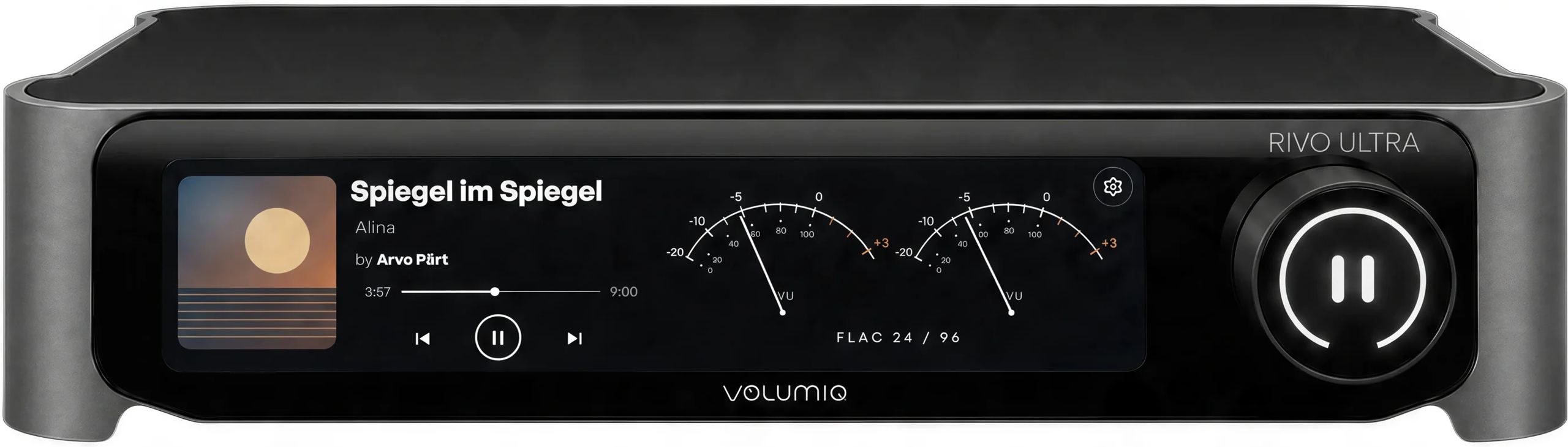
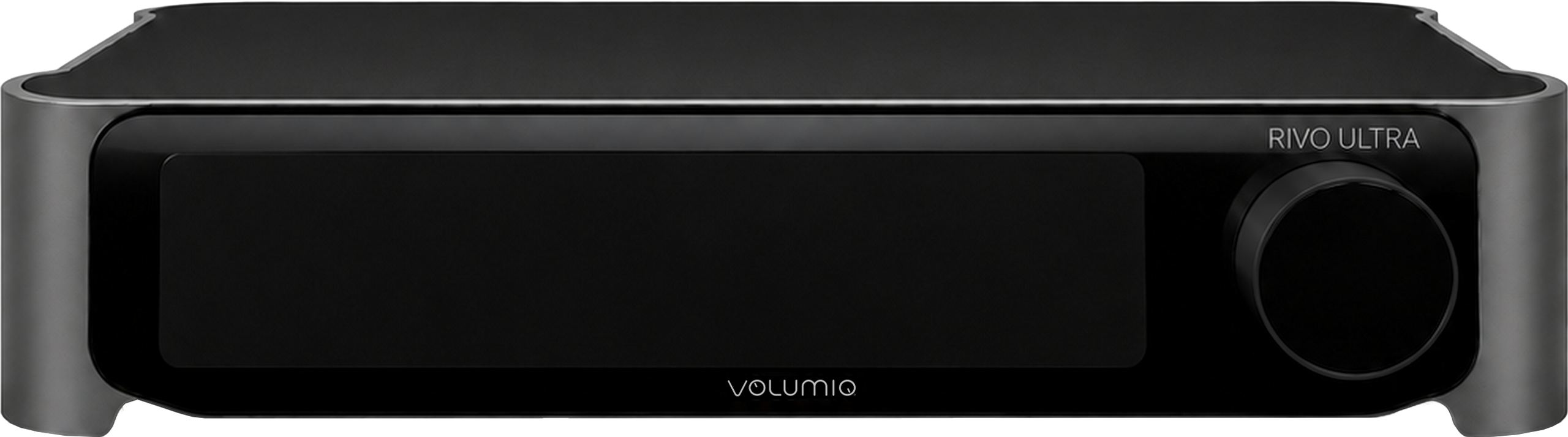
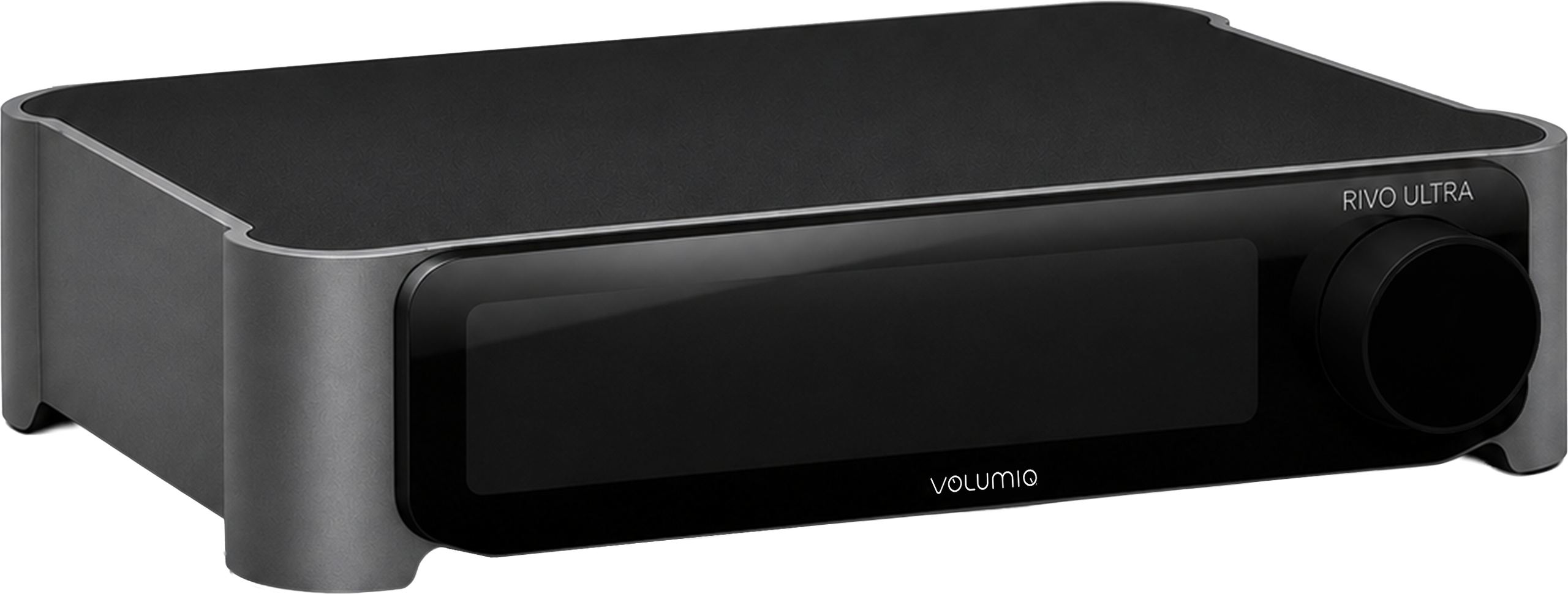
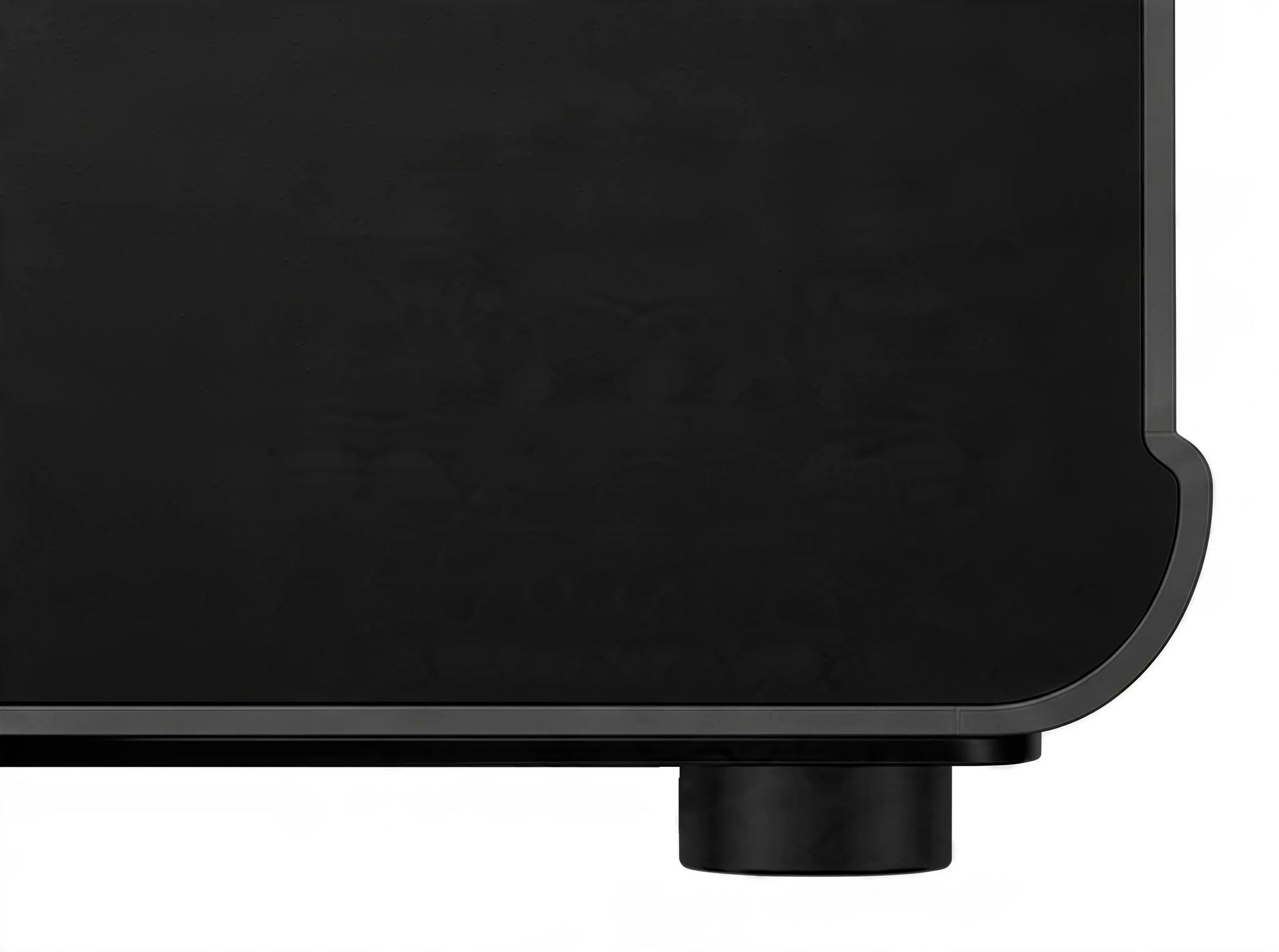
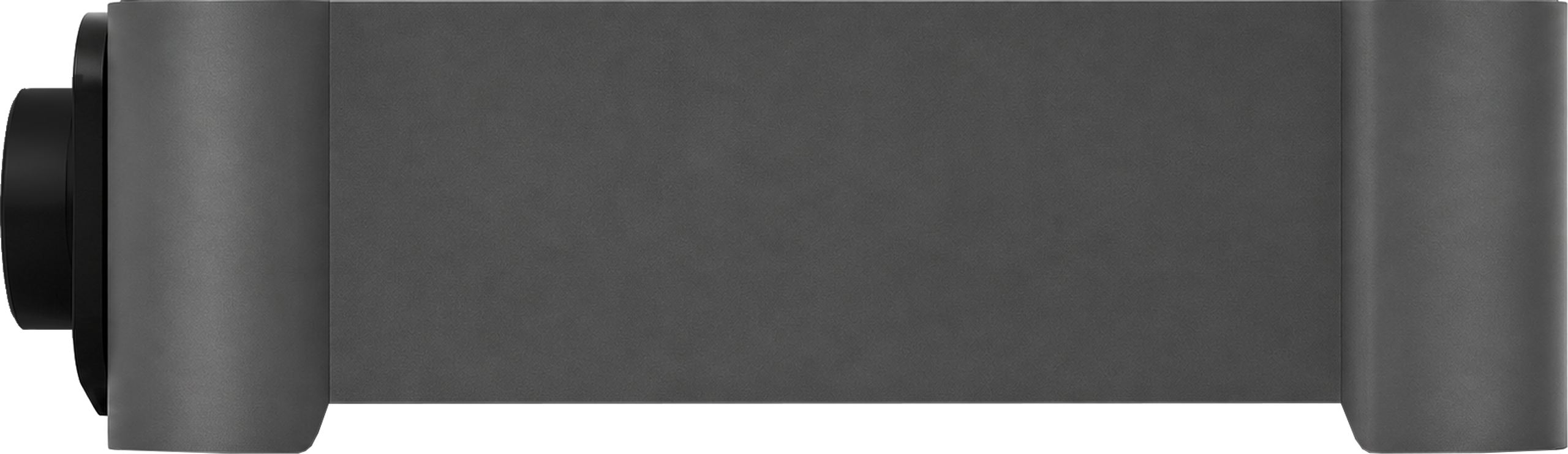
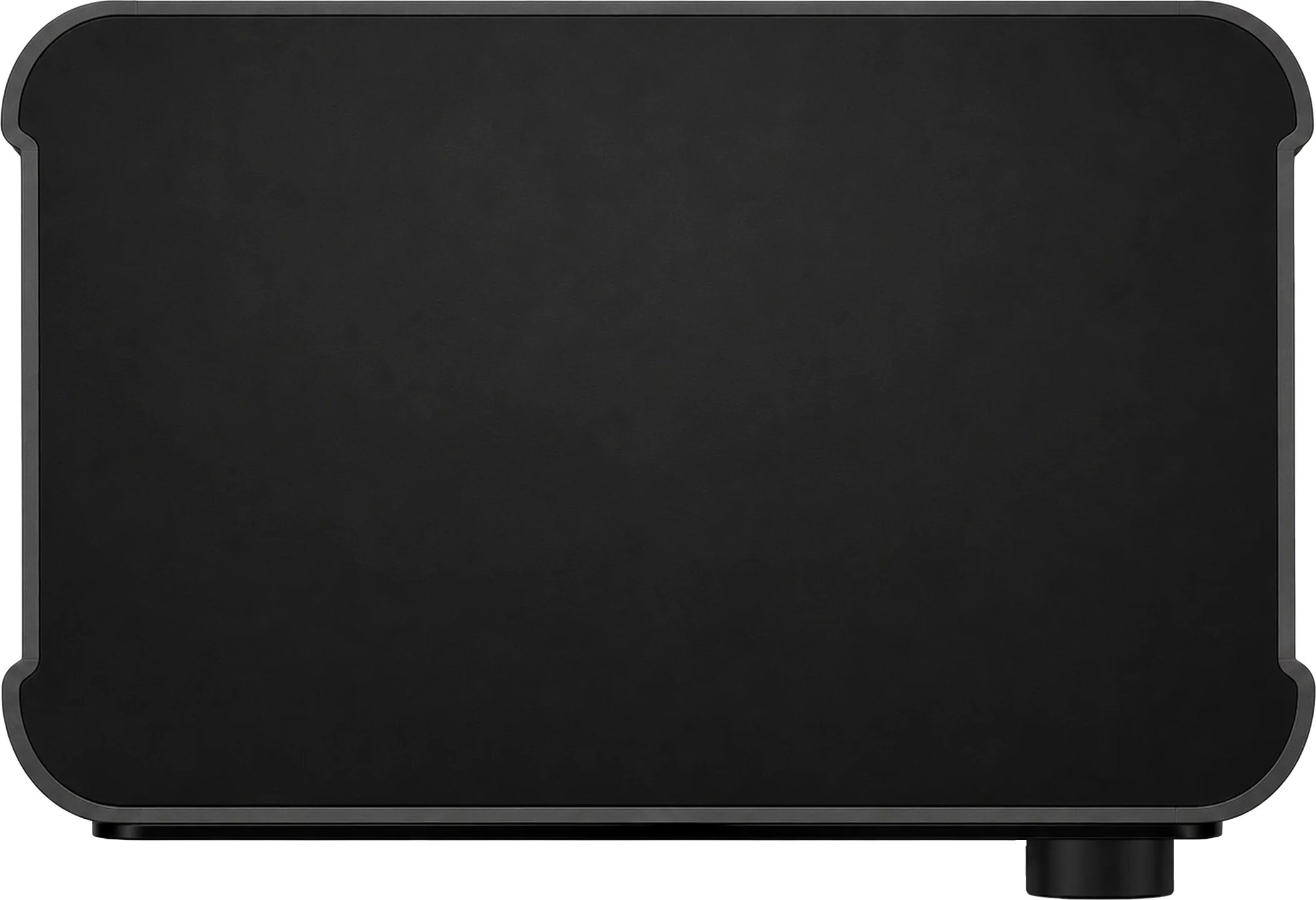
The front panel features a 30.2 cm (11.9-inch) touchscreen with adjustable brightness. It displays the cover art, title, source and format, and lets you browse the library. Twelve display styles are available, including VU meters, a clock and a dot-matrix pattern. Beside it, a rotary push-button control incorporates its own small screen and a status LED. The aluminum Remoto infrared remote control is included. The chassis measures 440 mm wide, 340 mm deep and 90 mm high, and weighs 6 kg. It is available in an all-aluminum finish or with a stitched black leather top.
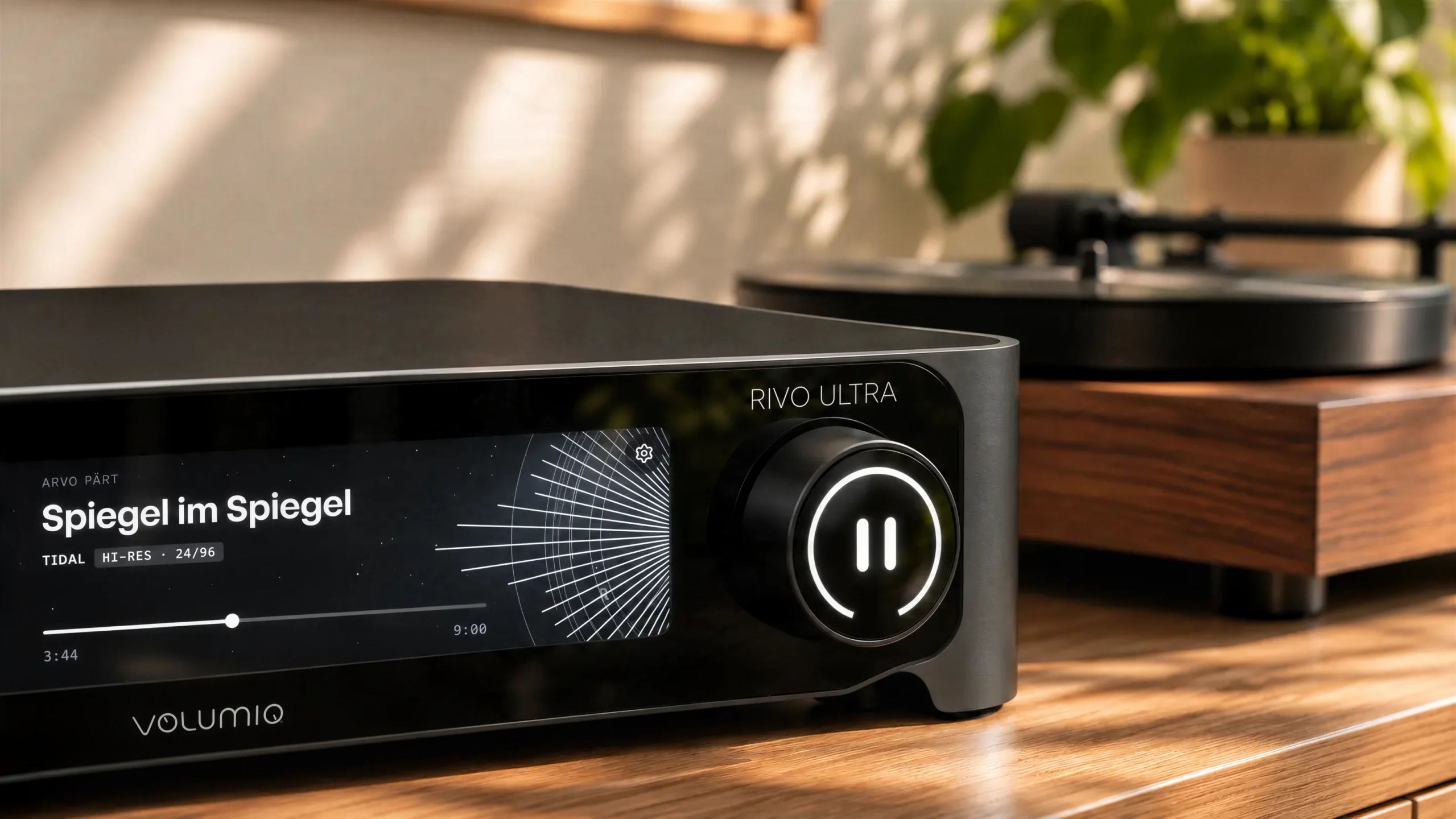
Volumio OS with Premium features included
For everyday use, the Rivo Ultra is mainly controlled through the Volumio app for iOS and Android, or from a web browser. It runs a version of Volumio OS tailored to its hardware, with the new NOVA interface and all Premium features, with no subscription to pay. It receives AirPlay, Spotify Connect, TIDAL Connect and Qobuz Connect, is Roon Ready and serves as an OpenHome-compatible UPnP/DLNA player. Add-ons provide Squeezelite, Radio Paradise, podcasts, SoundCloud, Mixcloud or Fusion DSP processing. Supersearch searches both the local library and online services. Updates are installed over the network.
Documentation
Technical specifications
Overview
- Type: network transport (network player without built-in digital-to-analog converter)
- Series: Ultra
Software
- System: Volumio OS, NOVA interface, Premium features included
- Updates: automatic over-the-air (OTA)
- App: Volumio for iOS and Android, web browser access
Digital processing
- Master clock: femto-clock
- Phase noise: 54 fs RMS on built-in outputs
- Digital interface: custom Amanero768 integration
- Volume control: hardware (via compatible USB digital-to-analog converter), software or disabled
- Formats: DSD, WAV, FLAC, ALAC, AAC, Vorbis, MP3 and others
Digital audio outputs
- USB output for digital-to-analog converter: 1 × USB-A 2.0
- Temperature-compensated clock (TCXO)
- Power supply filtering and signal regeneration
- Up to PCM 1536 kHz / 32-bit and DSD1024
- DSD256 in multiroom
- I2S / DSD over HDMI: 1 × HDMI
- Configurable pinout
- Up to PCM 768 kHz / 32-bit and DSD1024
- DSD256 in multiroom
- AES/EBU: 1 × XLR
- Coaxial S/PDIF: 1 × RCA, 1 × BNC
- Optical S/PDIF: 2 × Toslink
- AES/EBU, coaxial and optical output resolution: up to PCM 192 kHz / 24-bit and DSD64 via DoP
Other connections
- USB 3.0: 1 × USB-C, 3 × USB-A
- Supported devices: flash drives, hard drives and SSDs, optical drive
- Video output: HDMI, Volumio interface mirroring up to 4K / 60 fps
- Trigger: 3.5 mm jack, 12 V
- Expansion slot: M.2 NVMe for PCIe SSD up to 16 TB
Network and streaming
- Ethernet: Gigabit (10/100/1000)
- Wi-Fi: 802.11 a/b/g/n/ac, 2.4 and 5 GHz
- Bluetooth: 5.0
- Services: AirPlay (via Shairport Sync), Spotify Connect, TIDAL / TIDAL Connect, Qobuz / Qobuz Connect, Roon
- UPnP / DLNA: OpenHome-compatible player
- Plugins: Squeezelite, Radio Paradise, Podcasts, Pandora, Fusion DSP, SoundCloud, Mixcloud
Controls and display
- Screen: 30.2 cm (11.9-inch) TFT LCD touchscreen
- Adjustable brightness
- Rotary knob: with built-in display and status LED
Hardware platform
- Processor: ARM Cortex-A76, four cores at 2.4 GHz
- RAM: 2 GB DDR4
- Internal storage: 16 GB eMMC
- Real-time clock: powered by CR2032 battery
Power supply
- Type: dual linear, audio-grade transformer
- Voltage: 115 V or 230 V, manual selector
- Mains inlet: IEC C13
- Protection: 2 T 1.25 A fuses
Included accessories
- Remoto remote control: infrared, aluminum, CR2032 battery
- External Wi-Fi antenna
Dimensions and weight
- Dimensions (W × H × D): 440 × 90 × 340 mm
- Weight: 6 kg
Frequently asked questions
Which output should I choose to connect my DAC?
If the DAC has a USB input, it supports the highest resolutions and is the only one that allows you to control the hardware volume of a compatible DAC. I2S over HDMI is only relevant to DACs equipped with this input. AES/EBU, coaxial and optical are suitable for DACs that support up to 192 kHz / 24 bits. Optical has the advantage of allowing no electrical current to pass between the two devices, preventing ground loops.
How is the volume controlled?
Three settings are available. In hardware mode, via the USB output, the Rivo Ultra directly controls the volume of a compatible DAC. In software mode, it affects all outputs but modifies the digital signal before it reaches the DAC. You can also disable volume control and leave it to the DAC, preamplifier or amplifier. The stream is then output unchanged.
How does it differ from the Rivo Plus?
The Rivo Ultra retains the Rivo Plus’s TCXO-clocked USB output. It adds a femto clock for the built-in outputs, AES/EBU, two coaxial and two optical outputs, a dual linear power supply integrated into the chassis, an 11.9-inch touchscreen and an NVMe SSD slot.
Can the Rivo Ultra play and rip CDs?
Yes, with an external USB optical drive plugged into one of the USB 3.0 ports. CDs can be ripped and the files stored on the internal SSD or on a connected drive.
Does the Rivo Ultra support multiroom?
It syncs with the other Volumio players in the home to play the same music in multiple rooms. When multiroom is enabled, the USB and I2S over HDMI outputs are limited to DSD256.
What are the Rivo Ultra's computer specifications?
It is based on a quad-core ARM Cortex-A76 processor clocked at 2.4 GHz, with 2 GB of DDR4 RAM and 16 GB of eMMC storage for the system. A real-time clock, powered by a CR2032 battery, keeps the time when the device is unplugged.
Is the power supply protected?
It uses two 1.25 A time-delay fuses. When replacing them, use exactly the same rating and type.
- Eco-contribution included in the sale price.


