

Accuphase DP-470

Specifications and features


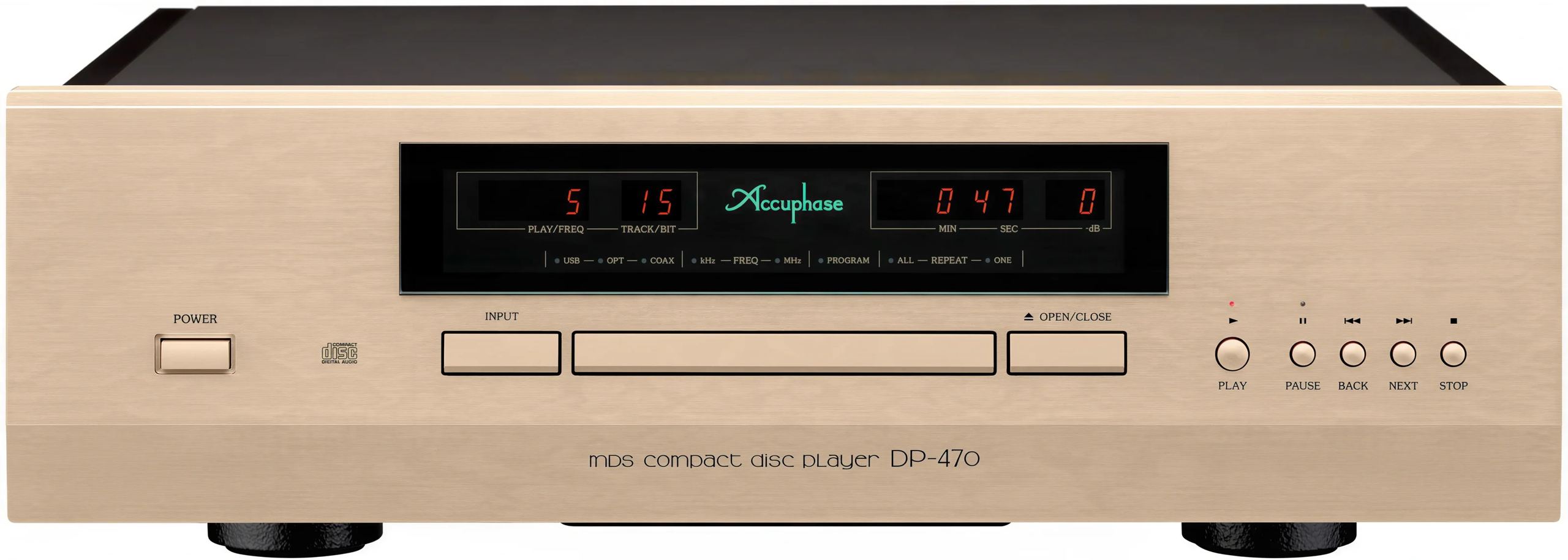
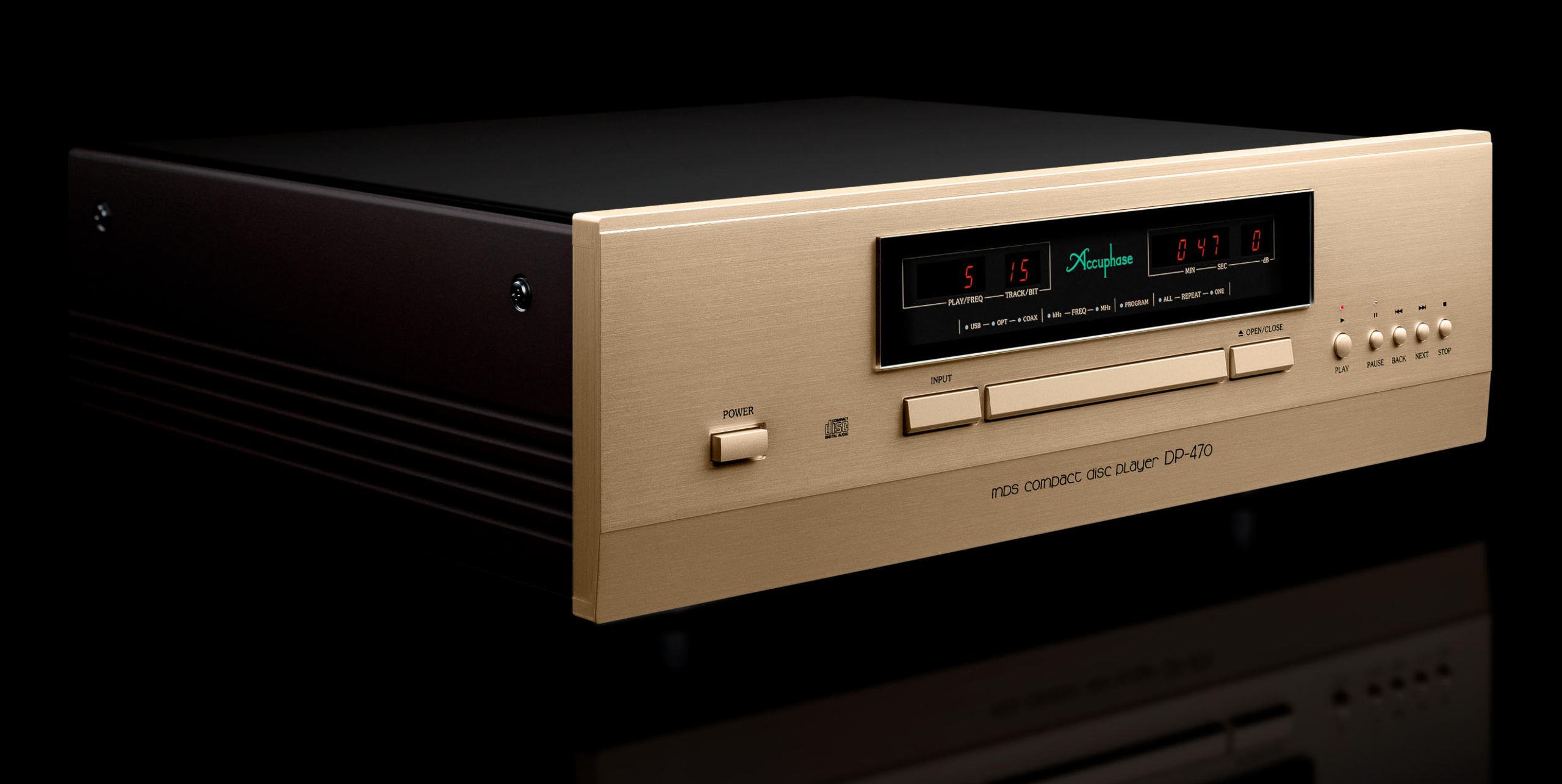
Accuphase DP-470, CD player with MDS+ conversion and ANCC
Forty years after its first compact disc players, Accuphase continues to build a machine that plays only CDs. The DP-470 replaces the DP-450 from 2021. It retains the same dimensions and playback mechanism. The conversion has changed, with a noise reduction circuit taken from the DP-570S, and the USB input now handles DSD up to 22.5 MHz. It also serves as a DAC for a computer, a network player or a television.
A playback mechanism positioned close to the base
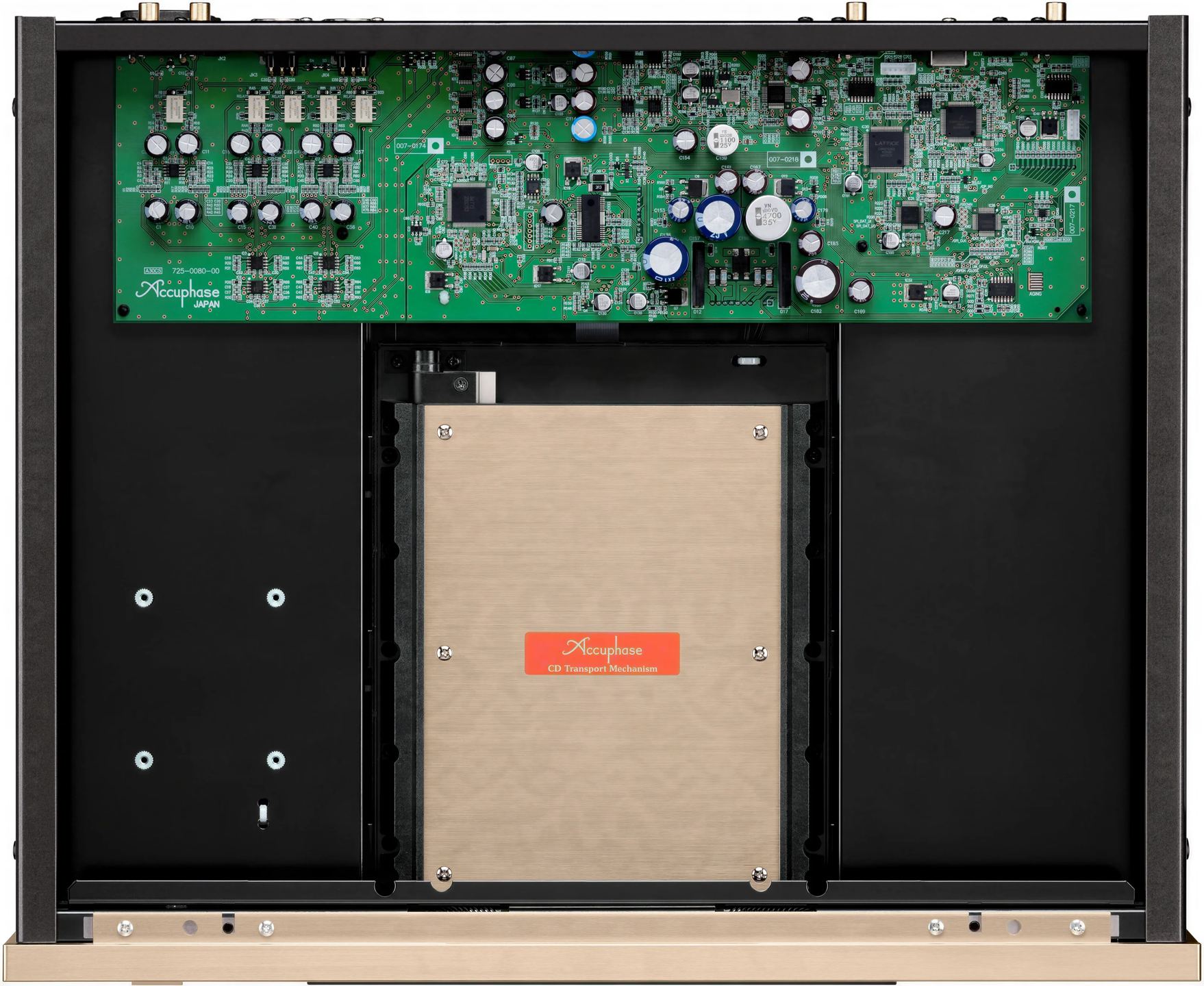
To play a CD, a lens continuously follows a track etched onto a disc spinning at high speed. The slightest vibration from the furniture or motor disrupts this reading process. Accuphase has positioned the optical pickup assembly as low as possible in the chassis, on a 1.6 mm steel plate recessed into the base. This lowered centre of gravity limits external vibrations reaching the mechanism. Between this mechanism and the loading system, elastic dampers isolate the natural resonances of the actuator that moves the lens.
The disc is clamped onto its platter by an eight-pole neodymium magnet, which holds it evenly so that it spins without wobbling. Above it, a large three-layer bridge (steel, open-cell foam, aluminium) covers the mechanism: it contains the airflow created by the spinning disc and prevents it from making the cover resonate. The tray is machined from a block of hard-anodised aluminium with a satin finish, and slides on steel shafts with bearings. It opens and closes silently. The player rests on high-carbon cast iron feet.
Four converters in parallel and a corrected output stage
Digital-to-analogue conversion follows Accuphase’s MDS+ principle: four ESS ES9026PRO converters receive the same signal and work in parallel. Their imperfections do not add together in the same way as the signal, and in theory noise, distortion and linearity errors are halved (√4) compared with a single circuit. This improvement remains the same regardless of frequency or level. It therefore also matters during the quietest passages, reverb tails or the attacks of a piano played pianissimo, where a conventional delta-sigma converter reveals its noise.
The real innovation compared with the DP-450 comes immediately afterwards. A converter outputs a current, which an amplifier must turn into a voltage. On the DP-470, this stage incorporates the ANCC (Accuphase Noise and distortion Canceling Circuit) circuit already used in the DP-570S: a secondary amplifier measures the noise and distortion produced by the main amplifier, then subtracts them from the signal. The conversion board has been redesigned at the same time, and the power supply revised. The transformer retains separate windings for the analogue and digital circuits. The analogue stages also have their own low-noise regulated power supplies, built using discrete components.
Output filtering follows Accuphase’s Direct Balanced approach: the balanced XLR output and unbalanced RCA output each have their own filtering circuit, with no shared stage or conversion from one to the other. The stated figures reflect these changes. Total harmonic distortion plus noise is 0.0008% between 20 Hz and 20 kHz. The signal-to-noise ratio reaches 120 dB, dynamic range 117 dB and channel separation 114 dB, an improvement of one decibel over the DP-450 in each of these three areas.
A DAC for a computer, network player or television
The DP-470 does not connect to a network and has no Bluetooth. Its three digital inputs nevertheless turn it into a DAC for other sources. The USB Type-B input accepts PCM from 44.1 to 384 kHz at 16 to 32 bits. For DSD, it covers rates from 2.8 to 22.5 MHz via native transfer, and goes up to 11.2 MHz via DoP (DSD carried in a PCM stream). The DP-450 topped out at 11.2 MHz. The display shows the sampling rate and resolution of the incoming signal: you can check at a glance that the computer or network player is sending the file at its original resolution.
The coaxial input accepts up to 192 kHz and the optical input up to 96 kHz, both at 24 bits. Connecting a television to the optical input routes the sound from programmes and films through the player’s conversion circuitry and the stereo system.
Digital outputs and a loop to an Accuphase equaliser
At the rear, a coaxial output and an optical output deliver the stream read from the disc. They can feed an external DAC, but Accuphase primarily designed them for a loop with its DG-series digital acoustic correction equalisers, the “voicing equalizers” (the DG-68 is the current model). The DP-470’s transport outputs are connected to the equaliser, then the equaliser’s output to the player’s digital inputs. The CD signal is corrected to suit the listening room without leaving the digital domain, then converted by the DP-470’s MDS+ section.
Two analogue outputs with adjustable levels
The XLR and RCA outputs both deliver 2.5 V at 50 Ω. The level can be adjusted from 0 to −60 dB in 1 dB steps using digital attenuation: this setting matches the player to the other sources connected to the preamplifier, preventing a jump in volume when switching inputs. A selector on the rear reverses the polarity of the balanced output.
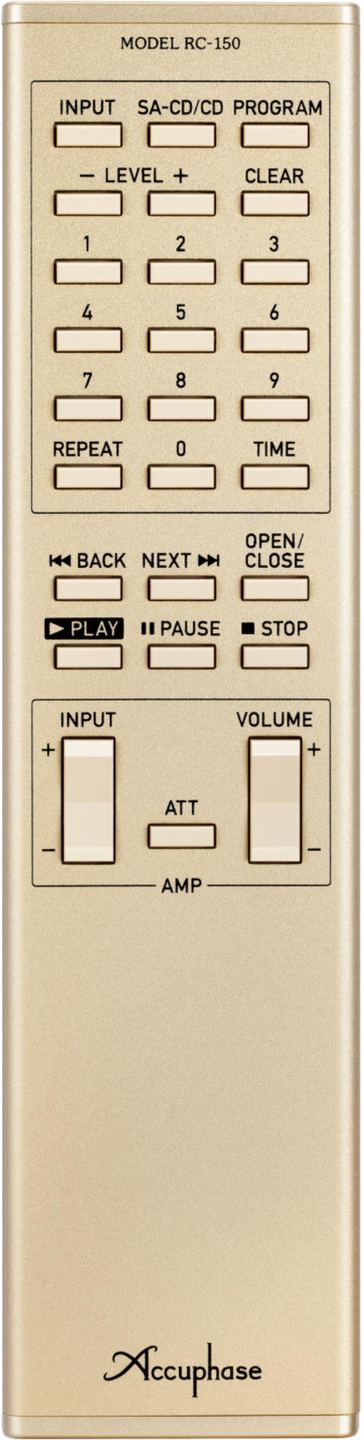
Programmable playlists play a disc’s tracks in the chosen order. The display shows elapsed time, the current track, the total number of tracks and the output level. Everything can be controlled from the front panel or with the supplied RC-150 remote control.
Documentation
Technical specifications
Overview
- Model: Accuphase DP-470
- Type: high-end MDS+ CD player with integrated D / A converter (DAC) and digital inputs
- Manufacturer: Accuphase (Japan)
Transport section (CD playback)
- High-quality, quiet and precise CD mechanism
- Disc format: CD
- Reading principle: non-contact optical pickup
- Laser wavelength: 790 nm
- Mechanical design
- Low center of gravity: high-rigidity mechanism positioned as close as possible to the bottom (recessed bottom plate, 1.6 mm steel), reducing vibrations transmitted to the pickup assembly
- Elastic dampers between the traverse mechanism and the loading assembly: reduced lens actuator resonance, improved reading accuracy
- 8-pole bonded neodymium clamping magnet: firm and even disc retention, wobble-free rotation
- Large 3-layer bridge (steel / open-cell foam / aluminum): sound insulation, reduced air noise caused by rotation
- Tray machined from a solid aluminum block, hard-anodized with a satin finish, guided by steel bearing shafts: smooth and quiet opening / closing
Digital section and D / A conversion
- Principle: 4MDS+ (Multiple Delta-Sigma), 4 delta-sigma converters in parallel
- DAC chips: 4 × ESS ES9026PRO
- Theoretical improvement: distortion, noise and linearity improved by a factor of 2 (= √4), regardless of frequency and level, resulting in very low noise even at very low levels
- I-V conversion: ANCC (Accuphase Noise and distortion Canceling Circuit) technology, low noise and low distortion
- “Direct Balanced” filter: independent and completely separate circuits for the line output (RCA) and balanced output (XLR)
- Internal power supply: transformer with separate analog / digital windings, discrete low-noise power supplies for the analog circuits
Digital inputs
- Can be used as a standalone DAC
- USB (type B)
- Standard: USB 2.0 Hi-Speed (480 Mbit/s)
- Cable: USB 2.0 type B
- DSD: 2.8 / 5.6 / 11.2 / 22.5 MHz (≤ 11.2 MHz via DoP), 1 bit
- PCM: 44.1 / 48 / 88.2 / 96 / 176.4 / 192 / 352.8 / 384 kHz, 16 to 32 bits
- Optical
- Standard: JEITA CP-1212
- Cable: standard JEITA optical fiber
- PCM: 32 / 44.1 / 48 / 88.2 / 96 kHz, 16 to 24 bits
- Coaxial
- Standard: IEC 60958 / AES-3
- Cable: 75 Ω coaxial digital cable
- PCM: 32 / 44.1 / 48 / 88.2 / 96 / 176.4 / 192 kHz, 16 to 24 bits
Outputs
- Transport outputs (digital)
- Optical: JEITA CP-1212
- Coaxial: IEC 60958 / AES-3, 75 Ω
- Analog outputs
- Balanced (BALANCED): 2.5 V, 50 Ω, XLR connector
- Unbalanced (LINE): 2.5 V, 50 Ω, RCA connector
- Phase selector: reverses the polarity of the balanced output
- Output level adjustment: 0 to −60 dB, in 1 dB steps (digital attenuation)
Audio performance (JEITA CP-2402A standard)
- Frequency response: 0.7 Hz – 50000 Hz (tolerance illegible in the PDF, presumably +0 / −3 dB)
- THD + noise: 0.0008% (20 Hz – 20 kHz)
- Signal / noise ratio: 120 dB
- Dynamic range: 117 dB
- Channel separation: 114 dB (20 Hz – 20 kHz)
Features and usability
- Display: sampling frequency and quantization bit depth (e.g. 22.5 MHz / 1 bit), time, current track / total number of tracks, output level
- Indicators: input, repeat, program, frequency
- Programmable playlists: track playback in the selected order
- Front-panel controls: power switch, input button, open / close, play, pause, stop, previous / next, rewind / fast forward
- Feet: high-carbon cast iron isolators
Connection examples
- TV: optical input (set the TV audio output to PCM)
- Computer / network player: USB type B input (high-resolution playback)
- Digital equalizer (“voicing equalizer”): inserted in a loop between the transport outputs and digital inputs, for room acoustic correction in the digital domain
- Amplifier: preamplifier or integrated amplifier via XLR or RCA
Power supply
- Voltage: 120 V, 220 V or 230 V AC, 50/60 Hz (depending on version, see rear panel)
- Power consumption: 18 W
- Eco mode: 230 V version, powers off after 120 min of inactivity
Supplied accessories
- Power cord (2 m)
- AL-10 audio cable (1 m)
- RC-150 remote control
- “USB Driver 4” CD (USB driver) and installation guide
Dimensions and weight
- Max. dimensions (W × H × D): 46.5 × 15.1 × 39.3 cm (465 × 151 × 393 mm)
- Net weight: 13.7 kg
- Packed weight: 20 kg
Frequently asked questions
Does the DP-470 play SACDs?
No. It only plays audio CDs. In the Accuphase range, SACD playback starts with the DP-570S, the next model up in the player lineup.
Do I need to install any software to use it via USB with a computer?
Yes, Accuphase supplies its USB Driver 4 on CD, along with an installation guide. DSD up to 22.5 MHz requires native transfer via ASIO, the Windows audio standard. A source that only supports DoP will be limited to 11.2 MHz.
Can the player decode Dolby Digital sound from a TV?
No. The digital inputs only accept PCM. In the TV’s audio settings, select PCM output: the player will then receive a stereo signal, which it converts normally. With a Dolby Digital or automatic setting, it produces no sound.
What is the polarity inverter on the balanced output used for?
Depending on the brand, the “hot” pin of an XLR connector is either pin 2 or pin 3. If the preamplifier does not follow the same convention as the player, the signal arrives with reversed polarity. The selector restores the correct polarity without changing cables. It also lets you compare the two polarities of a recording by listening.
Does the DP-470 turn off by itself?
The 230 V version sold in Europe has an Eco mode that cuts power after 120 minutes of inactivity. During operation, the player consumes 18 W.
- Eco-contribution included in the sale price.