

Accuphase DP-570S
Specifications and features


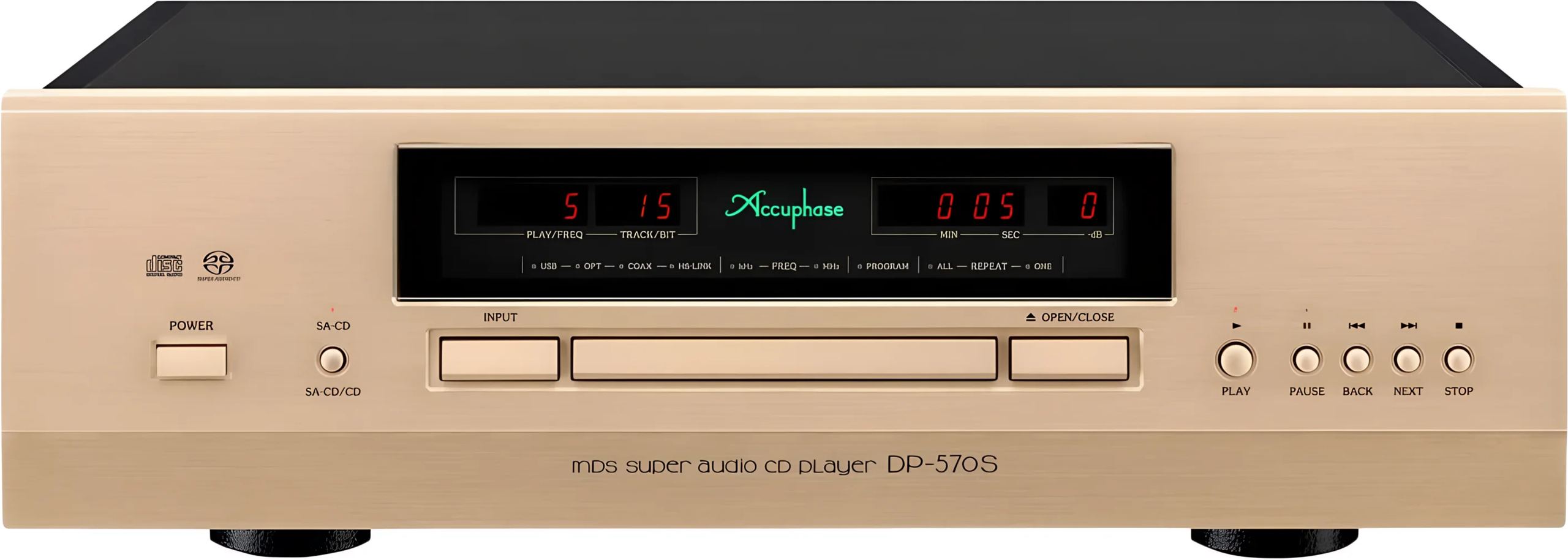
Accuphase DP-570S: SACD/CD player and converter
Five years after the DP-570, Accuphase revisits its mid-range SACD/CD player, positioned between the DP-470 and the DP-770, and improves it in two areas: a more stable disc mechanism and a converter equipped with the ANCC circuit, which eliminates noise and distortion as the digital signal becomes analog. The player also serves as a converter for a computer, television or network player.
A disc mechanism isolated from vibrations
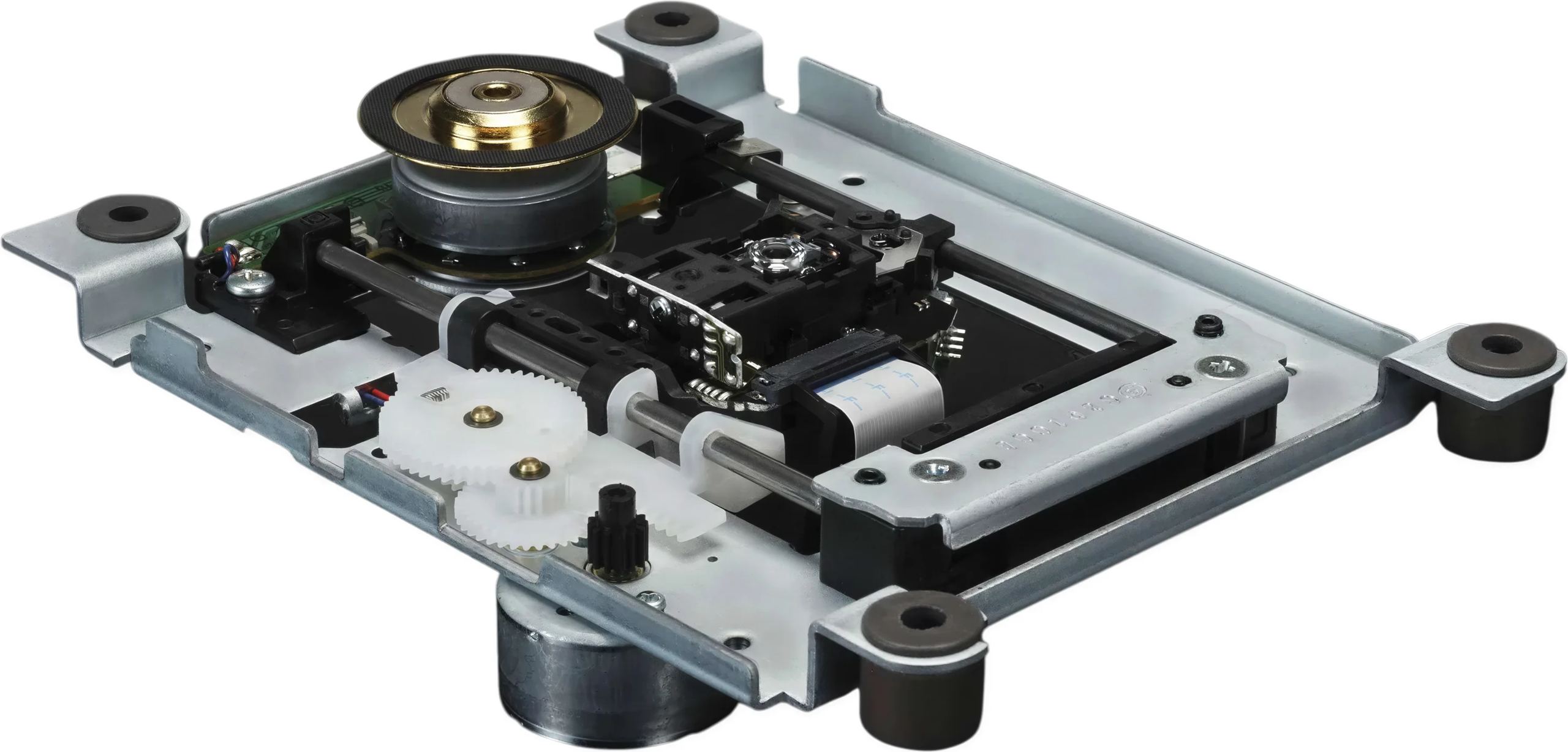
A disc player reads data recorded on a rapidly rotating surface, and the slightest vibration reaching the lens forces the electronics to correct more errors. The DP-570S’s SACD/CD drive assembly rests on a three-layer base plate, lowered into the chassis to place the center of gravity as low as possible. High-carbon cast iron feet support the assembly and block vibrations coming up from the furniture. The laser module is mounted on rubber dampers selected after testing numerous materials, and the lens movement mechanism is suspended by viscoelastic dampers that limit optical resonance. The motor that spins the disc is an outer-rotor brushless motor, chosen for its low vibration and quiet operation, and a five-layer cover encloses the mechanism to contain rotational noise.
The tray is machined from a block of aluminum, hard-anodized and then given a satin finish in a champagne shade. It slides on steel shafts and opens smoothly and silently, a detail that matters on a device handled every time a disc is changed.
Four converters per channel and an ANCC circuit
Conversion is based on a 32-bit ESS ES9028PRO Sabre chip, the same one used in the DP-770. This chip contains eight converters, and Accuphase combines four in parallel on each channel according to its MDS+ (Multiple Delta Sigma) principle. A delta-sigma converter produces a very rapid stream of pulses that is then filtered to recover the musical signal; when four identical converters are combined, the useful signal adds up equally, while the random noise generated by each adds up to a much lesser extent. The improvement applies to noise, distortion and linearity, at all levels and frequencies, including very quiet passages where conventional converters struggle most. This 4MDS+ processing applies to all digital signals, whether they come from the disc or the inputs.
At the chip’s output, the signal takes the form of a current and must be converted into a voltage by what is known as an I/V stage. The ANCC (Accuphase Noise and Distortion Canceling Circuit) is located at the input of this stage: an auxiliary amplifier detects the noise and distortion generated in the main stage, then injects a current of opposite polarity to cancel them out. The entire signal chain is balanced from this point onward.
Two analog outputs, each with its own filter
On many devices, the RCA output is derived from the XLR output or vice versa. The DP-570S gives each its own five-pole Butterworth low-pass filter, following a principle called Direct Balanced Filter, so that neither output depends on the other. Both deliver 2.5 V with an impedance of 50 Ω, and the frequency response extends from 0.5 Hz to 50 kHz.
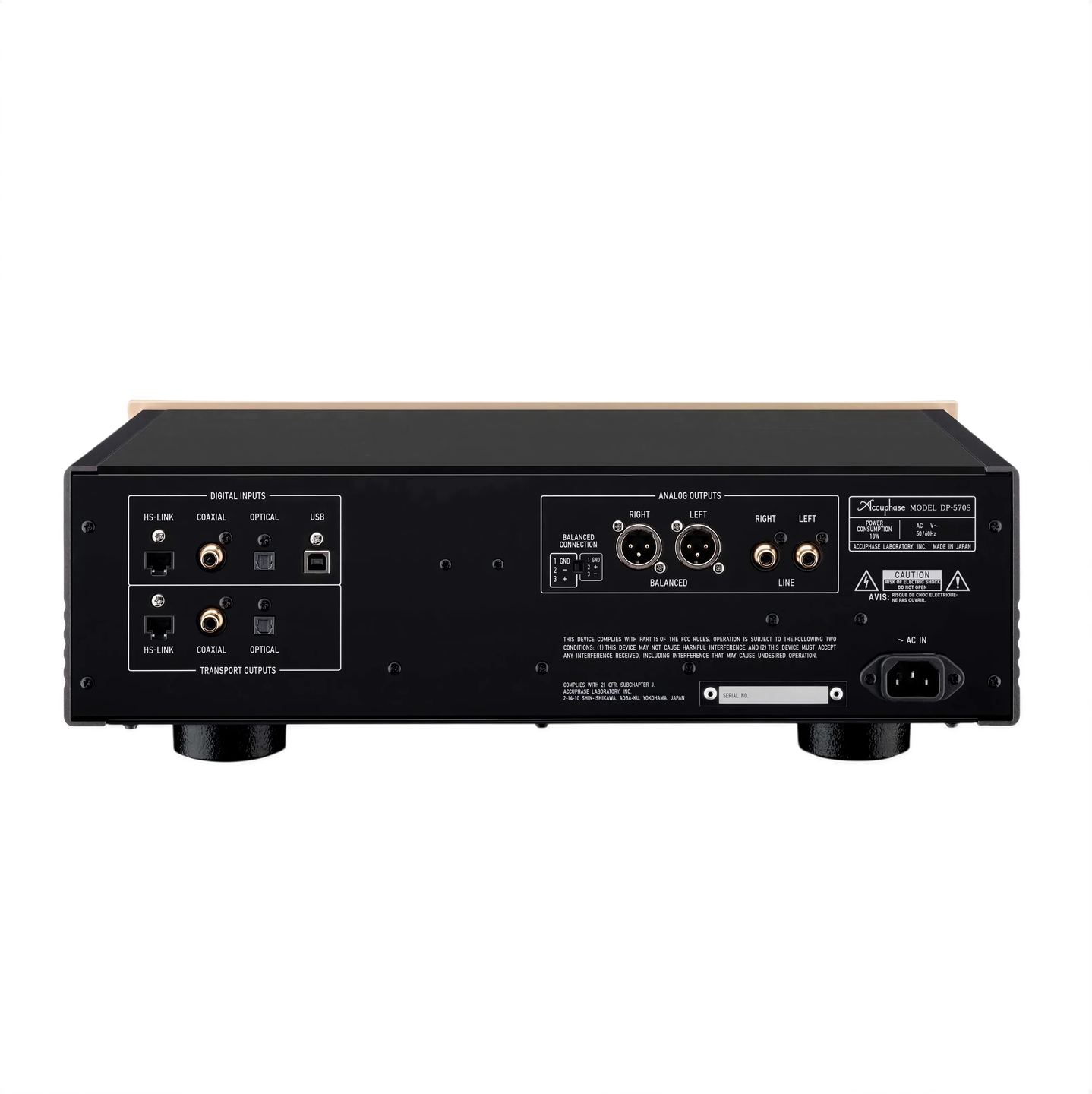
The balanced XLR output has a phase selector on the rear panel. Not all manufacturers assign the hot signal to the same pin, and this switch restores the correct polarity when connected to a preamplifier that follows the other convention. Finally, digital output level adjustment in 1 dB steps matches the DP-570S to the other sources in the system to avoid volume jumps when switching inputs.
A power supply and chassis arranged in blocks
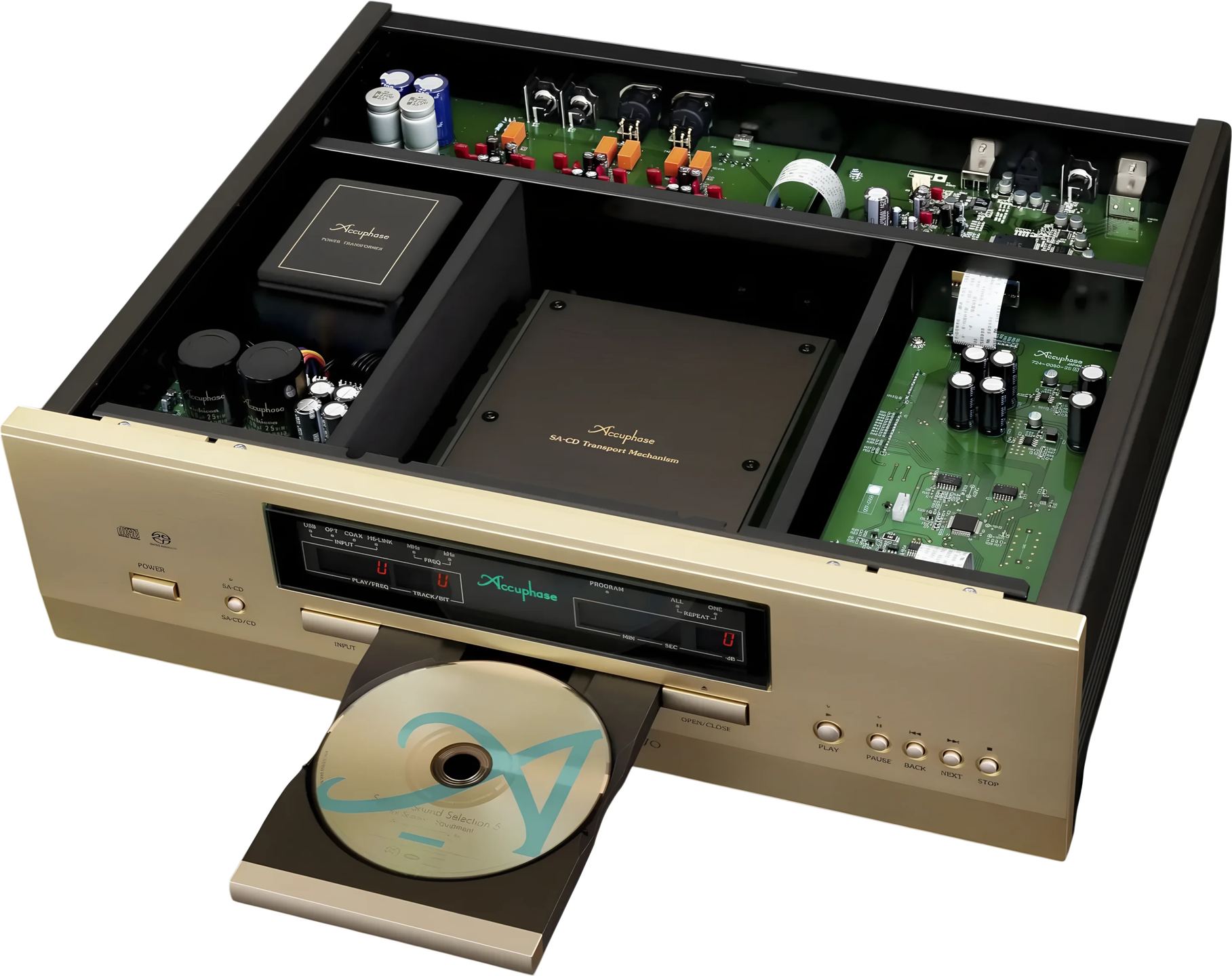
The transformer has separate windings for the analog and digital circuits, which operate without interfering with one another. The power supply must both provide enough energy to keep the mechanism running steadily and remain very clean for the analog circuits, which are sensitive to the slightest noise: discrete low-noise power supplies serve the latter, with custom-made filter capacitors of 15,000 µF each.
The interior follows a strict layout. The SACD/CD mechanism occupies the center, the logic control board sits to its right, and the power supply and its transformer to its left. At the rear, the digital circuit is on the right and the analog circuit on the left, as close as possible to their respective connectors to keep the signal path as short as possible. A brushed aluminum top cover encloses the assembly.
A converter for a computer, television or network player
The digital inputs turn the DP-570S into a converter for other sources. The USB-B port accepts PCM up to 384 kHz/32-bit and DSD up to 22.5 MHz, covering high-resolution files played from a computer. The coaxial input supports up to 192 kHz/24-bit and the optical input up to 96 kHz/24-bit: the former suits a network player, the latter a television or console, provided the device is set to PCM output. The player does not decode the compressed multichannel formats used in films. There is also the HS-LINK input, a proprietary Accuphase connection that links the brand’s devices using a dedicated cable; in version 2, it carries PCM up to 384 kHz/32-bit and DSD at 5.6 MHz, and the DP-570S automatically recognizes the version used by the connected device.
The reverse path is also available. HS-LINK, coaxial and optical digital outputs make the DP-570S a transport capable of feeding an external converter. The display continuously shows the sampling frequency and resolution of the incoming signal, handy for checking that a file is arriving at its original resolution.
A fifth generation quieter than the DP-570
The dimensions remain unchanged (465 × 151 × 393 mm) and the weight drops slightly, from 19 kg to 18.4 kg. The improvements are found in the measurements: guaranteed output noise falls from 2.5 to 2.2 µV, a reduction of 12%, for a signal-to-noise ratio of 121 dB. Total harmonic distortion including noise drops to 0.0006% across the entire audible range and is reduced by up to 30% in the bass compared with the DP-570, the region where music concentrates its energy. Dynamic range reaches 118 dB and channel separation 117 dB. These differences remain modest on paper, on a device whose predecessor already had very low noise, but they affect very low levels: the tails of notes, reverberation and the silences between tracks.
Technical specifications
Overview
- Model: Accuphase DP-570S.
- Type: SACD / CD player with integrated digital-to-analog converter (DAC).
- Generation: 5th generation of the range, succeeding the DP-570 released in 2020.
SACD / CD playback mechanism
- Improved mechanism with a low center of gravity and highly reliable construction.
- Mounted on a sturdy chassis to minimize external vibrations.
- Laser module resting on specially selected rubber absorbers.
- Viscoelastic vibration dampers.
- Champagne-colored tray with smooth sliding action.
Digital-to-analog conversion
- MDS technology: multiple delta-sigma conversion.
- 4MDS+ architecture handling all digital signals.
- Conversion per channel: 4 digital-to-analog converters connected in parallel.
- Converter chip: ESS ES9028PRO Sabre, 32-bit, HyperStream II, identical to that in the DP-770.
- Fully balanced circuit after conversion.
- Filtering: dedicated 5-pole Butterworth low-pass filter for each output, using Direct Balanced Filter technology.
Noise and distortion reduction
- ANCC technology: Accuphase noise and distortion cancellation circuit.
- Implemented at the input of the current-to-voltage (I/V) converter.
- Detection of noise and distortion, followed by injection of a reverse-polarity current to cancel them.
- Combined total harmonic distortion and noise (THD + N) lower than those of the DP-570.
Audio performance
- Guaranteed signal-to-noise ratio: 121 dB.
- Guaranteed output noise: 2.2 µV, compared with 2.5 µV on the DP-570, a reduction of 12%.
- Measured THD + N reduction in the bass: up to 30% compared with the DP-570.
Digital inputs
- HS-LINK:
- Version 1: PCM up to 192 kHz / 24-bit, DSD up to 2.8 MHz.
- Version 2: PCM up to 384 kHz / 32-bit, DSD up to 5.6 MHz.
- Automatic recognition of version 1 or 2.
- Coaxial input: 192 kHz / 24-bit.
- Optical input: 96 kHz / 24-bit.
- USB-B:
- PCM up to 384 kHz / 32-bit.
- DSD at 11.2 MHz via DoP and ASIO.
- DSD at 22.5 MHz via ASIO.
Analog and digital outputs
- Analog outputs: one unbalanced RCA line output, one balanced XLR output.
- Digital outputs for use as a transport: HS-LINK, coaxial, optical.
Power supply
- Transformer with separate windings for the analog and digital circuits.
- Custom-made filter capacitors: 15000 µF each.
- Powerful power supply to stabilize the SACD / CD mechanism, with very low noise to preserve sound quality.
Internal construction
- Fully separated circuits arranged to minimize the signal path:
- Digital circuit on the right.
- Analog circuit on the left.
- Logic control board to the right of the mechanism.
- Power supply and transformer on the left.
- SACD / CD mechanism in the center.
Dimensions and weight
- Dimensions identical to those of the DP-570:
- Width: 465 mm.
- Height: 151 mm.
- Depth: 393 mm.
- Weight: 18.4 kg, compared with 19.0 kg for the DP-570.
Frequently asked questions
Can the DP-570S be connected directly to a power amplifier?
No. The output level adjustment covers a limited range in 1 dB steps and is used to match levels between sources, not to control listening volume. The DP-570S connects to a preamplifier or an integrated amplifier.
What discs does the player support?
It plays stereo SACDs and audio CDs. It also plays data discs burned onto CD-R/RW and DVD-R/RW/+R/+RW containing WAV, FLAC, DSF or DSDIFF files, providing access to high-resolution and DSD recordings without a computer. SACDs are played from their stereo layer: the device has only two output channels.
Does the DP-570S play streaming music?
It has no network connection. A network player or transport connected to the coaxial or USB input allows you to listen to streaming services through its converter.
Is a driver required for the USB input?
The USB Driver 4 driver is supplied on CD with its installation guide. DSD is delivered in two ways: DoP, which encapsulates the DSD stream in a PCM signal and tops out at 11.2 MHz, and ASIO, a Windows-specific interface and the only one to reach 22.5 MHz.
What is the purpose of connecting to a tone equalizer?
An Accuphase digital equalizer from the voicing equalizer family is inserted in a loop between the transport outputs and the DP-570S digital inputs. It corrects the room response and differences between the left and right channels in the digital domain, before conversion, without adding an extra analog stage.
- Eco-contribution included in the sale price.








