

FiiO M25 Verita silver


Specifications and features


FiiO M25 Verita, Android portable player with AKM converters
Up to 1,700 mW per channel from the balanced output, in a 318 g enclosure: this figure requires a connected power supply, but it places the M25 Verita among the portable players capable of driving demanding headphones. Conversion is handled by three AKM chips, the system runs Android, and it also serves as a USB DAC or wireless receiver. FiiO sells the same enclosure in an R2R version; the Verita is the AKM version.
Three AKM chips, digital separated from analog
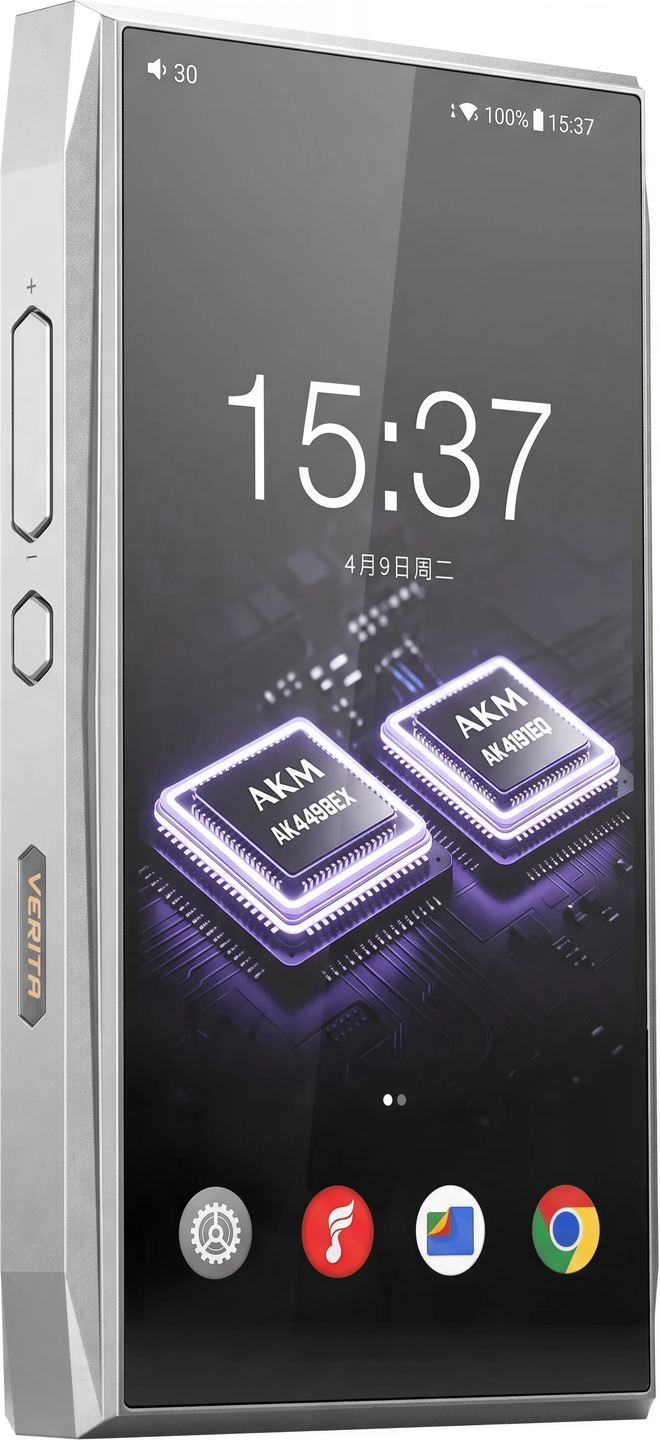
AKM has split its most ambitious converter into two separate components. The AK4191EQ handles the digital section, filtering and modulation, then sends the signal to two AK4499EX chips that handle conversion alone, one per channel. Keeping digital processing away from the analog stage limits the noise passing from one to the other. That is the purpose of this pairing, which FiiO uses here in a dual-mono configuration.
After conversion, the circuit remains fully balanced all the way to the outputs. Two custom-made femtosecond crystal oscillators, complemented by an FCXO-05, clock the conversion.
On the balanced line output, FiiO specifies 0.00038% total harmonic distortion plus noise and a signal-to-noise ratio of over 128 dB. Frequency response stays within 0.14 dB between 20 Hz and 20 kHz, then drops by 3 dB at 85 kHz. The most telling difference concerns crosstalk: 110 dB on the 4.4 mm socket, compared with 75 dB on the 3.5 mm jack, where both channels share the same ground. Headphones fitted with a balanced cable benefit from significantly better left-right separation.
Four gain levels, including one requiring external power
On battery power, the M25 Verita offers Low, Medium and High gain. The fourth, Super High, is only activated with a fast charger plugged in or a power supply connected to the second USB-C port, marked “POWER IN”. This port is for power only. Full power is therefore reserved for listening at a desk, with a cable plugged in.
| Output and load | High (on battery) | Super High (external power) |
|---|---|---|
| 4.4 mm, 32 Ω | 1,000 mW | 1,700 mW |
| 4.4 mm, 300 Ω | 140 mW (6.5 Vrms) | 220 mW (8.1 Vrms) |
| 3.5 mm, 32 Ω | 315 mW | 500 mW |
| 3.5 mm, 300 Ω | 35 mW | 55 mW |
These figures are the minimum power outputs per channel specified by FiiO, measured with less than 1% distortion. For 300 Ω headphones, the available voltage limits the volume: the balanced output goes from 6.5 Vrms in High to 8.1 Vrms in Super High. The 3.5 mm jack, limited to 35 mW into 300 Ω on battery power, is poorly suited to these headphones.
At the other end of the scale, sensitive in-ear earphones work well with Low gain. The noise floor drops below 1.4 µV on the 3.5 mm jack and below 2.1 µV on the 4.4 mm output. Output impedance remains below 0.6 Ω at 3.5 mm and 0.9 Ω at 4.4 mm. It therefore barely alters the response of multi-driver earphones, whose impedance varies with frequency. FiiO recommends headphones from 8 to 350 Ω.
Full Android, with a dedicated music mode
The Qualcomm Dragonwing QCS6490 processor has eight cores, runs at up to 2.7 GHz and belongs to the Snapdragon 778G family. It works with 8 GB of RAM. This is a recent smartphone platform, running Android streaming apps on a 5.5-inch laminated screen with a resolution of 1080 × 2160. Dual-band Wi-Fi (2.4 and 5 GHz) supports streaming, remote control and AirPlay.
When file playback is all that matters, Pure Music mode reduces the system to the music player. The M25 Verita also sends audio to wireless headphones over Bluetooth 5.2, with LDAC, LHDC, aptX Adaptive, aptX HD, aptX and SBC codecs.
31-band equalizer and second-harmonic adjustment
The 31-band parametric equalizer finely corrects a headphone’s response curve. Auto EQ mode makes the adjustment automatically, without going through each band.
The three-level second-harmonic adjustment adds a controlled amount of even-order distortion: this is the coloration associated with tube amplifiers. It is exclusive to the Verita version; the M25 R2R offers Flat and Warm modes instead.
Balance adjusts from L20 to R20 in 0.5 dB steps. This fine increment compensates for one ear being less sensitive than the other or a slight imbalance between the two sides of a pair of headphones. The ALL TO DSD function converts any PCM signal to DSD before conversion.
318 g, 6,500 mAh and a recharge in two and a half hours
At 139.8 × 76 × 18 mm and 318 g, the M25 Verita slips more readily into a jacket pocket or bag than into a jeans pocket. The machined chassis, with beveled facets, comes in black or silver.
The 6,500 mAh battery lasts 9.5 hours using the 3.5 mm output and 8.5 hours using the 4.4 mm output. FiiO measured these runtimes in High gain, with 32 Ω headphones, MP3 files, the equalizer disabled and the screen off. The R2R version, in the same enclosure, claims 14.5 and 12.5 hours. Fast charging accepts up to 30 W via PD 3.0 PPS, and is compatible with QC 3.0 and QC 4.0. A full charge takes around two and a half hours with a PD 3.0 PPS charger.
Technical specifications
Overview
- Device type: high-resolution portable music player
- Operating system: Android
- Processor: Qualcomm Dragonwing QCS6490
- 8 cores
- Clock speed: up to 2.7 GHz
- RAM: 8 GB
- Storage: 128 GB (approximately 112 GB available)
- Memory expansion: microSD card up to 2 TB
- Screen: 5.5 inches (14 cm)
- Resolution: 1080 × 2160
Operating modes
- Android
- Pure Music
- AirPlay (via Wi-Fi)
- USB DAC
- Use with a computer
- Formats: up to PCM 768 kHz / 32-bit and DSD512
- Bluetooth reception
- Version: Bluetooth 5.2
- Codecs: SBC, LDAC
Audio electronics
- AKM audio conversion chips: 3
- 1 AK4191EQ: digital processing
- 2 AK4499EX: audio conversion, one per channel
- USB interface: XMOS XU316
- Audio architecture: fully balanced
- Precision oscillators: 3, including 2 femtosecond crystal oscillators
- Operational amplifiers: part numbers not disclosed
Connections and outputs
- 3.5 mm jack
- Functions: headphone output, line output, S/PDIF coaxial digital output
- Line output level: 2.3 Vrms
- Output impedance: less than 0.6 Ω
- 4.4 mm jack
- Functions: balanced headphone output, balanced line output
- Line output level: 4.6 Vrms
- Output impedance: 0.9 Ω
- USB-C: charging and data transfer
- USB-C POWER IN: separate power supply
- Coaxial output: up to 384 kHz / 24-bit and DSD128
- Compatible headphone impedance: 8 to 350 Ω
- Gain levels: Low, Medium, High, Super High
- Power adjustment for different types of headphones
- Super High gain: requires an external power supply (USB-C POWER IN) or a connected fast charger
Headphone output power
- 4.4 mm balanced output (per channel, depending on gain)
- 16 Ω headphones: 160 to 1000 mW
- 32 Ω headphones: 85 to 1700 mW
- 300 Ω headphones: 10 to 220 mW
- 3.5 mm unbalanced output (per channel, depending on gain)
- 16 Ω headphones: 40 to 770 mW
- 32 Ω headphones: 20 to 500 mW
- 300 Ω headphones: 2 to 55 mW
- Measurement conditions: distortion + noise below 1%
Audio performance
- 3.5 mm headphone output
- Distortion + noise: 0.00046%
- Signal-to-noise ratio: up to 125 dB
- Dynamic range: 125 dB minimum
- Noise floor: below 1.4 to 2.2 µV depending on gain
- Crosstalk: 75 dB minimum
- 4.4 mm headphone output
- Distortion + noise: 0.00048 to 0.00053% depending on gain
- Signal-to-noise ratio: up to 128 dB
- Dynamic range: 129 dB minimum
- Noise floor: below 2.1 to 2.9 µV depending on gain
- Crosstalk: 110 dB minimum
- 3.5 mm line output
- Distortion + noise: 0.0004%
- Signal-to-noise ratio: 125 dB minimum
- Noise floor: below 1.3 µV
- Crosstalk: 106 dB minimum
- 4.4 mm line output
- Distortion + noise: 0.00038%
- Signal-to-noise ratio: 128 dB minimum
- Noise floor: below 1.9 µV
- Crosstalk: 107 dB minimum
- Frequency response
- 20 Hz to 20 kHz: 0.14 dB variation
- At -3 dB: up to 85 kHz
Supported audio formats
- PCM: up to 768 kHz / 32-bit
- DSD: DSD64 to DSD512
- Files: ISO, DSF, DFF
- FLAC, WAV, AIFF: up to 768 kHz / 32-bit
- ALAC: up to 384 kHz / 32-bit
- APE: up to 384 kHz / 24-bit
- DXD: 352.8 kHz / 24-bit
- WMA Lossless: up to 96 kHz / 24-bit
- Other formats: MP3, OGG, WMA
- MQA: full decoding claimed by FiiO
- ALL TO DSD: conversion of all audio signals to DSD
Wireless connectivity
- 2.4 and 5 GHz Wi-Fi: music transfer, remote control
- Bluetooth 5.2 transmission
- Codecs: SBC, aptX, aptX HD, aptX Adaptive, LDAC, LHDC
Sound settings
- Parametric equalizer: 31 bands
- Auto EQ function
- Second harmonic adjustment: 3 levels
- Sound profiles: several (four according to a third-party source, number not confirmed by FiiO)
- Left / right balance: from L20 to R20, in 0.5 dB increments
Usability
- Navigation: gestures or virtual buttons
- Double-tap to wake the screen
- Screen rotation
- Programmable sleep timer
- Programmable automatic shutdown
- Updates: via the Internet or microSD card
Battery and battery life
- Battery capacity: 6500 mAh
- Battery life claimed by FiiO
- 3.5 mm output: 9 h 30 min
- 4.4 mm output: 8 h 30 min
- Measurement conditions: 32 Ω headphones, High gain, MP3 files, equalizer disabled, screen off
- Fast charging: 30 W
- Supported technologies: QC 3.0 / 4.0, PD 2.0 / 3.0 PPS
- Full charging time: approximately 2 h 30 min with a PD 3.0 PPS power supply
Differences from the M25 R2R
- The M25 R2R is a separate model, not to be confused with this portable music player
- Audio conversion: FiiO R2R PRO technology on the M25 R2R, instead of AKM chips
- M25 R2R battery life: 14 h 30 min with 3.5 mm and 12 h 30 min with 4.4 mm
- Second harmonic adjustment: absent on the M25 R2R, replaced by Flat, Warm and NOS modes
- M25 R2R balanced line output: 4.2 Vrms
Finish, dimensions and weight
- Available colors: black or silver
- Chassis: machined, “diamond-cut” finish
- Dimensions: approximately 139.8 × 76 × 18 mm
- Weight: approximately 318 g
Frequently asked questions
What is the difference between the M25 Verita and the M25 R2R?
Both versions share the same chassis, processor, display, memory and headphone output power. The M25 R2R replaces the AKM chips with a resistor ladder converter, the FiiO R2R PRO. It adds a NOS mode, meaning no oversampling, for PCM. The balanced line output delivers 4.6 Vrms on the Verita versus 4.2 Vrms on the R2R.
Can the M25 Verita be connected to a hi-fi system?
Yes, via the line output: 2.3 Vrms on the 3.5 mm jack and 4.6 Vrms on the 4.4 mm socket. The latter connects to an amplifier with balanced inputs using a suitable cable. The 3.5 mm jack also serves as an S/PDIF coaxial digital output, supporting up to 384 kHz / 24 bits and DSD128 (DoP). This allows conversion to be handled by an external DAC, using a 3.5 mm jack to coaxial RCA cable.
Can the M25 Verita receive music from a smartphone?
Yes, in two ways. In Bluetooth 5.2 receiver mode, it supports SBC and LDAC and becomes a wireless headphone amplifier for an Android phone. An iPhone doesn’t support LDAC: it uses AirPlay mode instead, over Wi-Fi, which also works with a Mac.
How do I use the M25 Verita as a DAC with a computer?
In USB DAC mode, it connects via its USB-C port (USB 3.0). It then supports PCM up to 768 kHz / 32 bits and DSD512 natively, via DoP or D2P. The connection uses an XMOS XU316 controller. For desktop use, an additional power supply connected to the POWER IN port enables Super High gain.
What file formats does the M25 Verita play?
It plays FLAC, WAV and AIFF up to 768 kHz / 32 bits, ALAC up to 384 kHz / 32 bits, as well as APE, DXD and WMA Lossless. For DSD, it plays .dsf and .dff files and .iso images from DSD64 to DSD512, including DST. FiiO also claims full MQA decoding. MP3, OGG and WMA are also supported.
How much space is needed for a music library?
Internal storage is 128 GB, with approximately 112 GB available. A microSD card reader supports up to 2 TB. Files can also be transferred over Wi-Fi from a computer, without a cable.
How is the software updated?
Updates are carried out over the Internet, locally or from a microSD card. For navigation, you can choose between gestures and a bar with two or three virtual buttons. A double tap wakes the screen.
- Eco-contribution of €0.85 included in the sale price.
- Manufacturer reference: FIIM25SR
- GTIN / EAN: 6953175761815