

MartinLogan Impression ESL 11A (pack of 2)
Overview
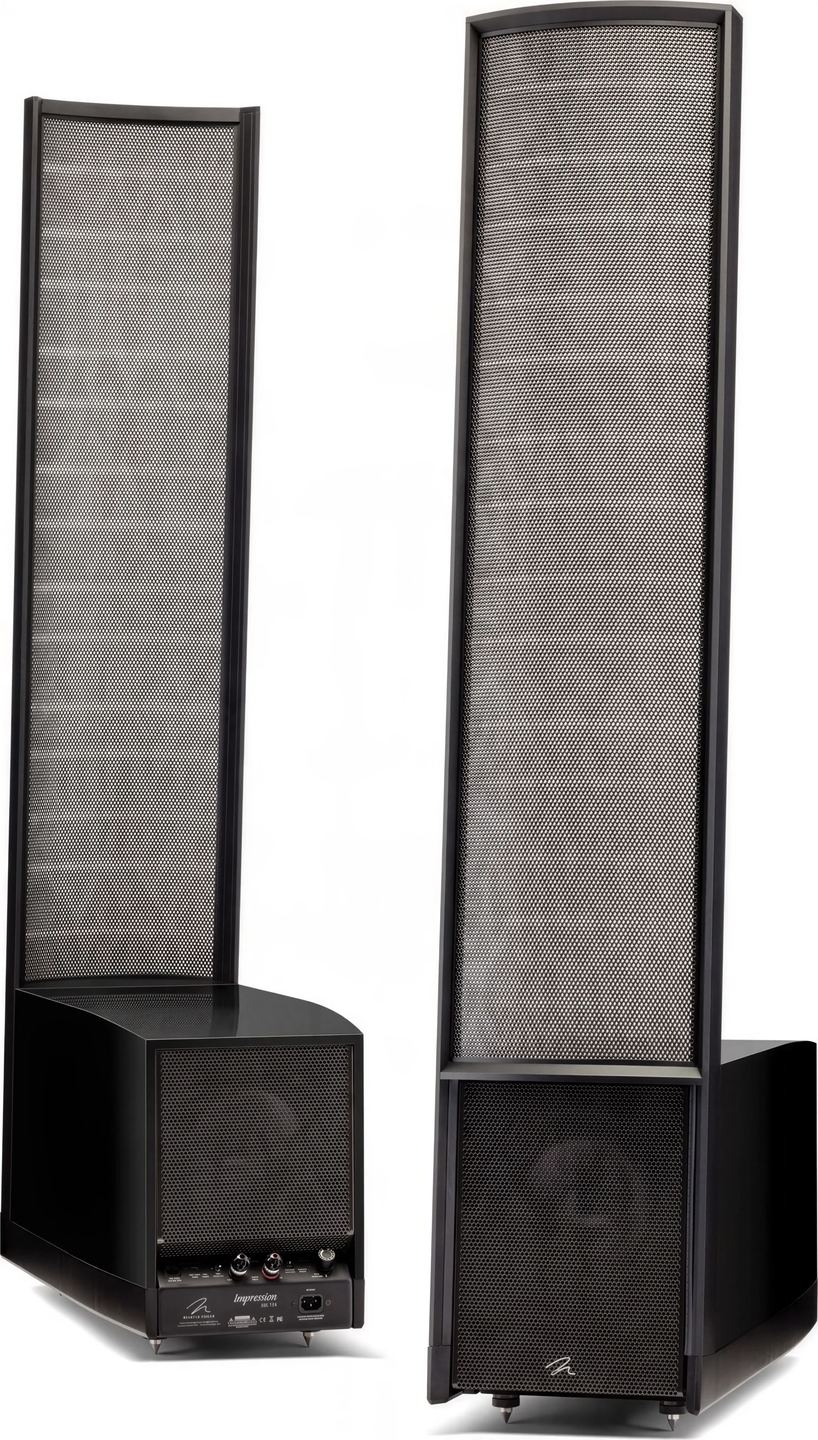
An open electrostatic panel 112 cm tall, mounted on a compact base that houses two woofers and their amplification. This hybrid floorstanding speaker assigns the entire spectrum above 300 Hz to a thin diaphragm stretched between two grilles, and the bass to two 20 cm drivers controlled by a digital processor. It sits in the middle of the MartinLogan Masterpiece series, between the Classic ESL 9 and the Expression ESL 13A.
A 112 cm panel for voices and instruments
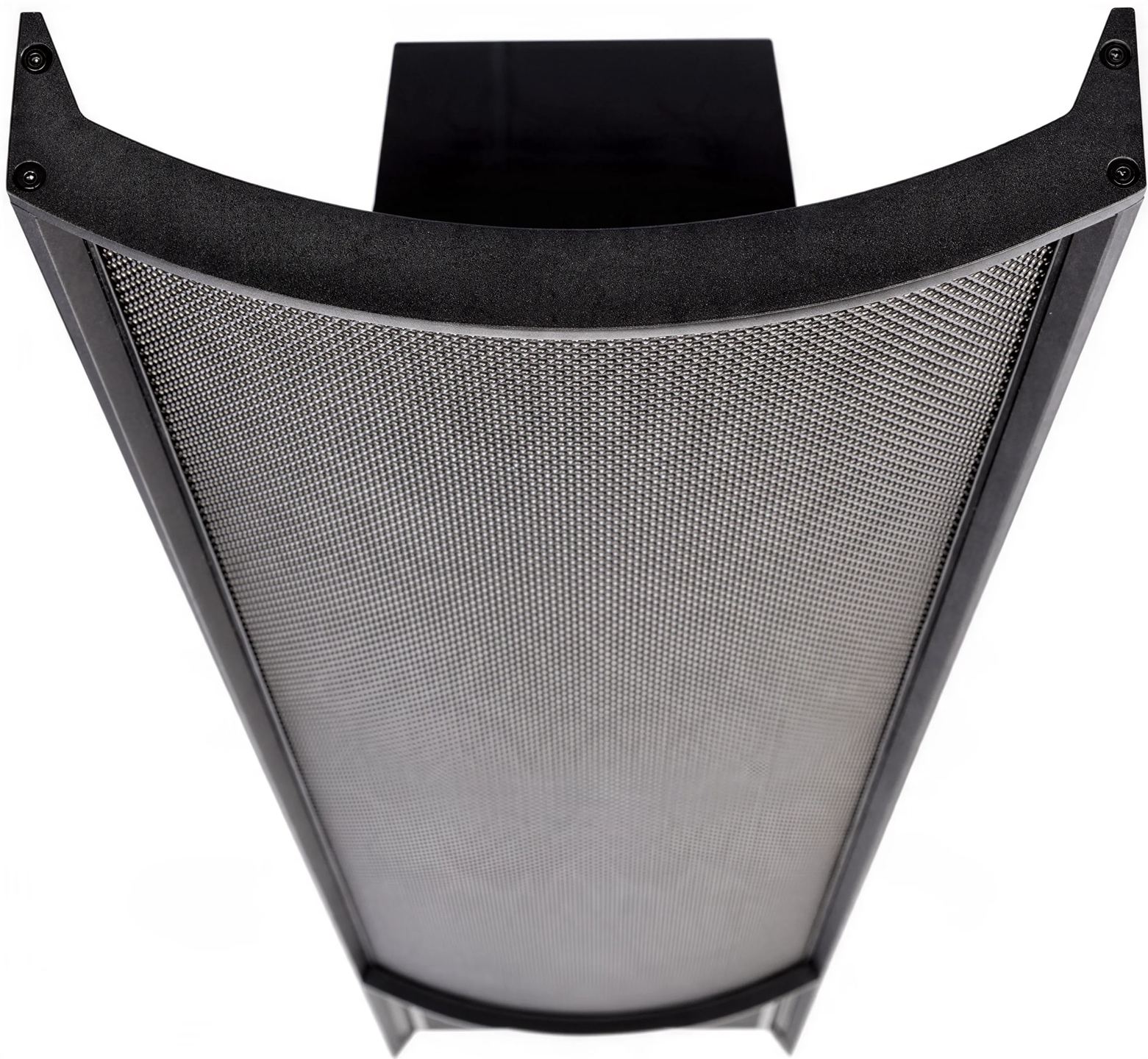
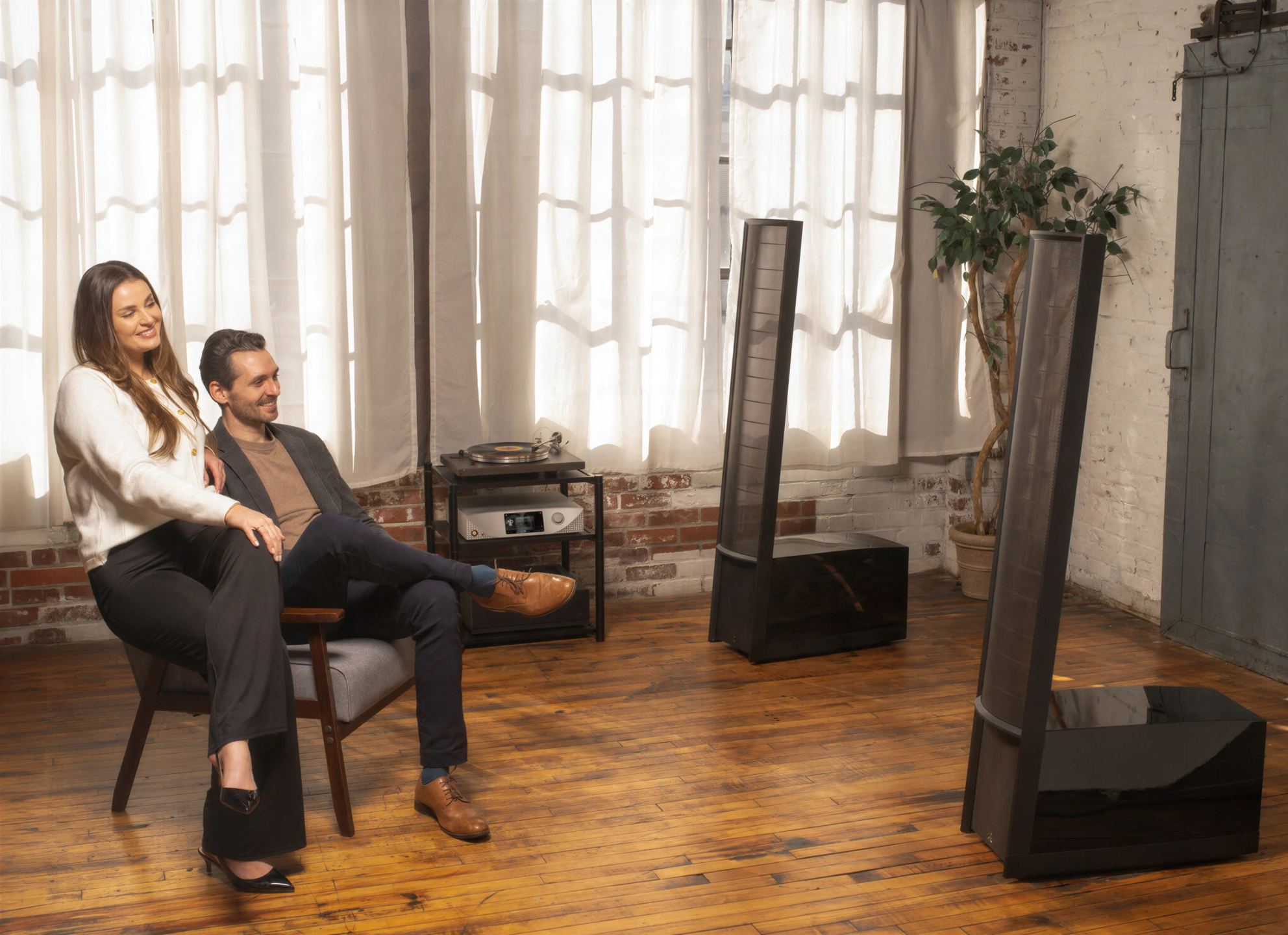
An electrostatic driver has neither a cone nor a voice coil. It uses a very light diaphragm stretched between two perforated metal grilles called stators. A custom-wound audio transformer steps up the voltage of the signal from the amplifier, and the diaphragm then moves as a single unit across its entire surface. On the Impression ESL 11A, the XStat CLS panel measures 112 × 28 cm, providing 3,136 cm² of radiating area. Its MicroPerf stators have finer perforations. They expose almost twice as much diaphragm as a traditional electrostatic panel of the same size. The diaphragm is vacuum-bonded, then held under tension by rigid ClearSpar spacers.
With a crossover at 300 Hz, voices and the midrange of most instruments pass through this single transducer. No crossover between two drivers interrupts the midrange. The panel is slightly curved horizontally, hence its CLS name (Curvilinear Line Source). This curvature spreads the treble over a 30° angle. Vertically, the panel’s 112 cm height behaves as a line source: little sound is directed toward the floor and ceiling, so they produce fewer reflections. A horizontal angle of 30° defines a fairly narrow listening area. The stereo image is sharpest when the listener is on-axis with both panels.
Like any electrostatic driver, the panel radiates as much to the rear as to the front (in opposite phase) and almost nothing to the sides. The side walls therefore reflect little sound. The rear wave bounces off the wall behind the speaker and reaches the ear slightly later, adding ambience to the midrange and treble. The panel is attached to the base by the AirFrame Blade, an extruded aircraft-grade aluminum alloy frame, narrow at the front and wider at the sides. This frame stiffens the panel without obscuring the sound-radiating surface. It also isolates it electrically and mechanically from vibrations in the bass enclosure, which would otherwise produce intermodulation distortion.
Two 20 cm woofers with their own amplification
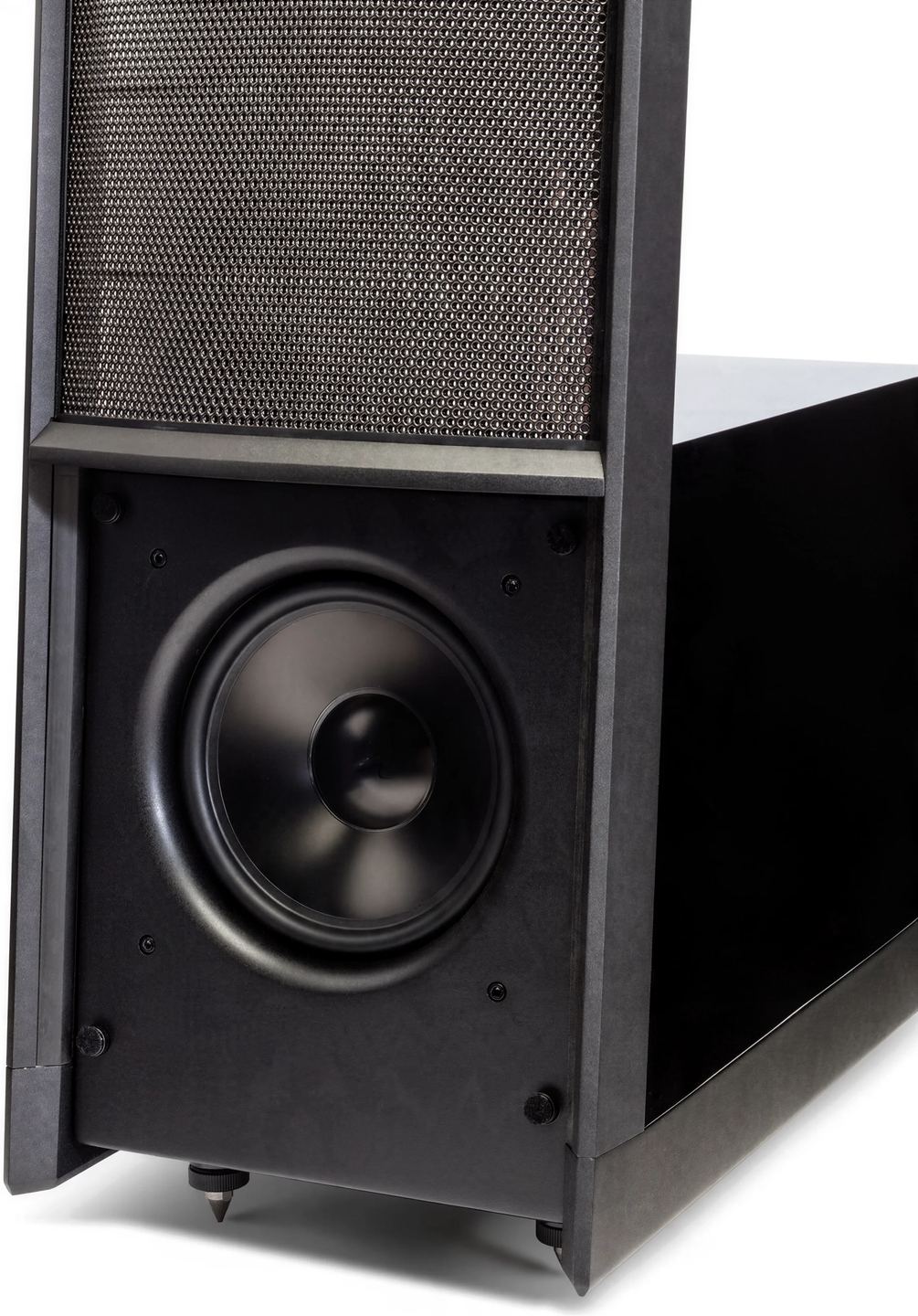
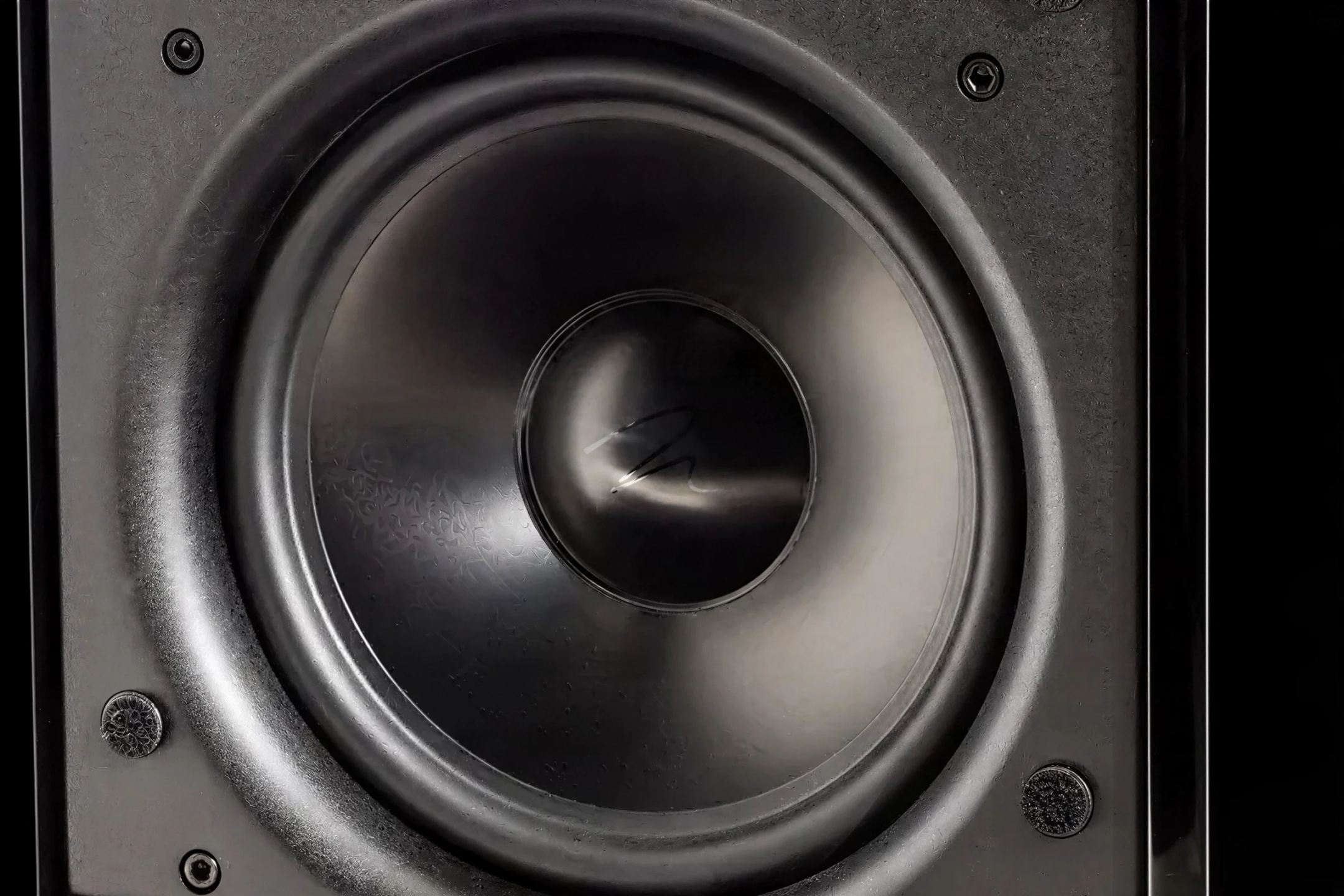
The base contains two 20.3 cm drivers with rigid aluminum cones, cast baskets and long-excursion motor assemblies. Each has its own sealed chamber, asymmetrically shaped to limit resonances. One radiates forward, the other backward. PoweredForce Forward technology adjusts the phase between the two to reduce bass reflected by the wall behind the speaker. The enclosure can therefore be placed closer to the wall than previous generations of MartinLogan speakers.
Two Class D amplifiers rated at 275 W into 4 Ω (550 W peak) power these drivers. A 24-bit digital processor, the Vojtko DSP engine, handles low-pass filtering, bass equalization and limiting. On the panel side, the crossover remains passive, hand-assembled with air-core inductors and polypropylene capacitors. The system covers 29 Hz to 23 kHz at ±3 dB.
Adapting the bass to the room, manually or with ARC
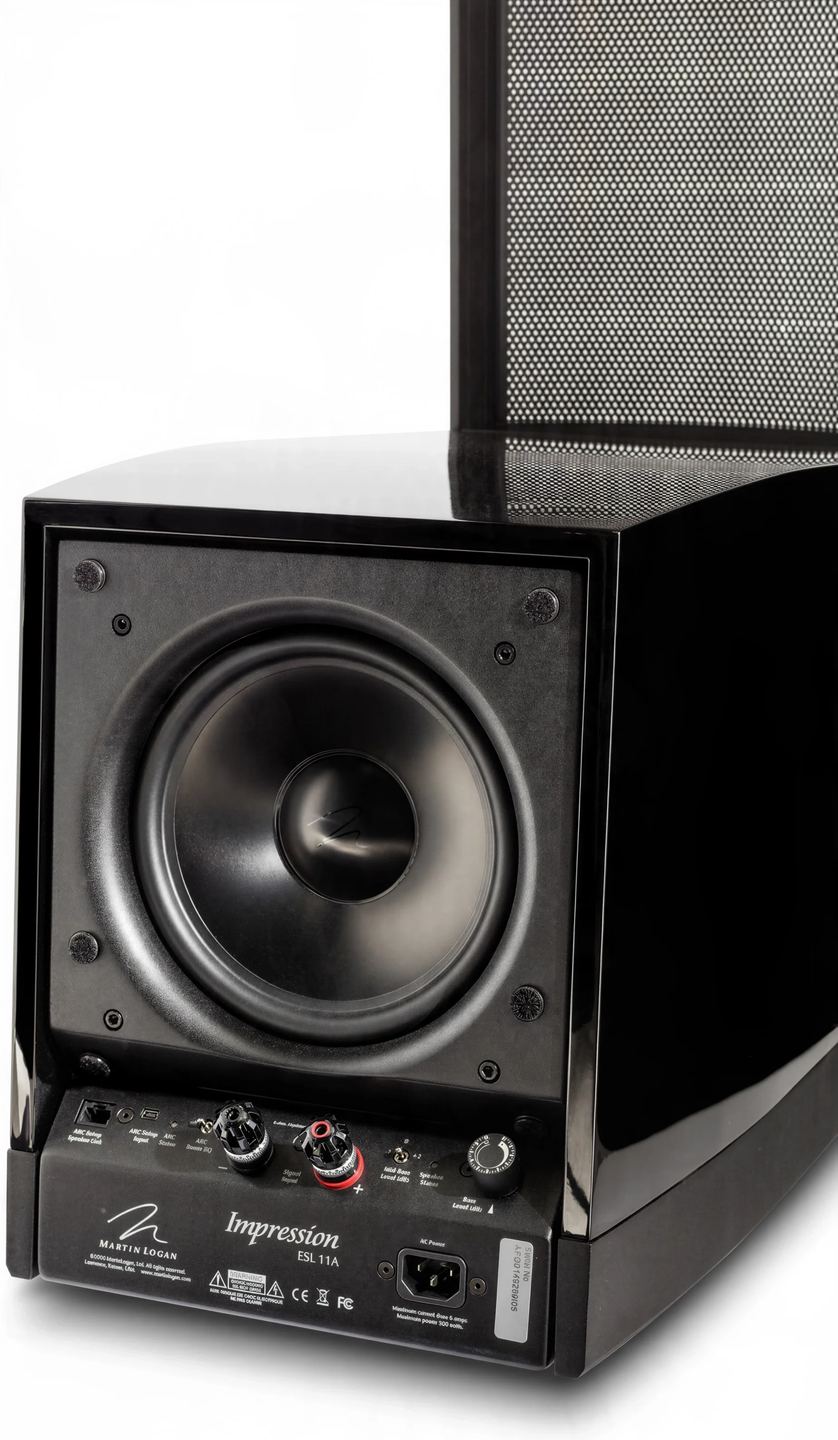
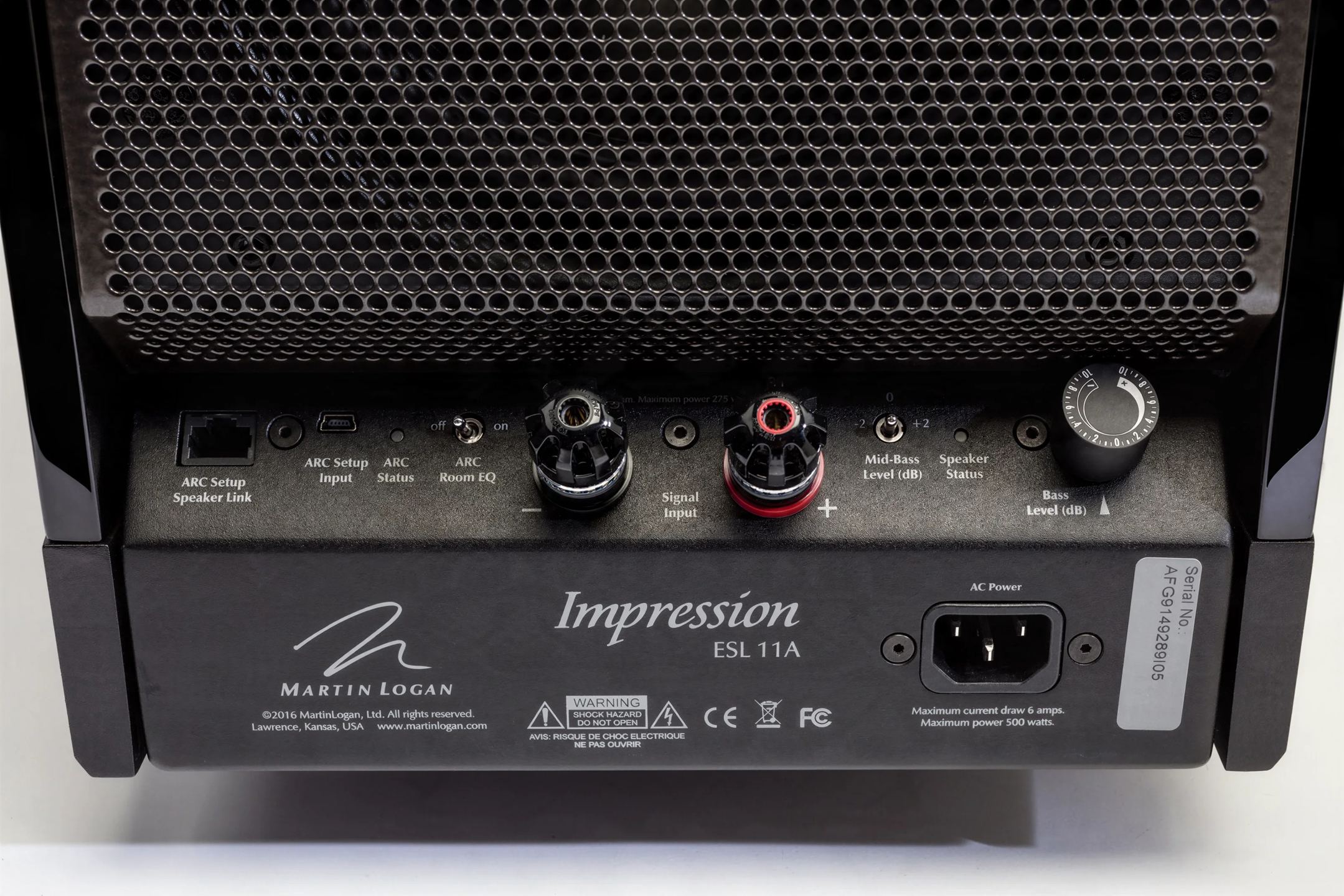
Depending on its dimensions, each room reinforces certain bass notes and weakens others, and the result changes from one listening position to another. The speaker offers three settings. The first adjusts the level below 75 Hz by ±10 dB. The second adjusts the lower midrange in steps of −2, 0 or +2 dB. The third enables or disables ARC correction.
ARC (Anthem Room Correction) uses a calibrated microphone to measure the bass at the listening position. It compares this measurement with a target curve, and the processor then corrects the difference. The correction acts only on the bass section and leaves the panel unchanged. The switch lets you compare listening with and without correction.
Choosing the amplifier that drives the panel
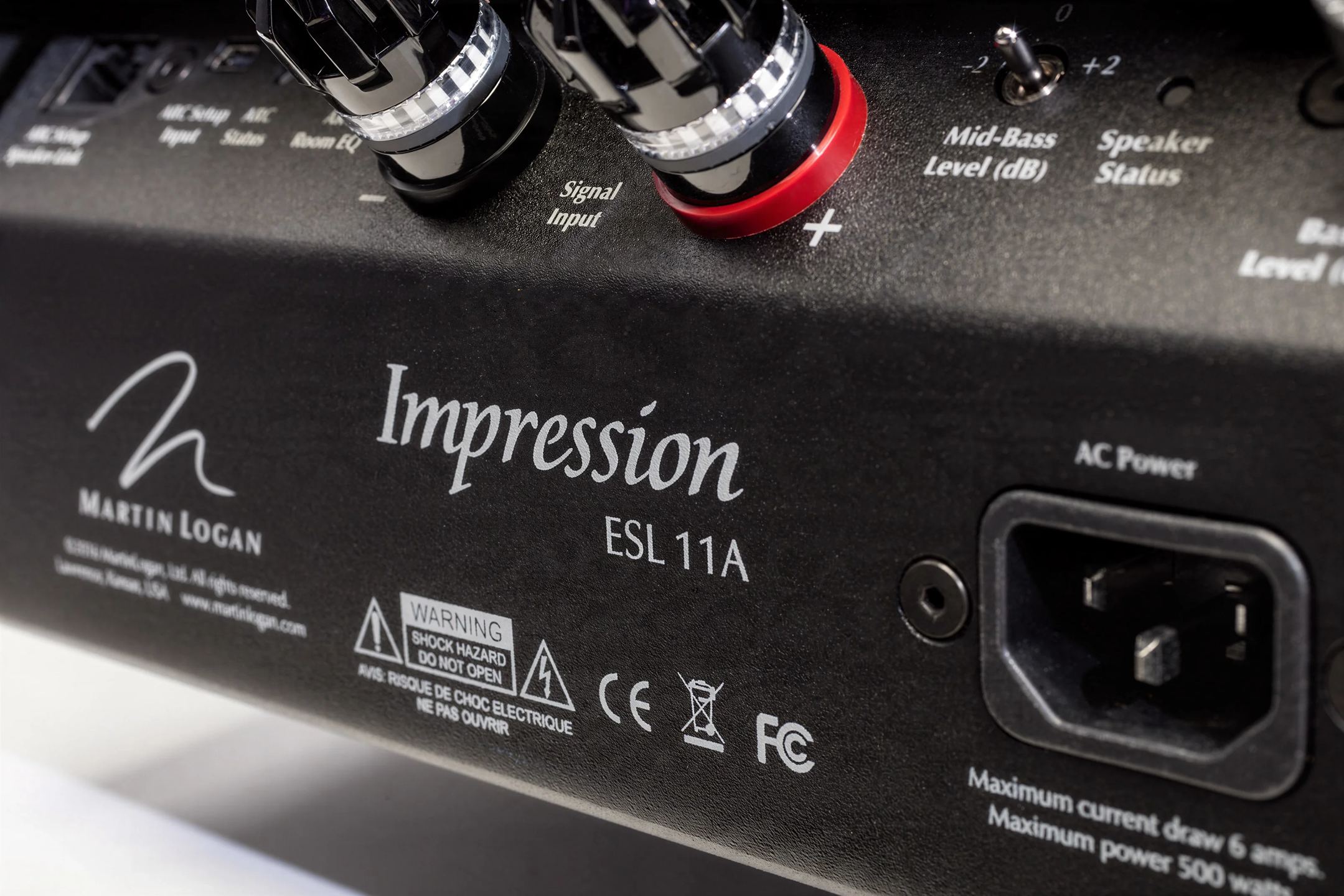
The amplifier powers the electrostatic panel through a single pair of binding posts. The bass has its own amplification, so the amplifier does not have to handle it. Sensitivity is 91 dB at 2.83 V at 1 m. Allow for 50 to 550 W per channel into 4 Ω. One constraint comes from the impedance: nominally 4 Ω, it drops to 0.6 Ω at 20 kHz. An electrostatic panel behaves like a capacitor, whose impedance decreases as frequency rises. The amplifier must remain stable into such a low load in the extreme treble. The 4, 6 and 8 Ω outputs are suitable.
The binding posts are WBT-0703 Cu nextgen 5-way models (banana plugs, spades or bare wire). Their conductor is made of gold-plated pure copper, nickel-free, non-ferromagnetic and fully insulated, preventing eddy currents.
Positioning a 154 cm dipole in the room
Each speaker measures 154.3 cm high, 30.2 cm wide and 69.6 cm deep, and weighs 40.9 kg. Leave at least 20 cm between the rear of the enclosure and the wall, equivalent to the diameter of a woofer. The panel must be at least 76 cm from the wall to give the rear wave room to develop before returning. The base is available in gloss black, gloss white, walnut and dark cherry. Seven premium finishes are also available: Arctic Silver, Desert Silver, Meteor Grey, Rosso Fuoco, Cordoba Red, Deep Sea Blue and Basalt Black.
Technical specifications
Acoustic performance
- Frequency response: 29 Hz to 23000 Hz ± 3 dB
- Sensitivity: 91 dB / 2.83 V / m
- Impedance: 4 Ω, 0.6 to 20 kHz
- Compatible with 4, 6 or 8 Ω amplifiers
- Horizontal dispersion: 30°
- Vertical dispersion: 112 cm (44 inches) line source
- Crossover frequency: 300 Hz
Transducers
- High-frequency transducer: XStat CLS electrostatic transducer
- Panel dimensions: 112 × 28 cm (44 × 11 inches)
- Radiating area: 3136 cm² (484 in²)
- Low-frequency transducer: two 20.3 cm (8 inches) drivers
- Cast frame
- High excursion
- Rigid aluminum cone
- Long-throw motor
- Asymmetric anti-resonance enclosure loading
Amplification and electronics
- Recommended amplifier power: 20 to 550 W per channel
- Built-in bass amplifier: 2 × 275 W per channel (4 Ω), maximum of 2 × 550 W
- Components: custom-wound audio transformer, air-core inductors, polypropylene capacitors
- 24-bit DSP preamplifier, paired with the bass amplifier
- Room acoustic correction (bass section): compatible with Anthem Room Correction (ARC), sold separately
Audio settings
- Bass: ± 10 dB below 75 Hz
- Lower midrange: –2 dB, 0 dB, +2 dB
- ARC room equalization: on / off
Connectivity
- Signal binding posts: WBT-0703Cu nextgen
- Gold-plated pure copper filigree signal conductor
- Nickel-free, non-ferromagnetic
- High conductivity, fully insulated
- No eddy current effects
- Inputs: AC power, RJ45 (for ARC), mini USB (for ARC)
Power consumption
- Idle: < 1 W per channel
- Maximum: 500 W per channel
Dimensions and weight
- Dimensions: 154.3 × 30.2 × 69.6 cm
- Weight: 40.9 kg
Frequently asked questions
Why pair an electrostatic panel with powered woofers?
To produce powerful bass, an electrostatic diaphragm would need to move a great deal, which its very narrow gap with the stators does not allow without a considerable surface area. Dynamic woofers therefore take over below 300 Hz. They have their own amplification and digital processing, allowing the bass to be equalized and corrected with ARC without affecting the panel.
Does each speaker need a power outlet?
Yes. Each speaker plugs into the mains to power its bass electronics. It consumes less than 1 W per channel at idle and up to 500 W per channel at maximum output. Without power, the bass section does not work.
Is the ARC kit included with the speaker?
No. The speaker is ARC-ready, but the kit (microphone and software) is sold separately. Measurement is started from a computer running macOS 10.12 or later, or Windows 7 to 11, equipped with a USB port. It connects to the speaker via the RJ45 or mini-USB port.
Can the Impression ESL 11A be bi-wired or bi-amped?
No. There is only one pair of binding posts per speaker. It isn’t necessary: the bass already has its two internal amplifiers, and the external amplifier only drives the panel.
Would a tube amplifier be suitable?
Yes, provided you meet the minimum of 50 W per channel and use an output that remains stable when the impedance drops to 0.6 Ω in the extreme treble. Since the bass is amplified in the base, the tube amplifier does not have to supply the current required by low frequencies, often its weak point. It is best to check with the amplifier manufacturer how it behaves with an electrostatic load.
How low does the bass go?
The response extends down to 29 Hz at ±3 dB. Digital processing still produces bass down to around 24 Hz, slightly beyond this tolerance. The level below 75 Hz can be adjusted by ±10 dB if the room produces too much or too little bass.
- Eco-contribution included in the sale price.