

Cardas Clear Beyond Power IEC C19 2.5m
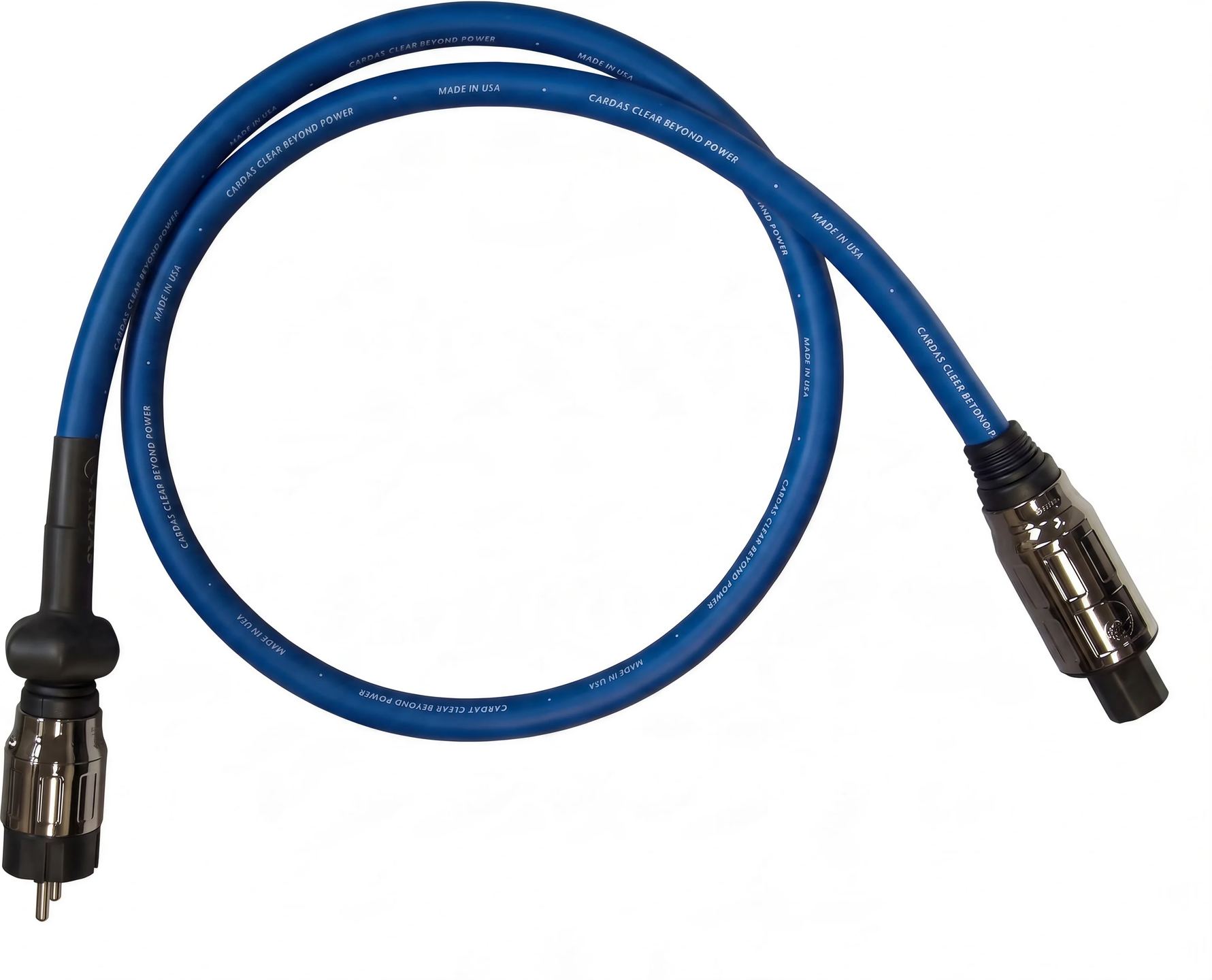
Cardas Clear Beyond Power IEC 15 A, heavy-gauge filtered power cable
A power cord does not generate any current. It carries the final stretch of the electrical supply to the device, along with the noise that comes with it. Cardas addresses two points here at once. Three heavy-gauge conductors let the device draw current freely, and the cable contains the largest filter in its power cable range. In this version with an IEC 15 A connector, it plugs into the C14 inlet found on the back of the vast majority of hi-fi components: DAC, preamplifier, network player or amplifier.
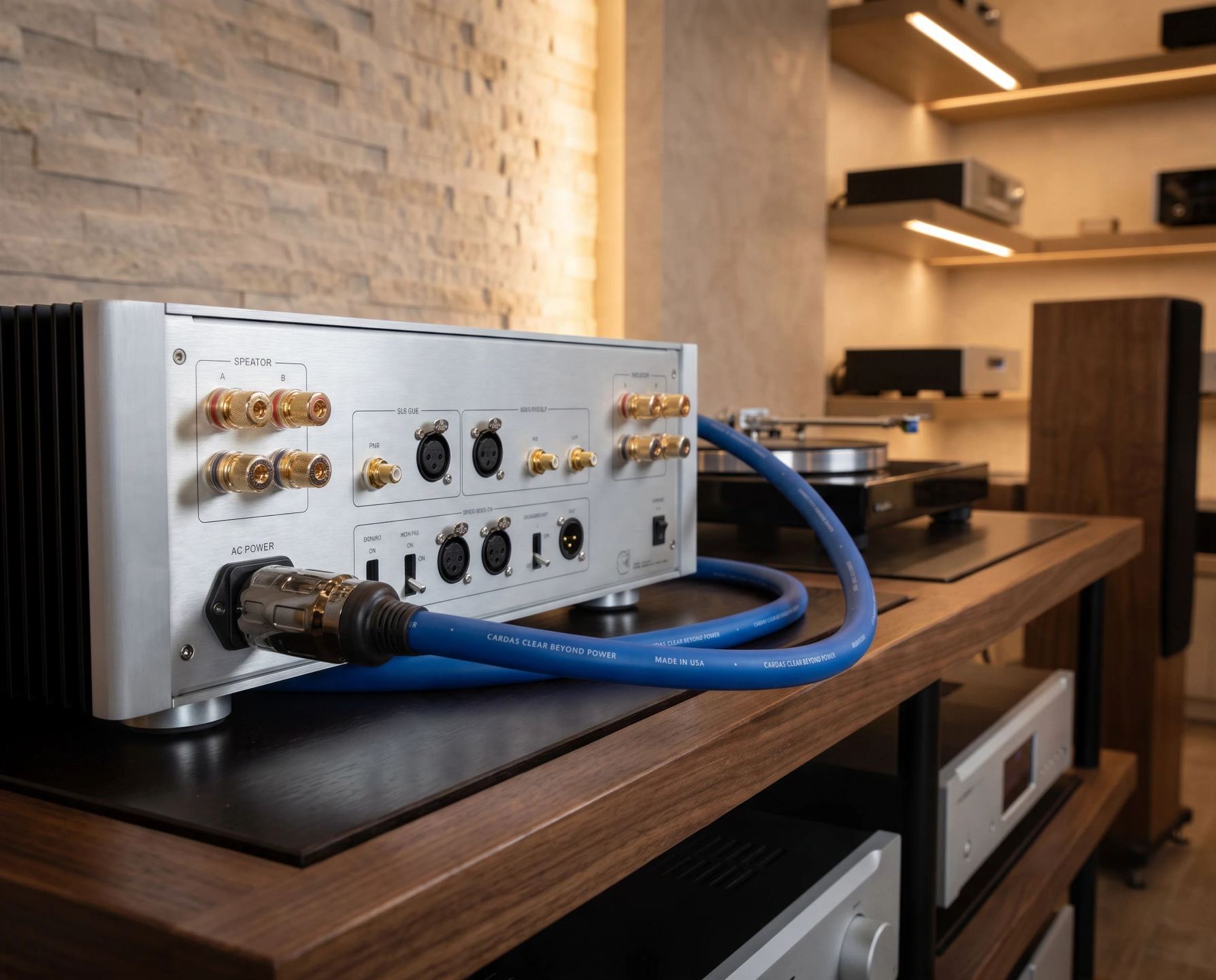
Three 6 mm² Grade 1 copper conductors
The live, neutral and earth conductors each have a cross-sectional area of 6 mm², or 10 AWG under the American standard. The Clear Power, one step below in the range, stops at 11.5 AWG, approximately 3.7 mm². The metal is Cardas Grade 1 copper, oxygen-free and 99.9999% pure, with a tinned surface to prevent oxidation. With a larger cross-sectional area, the line offers less resistance. When an amplifier demands a current peak, on a bass drum attack or an orchestral tutti, the voltage at its terminals therefore drops less.
The strands within a conductor are not all the same diameter. Cardas assembles them in proportions based on the golden ratio (approximately 1.618), a principle patented by George Cardas to prevent all the strands from resonating at the same frequency. Successive layers are wound in opposite directions (a crossed-layer geometry known as “crossfield”), so that the magnetic fields of two adjacent layers cancel each other out. Each conductor is insulated with a PTFE jacket, the material known as Teflon.
A tuned earth filter and broadband filtering
In the Clear power cable range, filtering is what distinguishes the models most: it increases with each step up, and the Clear Beyond Power has the largest of the three. The filter is based on a tuned toroid placed on the earth conductor. It is combined with a conductor arrangement that cancels out some of the interference travelling along several paths at once. The filtering acts across a broad band on the live, neutral and earth conductors.
The principle is the same as that used in Clear interconnect and speaker cables, but reversed. In a signal cable, Cardas matches the propagation speed of the conductor to that of the insulation so that transients pass without smearing. In a power cable, the aim is the opposite: a deliberate propagation mismatch damps the high-frequency noise travelling along the line, while 50 Hz passes unhindered. This filter does not regulate voltage and does not replace a power conditioner. It cleans the current along the section of the line occupied by the cable.
Shielding for each conductor, then overall shielding
Each of the three conductors has its own shielding, and the assembly is surrounded by dual overall shielding made from tinned copper and enamelled copper wire. The earth conductor is shielded too. Without shielding, it would act as an antenna and carry interference picked up along the way back to the device.
The conductors are twisted into a three-way braid and separated by PVC air tubes that keep them apart. FEP tape binds the assembly. The thermoplastic rubber (TPR) outer jacket remains flexible, making it easier to bend the cable towards the inlet when the device is positioned against a wall.
E-5 connectors hand-terminated in Bandon
The cable is terminated with Cardas E-5 connectors, originally developed for the Clear Beyond XL, the model above it. Their solid copper contacts are plated first with silver, then rhodium. Silver provides good surface conductivity, while rhodium adds the hardness needed to withstand wear from repeated connections. Each connector is crimped for mechanical strength, then soldered for electrical continuity. Cardas terminates each cable by hand at its workshop in Bandon, Oregon.
At the device end, the IEC 15 A connector plugs into the standard C14 inlet, the one with three flat pins found on the back of most hi-fi components. If your device has a wider C20 inlet, intended for high currents, choose the IEC C19 version of the same cable.
The Clear Beyond Power is made to order. Delivery times may therefore be longer than for a cable supplied from stock.
Which devices to connect first
Cardas designed the Clear Beyond Power for two uses that place different demands on a power cable. A power amplifier, whether valve or solid-state, stereo or monoblock, benefits mainly from the low resistance of the conductors, since it draws large bursts of current. A DAC, preamplifier or phono preamplifier draws little current, but its low-level stages are more sensitive to noise passing through the power supply. For these devices, filtering is what matters. With these source components, Cardas aims for a neutral presentation: the cable is not intended to add any sonic character; it delivers current with less interference.
The Clear Beyond Power can be connected to either a wall socket or a power conditioner. It does not correct faulty electrical wiring. A loose socket, a circuit shared with a refrigerator or a poor earth connection still need to be addressed at the source.
Its place in the Clear power cable range
The Clear Beyond Power was the first power cable designed entirely for the Clear range. It sits at the top alongside the Clear Beyond XL, above the Clear M and Clear Power. The XL uses the same construction with upgraded conductors and shielding, then adds an extra filtering stage. This extends the path to earth to as much as three times the length of the cable. Further down the Cardas power cable catalogue are the Clear Reflection, Clear Cygnus, Parsec and Iridium.
Technical specifications
Conductors and materials
- Conductors: 3 × 10 AWG (6 mm²), Grade 1 oxygen-free copper, 99.9999% pure, tinned
- Insulation: PTFE (Teflon) on each conductor
- Outer jacket: ultra-flexible thermoplastic rubber (TPR)
Construction and geometry
- Technology: golden ratio proportions, cross-layer geometry (crossfield)
- Geometry: twisted triad with PVC air tubes, FEP tape wrapping
- Shielding: individual shielding for each conductor + double overall shielding of tinned copper and enamelled copper wire
- Filtering: tuned toroid on earth, broadband filtering on live, neutral and earth (the most extensive in the Clear power cable range)
Connections
- Equipment end: 15 A IEC plug, for C14 inlet
- Mains end: 16 A mains plug (Schuko / FR)
- Connectors: Cardas E-5 Premium, solid copper contacts plated with silver then rhodium
- Manufacturing: hand-crimped and soldered in Bandon, Oregon (United States)
Dimensions
- Cross-section: 3 × 6 mm² (10 AWG)
- Outer diameter: 16.51 mm (0.650”)
Performance and use
- Maximum current: 10 A under the European IEC standard (15 A under the American UL standard), limited by the IEC plug
- Recommended use: source components and preamplifiers, integrated and power amplifiers equipped with a C14 inlet
- Sound signature: neutral and transparent
- Made to order: longer delivery time than an in-stock item
Frequently asked questions
Is there a version for amplifiers equipped with a 20 A inlet?
Yes. Some large amplifiers have a C20 inlet, recognizable by its horizontal pins, instead of the usual C14. The Clear Beyond Power is available with a 20 A IEC C19 connector on the device end for this purpose. Check the inlet before ordering, as the two connectors are not interchangeable.
Does the ground filter affect electrical safety?
No. The cable retains three conductors, live, neutral and earth, as required by the standard. The toroid is a passive component placed around the earth conductor and does not interrupt the continuity of the connection. The device and user are protected in the same way as with an original cord.
Can it be used with a power conditioner or a filtered power strip?
Yes. The power conditioner treats noise for all the devices connected to it, and the Clear Beyond Power provides additional filtering along the section connecting it to a given device. The two effects are additive. For a high-power amplifier, it is best to choose a high-current outlet on the conditioner, if it has one, so as not to limit the current available upstream of the cable.
What is the point of a 6 mm² cross-section when the house's electrical circuit is wired with 2.5 mm² cable?
The two do not serve the same purpose. The in-wall circuit is sized to match the circuit breaker’s protection rating and supplies all the outlets on the line. The power cord is the final link, specific to a single device. A larger conductor cross-section reduces voltage drop along this link during current peaks, without compensating for the limitations of the upstream circuit. If the system draws enough power for this to be a concern, a dedicated line from the electrical panel is the next step.
Why is copper tinned?
The thin layer of tin protects the copper from oxidation over the years, particularly where the strands are exposed to air near the plugs. It also makes it easier to create a clean, durable solder joint between the conductors and the contacts. At mains frequencies, the current flows through the entire cross-section of the conductor, not through this surface layer.
How do you maintain rhodium-plated contacts?
A dry, lint-free cloth is sufficient. Avoid abrasive products or cleaning erasers, which would eventually wear away the plating. For more thorough cleaning, a residue-free contact cleaner is suitable, applied with the cable unplugged. Allow it to dry completely before reconnecting.
When should you choose the Clear Beyond XL?
The XL is designed for the same devices, but takes shielding, conductor cross-section and especially filtering further, with an additional stage. It appeals to those who already have a Clear Beyond Power on their amplifier and want to go further with a source component that is highly sensitive to noise, or those powering very high-powered amplifiers. For a first mains cable at this level, the Clear Beyond Power already covers both uses.
- Eco-contribution included in the sale price.