Real Cable CPU660B Universal Spike Shoe
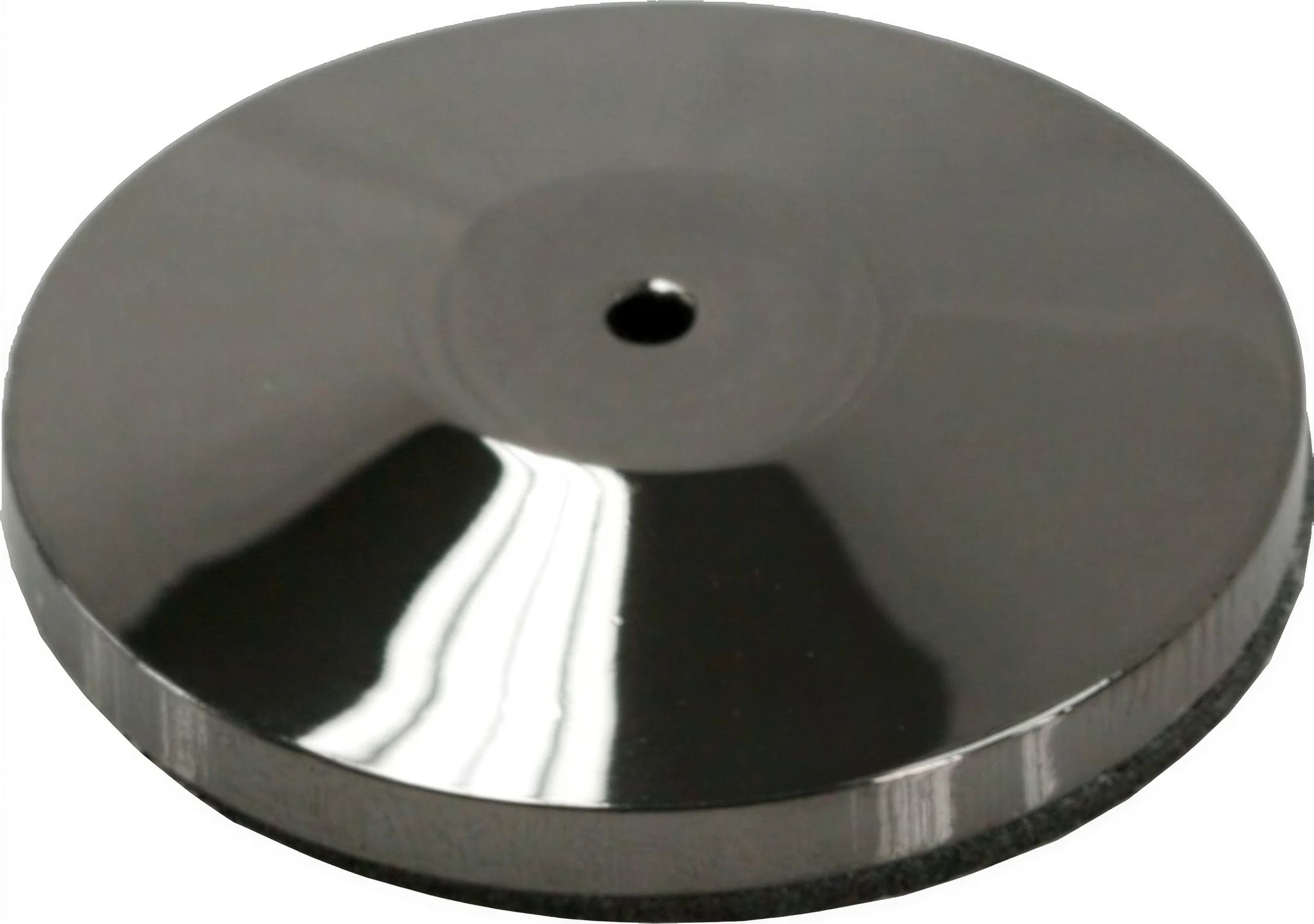
A decoupling spike steadies a speaker, but it leaves marks on wooden flooring within a few days and slips on tiles. The spike shoe sits between the two. It is a small 30 mm metal disc with a central recess that holds the tip of the spike, resting on a pad that protects the floor. It slips under a floorstanding speaker, the stand of a bookshelf speaker, or an audio rack already fitted with spikes.
A 30 mm disc between the spike and the floor
The metal body has a low profile. The speaker is raised by only a few millimetres, which makes no difference to the tweeter’s height relative to your ears. On top, a central recess holds the spike: it centres it and prevents it from slipping sideways, even when you push the speaker slightly while adjusting its position.
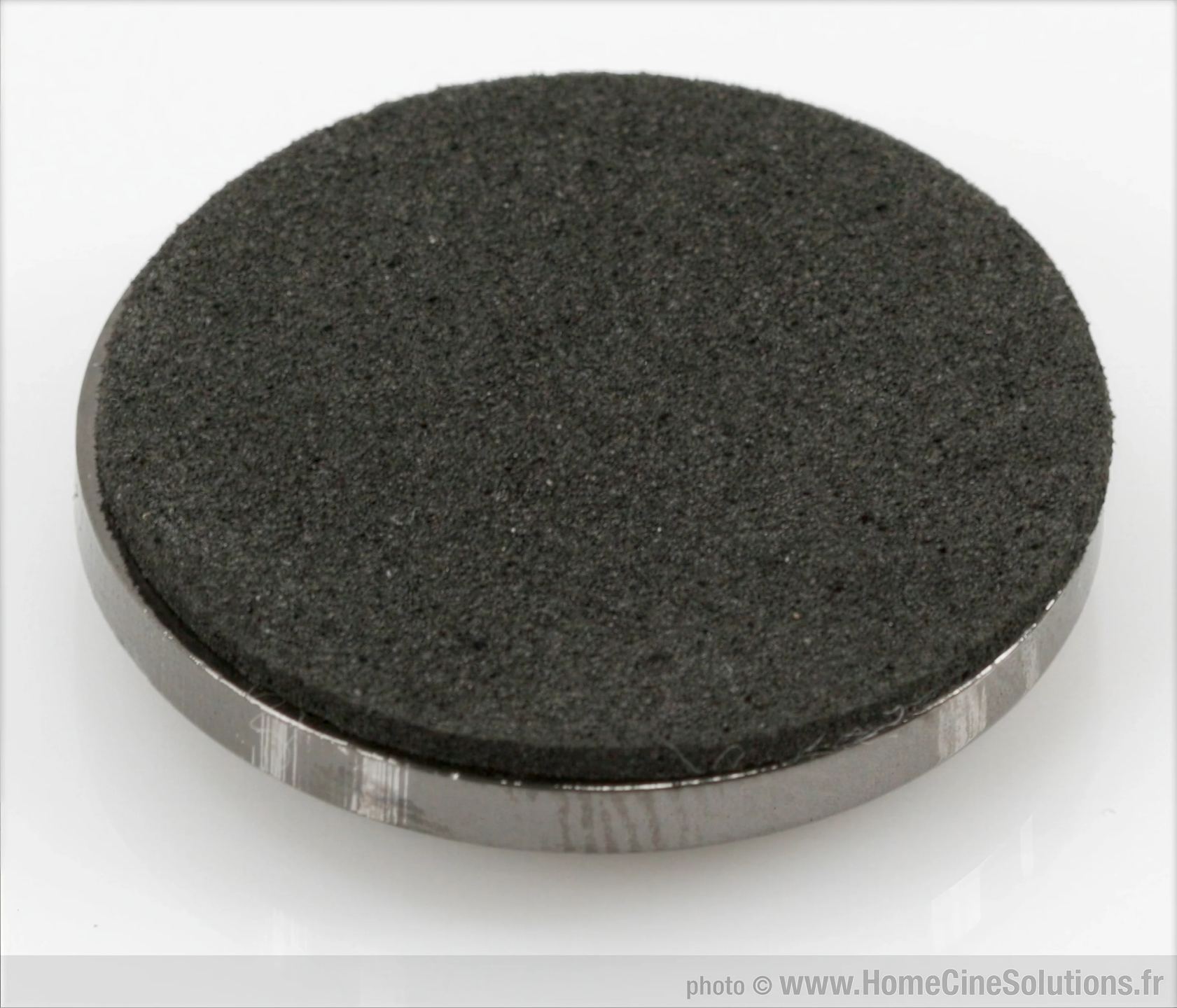
The spike concentrates the speaker’s entire weight on a tiny surface, which is what damages the floor. The spike shoe distributes this load over a 30 mm diameter, a much larger surface. The pressure is reduced accordingly: the wood no longer retains an indentation, and the glaze on tiles is not scratched. Each spike shoe has a non-slip pad underneath, so the metal never touches the flooring directly.
The stability of spikes, without the marks
A spike’s primary purpose is to give the speaker well-defined support points, without rocking, regardless of how level the floor is. The spike shoe preserves this behaviour. The spike stays seated at the bottom of the recess, with no sideways play, and the speaker remains supported on three or four points.
The pad adds a thin, flexible layer between the metal and the floor. The connection is therefore not quite as rigid as a spike resting directly on a concrete slab. In return, the assembly stays in place on smooth tiles or sealed wooden flooring, where a bare spike would slip. On a hard, finished floor, most setups benefit.
Screw-free placement under any spike
The spike shoe does not screw onto anything. The spikes’ thread size (M6, M8 or otherwise) does not matter: the spike simply sits in the recess. This is what makes it universal. It can be used under floorstanding speakers, under the spikes of a speaker stand, under a hi-fi rack, or under an audio or video device mounted on spikes.
As nothing secures it to the spike, it needs to be positioned carefully. The simplest method is to tilt the speaker, slide a spike shoe under one spike, lower it back down, then repeat on the other side. Aligning four spikes with four recesses takes a little patience, and with a heavy floorstanding speaker, it is best to have two people do it.