Dirac Live Processor: active room mode correction on PC and Mac
July 10, 2026
Contents
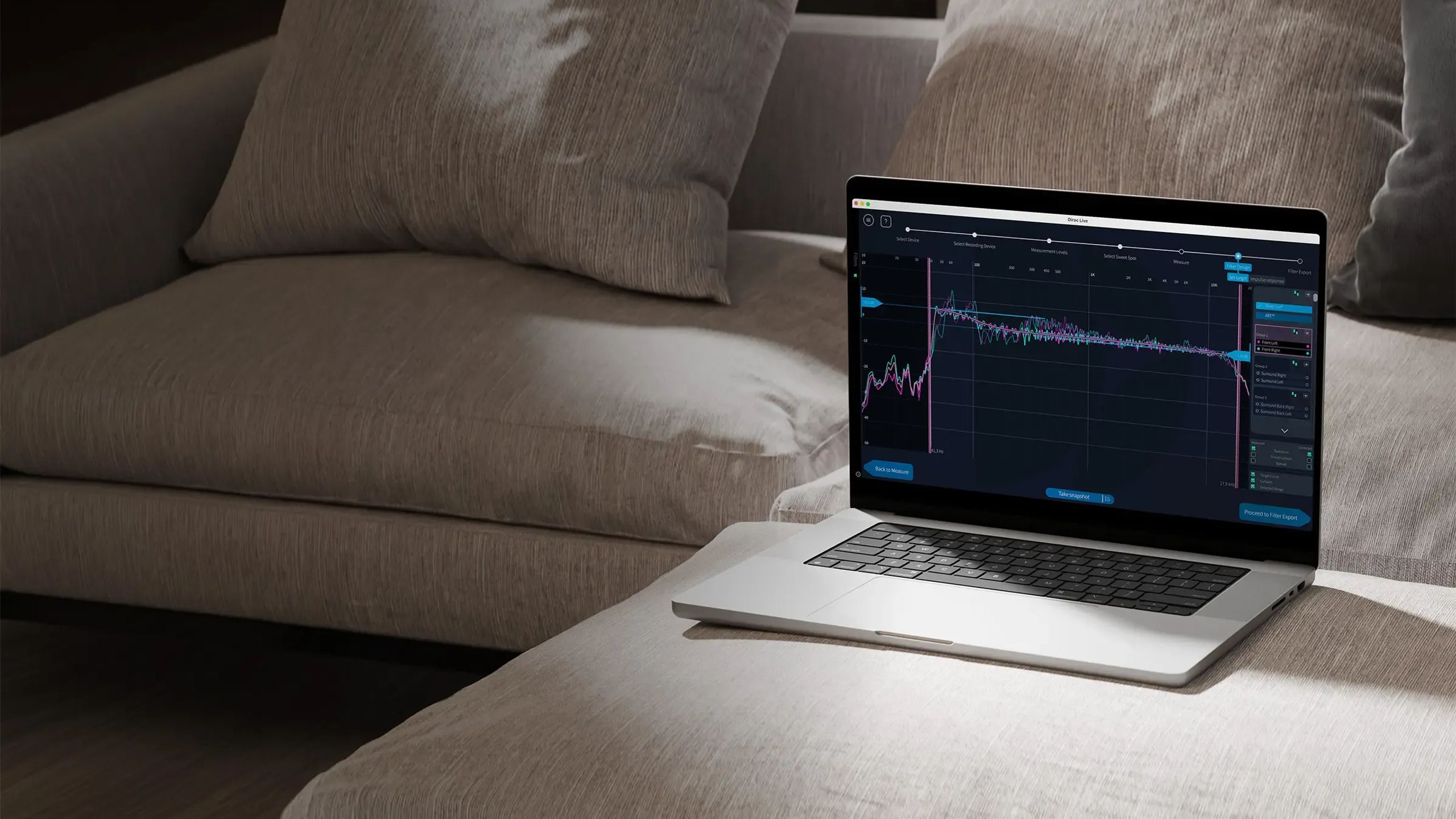
Until now, accessing Dirac’s Active Room Treatment required buying a compatible device, a StormAudio processor, or a high-end Denon or Marantz amplifier. Since June 30, 2026, a computer is enough. Dirac has renamed its correction software for PC and Mac: the former Room Correction Suite becomes Dirac Live Processor, and now includes its most advanced acoustic correction. Technology once reserved for dedicated electronics becomes a module you install on the machine you already own.
→ Discover Dirac Live products
Renamed software that brings together the entire catalog
The change starts with a name. Room Correction Suite, the software version of Dirac Live running on a computer, is now called Dirac Live Processor. Under this label, Dirac groups all of its correction tools: Dirac Live Room Correction for frequency and phase response, Dirac Live Bass Control for subwoofer management, and ART. Users of Room Correction Suite are automatically moved to Processor, with their licenses and settings preserved.
Nilo Casimiro Ericsson, Dirac Live product manager, presents ART as the company’s most advanced work in room acoustics, now installable directly on a PC or a Mac so users can judge its effect in their own system.
How ART works in the bass range
Traditional room correction measures the response at the microphone position and applies an inverse filter, channel by channel. ART works differently. It is based on patented MIMO (Multiple-Input Multiple-Output) technology that treats all speakers and the room as a single acoustic system. Below 150 Hz, each speaker capable of reaching into the bass range, subwoofer or main channel, can play its own signal or reinforce the others. The drivers emit calculated out-of-phase signals to cancel room resonances in real time during playback.
This range below 150 Hz corresponds to room modes, those standing waves that hollow out and swell the bass depending on where you are, and that lengthen bass decay time. Above 150 Hz, classic Room Correction, impulse by impulse, takes over. The intended result: tighter bass, better consistency from one seat to another, and a level of performance that previously required physical panels and diffusers.
Processor as the processing hub
Processor is a virtual audio processor: it applies correction to the signal on the computer before the sound reaches the playback system. Two paths coexist. As a standalone application or through its plug-ins (VST, VST3, AAX, AU), it inserts itself into a player or digital audio workstation, opening the door to both studio setups and media players. For a computer placed at the front of a system, connected to a converter and then to an amplifier and speakers, correction, including ART, is applied directly to the stream.
The key point to keep in mind: connecting Processor to a home theater amplifier or a separate streamer assumes the device and the computer are on the same network, and that the system is compatible. Not every connected system becomes ART-compatible overnight. Filter calculation and application remain subject to compatibility and licensing conditions.
What you need to install it
Installation begins by connecting a measurement microphone to the computer, a miniDSP UMIK-1 for example. The software then guides measurement taking from several listening positions, analyzes the behavior of the room and the system, then calculates filters suited to the space. The process remains identical to that of Dirac Live hardware implementations, except that the entire calibration chain lives on the machine.
The limited scope of active correction
One point deserves to be clearly stated, because it determines whether the expense is worthwhile. ART acts on room modes in the bass, between 20 and 150 Hz, and nothing else. It does not affect the midrange, the treble, or the room’s overall reverberation across the full spectrum. It does not replace full acoustic treatment. Its field of action is narrow, but within that field, active cancellation of low-frequency resonances does work that speaker placement and manual adjustment rarely achieve. ART also performs better on multichannel systems equipped with several speakers capable of reaching low frequencies, where the collaborative network has material to work with.
The real cost of licenses
Unlike the basic corrections built into many amplifiers, Processor functions are paid for by license, and they stack. Room Correction costs about €320 in stereo, about €460 in multichannel. Bass Control adds about €275. ART is billed at about €275 more. It does not work on its own: it requires Room Correction, and Bass Control becomes necessary as soon as one or more subwoofers are involved. Starting from scratch, the complete suite comes to around €740 as a bundle. Dirac offers a fourteen-day trial period to evaluate before paying.
For a listener whose PC or Mac is already the center of their setup, Processor removes a barrier: there is no longer any need for a specific amplifier to access Dirac’s most advanced correction. The combined price of the licenses remains significant, and the benefit depends on the system involved, the number of speakers, and the room’s acoustic condition. On a good setup installed in an imperfect living room, the tool is worth considering.
Popular products
You may also like to read
 Dirac Live Room correction available on Marantz Model M1 and Denon Home AmpHi-fi and home cinema news
 Bluesound adds Dirac Live acoustic correction to its connected audio playersHi-fi and home cinema news
 Flexus Core 300: Klipsch introduces the first soundbar with Dirac Live correctionHi-fi and home cinema news
 Free Dirac Live on Onkyo, Pioneer and Integra amplifiers: acoustic correction includedTutorials and practical guides
 Update 1.5.45: Eversolo focuses on NAA, backup, and acoustic correctionHi-fi and home cinema news