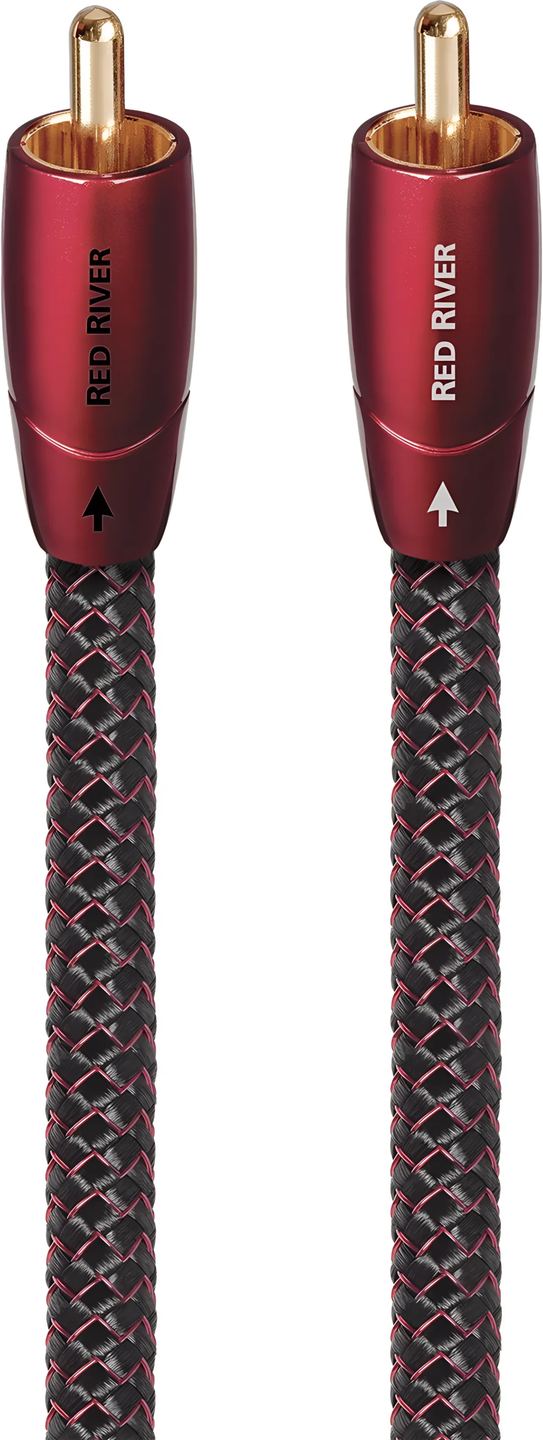
AudioQuest Red River RCA, analog interconnect cable
Between a source and an amplifier, the analog signal travels at a very low level, and anything the cable picks up or distorts along the way ends up in the speakers. AudioQuest built the Red River, an RCA cable in the Rivers series, around solid copper conductors and a shield that dissipates radio-frequency noise without ever carrying the signal.
Solid copper with a smooth surface
The conductors are made of Perfect-Surface Copper (PSC), a high-purity, low-oxide copper whose surface is protected at every stage of wire drawing (stretching the metal into wire) by a process proprietary to AudioQuest. The smoother this surface, the fewer irregularities the signal encounters at the boundaries between the metal’s grains, one of the sources of distortion the brand seeks to reduce. Each conductor is made of a single solid strand. In a stranded cable, neighboring wires interact electrically and magnetically, which a single conductor avoids. There is a mechanical trade-off: a solid wire bends less easily and does not tolerate repeated flexing well. This drawback matters little for a connection installed once and left in place behind your equipment. The Mackenzie, just above it in the Rivers series, steps up to PSC+, an even purer version of this copper.
AudioQuest listens to the copper from each batch and chooses the direction in which it will be installed. This direction is indicated by arrows on the plugs, pointing toward the device receiving the signal, namely the amplifier or preamplifier. The installation direction determines how radio-frequency noise picked up by the cable is drained away from the most sensitive parts of the circuit.
Three conductors and a shield that does not carry the signal
In most RCA cables, the signal return runs through the braided shield, which serves as both protection and conductor. The Red River uses a geometry the brand calls Triple-Balanced: the positive and negative poles each run through an identical PSC conductor, with a separate ground reference added. Both halves of the signal therefore benefit from an equally high-quality path, and the shield serves only to protect. The connection remains unbalanced, since an RCA connector has only two contacts: the word “balanced” here describes the cable’s construction, not the type of connection.
Around the conductors, the metal-layer Noise-Dissipation system absorbs and reflects most of the radio-frequency energy before it reaches the layer connected to ground. The aim is to prevent this noise from disturbing the equipment’s ground plane, the common electrical reference used by all its circuits.
Air-filled insulation for stable geometry
Every insulator absorbs a small amount of the signal’s energy and releases it with a slight delay, blurring fine detail and reducing dynamic contrasts. Air stores almost none. The Red River’s Hard-Cell Foam insulation is a nitrogen-injected polyethylene foam filled with air pockets, which greatly limits this phenomenon. Because this foam is rigid, it also keeps the conductors the same distance apart along the entire length of the cable. Impedance therefore remains constant from end to end. The jacket is firm, however: behind a device placed close to a wall, allow enough room for a gentle curve rather than bending the cable at a sharp angle.
Cold-crimped plugs, without any solder
The gold-plated RCA plugs are cold-welded: a press secures them to the conductor under very high pressure, fusing the metals without tin. This avoids introducing a solder alloy into the signal path, a potential source of distortion. The ground shells are stamped rather than machined, allowing their metal to be chosen for its conductivity rather than its ease of machining. The assembly is protected by a black braided jacket with a red pattern.
The Red River connects to all analog RCA outputs: CD player or SACD player, DAC, streamer, phono preamp output, preamplifier to power amplifier, or the analog inputs of an AV receiver. A turntable equipped with RCA outputs can also be connected directly to a phono preamp. In this case, its ground wire must still be connected separately, as the cable does not include one.